Translating the book this purely, and this poetically, was a choice of extreme integrity.
If you’re a working director, you are generally always doing one of two things: building a project from the ground up, or trying to get someone to hire you to direct something that is already mid-build. These mid-build projects can be at various stages of development when a director is hired, and as the person who will take it from that point to the finish line, you are tasked with entering a room and conveying two things to those doing the hiring: your take and your vision.
As I understand it, your take is basically notes on the material—what works and what doesn’t about the story, the characters, the themes, etc. It’s the practical response to what already exists, whether it be a script, a book, an optioned magazine article, etc. Your vision, on the other hand, is where you want to take it. What is the world you will create? How will you do it? This is the part where you try to transform the images and sounds that are inside your mind into tactile, understandable pieces that a third party can see, smell or touch.
I’ve gone in on several of these kinds of “mid-build” meetings. Leading up to each of them, I spend hours of time and unquantifiable mental energy delving into the material to envision the version I believe will have the most profound connection with other people. It’s an intense process, and I don’t enter into it lightly. Especially since I have seen so many of the projects I have pursued wither on the vine. I have a great meeting, or several great meetings, and then I hear that the project is stalled, or shelved, often without explanation or anyone else seeming that bothered. It’s just gone now, sorry.
I think there have only been two projects I’ve gone through this process with that have actually been made. It’s fascinating to watch these films because I get to see what a project that I know pretty intimately has evolved into in someone else’s hands. I’m simultaneously more critical (because I’m comparing it to my perfect fantasy version) and more forgiving (because I understand the challenges that are encountered along the path to a finished film, and know that my perfect fantasy version would have ultimately been compromised as well).
I went on only one meeting for Into the Forest, but it was a really good one. I got along instantly with the producers and felt that my take and vision were incredibly in sync with theirs. It was a book at that point, and they were looking for a writer-director who could tackle the adaptation and then take it all the way. I really dug the novel, and I saw a stunning film play out in my head as I read it. A film about tenacity, authenticity, and connection. It felt like a story that spoke to society in a way that we should be listening to.
Into the Forest is about a privileged family of three — a man and his daughters (Eva and Nell) — who start off the film in relative isolation out in the woods of the Pacific Northwest, living alongside the specter of their recently deceased wife and mother. Even though they’ve chosen to live at a distance from civilization, they still rely heavily on the connectedness brought by power and gasoline — Eva plays music to dance to, Nell is deep into some online tutoring for her SAT, their dad reads e-books while watching the news, and they all take frequent trips to town for Eva’s dance lessons, where Nell interacts with friends and boys. And then one day, it goes away. Aside from a few rumors and speculative news broadcasts heard from dying radios, there’s not much in the way of explanation — it’s just gone now, sorry. That electricity-centric, Wi-Fi-enabled, car-dependent connectedness is no longer a part of their lives, and there’s no real sense of whether it’s coming back. The characters process this loss in stages, and the novel ultimately posits that these “necessities” are superficial, and that we, as a species, are not dependent on them for survival, but merely for comfort.
—-//—-
You don’t generally get to know why you don’t get a job. Perhaps another candidate’s take and vision resonated more, or that person sparked better with the actors attached, or their previous work feels more aligned with the project. But so it goes. I didn’t get Into the Forest. Patricia Rozema got it. And she did an exquisite job.
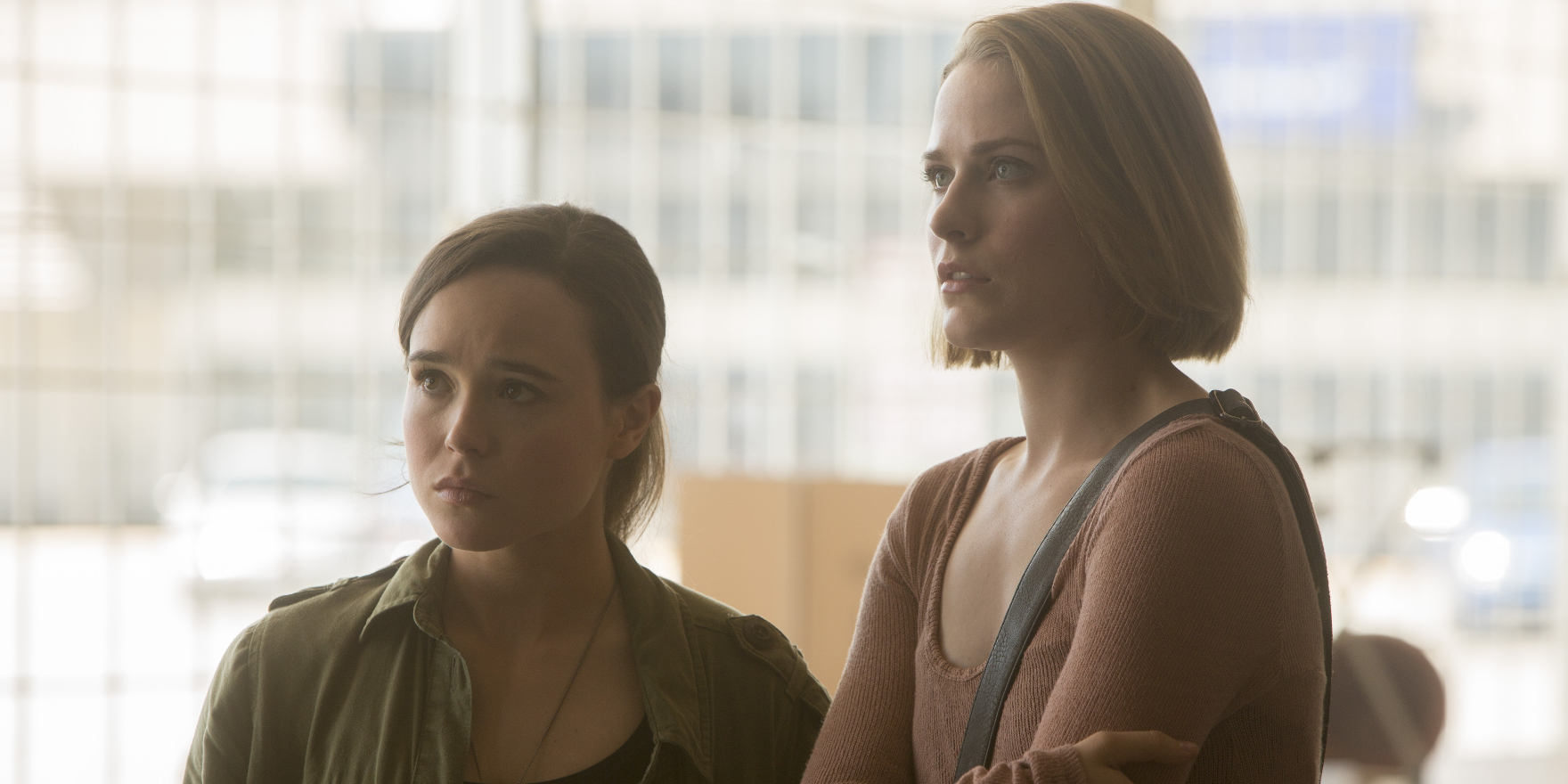
The film is gorgeously shot, beautiful even in horrible moments. Eva is raped, the camera never leaving her anguished face as the deed plays itself out, the horror of the moment unflinchingly awful. Nell pulls the skin off a wild pig, and it’s visceral. Pulling the trigger to kill that pig devastates her, even though she undoubtedly ate bacon without considering it before the world forced her hand. Rozema allows these kinds of moments to bear their full weight, sustaining them in her edit and trusting in her excellent leads (Ellen Page and Evan Rachel Wood) to fully realize their complexities in rich, textured performances.
The film is a Drama with a capital “D.” I remember noting that about the book in my meeting and suggesting that if the producers wanted to find a larger audience with the film, it felt like it needed to find levity somewhere. I don’t think Rozema felt the same, as the tone from the book permeates, and if anything, her direction leans into the earnestness. That said, I really respect her choice. Into the Forest, the novel, tells a hugely relevant story, and tells it via two female leads who are essentially the only characters. If the book were ever made by a studio, which is unlikely, I can only imagine the characters that may have been added or the measures taken to get butts in the seats. Translating the book this purely, and this poetically, was a choice of extreme integrity.
The film business can make you really competitive, and worse, it can make you bitter. But screw that. I don’t regret not making this film. Well, at least no more than I regret not making any project that I connect with. It was made — which is a small miracle with any film, especially one as subtle and “female” as this one — and it was made well, by a talented fellow filmmaker who slayed it. And now I get to watch and be inspired by it as I work away at building something new.