Trying to capture reality in my work means dealing with other people’s lives. Sometimes I yearn for something else, less interpersonal. I have a dear friend who’s been making films almost as long as I have. A few weeks ago, I started to vent (or dare I say hyperventilate?) with him about all the complex relationships that have emerged from my particular filmmaking practice. He said he understood completely, and that he’d decided to now only make archival films, no living people involved. The emotional toll was just too much.
Perhaps it would be better to bring people into my films through a more contractual or transparent arrangement where everything was laid out clearly. Then the people in front of my camera would have clear-cut roles. They could anticipate what I would be saying and how they were going to respond. This way, there might be fewer regrets, less instances of someone saying something they wished they hadn’t.
About 10 years ago, I started to ask people to sign film releases that would ostensibly clarify all of the potential problems that might arise. I try to convince myself that I am doing my professional best to acknowledge the rights of the person who signed on the proverbial dotted line, and theoretically, such documents also protect me. Unfortunately, their existence does nothing to relieve my anxiety, as asking people to “perform their lives” in front of my camera necessitates creating a fraught, sometimes unresolved arrangement that I find deeply intimidating.
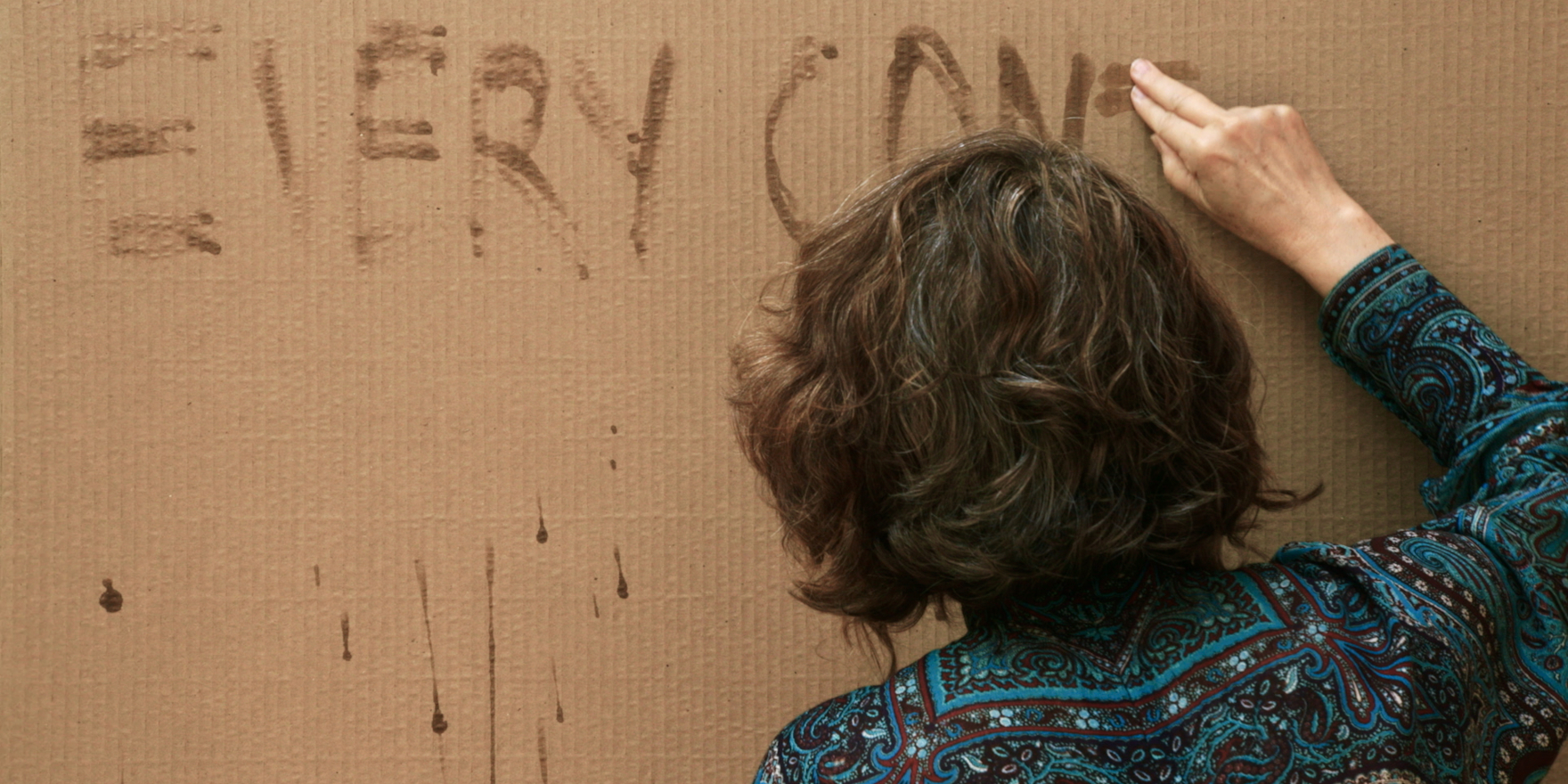
Facing these haunting dynamics was fundamental to my impulse to make my latest feature, Every Contact Leaves a Trace, an essay film that examines the nature of all sorts of fleeting relationships I’ve had over the course of life. For the past 40 years, I’ve collected business cards given to me by strangers. Now in this digital era, these names, numbers and addresses, stored in a box in my house, have taken on an uncanny resonance. The first step in this 10-year filmmaking journey involved choosing seven cards out of the hundreds. I needed to find out why meeting the people who gave them to me had left such an imprint on my consciousness.
Before I committed to using this cache of cards, I grappled with their legacy as material objects. I learned that the standard size for a business card is 3.5 inches by 2 inches; almost every card is the same, in this way. It’s the people “behind” the cards who are so distinct. I also learned as much as I could about the social provenance of the cards themselves. In Japan, for example, the manner by which a recipient (me!) treats the presenter’s card is indicative of how the recipient will treat the presenter. Actions such as folding the card, or placing the card in one’s back pocket are considered disrespectful. Perhaps how I “treated” the card could tell me something about my relationship to its original owner.
For me, the cards were simply a jumping off point for thinking about what French theorists Gilles Deleuze and Felix Guattari envisioned as “the body without organs,” a swirling storm of psychic energy that creates an affect that I could not ignore. What I wanted to explore was how these cards illuminated and obscured the essence of a human being – semiotically and interpersonally. I was deeply interested in working with the trajectories that transpired between us, both in our initial meetings and later, far later, as I restaged our interactions in my memory.
Each of the cards presented something challenging – an awkwardness or ambivalence that forced me to think more deeply about documentary subjects, participants, informants … or whatever term you might use to refer to the people in front of the camera. The messier the production of the film became, the more I learned about the process.
Here are a few of the people who “made the cut”:
A retired German film festival programmer. While I am filming with her, this woman – born in the early 1940s – recounts the war she experienced and somehow misunderstood as a child. In our recorded conversation, she remembers, “The Jewish girls one day weren't there any longer. You didn't see the action, but you saw the results. How is that possible?” Now more than three quarters of a century after the end of World War II, our conversation opens up my own thinking, as an American Jew, about the genocide in Gaza today. Reckoning with these issues in my own life as I make public my own criticisms of the Israeli government adds another layer to my professional interactions with German film organizations. I worry for almost a year about how my friend will feel about being in a film that makes clear my own politics.
A gay artist who faced censorship and persecution from Homeland Security during and after a specious and controversial conviction for having child pornography in his computer. I ask myself if I should reach out to someone I met more than 30 years ago who was involved in such a fraught situation. In making documentary films, does establishing a commitment to a subject necessarily announce our positionality? I wonder if I need to know the truth about what actually happened. I wonder if it matters. After an extensive period of indecision, my own internal confusion forces me to seek him out for a conversation and perhaps a filmmaking relationship. What happens is beyond what I could ever have imagined. We spend more than a year in constant conversation, developing an interwoven series of scenes that articulate his painful story. Through my work with my editor Emily Packer, we develop a story that parallels Oscar Wilde’s 1895 conviction for sodomy, his banishment to a work camp, and his early death. All of this comes through in my voiceover, uncomfortably and, I hope, with transparence.
A Syrian chef and mother I met on a documentary film set. I make a date to shoot with her, but she cancels just hours before our appointment. She tells me that there was an emergency and that she needed to go to Michigan right away. I am not interested in the truth, but rather the fact that she has taken control. Something tells me that she is not scared of me per se, but of what I would extract from her through the apparatus of the camera. Extraction has become the geological trope for something we all do in documentary films. Her refusal to engage with my camera forces me to think about the inherent power imbalance between a director and her subject. Ultimately, her only presence in the film comes through when I cook a traditional Syrian dinner and “think out loud,” through voice-over narration, about her absence. Her existence is only articulated in the minds of my audience, never before their eyes.
A former therapist whose advice changed my life. For two years, I look for her and fail. Luckily, my enthusiasm for hybrid cinematic inventions provides the opportunity to create a kind of speculative staging of what could have happened but never did. Once I realize that the search for my subject is not as intriguing to me as the staging of it in my imagination, I release myself to an extraordinarily generative interaction with a New York City actress who takes on the challenge of becoming my long-lost therapist. We spend a summer role-playing and filming our evolving discoveries of each other. I am working with an actress, and there is no need for her to reveal anything real about herself. Our interactions are closer to those of a narrative film. The social contract is clear.
In her book Suite for Barbara Loden, author Nathalie Léger wonders if she really wants to learn anything about Loden, the beloved and complicated actor-director of Wanda: “I find myself wavering between wanting to know nothing and wanting to know everything, writing only on condition that I know nothing, or writing only on condition that I omit nothing.” Reading these words from one of the most introspective and uncanny film writers I have ever encountered supports my desire to be released from the rigidity of the documentary paradigm. I take a fluid, hybrid approach to the making of my films and allow myself to confront the two extremes of my practice as an artist. I embrace the uncompromising strictures of the real and the unformed, ever-expanding space of the imagined.