

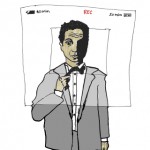
Caveh Zahedi is an autobiographical filmmaker whose body of work attempts to tell the story of his life as it unfolds. His latest film, Getting Stoned with Will Oldham, a follow-up to his cult classic Tripping with Caveh, 20 years on, has its world premiere on October 19 at the Roxy Cinema in New York City. His feature-length films include The Sheik and I (2012), I Am A Sex Addict (2005), In The Bathtub of the World (2001), I Don’t Hate Las Vegas Anymore (1994), and A Little Stiff (1991). His short films and other series include Getting Stoned with Caveh, Bob Dylan Hates Me, Tripping with Caveh, and I Was Possessed by God. A box set of his films is available from Factory 25.
I first met Ken Jacobs when I was still an undergrad at Yale. I had recently discovered the classics of American experimental cinema – which seemed to me the answer to the world’s most pressing problems – and, because of my quasi-messianic faith in the power of experimental cinema to transform the world, I was tasked with introducing film legend Stan Brakhage at a screening. Stan and I became friends after that, and it was Stan who gave me Ken Jacobs’ phone number and encouraged me to reach out to him.
Having already seen and been blown away by Tom, Tom the Piper’s Son, I phoned Ken to see if he would be willing to meet with me the next time I came to New York. He answered the phone and, to my shock and delight (I was a complete nobody at the time), he agreed.
He was insanely generous with his time, but what struck me the most from that first encounter was that he was on his way to submit a grant application for a grant that he had applied to every year for the past 15 years and had never gotten once. I couldn’t believe it. Ken Jacobs couldn’t get a grant? And he kept trying 15 years in a row?
I remember him telling me he was pretty sure he wouldn’t get it this time either, but what can you do except keep trying.
It was the first time I had come up against the idea that life might be harder than it seemed and that filmmaking might not be the flower-strewn path to glory I had imagined. I was stunned, but knowing that even Ken Jacobs had trouble getting money (and that he nevertheless persisted, year after year, in the face of adversity) helped me immeasurably whenever things didn’t go my way – which was, of course, every single day for the rest of my life.
Soon afterwards, I showed Ken a Super 8 film I had made called Sex and Violence. He liked it and invited me to show it to his class at Binghamton University. But the kicker was that he offered to pay me to show it. It was the first time anyone ever paid me to screen one of my films and, in that single moment, his invitation transformed me from a would-be filmmaker to a “real” filmmaker, at least in my own mind. It did wonders for my self-esteem and, whenever anyone would trash one of my films – which was pretty much whenever I would make a new one – I would think to myself, “Well, Ken Jacobs liked one of them, so who cares what you think?”
After showing Sex and Violence to Ken’s class – one of the most fun experiences of my filmmaking career – he invited me to his loft for a screening of Cherries, aka XCXHEXRXRXIXEXSX, his vintage-porn found-footage trance experimental extravaganza using two out-of-sync projectors. I had never seen anything like it and still haven’t to this day. It somehow replicated the experience of having sex and watching it was like having an orgasm. It was simply mind-blowing. It was also the first time I met Flo, his wife, and crossed paths with Azazel, his son, whom I would later befriend.
Twenty-eight years later, I ran into Ken Jacobs at an independent film festival in Buenos Aires. I was on the jury and he was there for a retrospective of his work. Flo was there too, and so was Mandy, my now ex-wife. We all ended up taking the same flight back to the States. Mandy was pregnant at the time and not feeling well. Ken had these super-duper noise-cancelling headphones which had just come out and he kindly offered them to Mandy to wear for the remainder of the flight. She loved them and it made the long flight back way more bearable for her. I’ve never forgotten that subtle kindness on his part.
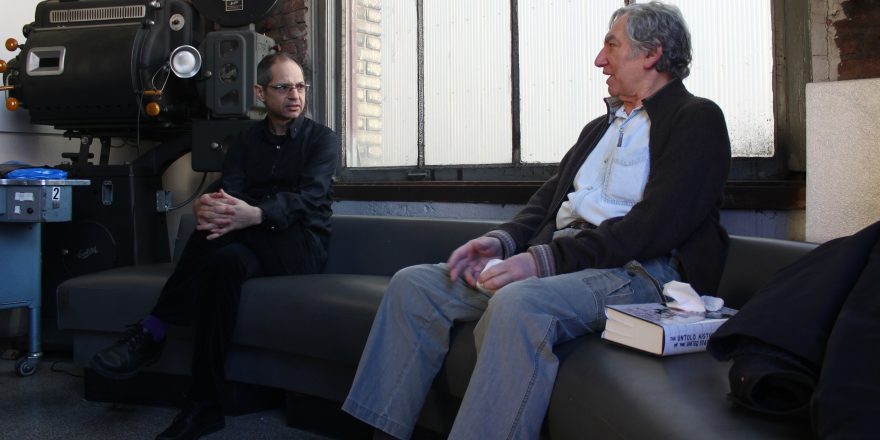
A few years later, I interviewed Ken on camera at Anthology Film Archives for a film I was making about Joseph Cornell, whom Ken had met several times and been influenced by. He told me amazing stories about Cornell. I remember thinking that his relationship to Cornell in some ways mirrored my relationship to him – that of a younger artist seeking out an older artist he admired who could serve as a kind of role model.
It was also around this time that I saw Azazel Jacobs’ Momma’s Man – starring Ken and Flo. I invited Azazel to show his film to my class (much like his father had invited me to show my film to his class) and I really enjoyed getting to know him a little bit. I remember he showed me some graffiti he had inscribed on a wall near my office as a teenager and I was impressed that the graffiti was still there after all these years.
I continued to see both Ken and Azazel intermittently over the next several years. I invited Azazel to show three subsequent films to my class and we shot a Getting Stoned with Caveh episode that is still unreleased. What touched me most about shooting that episode was that Flo kept texting him while we were getting stoned to make sure he got home safely. I found that incredibly touching and both marveled at and was a little jealous of how close he was with his parents. I remember thinking I hoped my son would, as an adult, feel about me the way Azazel clearly felt about both of his parents.
One thing that Azazel told me about his father was that when Ken didn’t like a film, he never said the film was bad. He would just say it wasn’t his cup of tea. I stole that from Ken and now use that phrase myself whenever I hate a movie. I used it just a few weeks ago in talking about a song that someone asked me to make a music video of. It’s such a gentle and yet honest way to describe aesthetic differences.
When Flo became ill and it seemed that she might not be long for this world, I was aware of how hard the whole ordeal was for Azazel. When she died, just a few months ago, my heart went out to him. I knew how close they had been and how deep their bond was.
When I heard that Ken had died, only a few months after Flo’s passing, I couldn’t believe it. My first thought was for Azazel and my second thought was that I wanted to do something to commemorate Ken’s passing, which is why I wrote this piece.
Ken was a true artist and, like all true artists, he was one of a kind. There has never been anyone like him before and there will never be anyone like him again. I feel blessed to have known him, however intermittently, and to have also gotten to know Flo and Azazel. Ken’s artistic integrity and single-minded faith in the importance of what he was doing – in the face of near-constant marginalization and neglect – has been a source of unending inspiration to me personally.
Azazel told me that in recent years, Ken, who had always had an aversion for mainstream cinema, had begun to love and appreciate films that in the past he would have described as not being in any way his cup of tea. Azazel told me that one night Ken called him and was raving about a film he had just seen. Ken was describing the plot to Azazel and when Azazel asked him what the film was called, he answered: Girl Interrupted. Azazel was tickled by that and so was I. For the rest of my life, whenever I think of the film Girl Interrupted, I will always warmly remember Ken loving it.
Featured image, showing Caveh Zahedi interviewing Ken Jacobs, courtesy Caveh Zahedi.