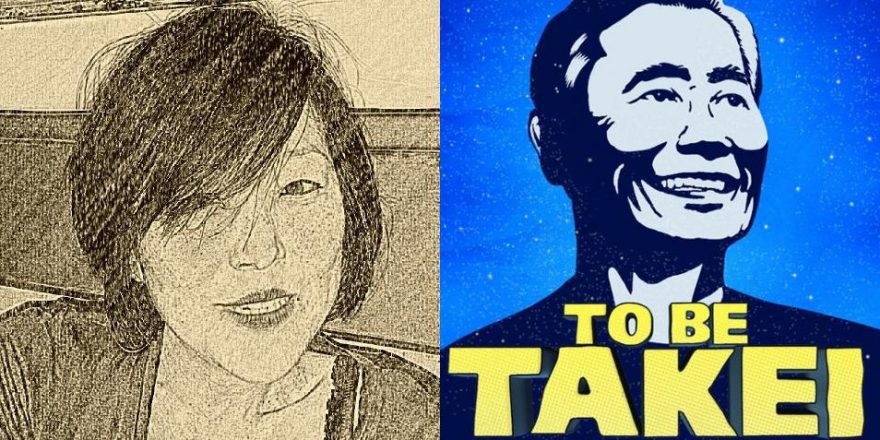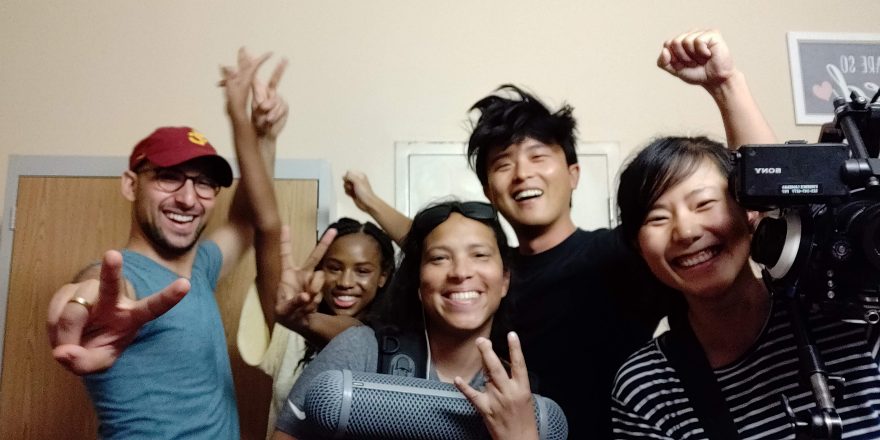



Timour Gregory is a British-Egyptian film director and the founder of Highway Child, a mission-driven creative studio focused on humanitarian storytelling. Sasha Schneider is a producer and director whose work explores the intersection of representation and the arts. They are the directors of Beam Me Up, Sulu, available February 17 on digital platforms to rent or buy. (Photo by Zachariah Levens.)
Today, 60 years after Star Trek first aired, it may seem as though the nerds have inherited the earth. Franchise installments from the likes of Marvel, The Lord of the Rings and Dune — all once considered “uncool” – routinely dominate the box office. Yet a certain cultural prejudice continues to dog Star Trek.
We all know the stereotype of the Trekkie: clad in an ill-fitting Starfleet uniform, Klingon dictionary in one hand, Vulcan-saluting with the other, arguing over which starship has the best propulsion system.
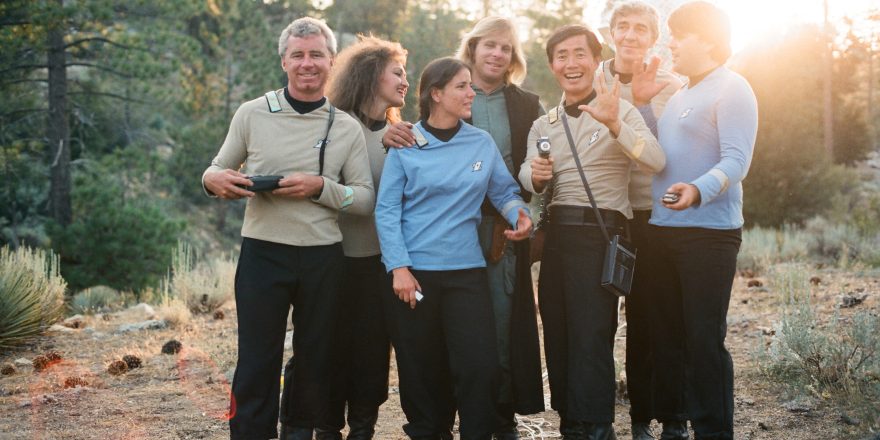
Back in 1985, one passionate Trekkie decided to express his love for the show by making a fan film: a DIY, unlicensed short movie set in the Star Trek universe. Miraculously, he convinced George Takei to reprise the role of Sulu that he made popular in the original Star Trek.
When we discovered this story, we were moved to tell it, but some of our peers were less enthused, and others were even disdainful. After all, we had made films about some of the world’s most serious humanitarian crises. Why were we tinkering with this seemingly trivial topic? What makes Star Trek so important?
It was this last question that drove our work on Beam Me Up, Sulu, our first film as a creative duo. We would ask it in nearly every interview, whether the subject was an actor like George Takei, a historian or a fan. The answer we found is as relevant today as it was in 1966.
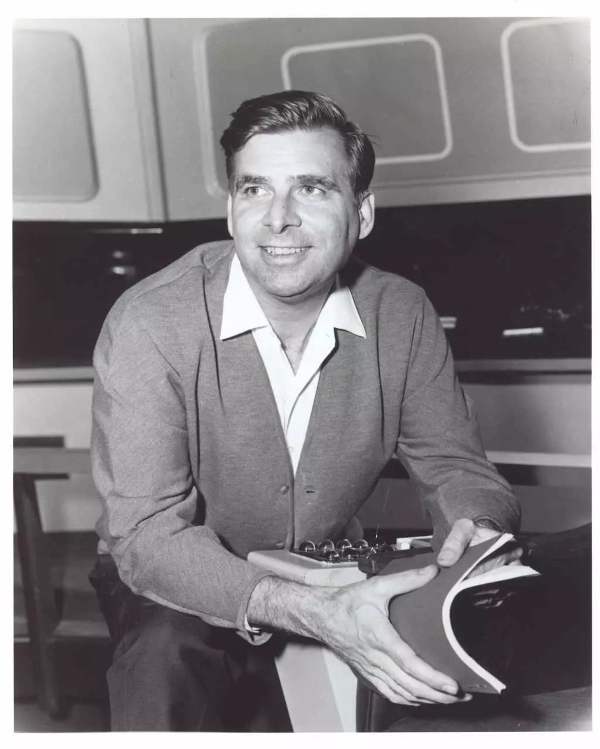
“Mass communications is our language today, between one another. We can’t say, ‘Let’s not really talk about anything serious on television.’ That is a criminal statement.” – Gene Roddenberry
In today’s parlance, Roddenberry would have said, “Pop culture is our language.” A potent cocktail of capitalism, social media and the erosion of norms has led to an almost complete collapse of faith in the news media. Advanced education, particularly in the United States, has become so expensive as to be inaccessible to many. Pop culture is one of the only remaining tools that we can use to inform public discourse and shape public opinion.
The Ancient Greeks had their myths, children of bygone eras had their fairytales; we have superheroes and starships. Roddenberry knew this when he created Star Trek. Though the show was pitched to the networks as a Technicolor Western in outer space, its writers wove important themes, symbols and allegories into each episode.
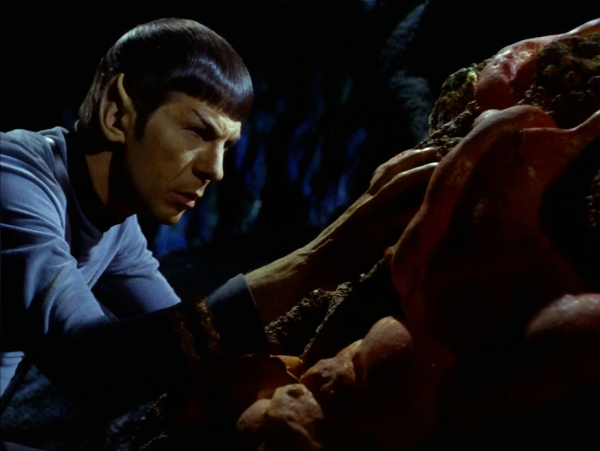
“The Devil in the Dark” was a cautionary tale about environmental issues. “A Taste of Armageddon,” in which two warring forces no longer do physical battle but instead run computer simulations and bloodlessly disintegrate the requisite number of casualties, foreshadowed the clinical nature of our present-day drone warfare. “The Doomsday Machine,” in which a gigantic planet-killing vessel pursuing the Enterprise, showed us how weapons of mass destruction cannot always be controlled by those who create them. This was a pop culture of ideas.
Beyond the themes of its scripts, Star Trek probed the country’s attitudes to inclusion. Kirk’s senior staff included Walter Koenig’s Chekov, a Russian character in a show airing at the height of the Cold War. Nichelle Nichols’ Uhura, the African communications officer, became iconic. Whoopi Goldberg was so impacted by the character that, 20 years later, she lobbied Gene Roddenberry for a role in Star Trek: The Next Generation. As one fan puts it in our film, “[Uhura] might as well have been sitting in the President’s office. If you’re by the captain, you’re somebody.”
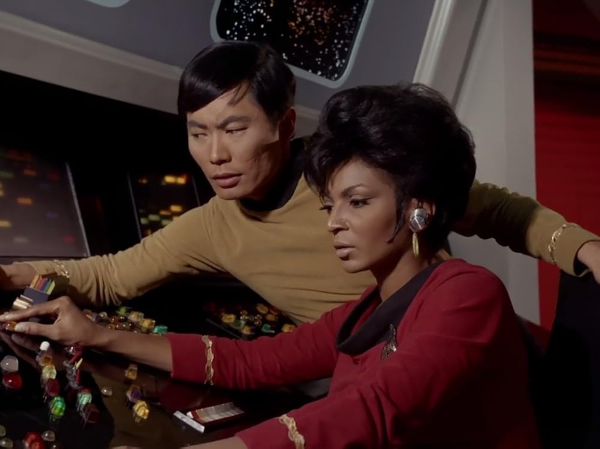
And the hero of our film, George Takei, played Sulu, a Japanese-American character, portrayed non-stereotypically, only 20 years after the United States had fought against Japan in the Second World War and unjustly incarcerated some 120,000 Japanese-Americans in camps.
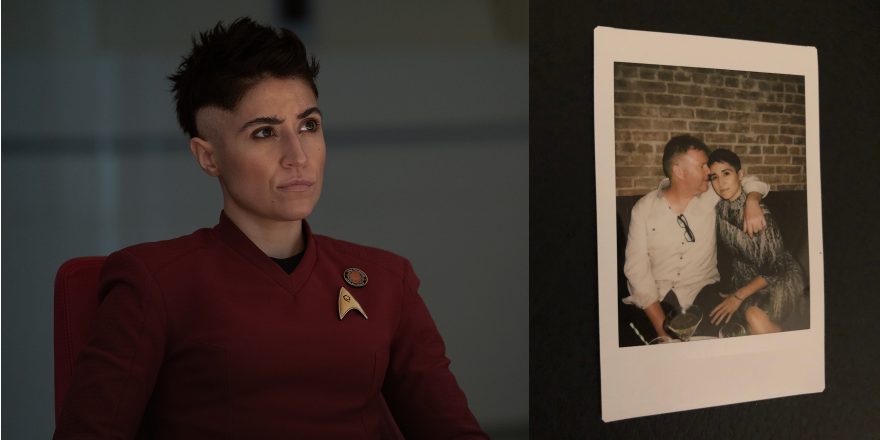
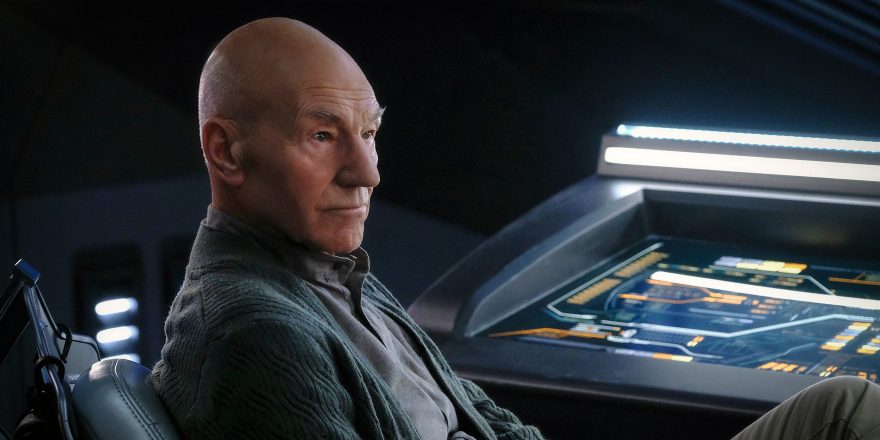
Roddenberry faced significant pushback from the networks and the advertisers when he made these decisions, and it only intensified when, in the third season, he had Nichols and the White leading actor William Shatner perform television’s first interracial kiss. His resolve never wavered and throughout Star Trek’s history, the franchise has continued to probe these complex ideas. In the ’80s and ’90s, it broke new ground in the area of gender equality – a major blind spot of Star Trek: The Original Series. And the newer shows like Star Trek Discovery and Starfleet Academy have boldly explored LGBTQ issues.
The esoteric 1985 fan film Yorktown: A Time to Heal at the heart of our documentary is living proof of the importance of Star Trek’s commitment to these ideals.
Its director, Stan Woo, embarked on his Fitzcarraldo-like folly to make an unlicensed Star Trek film with fellow students and amateur actors, because he was inspired by seeing George Takei portraying an Asian man on television in a central and non-stereotypical role. Takei decided to appear in that low-budget, potentially embarrassing film because he understood his responsibility to encourage young people to pursue their passions, particularly in fields where they had been traditionally underrepresented. Those same passions kept Stan and his motley crew going for the 40 years it took them to complete their labor of love.
As goofy as Yorktown: A Time To Heal may seem, its creators cared deeply about the ideas Star Trek represented. That devotion, earnest and unfashionable, has long made Trekkies a soft target for ridicule. Maybe it’s easier to mock someone in an ill-fitting Halloween store costume than it is to engage with the ideas that inspire them. But we have met Trekkies who don those uniforms to run a marathon or host a drag show that raises money for cancer research. They deserve a lot better than a punchline; they’re living proof of pop culture’s power to change the world.
Gene Roddenberry didn’t live to see the difficult times in which we now find ourselves. He would doubtless have found ample material in today’s headlines. But when he created Star Trek, he too was living in a divided country.
Now, as then, we need creators with integrity and ingenuity, who will probe the burning issues of our time and point us towards a better future. And as an audience, we have a responsibility not only to support but also to demand a pop culture of ideas. Trekkies have been doing just that for 60 years, through their words, their deeds, their fan films, and, yes, their Klingon dictionaries.
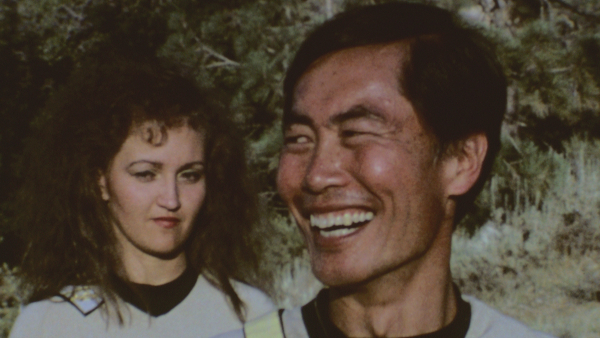
Featured image shows George Takei on the set of Yorktown: A Time To Heal, one of the earliest “fan films” and the subject of the new documentary Beam Me Up, Sulu. All images courtesy Timour Gregory and Sasha Schneider.