


Deborah Goodwin is a writer-director-producer whose work in film and television began as a development executive for Sanford-Pillsbury Productions (Desperately Seeking Susan, River’s Edge, How to Make an American Quilt). Deborah’s Urbanworld Film Festival Best Screenplay win for her darkly provocative family drama Cherrys launched her filmmaking path. She has written for Emmy-winning and Independent Spirit Award-nominated producers, and for shows like the cult favorite horror series Tales from the Cryptkeeper. She is a Film Independent and IFP lab fellow and an ABC and NBC diversity showcase director, best known for her horror fable Vampires in Venice and her action/drama The Pastor, released by Fathom Events and AMC. Her Icelandic noir Snaeland, which she co-wrote and produced, premiered at the Vail Film Festival and screens in the Brooklyn Film Festival 2020. Deborah is a Sundance Collab advisor and screenwriting professor at Brooklyn College, and a newly minted co-creator and writer of the noir-crime-thriller series Hot Freeze, with Canadian producer Nomadic Pictures (Hell on Wheels, Van Helsing, Fargo).
I’m standing on the Hudson Line commuter train platform ready for my journey into Manhattan to teach my NYU Screenwriting class, full of eager, wired, pugnacious and often gifted storytellers in their embryonic stage.
It is an engagement I take seriously. Because, seriously, who is going to be the next generation of storytellers if every avenue to professional realization is squeezed, obstructed, defunded, policed and politicized?
Oops – wrong essay!

Anyways, I’m standing on the platform when my phone rings. (Let me stress that in this day and age no one – but no one – CALLS me. So I know it’s either fraud or someone is dead.) I answer, “This is Deborah,” which is the first barrier to bullshit telemarketing calls; you identify you and they don’t get to play info Stasi. “Ms. Goodwin?” Yes, this is she – can I help you? The voice on the other end is neutral-human, not intense, not scripted, not automated — so I wait … “I’m sorry to bother you …” here it comes … “but I’m enquiring about a Brian Goodwin …”
There is a part of your brain that stores relevant information for times of crisis, birthdays, medications, social security numbers, addresses, what have you … — you memorize shit that might be useful if/when (hopefully never) someone calls enquiring about someone you love, someone whose existence is a constant, a staple, a bedrock of your own — to tell you something awful has happened.
But my brain is wired for crisis. I am prepared to stay calm and carry on.
I don’t hesitate. “Brian Goodwin has been, to my knowledge, deceased for at least two decades, I’m not sure how I can help you,” is my answer.
There is a beat. The voice on the other end seems to be consulting some intel and responds: “I’m sorry, please forgive this intrusion, we will remove you from this list.”

No stranger has spoken my father’s name in over two decades. that is true. But the other part of it? I don’t, in fact, know that my father is deceased.
No one has ever confirmed or denied this. And that is the first I’m writing about it. Is it likely? Very. Am I certain? No. I follow up, “Can I ask what this is regarding?” Click. The mystery caller has hung up. My heart is jumping. My train’s arrived.
I’ve seen Paul Thomas Anderson’s latest, greatest, broadly lauded film, One Battle After Another three times now, in theaters. I can’t recall doing that with any film in recent memory. The father-daughter story at the heart of it is gripping and funny and heartbreaking. I’ve unequivocally never appreciated DiCaprio, as an actor, more than in this role of Ghetto Pat turned Bob, a lost revolutionary thrust into the role of full-time father to a child (played by the revelatory Chase Infiniti) who may or may not be his genetic progeny — but is undoubtedly, irrevocably his daughter.
Ghetto Pat, in so many words, is a genius with explosives and a massive fuck-up everywhere else in his life, which galvanizes his pot smoking, day drinking and habitual night crawling. He’s by turns atoning and agonizing and self-flagellating and seething and absolutely besotted with his child. His sun and moon revolve around her and caring for her in his misguided ways. He is a stay-at-home-dad to with a tricky past, wanted by a four-star sociopath (played by Sean Penn as Colonel Lockjaw) with a personal axe to grind, for his cross-racial love affair with Black Militant Warrior Goddess Perfidia (the superlative Teyana Taylor). But, this is not a review. It is a meditation on why I find myself back in my theater seat again and again, because this movie was balm to my soul. It felt cathartic, deeply human and sublimely feminist all at once.

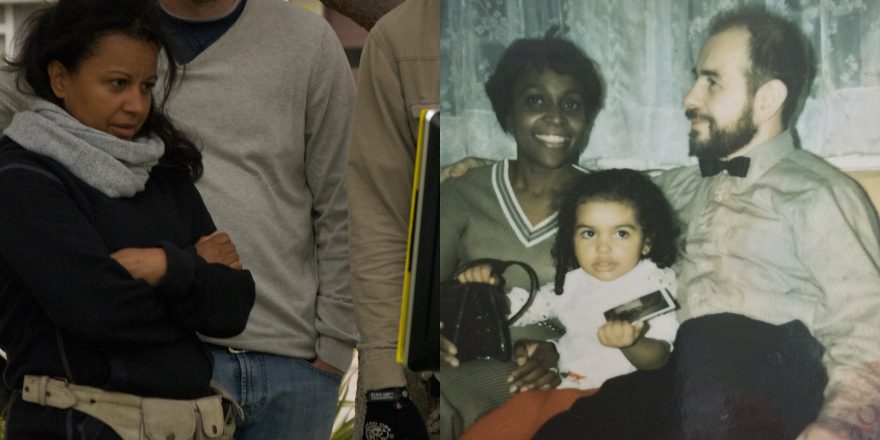
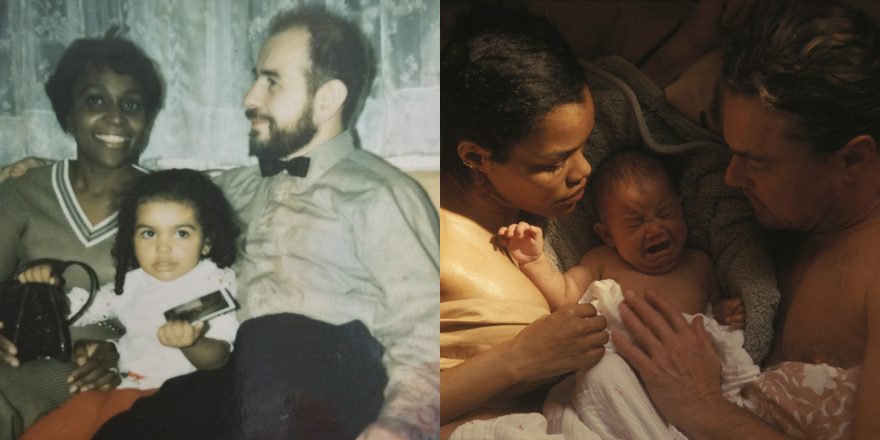
In the construct of my own biracial existence and childhood, my father was a stay-at-home-dad, while my mom was the valiant social warrior and defier of norms, using her indefatigable charm offensive and language skills to navigate the corporate sales world and bring home the bacon. While my dad, who could be described as a “beardo,” a “communist,” a “race traitor,” a “Jew,” an immigrant and, damningly, a member of the intellectual elite, walked me to and from school religiously, made sit down meals, read me bedtime stories, taught me to box, swim and skate, appreciate nature, question authority, ask difficult questions of myself and use the library.
In a pivotal scene in One Battle After Another, Bob (aka Ghetto Pat), holding and soothing his infant daughter, confronts his restless warrior wife, who is rejoining the revolution without him. This moment in the narrative is a stark, searing indictment of expectations of the “assigned” male and female roles in child rearing — and it hit deep and sincerely. I remember my mother’s restless frustration and fury with my dad. I remember his resignation. I remember their battles to inhabit their roles as parents in undefined territory that did little to make clear whose “freedoms” were more at risk. My mom wanted to live and dream beyond her status as solely a mother – she was ruthless in reclaiming territory after giving birth to me – and my dad assumed a highly non-traditional role in exchange for keeping their marriage afloat.
I see that now.

One Battle After Another challenges so many pathologies and destructive constructs, but it cuts closest to the bone for me on the issues of female autonomy. The very idea (then, in my childhood and now) that a woman, a Black woman, a new mother surges forward with a “warrior ethos” of this-is-who-I-am-take it-or leave it — is revolutionary in a mainstream film like this one and in real life.
I had to see One Battle After Another three times to be sure that I got its message right, and I did. In a moment rife with dismantling of freedom, and especially female freedom, that message makes this film one for the ages.