


Hailey Benton Gates is a filmmaker based in New York City whose Sundance-winning debut feature as writer-director, Atropia, starring Alia Shawkat and Callum Turner, is in theaters now. Her award-winning short film from which Atropia grew, Shako Mako, starring Alia Shawkat, premiered at the 2019 Venice Film Festival. As an occasional actress, Hailey has appeared in David Lynch’s acclaimed reboot Twin Peaks: The Return, the Safdie brothers’ Uncut Gems, Josh Safdie’s Marty Supreme and Luca Guadagnino’s Challengers. She received her BFA from NYU in Experimental Theater and Playwriting and was an editor at The Paris Review. For two seasons, she was the host and producer of the award-winning docuseries States of Undress for Vice TV, which saw Gates travel the globe, often to conflict zones, to explore the intersection of fashion, politics, and women’s rights. She received the Gracie Award by the Alliance for Women in Media for Best Non-fiction Series as well as the Front Page Award for Outstanding Reporting in Television.
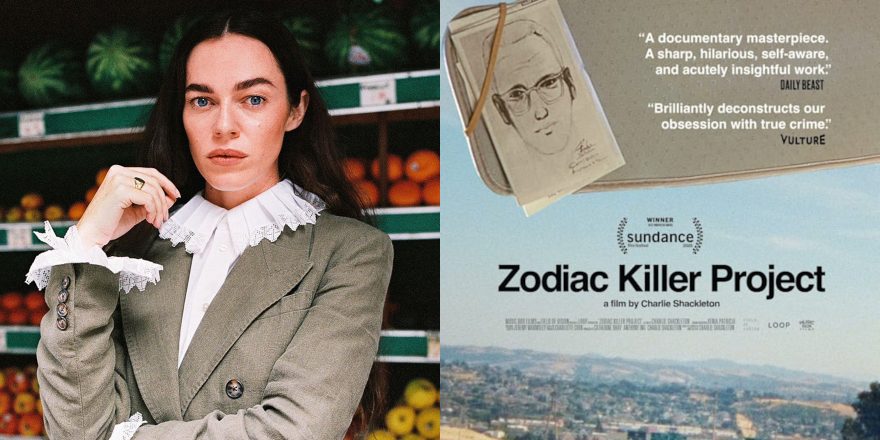
The film I’ve chosen is Charlie Shackleton’s Zodiac Killer Project, which had its world premiere at Sundance, but I didn’t get to see until it played as a theatrical release at the IFC Center last month. I was really charmed by it. For me, it’s in the tradition of one of my favorite genres of documentary – “director dilemmas” films like Hearts of Darkness, Sherman’s March, American Movie and Sandi Tan’s Shirkers – which explore the hubris and folly of trying to make something, and it not going as planned. I really admire that kind of pivot. To begin to have hints of recognition that the journey may be as or more compelling than the intended result.
Charlie, in many of his projects, has taken it upon himself to make something like “protest films,” which make them sound more aggressive than they are, because the tone the films themselves take is quite charming and sometimes even gentle, but no less effective. I think he has a particular way of expressing the modern indignities of being a filmmaker that I find very moving and deeply funny, and it’s a gesture I really admire. So I just want to make sure that he continues on his path because he is doing God’s work!
When I saw Zodiac Killer Project, it made me think a lot about Janet Malcolm’s book The Journalist and the Murderer. There’s a line in the film where Charlie says, “If you’re convinced that what you’re making is for the greater good, there are very few ethical lines,” echoing the iconic opening of The Journalist and the Murderer, where Janet Malcolm writes, “Every journalist who is not too stupid or full of himself to notice what is going on knows that what he does is morally indefensible.” We live in this time where it feels impossible to get a documentary made if it’s not about a celebrity or true crime. Zodiac Killer Project almost feels like a eulogy for all of the many imaginative, brilliant documentary filmmakers who find themselves at the mercy of this moment and its accompanying pitfalls. If you want to work, it feels like you have to make one of those and nothing in-between.
The film is also uncomfortably beautiful. It’s shot on this gorgeous 16 millimeter film, and there’s a kind of lament in its execution. These lush slow zooms accompanied by Charlie’s retelling of what the dramatic sequences would have been. It’s like, if Charlie can make an empty frame this compelling, what we would have been blessed with if he’d had the budget to make this movie?
I also think Charlie’s just really funny and impish and I love the paint drying film concept, because it’s so hard to make a movie and if you don’t have the benefit of being distributed and you’re at the mercy of government entities that force you to pay for being rated, to force them to watch 10-plus hours of paint drying … what a charming, wonderful thing to do. He was telling me at Sundance that the film has had this subsequent life on Letterboxd, with people using the film’s page as a diary or somewhere to post things that would be out of place elsewhere. I haven’t looked at it yet, but it sounds like a beautiful project.