


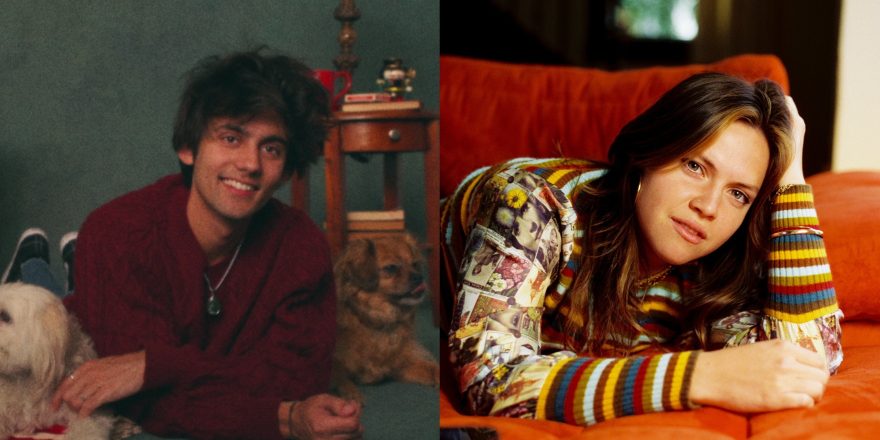

aron! is a multi-instrumentalist jazz musician. His new record cozy you (and other nice songs) is out now on Verve.
aron! is a multi-instrumentalist jazz musician; Hohnen Ford is a singer-songwriter based in London. aron and Hohnen just put out a Christmas song together — “cozy you (christmas),” off of aron!’s three-track EP a cozy christmas — so to celebrate, the two got on the phone to chat about it.
— Annie Fell, Editor-in-chief, Talkhouse Music
aron: What are we talking about today? We’re talking about Christmas music?
Hohnen Ford: Christmas music, what it means to us, and what it means to Gen Z.
aron: Wow. This is a big torch for us to carry.
Hohnen: I know. Did you watch Girls? You know that bit where Lena Dunham’s like “I’m the voice of my generation. Or I’m a voice, of a generation”? That’s us right now with jazz. We are the voice of jazz for Gen Z — or at least we are a voice of a jazz generation.
aron: Is that the show with Adam Driver?
Hohnen: Yeah.
aron: I always liked him.
Hohnen: He’s so hot. You know when Adam Driver sings “Being Alive” at the end of Marriage Story?
aron: I know the song.
Hohnen: He sings it so well, aron.
aron: Really? Well, I’m zero for two with these references today.
Hohnen: Well, I’m zero for two on the questions. I was actually reflecting on my journey — I was just doing a Christmas photo shoot, hence this new look.
aron: I was wondering why you looked so good.
Hohnen: [Laughs.] The men in my life don’t like it when I change anything about my appearance. Right now I have a different hairstyle and all the men in my life are like, “Are you OK?” I’m like, “It’s completely fine. Everything is the same. Just my hair is a little to the left.”
aron: I feel like I’m a man in your life. But maybe I’m a boy in your life, who just loves whatever new hairstyle you’re throwing on.
Hohnen: I should have said the other men in my life had a different reaction. And that’s what makes you the only man in my life that I need.
aron: [Laughs.] So what was this Christmas photo shoot for?
Hohnen: For our, and my, Christmas EP. Our Christmas song, my Christmas EP. But I was reflecting on the way home about why Gen Z might be gravitating towards jazz. Because I think both of us have always loved jazz. It’s always been a part of us from day one, kind of. So in some ways, it makes us not very good spokespeople for why jazz is coming back right now. But in the same way that everyone is buying vintage clothes and secondhand things, I think as a swing back on fast fashion and fast music, people want really well made, well crafted things that stand the test of time. And that’s what I think a lot of the jazz repertoire is.
aron: I like that.
Hohnen: I think it’s not just nostalgic. I think it’s quality stuff, a repertoire and a songbook that has been cobbled together over nearly a century.
aron: I think maybe the counterculture thing is also just an authentic thing versus a… I don’t know, I’ve been thinking about AI, and I think the push against that is like, “Just do the authentic, genuine thing that you’ve loved.” Which for us happens to be jazz. But it’s also bigger than that.
Hohnen: I think the authentic thing is a really good point. Audiences can smell a fish. And what I mean by that is sometimes there’s this assumption that artists should simplify or dumb down or pander to a trend in order to hook an audience. And I think when we do that, in the same way that AI shit is in some ways not that threatening — because why do we make art? Why do we make music? We make it so that us as artists can feel understood and seen and then people as listeners feel understood and seen. And if you’re forcing something that is inauthentic, or making something by just computers doing it without any perspective, you don’t really feel understood and seen. People can handle a lot more complex and nuanced music and art than we think they can. And now that we have direct access to our fans, we’re able to do that, and then people can give us feedback that they get it and we don’t have to be like, “Oh, jazz is complicated and jazz is weird.”
aron: Wow, yeah. I think you’re totally right about the audience being much smarter than we usually assume. [On tour], I’ve been making them sing along to these crazy things, where I teach them eight bars of non-repeating melodic info, and then later in the song I’m like, “OK, now it’s your turn. Do the thing.” And they all sing it. It’s wild. And now, I play a little samba thing for “Table for Two,” and then I make some of the audience just snap whatever they want, and somehow it ends up being crazy pocket. At least from where I’m standing.
Hohnen: That’s so interesting. Because if you were to prescribe to them, “Everyone clap on one and three,” or try and kind of make it heady, often it doesn’t feel good and people are dragging. But maybe if you give people the freedom and the trust of, “You snap when you feel it,” then it ends up actually having a much deeper pocket or a much better feel. That’s cool.
Aron: Yeah. I think it’s because I saw this guy named Toninho, who’s an old Brazilian legend, play in New York, and he just sits down with the nylon and the band behind him, and he just points to an area of the crowd, and then he points to another area, totally different line, and just makes people work for it in a way that’s not heady and not overly explained. Which is really cool.
I don’t know if we’re talking about Christmas anymore, but I do have one more tour story that’s Christmas related.
Hohnen: Please.
aron: Every time a venue has a piano — which is pretty often in the dressing rooms in Europe, which is very cool.
Hohnen: Yeah, bless Europe.
aron: I just sit down, play some stride, and now everybody calls me “Christmas aron” on tour. Which, there are worse names to be called on tour.
Hohnen: [Laughs.] True. I guess the world associates jazz with Christmas.
aron: Which is something that I struggle with. I don’t know if I love that.
Hohnen: Say more.
aron: After the show, people will either say, “Man, it was just so cozy” — which is cool. It’s the name of the EP.
Hohnen: Branding.
aron: But another thing they’ll say is, “I got Christmas vibes.” And maybe it’s the thing where it’s almost December, so that’s what it is. But I think it’s just, jazzy chords mean Christmas. And I’m wondering if we can make jazzy chords mean other things. If I played the same songs in the middle of summer, but would it still sound like Christmas?
Hohnen: Yeah, that’s a great point. I mean, I do think that what you’re doing is objectively broadening jazz’s current cultural reference from Christmas. I’ve definitely had a similar thing of people saying those kind of comments. Like, “Your voice sounds—” and obviously some of those artists I think they hear in our voices, like our references of Ella and Frank, that’s the only context that they’ve heard this repertoire in. But there are so many greater, amazing records of those artists, and we should be giving those the space too. We’ve both learned so much from those artists and those records. And, I mean, the reason why I wanted to do a Christmas project was because it’s a great opportunity to sing some songs in The Great American Songbook, which people have a reference for. So for example, in this EP that I’ve got coming out, it’s some Christmas songs, but also then—
aron: [Sings,] “It’s you I like…”
Hohnen: Yeah! Which I guess has a cultural reference because it’s Mister Rogers, which some people will know, some people won’t, but it’s just trying to broaden people’s understanding of what that music is. And actually, all that nuance and all that beauty can be applied to not just when your grandparents are shouting at your auntie at the Christmas table or whatever.
aron: [Laughs.] Oh, my lord… I think maybe Christmas music was my gateway to jazz, so I feel some kinship with all the people who think that Christmas is jazz, or that jazz is Christmas, because that’s how I got here.
Hohnen: What record was your mom playing at Christmas?
aron: [Sings,] “Christmas time is here…” I’ve never heard a chord like that second chord.
Hohnen: Flat 7. Is that what it is?
aron: I think so.
Hohnen: Come on, now.
aron: Bro.
Hohnen: You know what Christmas records I listened to growing up?
aron: Let me ask you. What Christmas records did you grow up listening to?
Hohnen: [Laughs.] Well, one that comes to mind is Jamie Cullum.
aron: Oh, my gosh.
Hohnen: With whom you’re playing next month. [aron played with Jamie on December 12 at Royal Albert Hall.] Have you met Jamie yet?
aron: I haven’t met him. The only correspondence that him and I have had was I posted the flyer for our show together, and then he sent me two strong arm emojis. [Laughs.] I’m really excited. He’s great. In some ways, he feels like the Gen Z jazz thing, but just a couple years earlier, with Norah Jones.
Hohnen: They brought jazz to the masses in the 2000s. And then it sort of lulled, and now you’re bringing jazz to the masses.
aron: and you.
Hohnen: Well…
aron: And Laufey..
Hohnen: The holy trinity. And Samara Joy!
aron: There we go.
Hohnen: I want to know a little more about your Christmas EP, which I love. I love the cover of it. What made you want to do a Christmas project?
aron: In some sense, I wanted to get it out of the way. I love this music so much and I just wrote a Christmas song, so. It was in May when I recorded it.
Hohnen: Wow. That’s really bad luck, you know that?
aron: Really? Am I going to get coal?
Hohnen: Yeah.
aron: [Laughs.] But it was also an excuse to have fun with arranging. It used to be my favorite thing in the world to write for string quartet, and this one was string quartet, clarinet, saxophone, flute. So part of it was just, I want to have fun and see what happens. And that’s also why there’s dogs on the cover, because I just wanted to play with dogs that day.
Hohnen: That’s sick.
aron: Now it’s my turn to ask you. What do you want this Christmas EP to do in people’s lives?
Hohnen: The idea that it would be a soundtrack to someone’s family time is a really beautiful thought. And, I don’t know, I think there’s a real warmth and intimacy in the performances. I’m really happy to have these very simple recordings. The seasons changing can be really hard — I find them really hard — and they can feel quite isolating and and cold. And I hope that this can be a little pocket of solace and warmth and ease and simplicity. And a lot of the songs that I write, I’m really working through stuff, and I’m hoping that it will give them cause for reflection or just to feel a lot in their life. But this project, it doesn’t need to be that deep. I just hope there’s a comfort and a familiarity and a friendliness in them.
aron: Wow.
Hohnen: “Hohnen Ford wants to be your friend this Christmas.”
aron: [Laughs.]