

Daguerreotypes is a worker in song. Daguerreotypes has written 112 songs so far. With his debut double album, This Is My Way to Tell You That Everything Is Real and Happening Right Now, out now, Daguerreotypes dares you, the reader of this sentence, to experience the astonishing new folk sounds of Daguerreotypes.
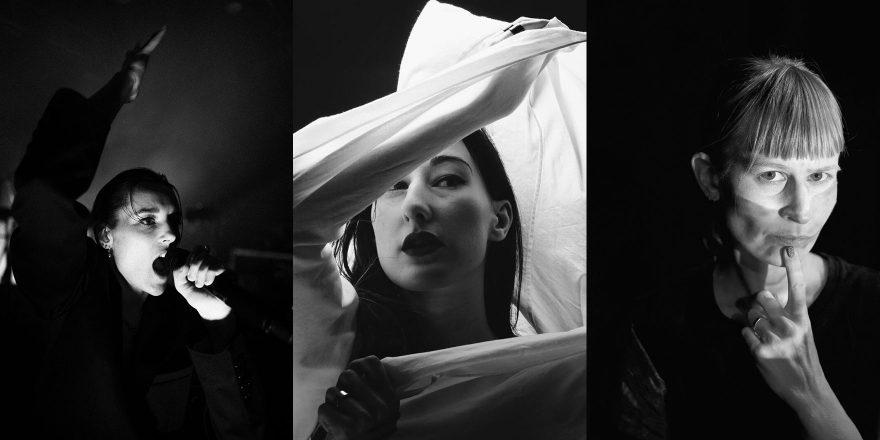
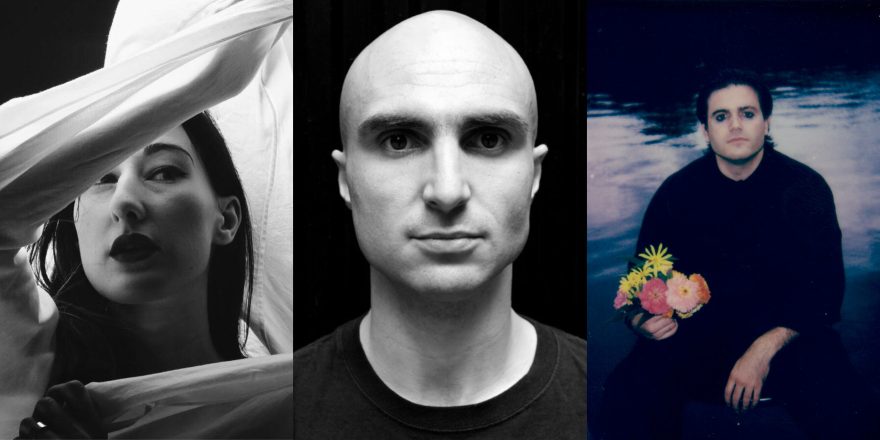
James Samimi Farr is a Minnesota-based songwriter who plays under the name Daguerreotypes; Nika Danilova is a Wisconsin-based artist who performs as Zola Jesus and NIKA; Devon Welsh is formerly one-half of Majical Cloudz and now releases music under his own name. The debut Daguerreotypes record, This Is My Way to Tell You That Everything Is Real and Happening Right Now, just came out at the end of last year, and to celebrate the three friends sat down to chat about it, and much more.
— Annie Fell, Editor-in-chief, Talkhouse Music
Nika Danilova: Can you guys explain how you guys met?
Devon Welsh: Well, me and James went to the same university, and we first met in a seminar that is the culmination of the honors program in religious studies at McGill University. Is that right?
James Samimi Farr: Yeah. There were about six or seven other students in the class, as I recall, and it was a lot of hardcore philosophy of religion. Pretty dense readings. You and I didn’t know each other super well then, and I remember that we exchanged some pleasantries and we went out for breakfast at the conclusion of the seminar with a couple of the other people in it. I remember at that time, I was really just starting to experiment with performing and songwriting in a more serious way, and you were quite a bit ahead of me on the road with that. You were with your band Pop Winds at the time, and you had released a couple of records. And you were always publishing this really kind of eerie poetry in the McGill Daily.
Devon: [Laughs.] Yeah.
James: I remember being really intimidated by you, actually, that you had this really powerful artistic force even then, and I was aware I wasn’t even ready to offer what I had to you at that moment.
Nika: Aw.
James: After that course ended, we fell out of touch, because we weren’t even really in touch to begin with. Flash forward to 2013: You were then in Majical Cloudz and I went to see you in Toronto. You put on this amazing show, and I remember I came up to you after and reminded you who I was, and you were happy to see me but it was that kind of post-show thing where you’re overwhelmed by all this attention of people you know. We had a really warm exchange, but for some reason, I wanted more — like, I wanted to be your friend. Then I was living in Washington DC, probably in 2017 or ‘18, and you played at a club called DC9. You had some tape loops of stuff that would be the Devon Welsh record, and I remember being totally blown away, particularly by your song “Comedian,” and just thinking, This is the greatest thing I’ve ever heard this guy do. I went up to you after that show, and I just kind of cornered you like, “I love your music. Let’s be in touch.” And very graciously, you weren’t totally put off by it. You gave me your email address, at least. And we started corresponding after that.
Devon: I remember the next time that I came through DC, we had dinner together before or after the show. And we had a conversation about God, I recall.
Nika: Sounds about right.
James: [Laughs.]
Devon: And then the next time I played in DC, you were opening the show at Comet Ping Pong.
James: Yeah, that was a total dream come true. We kept corresponding and realizing that we had a lot in common in terms of our mutual interest in music and art, and just sort of an open heart and mind around… maybe just taking life seriously, but not ourselves seriously?
Devon: I was going to also say, sense of humor. I feel like that’s something that we really connect on, and something I enjoy about you.
James: Likewise. And so then you two were living together in Wisconsin, and I was driving through because I was moving to Minnesota — which was also the coolest thing ever, that we had linked up back in Montreal, and then all of a sudden both of us were sort of these Midwestern satellites. I came over to your place and you guys treated my family and me with such hospitality. Nika, you were so warm and inquisitive about what I was up to artistically, and I really just felt like, OK, there’s a little community here. We can get to know one another and develop this friendship.
Nika: You have been such a beam of light, and being in close proximity to you has been such a gift. I’ve loved getting to know you, and I’m so glad that you were so persistent to get to know Devon.
Devon: Yeah, likewise. [Laughs.]
Nika: Your sensibilities and your intuition was right. You guys are very well matched, to a deep level.
Devon: For a long time then, I was like, “How’s the recording going. What’s happening with the record?” And then you sent it to us, and I was like, I’ll go for a walk with my dog and listen to it. And then, like, half an hour in, I looked at the SoundCloud playlist and I was like, Oh, it’s not even at the halfway mark. [Laughs.] I thought the album was over, and then I was like, Oh, no, the second half is just starting.
Nika: You came in and you urged me to listen to it. He was like, “You have to listen to it. It’s insane. It’s so good.”
Devon: Yeah. The feeling was sort of like, That bastard. He’s done it.
James: [Laughs.]
Devon: I feel like I had a kind of spiritual lesson — by listening to it, I was kind of provoked to reflect on all kinds of ideas about my place in life and my relationship to other people. It has a kind of edifying aspect to it.
Nika: It’s so humanizing. I’m thinking of the song “Home Planetarium.” You take aspects of your life, these small, little stories of your life, and who knows if they’re real or not — I’m assuming they are, because they’re so specific — and then they’re writ large into this kind of macrocosmic… You have a way of making the personal universal. It’s so deeply intimate, the details are so specific, but then somehow you bring out the universal human experience, the kind of the cosmic link.
Devon: We’re both trying to read together The Brothers Karamazov right now.
James: Woah, that’s great.
Nika: He reads one line, then I read the next line.
Devon: [Laughs.] No, no, we’re reading it at our own pace. But I am loving that book, and there’s a quality to your album that is in The Brothers Karamazov, which is, it tells a story, but that story contains these themes that are just so profound and central to being a human being.
Nika: The stories themselves teach the lesson. It’s so interesting. And the shocking thing about the record and your music is: you’re an insane vocalist, you’re an insane guitarist, you’re an insane wordsmith. You don’t usually get all those things at once. You don’t usually get someone that really knows the craft of their instrument, that can make a a song that’s so meaningful. It’s the total package.
Devon: One thing that I surprised me about you, in getting to know you, is you have a very encyclopedic, deep knowledge of popular music.
Nika: And unpopular.
Devon: Right. But in conversations, Nika will bring up some artist and you’ll be very familiar with them, you’ll have a lot to say about it. I remember a conversation about Diamanda Galás, and you were like, “Oh, my god, she’s my favorite.” And the genre or style of music that you work in is kind of, would it be fair to say, in a folk tradition?
James: Yeah.
Devon: Have you arrived at that tradition through a conscious choice? Have you ever considered making more avant garde music? How does the tradition that you work in sit alongside your appreciation for music like Diamanda Galás or Nick Cave?
James: First of all, thank you so much for everything that you’ve said. It’s really sweet. Your encouragement as I made this and your belief in the work has just meant the world. But speaking to your question: That’s been a problem for me, figuring out how to make sense of my more omnivorous listening habits. A lot of the things that I enjoy, finding a way to coherently enjoy them, and figuring out the ways in which the things I listen to do or do not influence my practice. I would say about five to 10 years of my time as a songwriter was very much spent in sort of an apprenticeship mode of writing songs like other people write them. When things are so beautiful, you want to be like them. That’s both a really beautiful thing and a really dangerous thing.
There’s this part in the book Bambi, where the deer are hanging out in this pasture together, and then this elk comes by — like a bigger, cooler version of the deer — and all the deer just start bleating. They’re just kind of overcome with this desire to worship or engage with the elk in some sense. I read that book when I was a child, but it’s really stuck with me in my artistic practice, because it’s really hard for me not to just imitate. That was something that I had to overcome for quite some time. Eventually, I suppose, you just run out of patience with not being yourself, and realize that other people have already offered the things that you’re trying to imitate. It’s less satisfying than trying to find your own way at a problem. Often songs for me start as problems, like conceptual or life problems, and then you’re just trying to get at that problem in the most straightforward way. You’re trying to, like, Occam’s Razor the problem musically.
Devon: Yeah. A hundred percent.
James: And it turns out that the most efficient way to do that is just to come by it honestly and do the thing that’s not just the sum of your listening experiences, but then also engage that part of you that no one else has access to.
Nika: I definitely have struggled with that. It’s also feeling like I don’t trust myself, my voice. It’s like I need to conform to something that already exists. That’s been a long journey for me, coming to terms with my own unique voice and not being afraid of it and going, “No, that’s wrong. It’s wrong because it doesn’t sound like the other people.” I think we all struggle with that to an extent.
Devon: Yeah, I feel like I had that problem less because I was never good enough at music to be able to even effectively imitate people.
James: [Laughs.]
Devon: I did an acoustic guitar class in high school, and I just didn’t know how to play music at all, but I started learning how to play guitar by just writing whatever I came up with. Even though it was horrible, I was so satisfied by it. I would listen to a song that I liked and then I’d be like, I’m going to try to imitate that. And I had no capacity to do so, so it would turn into something completely different. And then I would be like, Oh, yeah, this is great. And I just kept doing that for a long time. [Laughs.]
Nika: That ignorance is really freeing.
Devon: But I feel like at a certain point, you develop the healthy hostility to put your music out there. Because I feel like the confidence, or whatever is — there’s a sense of, “No, it doesn’t matter. I’m giving this to you, even if it’s terrible.”
Nika: You need to be a bit authoritarian.
Devon: You need to be angry, to throw it at people. And I feel like you’ve captured that energy.
James: Absolutely. And actually, I depended on both of your friendships to push myself to that stage. I remember you two had visited me, and you hadn’t yet heard me perform. We were reflecting on what constitutes a successful performance and you told me that, “There’s going to be a natural tendency to undercut yourself and try to relieve the tension inherent in performance between the audience and the performer by almost apologizing for your presence and being self-deprecating.” And indeed, that had been my preferred mode of engaging with an audience. And both of you said, “Don’t do that.”
Nika: It’s so hard, but it’s so powerful when you realize that you have the power on stage, and to not let go of that power and give it to the audience. Don’t give it up.
Devon: To be on the stage and performing is an unusual social dynamic. And if you’re normally an agreeable person, you want to not have tension within your interaction with somebody. You want to put them at ease and make small talk and be like, “No, I’m just a friendly guy!” But then when you’re on stage, the audience will actually enjoy it much more if you resist that and take on this different social role, which is to almost cultivate tension in ways, and bring them to a place that is not everyday.
Nika: Yeah. Because I feel like there’s something about being on stage where it’s like you’re human, but not quite human at the same time. You’re removed from that normal social experience with humans. And so you become like an ubermensch where you reflect the audience’s emotional experiences through your songs. But there needs to be this wall in between you two Vulnerability is something that can be displayed, but not to the extent where they feel responsible for it.
James: Yeah. When you both shared some of these ideas with me, it was as though a veil had lifted and it completely recontextualized my performance style, and significantly strengthened it. It was one of the few moments in my life that I would describe as an epiphany. Normally, understanding comes very slowly for me, if at all. [Laughs.] I started to relate to my audience members in a little bit more of a sympathetic way, because I know that when I come as a member of an audience to a concert, ultimately what I’m hoping for is some sense of transcendence or deep catharsis. When I was young, I used to think that art could really change things. I’m not as sure about that now, but I do feel like it provides catharsis, at least, or some transcendent experience, and that’s really powerful. And so I thought, Well, why am I denying my own audience the opportunity to have that? Which was funny, too, because at the time, the audience was almost more of an imagined concept than a real one. But at the same time, you have to perform to the people that you’re hoping to find, in a certain sense.
Nika: A thousand percent. I think performance is definitely one of my favorite aspects of being a musician, because it is so urgent and transcendent. And I do think that art can change in the sense that transcendence can be transformational. It’s one of the most powerful social experiences that we have as humans, and the most unique. What other animal performs in front of others of its species like that? It’s so bizarre. It’s such a surreal exchange of energy, that is so unique to humans.
James: And perhaps dolphins.
Nika: [Laughs.] Dolphins love a big show.
Devon: I’m thinking about how you have had this longer road to making your debut album. It’s very long and it’s full of very good music. But when you said it was going to be a double album, I was like, “Are you sure?” It flies in the face of the recommended strategy for a new artist. But then, I feel like you are not in the mold of the proper strategy: You’ve come to this later in your life than the marketing formula of popular music, which is created by young people for young people, and sort of reflects youthful emotions and values. And your album arrives fully formed in this way where the subjects of the songs are not…
Nika: They’re mature. They’re complex ideas and stories and feelings and emotions that have arrived through time.
Devon: Right, that display the wisdom of age. And then you’ve gotten to this release through sending the record out pretty widely, and struggling to find basically a label. Which shocked me.
Nika: Me too. I mean, we both tried to also send it to people. It’s just a really conservative time right now, unless you’re already demonstrating that you’re a viral hit maker on TikTok.
Devon: It’s obviously a good thing that you don’t fit the mold. But do you have any thoughts on where you see yourself in music, or what position you feel you would like to take in music?
James: Well, I remember when I sent you my record, I was full of hope because I was convinced of its quality. But we also had a chat that there was a very good chance that it would not connect. Those reasons have all kinds of variables behind them — and I’m really sympathetic to a label that doesn’t want to support me, because I don’t think it’s easy for a lot of independent labels economically right now either. You know, printing two pieces of wax for an unknown unsigned artist in his 30s with no audience, it’s probably not a good idea. [Laughs.]
Devon: [Laughs.] Yeah, it’s financial suicide.
James: Have you ever heard of the word “extremophiles” before?
Nika: No, but it sounds like something I am.
James: [Laughs.] It’s a kind of creature that lives in an environment that is not very tolerable toward life. So, for example, it’s a salamander in a volcano, or a cave creature. They produce certain adaptations in an evolutionary sense to allow them to cope with the environment that they live in, so certain creatures that have evolved to live in caves no longer have eyes because they just don’t use them anymore, and certain lizards that live close to volcanoes have this really high heat tolerance. I’m 36, I started writing songs when I was 15. So over 20 years, I was not convinced that my music was of a sufficient quality to share yet, and I made a promise to myself that I wouldn’t put out something in a major way until I felt like it was ready. And that was really painful for me, because no matter how good you are, when you’re making things you want them to have a little world where people appreciate them. An artist that doesn’t have an audience is like a short circuit. It’s a dangerous thing. I don’t make art just for me, I make art because I want to connect with other people. That’s a really important part of my practice. But I couldn’t bring myself to do it for 20 years. But what that did was, it had this real pressure on my psyche where I long for an audience, but I don’t need those kind of accolades to keep going anymore. I punished that part of myself out of existence. And as much as I long for that, I’m pretty realistic about what’s possible. And I’d be happy to be proven wrong.
Devon: Yeah, of course.
James: And I think this record will find an audience because, again, I’m convinced of its quality, but it just may have to take a different route. It’s not going to be the route where I’m this 20 year old hotshot with an amazing vision. And I love those guys too — like Cameron Winter, I love him. But it’s just not my path. So at that point, why bother to do anything the conventional way? There’s obviously no hope that that’s going to work out. So I might as well do things in a way that makes sense to me. I had personal reasons for putting it out at the time that I did. after the many years that I did, and in the way that I wanted to as a double album. I was convinced that those were the forms in which that release made sense. So then I think, OK, well, maybe there’s people out there who would really appreciate that I’m doing it the way I’m doing it. And those are the people that I want to reach. We’re in a time of fragmented audience and very small micro communities. I’m totally happy just to find mine.
Nika: Well, we are so proud of you as your friends to experience your music finally. And we are honored to help you show it to the world. Because we have a lot of friends that make music, but when you have a friend that makes music and you’re like, “The world needs to hear this. I will put my neck on the line for this guy” — I will die on the Daguerreotypes hill. I’m dying on Daguerreotypes mountain. [Laughs.]
James: Well, good. I’ve already died there. [Laughs.]
Nika: [Laughs.] We can all go there together.