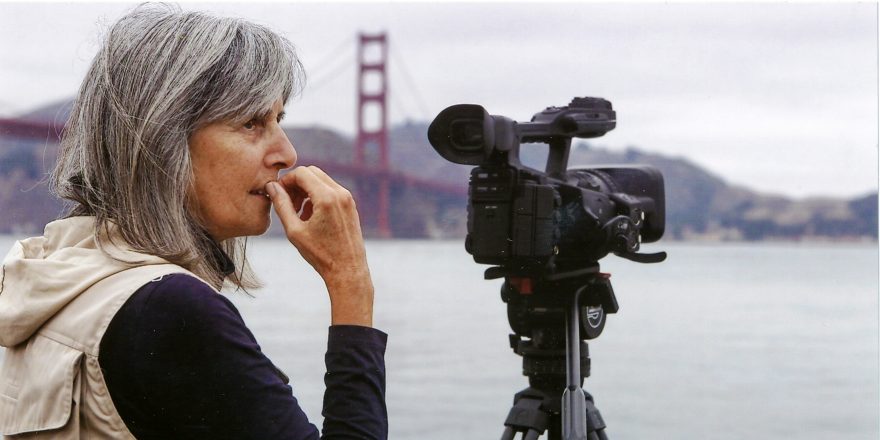



Beth Harrington’s latest documentary, Beyond the Duplex Planet, a portrait of artist David Greenberger, premieres at the 2026 SXSW Film Festival on March 12. Beth is an Emmy-winning, Grammy-nominated independent producer, director and writer, born in Boston and transplanted to the Pacific Northwest. Harrington’s documentary Welcome to the Club – The Women of Rockabilly, was honored with a 2003 Grammy nomination and her 2015 film The Winding Stream – The Carters, the Cashes and the Course of Country Music premiered at SXSW, later appearing in over 30 film festivals in the U.S. and abroad. As well as making music-centric films, Harrington has been a singer and sometimes guitarist, most noted for her years as a member of Jonathan Richman & The Modern Lovers on Sire Records. Her 2025 documentary Our Mr. Matsura, about a Japanese photographer’s unconventional work documenting the people of Washington State in the early 1900s, is currently playing festivals.
I wish I could remember the actual moment I learned about artist David Greenberger, but that’s lost to time. I assume it was through a mutual friend, a guy named Eddie, who was the undisputed guru of record- and comic book-collecting in our circle, someone who, even in his 20s, had expansive interests and tastes and an intellect to go with it. Eddie was always scanning for the new and the worthy. That which was cool not because it was trendy, but because it was resonant, unique, authentic.
I recall one of those revolving display racks in Eddie’s living room. There, among the Marvel and DC back issues, were copies of a homemade, photocopied publication, an early zine, before they were called that.
Or maybe that’s wrong. Maybe Eddie just handed me a stack of these folded booklets and said, “Check it out. My friend David publishes this.”

I do remember a day probably just a bit later when David and I took a long walk in my Boston neighborhood and discussed what he was doing – asking unconventional questions of the elderly men at the nursing home he worked at (“How close can you get to a penguin?” “Which do you prefer – coffee or meat?” “What is embarrassment?”) and forming the answers into a periodical called The Duplex Planet. I recall vividly that the instincts and curiosity that turned me into a documentarian were piqued by this conversation. This guy was actually doing things that spoke to him and others. I wanted that, too.
These were the days in our young lives – the late 1970s – when time seemed infinite and the idea of aging barely registered on our radar screens. It was also a time when hanging around someone’s apartment, listening to vinyl, reading liner notes aloud, trading cultural information, zany ideas, dreams and gossip became the building blocks of a ragtag creative community. Most of us had some sort of day job that effectively allowed us, usually in association with others, to pay rent on not-horrible living quarters in funky parts of the city. I was working as a scriptwriter at a slide-show company (yeah, that was a thing), yet to find my footing in filmmaking but creeping toward it. On the side, some of us were musicians with aspirations to greatness, or at least hopes of gigs and maybe record deals. Mostly we were trying to figure out how the art part of our lives could supersede the drudgery of the nine-to-five.

But here was David, an art school grad, a musician, who had turned his day job into an art project.
It impressed me.
Like a lot of our friends, I became a subscriber to The Duplex Planet and came to know the names and personalities of the men he interviewed. We all had our favorites. Mine was Ken Eglin, the ebullient record reviewer whose off-the cuff, freeform critiques seemed to mirror my own passion for music.
David was in a band called Men & Volts and not long after I joined a band called the Modern Lovers. Neither band quite fit into the punk/new wave sensibility of the day, but I don’t think either of us cared much. The “doing” was the thing.

Back then, the sustaining of friendships didn’t require a lot of consistency. There were fluid, intersecting networks of people who dovetailed into certain parts of our lives and then moved on. I don’t recall hanging around David a lot back then, but I felt his presence and followed his work, some of which wound up in my mailbox every month in zine form. I know I was away a lot touring with our band in those years (which sounds way more glamorous than the reality). At some point, David married and moved to central New York State. I understood he was still pursuing Duplex Planet-related work, but now he was a father and had a graphic design job. After I quit the Modern Lovers, I finally got around to trying to be a filmmaker full-time, making my first documentaries in my Italian-American neighborhood and freelancing with other film people for pay.
Here’s where I am compelled to make some stultifyingly obvious statement about time flying. But hackneyed as that is, I’m here to say: Kids, time flies. It does. You will be astonished.

Still, time’s vagaries are softened when friends somehow manage to stay connected. I like to think I’m pretty good at that, but no one I’ve ever known comes close to David Greenberger’s commitment to friendship and the small gestures that enhance it. David is the Connection G.O.A.T. He understands the ebb and flow of it and allows no room for guilt trips associated with lapsed contact. He also doesn’t spend a lot of time on nostalgia. The here and now is what he promotes, even as he explores memory. When you are his friend, it means there will be calls and texts and emails and mail art. Someday he might incorporate carrier pigeon into his repertoire. The act of reaching out is one of his most refined art forms.
To be his friend is to be remembered and seen.
I think he would say most of this comes to him naturally, but some of it might be the result of living in the world of memory shared by his elderly collaborators. David was not only the Connection G.O.A.T. but, after all, also the Old People Whisperer. Listening to stories. Presenting them to the non-elderly. Subtly imparting lessons – but not those didactic “moral of the story” sorts of lessons. Rather lessons on the fine points of being present and attentive and interactive. The odd tip. The oblique angle into a situation. The silly anecdote. The song you need to hear. The stuff we all crave as humans.

About 10 years ago, I realized my father was going to need a higher level of care than he’d been getting. His cognitive abilities were slipping and the place he’d been living was no longer a good fit. Our family decided the best option was to bring him out to live near my husband and me.
The changes to my dad were already sadly apparent. This was the guy who shared his love of art and music and conversation with me, instrumental in the way I learned to intersect with all that, now oddly withdrawn and struggling to recall the basics.
By coincidence, David had called me one afternoon I was struggling to sort out my dad’s circumstances. As soon as I heard David’s voice, I knew he was who I should be talking to. David isn’t one to give advice, but the conversation was rich and nuanced and informed a lot of what I did in the coming months as I tried to meet my father where he was in the alternate reality of dementia.

After that call, I sat with what David had said, and I realized what a unique perspective he held. At that point, he had spent close to 50 years engaged with seniors. But he was not a medical provider or a social worker or a geriatric case manager.
He was “just” an artist, doing a special level of work that went beyond the corporal or even temporal.
I called him back and asked him if I could make a film about him. And he agreed.
When David started this work, he was in his early 20s. He’s now 71. I’m 70. There are no degrees of separation between David, me and the seniors he works with. Working with David on Beyond the Duplex Planet, I came to the realization that David was not an Old People Whisperer anymore. Just a People Whisperer.