

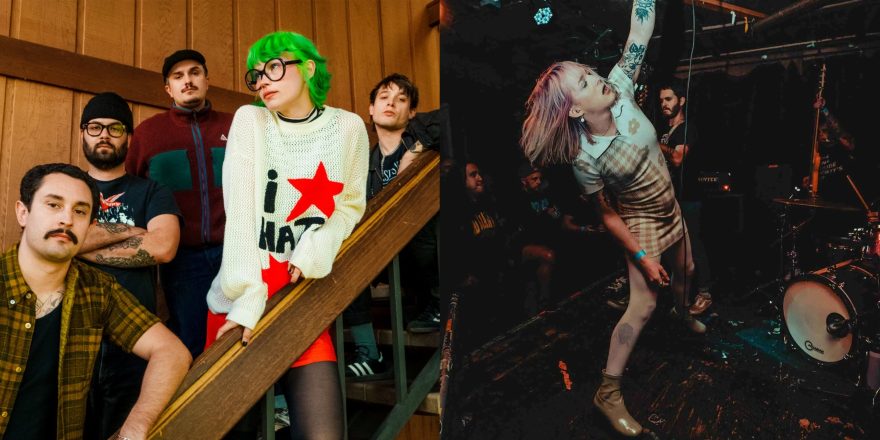

Destiny Bond is a hardcore band from Denver, Colorado. Their latest record, The Love, is out October 17 on Convulse.
(Photo Credit: Jacki Vitetta)
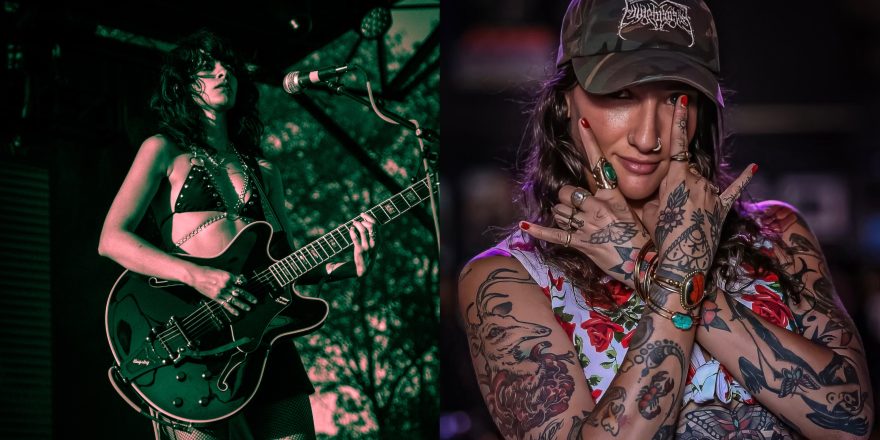
Kat Moss fronts the Santa Cruz hardcore band Scowl; Cloe Madonna fronts the Denver hardcore band Destiny Bond. The new Destiny Bond record, The Love, will be out October 17 on Convulse, so to celebrate, Kat and Cloe got together to chat about it, and much more.
— Annie Fell, Editor-in-chief, Talkhouse Music
Kat Moss: Yay! Look at us! How are you?
Cloe Madonna: Good! I’m pulling up my little notes.
Kat: I wrote some in my journal.
Cloe: Cute!
Kat: At first I was like, I don’t have any notes. I was just gonna raw dog this whole thing. But then I was like, I’ll write some notes. It’ll be helpful. Also because they don’t want us to talk for too long, which with me, that’s a little hard to do.
Cloe: Same. I have a stopwatch set for us. I was also like, I’ll just wing it, but then I was like, Oh, this is such a fun time… Because we obviously get to talk often, but not about the actual inner-workings of what we’re doing.
Kat: I am really happy that this is possible finally. Because genuinely, besides us being friends and having this really cool connection through scenes and hardcore, I genuinely am a fan of the band. And I personally feel like from my perspective — and of course it’s limited, because I’m not in the band and I’m not in the van — but I connect really hard with what Destiny Bond’s about. I feel like I sound so corny, but I just really respect and appreciate what you guys do.
Cloe: Ah, thank you! I’ve always felt the same way, even since picking y’all up from the airport in Denver in 2021.
Kat: [Laughs.] I remember when you picked us up from the airport for Convulse Fest. A lot of people in my touring group in Scowl were already pretty familiar with Denver and Colorado Springs, and I came in more like I had no idea, because that was the farthest east I had ever been with Scowl at that point. So it was such a cool introduction. And everyone was like, Oh, Cloe is really cool,” and I was like, “OK!” And then we met and I was like, “Wait, you’re very dope. The aura is emanating.” [Laughs.]
Cloe: Oh, my god.
Kat: OK, we will not put the word “aura” in this, maybe…
Cloe: No, it’s allowed! No rules.
Kat: But, yeah, I remember that weekend being such a catalyst moment — for Scowl specifically, and it just was a really cool moment for Convulse. Because I remember when Scowl put out Reality After Reality…, before we put out that EP, Convulse contacted us and was like, “Hey, we want to work together somehow.” And so all that time went by with COVID, and all of a sudden it was this really explosive thing with Convulse, which was incredible to see. And the one thing I remember also about you for the weekend was that you were just in the trenches working sound, trying to manage two bands back-to-back-to-back-to-back over and over, and that was quite incredible to watch.
Cloe: Oh, thank you. [Laughs.] I’m glad that I had an aura at that point, because I was also kind of baby trans figuring things out. And that was probably the first giant social gathering for most of us at that point, because it was October 2021. I just remember that weekend was absolutely crazy — I have some stories that do not need to make this interview. But that was my first operation as a part of Convulse. I came on with Adam [Croft] and I remember him being like, “Can you pick up Scowl from the airport?” After loading in, like, multiple PAs to this decrepit theater. So I was like, “Yeah.”
Kat: [Laughs.] “Sure?”
Cloe: And then we just clicked immediately. I think I still have pictures of you in your green jacket outside the Irish bar with the green lighting, because I was like, I hope they don’t think I’m weird but I just have to take a picture because it looks so cool…
Kat: That was such a good memory. It brings a lot up and makes my heart feel so tender thinking about that, because it was such a different time for all of us. And I don’t want to talk about Scowl too much, but it was such a different time for us where we did have time and energy to just show up and go to the bar and play games. Not that we can’t do that now, it’s just a lot different, and I’m constantly thinking about, How can I preserve my energy on tour? I’m a lot more reclusive these days, in that way. And to some degree, I think it’s really healthy for me. But at the same time, it definitely brings up some feelings.
Fast forward now: you guys just got back from Europe. You guys have definitely been hitting it hard, I would say. It’s really cool that there’s a group of people that are all invested enough to go, “OK, we’re going to cut out the time and we’re going to go to Europe, we’re going to rough it out.” Driving yourselves in Europe is actually insane.
Cloe: It’s all Adam. I never would have done that. [Laughs.]
Kat: Adam is insane for that. Do you feel like things have shifted in some way, whether it’s positive or negative, with the touring capacity for Destiny Bond? How does that feel for you?
Cloe: It’s been really interesting, because I had a whole life of touring before COVID — I could say band names that were near and dear to me, but nobody who would ever read this would know. We didn’t make a name, but we toured a lot. And then after COVID, Destiny Bond had played our first show the month before Convulse Weekend. We were on the Fest, and it was seeing y’all, Gel, SPY, Militarie Gun, everyone crisscrossing. And now, years later, Destiny Bond I think has played with every single one of them. We toured with SPY and Gel. So that has been cool because what started in this theater of 300 kids is now, we’re all international and national. And I feel like we were kind of playing catch up, but we did last year 130 travel days, 100 shows.
Kat: That’s so sick.
Cloe: Yeah, and it’s stuff I always wanted to do. But also, now I’m 31 and I would have had so much more energy, like, seven years ago. So it is way different because it’s adjusting, and getting everything I ever wanted, which is my best friends to be in a van with me for entire portions of the year and seeing the world and playing with bands I love. So it’s been really cool, but the tiring aspect… The Gel Fall tour last year was six weeks, and then two weeks with Punitive Damage right after, and by week seven, we were all just zombies. I used to not believe that I could get worn out on tour. I was like, “Yeah, just keep me on the road, I can do it forever.” And it’s been a blast from reality about that.
Kat: That’s probably the hardest part for me right now. I’m 27, I turn 28 in a month or so, and I’m kind of like, I was always the baby, what’s happening? I’m tired. I mean, I would say I’m more healthy now than I used to be when we first started touring really heavily. I used to be sick chronically on tour, and it was pretty depressing. Now I’m finding a lot of balance and middle ground, taking way better care of myself. But I remember that feeling when we did a handful of tours — just the West Coast, the Southwest — prior to COVID lockdown, and I was like, “I have all the energy in me possible,” and then there was that moment of just having to sit and wait for it, and the unknown was so heavy. And then shows kicked off and we were so hungry — I’m sure you relate to that, being at Convulse Weekend and seeing all these bands and feeling that spark of inspiration. I would argue that you guys have more than caught up with the other bands. You guys have been everywhere and it’s so cool to see that hunger exists not just within myself or my own scene.
Another thing that I wanted to get into: I really, really appreciate the musicality in the band, and how every single person is so talented in their own way and brings so much to the table. And that was so obvious listening to the new record especially. Some of the influences and some of the back story, I feel like I could predict to some degree, as someone who’s listened to hardcore music. But I was curious if there was any unexpected backstory with any of the members, and how you guys got to this point of, “We’re going to write this music for this band.”
Cloe: Destiny Bond was a band a decade in the making. The longest story as short as possible, four of us — me, Emily [Armitage], Adam, and Amos [Helvey] — are from Wyoming, and then Rio [Wolf] is from Boulder. We were just circling each other, either being in scenes or in bands or touring together for a full decade in Wyoming and northern Colorado. Then Amos, Adam, and Rio started a hardcore band for fun right before lockdown, and then when that happened, their vocalist moved. And at the end of lockdown, Amos was having a real big moment of falling in love with ‘80s hardcore for the first time in his life — which, I am so envious of someone getting to go through that again. The way that had a grip on my life when I was 15… And Adam loves punk and hardcore, that’s what we bonded on, so they were like, “Hey, do you want to be the vocalist?” I was like, “Yeah!”
I mentioned the past bands I was in — I was just like, OK, well, I gave it an honest try. I’m late 20s now, probably no one needs to hear a hardcore record from me, but I’m gonna have fun. So I just went in, no expectations. And that’s where it came from. And then Emily had been in the scene the whole time. She’s played guitar her whole life but never been in a band, and she essentially went to Adam and was like, “I just want to play in a band. Let me in Destiny Bond.” Amos was like, “Hmm” — he’s, like, a musical genius — and he was just like, “If she can play the songs, let’s do it.” So she cracked down and knocked it out and joined. And since then, it’s kind of been a snowball effect, because I think the secret the whole time was just having fun and being lighthearted. I don’t think we try anything special with the genre. We just try the things we love about the genre. I did a whole metalcore and goth phase, and I still have a dream pop band, but hardcore and punk is the first genre that hit me in the heart and got me going. And so a return to form is, I think, another beautiful part of it for us.
Kat: I think the return to form is the coolest part of Destiny Bond. And, I mean, ‘80s hardcore punk is my favorite. Hearing that from a modern hardcore band is really exciting. That’s what first caught my attention, specifically the DC influence. At least, I pick up on that. I don’t hear a lot of bands current day in hardcore doing that. I don’t want to sound like old-man-yells-at-cloud here, but it’s really cool to see you guys pushing that and doing it so well. It’s so obvious how talented every single one of you are.
I do feel like some of the magic of it all is not taking yourself too serious, and that’s the same thing that happened in the ‘80s. None of the hardcore bands that were doing it at that time were too serious. There was no press. There was no like, “We have to do this by this day,” there was no deadlines. It was just like, get out there and tour, get the emotions out, and connect. And that has been so clear from the jump with Destiny Bond, and it makes me really happy. It’s also very relatable personally. For Scowl, we never had that intention in the beginning to be doing certain things like big festivals. Touring international was a dream come true. So I feel like it’s really cool to discuss these growth moments for both bands and relate to that pure excitement of it all of, “Oh, my god, we went to Europe. That’s actually crazy.”
Cloe: I think that no expectations thing really hits hard for me, because we were hicks from the least populated state in the United States. All that I had that I cared about was getting, like, 20 kids into my dad’s church basement, or the basement I lived in in Laramie. That was the best thing for me. Because I got in through Christian pop punk, and then metalcore. Like, Baptist pastor dad, emo, Sunny Day Real Estate CDs in fourth grade, all that. But then I remember my cousin talked to me about hardcore and I was like, I gotta do research. I got American Hardcore, the DVD, and learned about the DC scene. I’ve realized a lot in my own stuff that there’s a spirit I always speak to — and I hope it’s not just the ex-Christian in me — but I feel like DC has a lot of that spirit. I love New York hardcore, but the DC stuff wasn’t always about being scary or hard or just antagonistic for no reason. It was a lot of really deep emotional processing and community talk. I think now it’s you and I’s turn as femme people in hardcore to be like, “They had their time and now we can rejuvenate this.” I feel like that’s a lot of the commonalities: We started from wanting to just bring about the spirit of hardcore punk in a new way. And I’m glad to hear you see those things in it.
Kat: Yeah. I mean, that’s the source of it all. It’s funny because Scowl — I’m very straight up with people these days when they talk to me about the new music. Sometimes people are like, “Oh, it’s really good, there’s still some hardcore…” And I’m like, “It’s pop music. You can say it.” It’s very poppy and there’s a lot of exterior influence that has nothing to do with hardcore. But at its core, it is still simple, fun, ‘80s, ‘90s hardcore punk. And that’s one thing that to me will never be lost. It doesn’t matter how something gets mixed, it doesn’t matter how many effects or harmonies or this or that.
And that’s really cool about Destiny Bond — one thing I wrote in my notes was, “There’s always the tambourine moment.” There’s always a moment in the music that really gets my attention when there’s a little melody happening, and I want to give you so much props on your vocals right now on this new record. Something I heard is, where there’s that ‘80s DC really hardcore punk thing going on, there’s also quite a bit of emo influence in my opinion. I think it’s really well blended and just really exciting to hear. I was also hearing early AFI. Amazing performance.
Cloe: Thank you. Vocally I do feel torn between, I want to do punk stuff, I want to do hardcore stuff, but then Jeremy Enigk, Sunny Day Real Estate — he’s screaming, but there’s emotion in it. And AFI — I mean, the fact that I was obsessed with Boy George and Davey Havok as a child is very telling about where I’m at now. [Laughs.]
Kat: [Laughs.] I love it.
Cloe: So, yeah, it means the world that you hear that. We texted a little bit before, and I had gone back through the Scowl stuff. I love the new album and your voice is incredible. The tone you hit is so great, and I think your screaming has really homed in too. But even the old stuff, I was just like, Oh, you’re always doing your own thing. I think that’s cool that you’re like, “It’s pop,” but it’s like, “Yeah, but it’s from people who live and breathe hardcore and punk.” Saves the Day used to tour with Bane, and how many fucking hardcore bands were just singing in the ‘80s? It’s like this weird double standard that I think capital-H and capital-P Hardcore Punk people get, which is like, “If you sing, it’s not hardcore anymore.” It’s like, “Well, how do you explain half of Dag Nasty?”
Kat: I feel the exact same. Like, I’m sorry, even the Dead Kennedys, there’s choruses. Can we be real? Melody has always existed in hardcore.
Cloe: Even Paul Bearer from Sheer Terror, he’s crooning. How come he gets to? I mean, I’m glad he does, but…
I feel like the people who have a lot to say about hardcore, the vulnerability that we bring just in the way we are scares them.
Kat: Yes, I think sincerity scares a lot of people. And the thing is, I think if you’re making art, there’s to some degree some sincerity — unless you’re using AI. There’s definitely stuff out there that we can agree is just slop. But at the end of the day, it’s subjective, it’s art, it’s going to be sincere. And I think coming from people like us who have had that experience of coming into this space that is supposed to be welcoming — we’re fed this idea of, “You belong here if you don’t feel like you belong anywhere else” — but then experiencing some of the darker sides of that, because it’s inevitably going to be clique-y… I do struggle with that a lot, the fact that, for people like you and I specifically, maybe we’re a little bit different than the status quo of capital-H Hardcore. It’s odd how that sincerity and that vulnerability does scare people. And at the same time, it also attracts some really, really passionate young people, which I’m very grateful for.
One thing I want to touch on is toiling with, “Why is this sincerity and this vulnerability and this rawness so upsetting? Why is it so offensive?” If you feel like there’s an overarching theme on The Love, am I correct in guessing that that’s part of it?
Cloe: Yeah, I’ve really struggled with that. Or not even struggled, but played with it a lot. It goes so deep because I know who I am, I know my experiences, I know that even before I was out as me, I was still kind of on the wall. I think that a lot of people come into hardcore and think aggression, anger, domination — they think that it all has to be tough and scary. And for me, the way that aggression has helped me in my life is whenever I’m like, OK, I’m going to use this to have direct conversations and directly address problems. I’m going to turn into a productive thing instead of a destructive aggression.
Kat: Yeah, it’s like conflict resolution. I feel like the cool thing about aggression in hardcore is it’s always been there. It’s definitely a bit of the core, obviously. But aggression and anger — that’s a secondary emotion. That’s something I like to talk about, like, “Well, what’s deeper than that?” And I think one thing about Destiny Bond that I can relate to with Scowl is trying to dig deeper. I think we both are attempting to approach it from a different place, and I think that that’s really relatable for people who aren’t just looking for that, like, ass beater hardcore. And there’s nothing wrong with that; I enjoy it. It’s just different. Do you feel like that is the common thread that connects Destiny Bond with the scene with fans? What connects you guys with the people around you, especially on tour?
Cloe: I think we are a vulnerable and approachable space, which I think is good… I feel like I’ve started to take on a maternal voice of, “No, baby, this is wrong. This is what’s messing you up, let’s fix it.” So the grand scheme about The Love is, we don’t have to worry about losing this thing because time and time again, it’s been shown that we survive no matter what is pushing us down. And then through that there’s personal, introspective moments, and also interpersonal — like with Adam and I, we’ve been best friends for a long time, and that friendship didn’t actually start in the most healthy place. We had some aggression issues we had to work out. And so there’s a song called “Lookin’ For a Fight” that’s a conversation between me and Adam, how I perceive our fights in my brain. “You gotta stop yourself before you react again this time/Your anger can serve a purpose, but it’s just a drain.” You can’t really exist in community, or in just a greater life, in a peaceful way if you’re not addressing your internal battles while you’re taking on these gigantic externals. So I guess the record has the internal and external, and I think that attracts people, because there’s battle cries and there’s personal moments. It feels corny to talk about sometimes, but it took so much work to get me to where I’m at and happy in my life, and I just want to give other people the words to get there faster.
Kat: I think a lot of people are going to appreciate The Love. I really think it’s going to speak to a lot of people. It spoke to me, and I’m so excited that I get to listen to it right now. Congrats. It’s an amazing record.
Cloe: Thank you, Kat. It makes me so hyped that you’re excited about it.