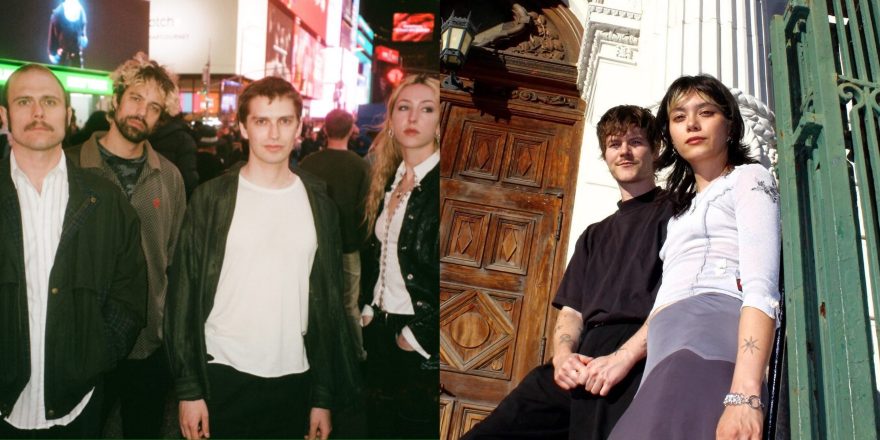


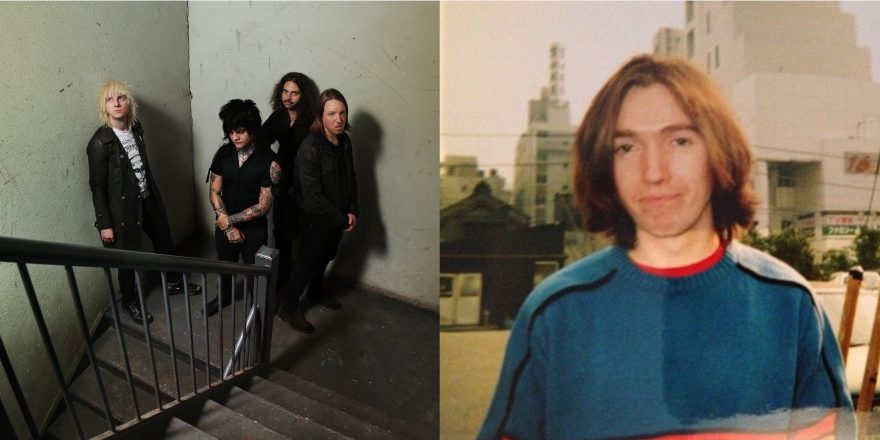
Lathe of Heaven is a post-punk/new wave band from Brooklyn. Their latest record, Aurora, is out now on Sacred Bones.
(Photo Credit: LJ Ripley)
Folks, they let the drummer write something.
Nobody ever wants to hear from the drummer. I’m not complaining. It’s part of the instrument’s appeal. I get to be at the back of the stage, obscured. The only organized sport I ever played was baseball, and wouldn’t you know it, I was a catcher. Let the pitcher have the mound. I’ll be their anonymous anchor, crucial and blank, squatting in my mask.
I stopped playing baseball around the time I started playing drums in bands. This would have been middle school, the bleeding edge of the 2000s. You can probably guess who had me in a headlock back then: Blink-182 and Travis Barker, a drummer who wound up being just as if not more recognizable than anyone else in the band, previous paragraph notwithstanding.
Of course, I wanted to play fast and rip off sick fills. We all do. It’s the most obvious thing to build your ego on — and I’m not talking any trash, that stuff is cool as hell. But then (and this is a “me” problem), it’s also fodder for comparison. When I would watch another band at the school talent show or whatever, I’d clock the drummer. Are they faster than me? Is that fill crazier than my fill?
It’s in this context that I heard My Bloody Valentine for the first time. I was a freshman in high school. I was starting to get a sense that there’s more out there than pop punk and nu metal. A friend made me a mix CD that had “Soft as Snow (But Warm Inside)” on it.
I was baffled by this song. I had no idea what genre to call it or what year it came from. The only instruments I could identify were drums and a bass guitar, but whether they were being played live or pre-programmed wasn’t clear. The beat recalled early hip-hop more than rock. It reminded me of “It’s Tricky” by Run-DMC. It even had a similar snare fill: evenly spaced, equally loud wallops, for what felt like a maddeningly long time. It’s the only fill in the “Soft as Snow.” It happens multiple times, over different durations, but it does not vary in tone or dynamic, nor do the hands hit any other drums
Whose hands are we talking about here? Colm Ó Cíosóig. Go to the “Sound” section of My Bloody Valentine’s Wikipedia page, and you won’t see any mention of Colm or the drums. But the band’s first two proper albums open with snare drum, and only snare drum. On “Only Shallow,” the glacial roll eventually does move to a rack tom later in the song, and he even takes a note off here and there, but functionally, it’s the same device as “Soft as Snow”: I’m going to pummel this poor snare, extremely loud and incredibly mid-tempo.
I would not say I liked “Soft as Snow” the first several times I heard it. But it was fascinating, and I kept listening to this song in spite of the fact that I don’t think I really enjoyed it, or at least not the way I had understood music to be enjoyed. I went out and bought Isn’t Anything, a CD that I didn’t understand as fitting in my collection, on a shelf with Enema of the State. I listened to it over and over again, still unsure of whether I liked it or why I was listening to it.
The faster songs on that album started to make me feel safer. It’s punk after all… kinda. “Feed Me With Your Kiss” was one of these. It has some skittery fills, and even does this sort of out-of-time, almost-buzz-roll thing leading into each chorus, but here too, I found that metronomic snare. The band counts up with each rep: first it’s four hits, then five, six, and finally an eight-beat phrase where Colm stretches out over the last four counts. That was a rewarding “aha” moment for me as a musician, sitting there and figuring out the internal logic of this bizarre song.
I realized that this band and drummer were holding my attention and getting a lot of mileage without playing at blistering tempos, or flexing chops. There was something almost anti-musical about the insistence on playing fills that didn’t vary in volume, or tone, or rhythm, and this was compelling. It made me think of obliteration, repetitive compulsion, and the tyranny of the clock. Had music ever made me think of what it was “about,” or what the sounds evoked, in such abstract terms?
That opening fill of “Soft as Snow” is pure grid. It includes every note at the smallest rhythmic subdivision of the song, no more and no less. Colm maintains that concept throughout the rest of the song across the snare, hi-hat, and kick drum. There are some full-band drop-outs and rests, but whenever the drums are playing, it’s only ever playing every 16th note in the measure. It’s a good impression of a drum machine; that a human might try to sound like automation hadn’t occurred to me before.
I have tried to use this idea. “Exodus,” the opening song on the new Lathe of Heaven record, is almost entirely an uninterrupted 16th-note lope, punctuated by big, flat snare rolls. “Oblivion” begins with another roll like that, a sped-up version of the introductory fill to “Who Sees You” from My Bloody Valentine’s 2013 album. “At Moment’s Edge” from our first album crests in the back half over yet another 16th-notes-on-the-hi-hat-all-day-every-day thing, with the kick playing every eighth note between two and four on the snare. Pure grid.
After the first album, Lathe started writing and playing to a metronome, in part so that we could perform to backing synth tracks at live shows. The first time we played live like that, I was astounded by how slow the tempos seemed, despite having practiced them with the band for months beforehand. The effects of adrenaline had been quantified in beats per minute. In our case, the music sounds better when we’re more regulated, and if we need to use automations in the form of backing tracks anyway, then I need to integrate automation into my playing. I’ve given myself over to the clock, but it’s for the best. I think of the tick-tick-ticking of Colm’s snare, and the human that sounds like a drum machine.
Look, there are a million ways to be good at your instrument and have an impact on your band’s sound. My personal experience, in my chosen genres and idioms: nobody I played with ever wanted a complicated fill, or wanted a song to be faster. Meanwhile, I kept coming back to these My Bloody Valentine records, and Colm’s steady but vibrant drumming, amazed that it always sounded so awesome and huge and disorienting, all the more so because it managed to be simple at the same time. How the hell does that work?
I still don’t know, but Colm has inspired me to think about it and apply it to my playing for almost 30 years now. So this is just to say, Colm, I see you: behind the drums, behind Kevin Shields and the deafening guitars that dominate the group’s lore, under whatever anonymity comes with being a drummer, you showed me a way to play the instrument and contribute to a band that rearranged my creative virtues. Thank you for that. And thank whoever’s reading this for hearing out the drummer.