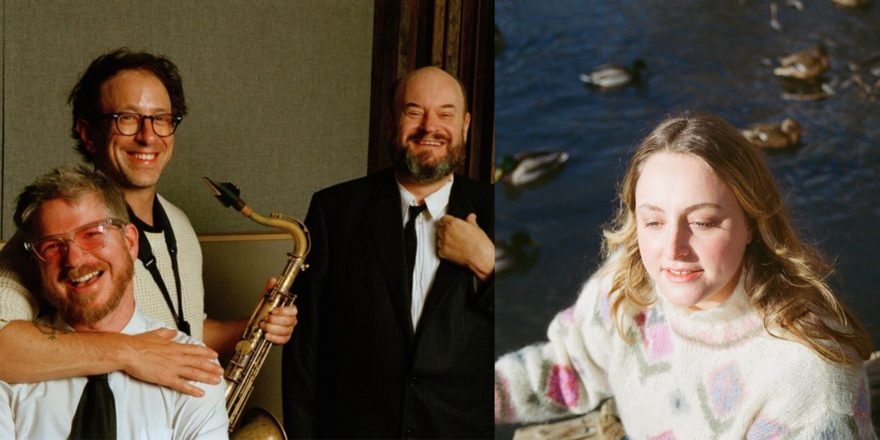


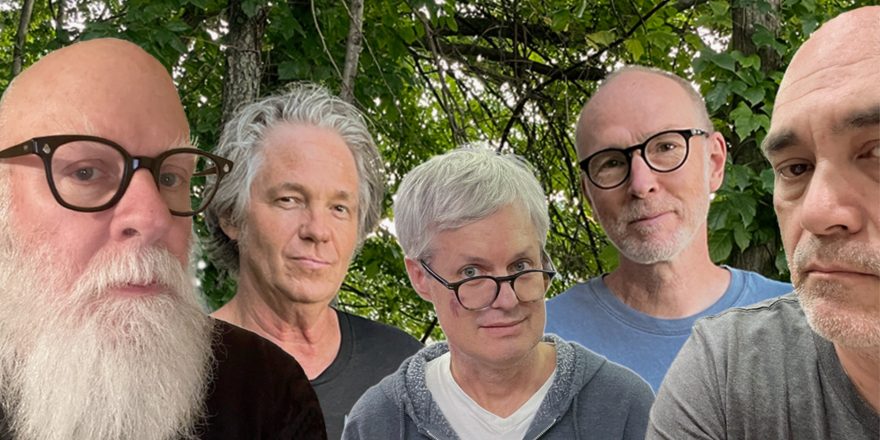

Pullman is an acoustic quintet featuring Doug McCombs (Tortoise, Eleventh Dream Day, Brokeback), Bundy K. Brown (Tortoise, Directions In Music), Chris Brokaw (Come, Codeine), Curtis Harvey (Rex), and Tim Barnes (The Tower Recordings). Their latest record, III, is out now on Western Vinyl.
Pullman is an acoustic supergroup featuring Ken “Bundy K.” Brown (of Tortoise and Directions in Music), Curtis Harvey (of Rex), Chris Brokaw (of Come and Codeine), and Doug McCombs (of Tortoise and Eleventh Dream Day), and drummer Tim Barnes. Last month, on January 9, their latest record, III, came out via Western Vinyl. To celebrate, Ken, Curtis, and Chris got on Zoom to catch up about the creation of it on the eve of the release.
— Annie Fell, Editor-in-chief, Talkhouse Music
Curtis Harvey: Good to see you guys.
Chris Brokaw: Nice to see you, too.
Curtis: No Doug McCombs, huh?
Ken Brown: I think Doug is either in Europe or on his way there. Tortoise has a bunch of shows very soon.
Chris: I see. So, I have a question. Does our album come out tomorrow?
Ken: Yes, tomorrow is the release day. I went on a walk with Kristen — for the readers, Kristen is my wife — the other night, and she was like, “What does a release day mean in 2026?” And I said, “Well, in this case it’s particularly meaningful because it is a physical release.” Not everything, as we know, gets a physical release. The record should have left distribution centers and be on the shelves in stores today.
Chris: I heard from a few people who had gotten copies a couple weeks ago.
Curtis: Very good. Well, congrats to everybody.
Chris: Yeah. I was just talking with John Engel, my sometimes still bandmate in Codeine, and I was telling him about our new Pullman record and how much I like it. I feel like I can be in some ways objective because what I like most about it is how it was crafted by you, Ken Brown. And I guess I should say: Pullman, which originally was me and Curtis and Ken and Doug, made the first Pullman record in Chicago around 1997 or ‘98, and then we made another one a couple of years later the same way, with Tim Barnes playing with us. Then we didn’t do anything for, like, 23 years. We made this record almost entirely remotely. So what I was telling John today was that, as a fan of Ken’s mixing skills, I feel like there was something of a golden era of his mixing hand around, as I recall it, the late ‘90s and maybe early aughts. Tortoise was super huge at the time, and I think part of something that was really influencing a greater music culture. And one tentacle of that was a big remix culture. I remember Bundy doing a lot of really cool remixes on stuff. I felt like you had your own style and your own sound, that I hadn’t heard you do in quite a long time, and I feel like you really brought that to bear on this record. I was psyched to hear that again.
Curtis: Yeah, man. Kudos to that. I think you’d agree that this record wouldn’t exist without Mr. Ken Brown at this point. Ken, you’ve been spearheading all the Tim projects, which I think is a really commendable thing. Your friendship with Tim, and then bringing Pullman back into the fold — I mean, even though we’ve probably talked about a new Pullman record every three years for 23 years, I don’t know if it would have happened now or not. And I agree with Chris, I love the way it unfolded and the way it ended up. Getting the mixes back was a pretty refreshing thing, because I was like, “Oh, this is not at all what it sounded like going into the blender.” [Laughs.] It came out an entirely different thing, which is great.
Ken: I did two other interviews this week, and everybody’s interested in the process of how this record unfolded. I talk of course about how it was remote. And the interesting thing about what you’re talking about, Chris — it’s very clear that in contrast to the other Pullman records, this is very technology-driven. It’s definitely made in the box. And I’ve talked a lot about the necessity of that, how I remember at one point we even talked about, “Maybe the way we work on this piece of this is, because Doug and I can get together pretty easily, and you guys are geographically proximate, each of us get together in these little pods and then that’s closer to all four of us getting together.” Because at that point, Tim for sure wasn’t traveling. Again, backgrounding for any readers that aren’t familiar: Chris lives in Cambridge, Curtis lives in Beacon, New York, Tim and I live in Louisville, Kentucky, and Doug lives in Chicago, Illinois. And Tim, our drummer, has been diagnosed and suffering from early onset dementia for quite a few years, so part of how this record had to be put together was making accommodations for his condition.
Anyways, dealing with this idea of making a record and doing it asynchronously — you know, none of us are doing things at the same time — is not to use that technology to make it sound like we’re all in the same room, but rather, to just lean into that fact.
My recollection is that the song that became “Weightless” was the very first thing that I shared with you guys. I shared one piece, and then I think Doug contributed to it first. And then, Curtis, I remember you specifically saying, “Can you send that to me and put Doug in just the left channel so I can separate it out and play off of Doug’s part?” But I think I just sent one piece out at a time to you guys over maybe a nine month, year long period. Weeks or months would pass because someone would send me something back and then I’d have to edit it in so that Chris was aware of what Curtis was doing, so I didn’t get two contributions that couldn’t mesh. I remember it was a similar thing with the piece that became “October,” because the basic composition was already super dense and you were like, “There’s not any room for me here.” And I was like, “OK, well, let me do an edit to make some room.”
As you guys remember, sometimes the things that I would send you guys were very sparse, like these loops or ideas. Or sometimes I would send them to you and they were very dense already, and you were just like, “What am I supposed to do with this?” And outside of the context of the way we’ve historically worked — which if you guys remember, Turnstyles [the first Pullman record] was a total of three or four days of actual work.
Chris: I think it was two days. It’s crazy how compressed that was.
Ken: Yeah. Curtis would say, “Here’s a riff I have,” and then we would play on it, and then we would arrive at a structure. Maybe two hours after we first heard the piece, we would record it. Done, move on to the next thing. That’s how that whole record came together, and thinking about that now with hindsight, it’s crazy that it sounds as unified as it does.
Anyways, let’s talk about “Weightless” again: We started with the loop, Tim’s cymbals and drums, and my bass, because those things were basically tracked semi-live. then I sent that out, then Doug did his thing, and then Curtis, you did your thing, and Chris, you did your thing. And at each point, there might be multiple things that I would get back, and so it was very much a reductive process where I had 18 to 24 things and it was like, “Well, how do I make something out of this and include all of the things that are cool about all five ideas that I got from Curtis, but I can’t have all of those things happening at once?”
Chris: And I trusted you enough to be like, “OK, I’m going to put a drum part all through this song and a bass part all through this song, but Bundy’s going to be smart enough to only use the bass part for the last 30 seconds of the song.” I also trusted that you wouldn’t be completely annoyed with having to sift through too much stuff or make so many executive artistic decisions. But, anyway, I appreciate the care with which you sifted through all that stuff.
Ken: Well, I think that’s an outgrowth of what you observed earlier, which is remix culture, which is somebody calls me and they’re like, “We’d like you to do a remix of this. What do you need?” And I’m like, “I just need all the multitrack parts as stems split out. I need to hear what the bones of this are.” I can listen to the final mix and have an idea of what the bones are, but there’s always some other thing happening, and I need to hear what your decision making process was. And I’ll say nine times out of 10, I try to take that little two second blip that never made it into the original song and then build something new out of that. And I think that’s cool. That’s the way most people approach remixes, even if they’re like, “I’m going to take the chorus that everybody knows and I’m going to edit it into this new version of this.” All the people I know that do remixes and lean into that, they try to find the thing that wasn’t emphasized in the original version and place an emphasis on it.
I’ll plant an Easter egg here for readers: for “Penumbra,” the Japanese bonus track, the original loop that I sent you guys, the source material for that particular song was — and you guys know about this, because we use another piece of it on the song “Valence” — Tim recorded almost every show that we did on the 2002 tour, and the piece for “Penumbra” was I think a 19 bar loop of the ending of “Sagamore Bridge” that we played live.
Chris: Oh, my god. That’s crazy.
Ken: And there is a song on III that is built off of a similar nugget of something from one of the previous albums.
Curtis: That’s actually an Easter egg to me and Chris too.
Chris: [Laughs.]
Ken: I dumped it in the computer and I messed with it, and then we did our thing on top of it. And I don’t think that the original loop that all of us played over exists in any explicit form in the final version. I built this thing out of the contributed parts and processed it in such a way that it’s just a ghost. So much of the stuff on III is like that. The short little track, “Valence,” is also from the 2002 live recordings that’s just a little blip.
Curtis: Is that from the Hideout?
Ken: I think so. I recall there was a lot of instrument switching on stage on that tour, so it was a moment where I think Doug was plugging his shit in, and I was just making some noise. And Tim started playing the brushes, because it was taking a little bit longer than we expected.
Curtis: I think the process of III for me was really freeing, because knowing that I wasn’t writing parts — I mean, I was writing parts, but that’s what they are in the literal term — and not have to worry about, OK, how does this piece segue into a bridge… That was a freeing thing for me as a songwriter. Because my own stuff, certainly what I’m working on now, is very composed. And to not have to worry about so much composition was really lovely for me. Knowing that I’m going to send these five tracks to Bundy and the end result, I may not hear any of them, or at least not in this fashion — they might be backwards — that’s a really freeing way to work. I can play this silly marimba thing down here and play on top of that, and then Chris is going to get it, and by the time Bundy gets it, it’s going to be something entirely different.
Ken: Well, you guys both carry that in other contexts, like Chris with Lupo Cittá, Come, and the Brokaw Rock Band, there’s a lyrical structure, there’s a verse and there’s a chorus and then there’s the things that happen to support those. And same thing, Curtis with your stuff.
Chris: One more thing I would mention: people have said, “Are you guys going to play live to support this record?” And we’ve said we have no idea. But I guess none of us have have ruled it out. And, as we’ve talked about it, we’ve said if we did play live, it would not be trying to replicate the new album. I guess if we did play live, we would just go out and do whatever the fuck we wanted. And that could theoretically draw from any of the three records.
Curtis: I would add to that, Chris: if we do play live, we’ll be playing Pullman four.
Ken: I played in not less than three different tunings — probably more like half a dozen tunings — and I don’t think any of them were standard tuning and I never wrote them down. I have no clue. I could try to replicate those parts, but it wouldn’t be the same.
Curtis: I don’t know who’s playing what on those records.
Ken: And I know for a fact, 2026, at least the first half of it, Doug is jammed. We all know this from being in bands with guys like Doug — I mean, there was a period of time, Chris, where you were that guy where your calendar, between Evan [Dando] and Clint [Conley] and Come reunions—
Chris: And Codeine.
Ken: Yeah. And I love that Doug is busy. I love that you all have these other things that are keeping you busy, because I love all those projects as a fan.