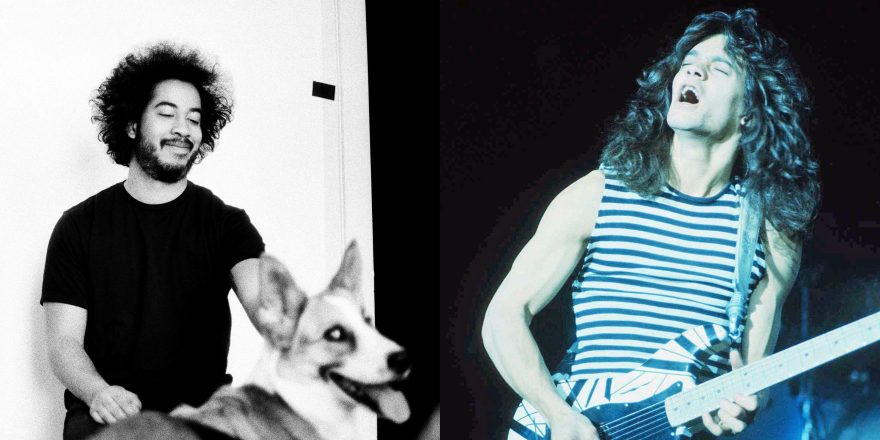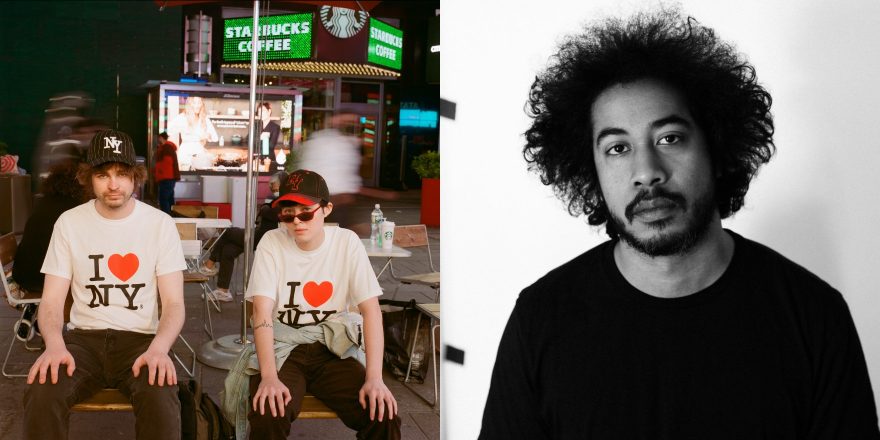


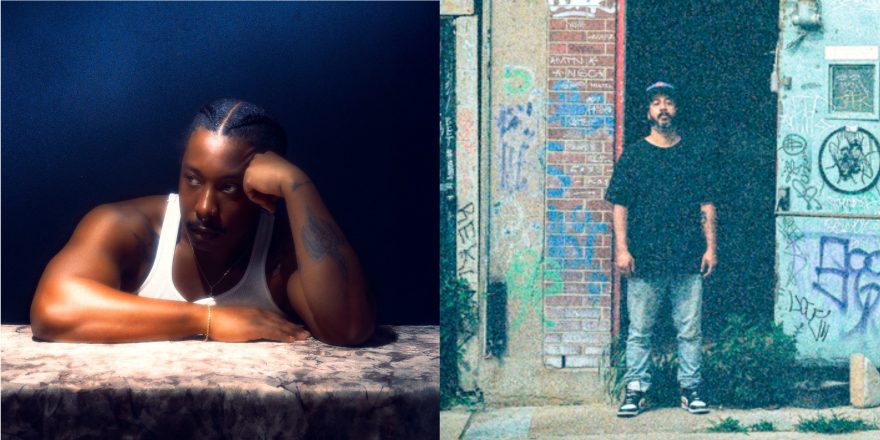

Devin McKnight is currently a working musician in Brooklyn, NY. You might have previously seen him playing guitar in such indie rock projects as Speedy Ortiz, Grass is Green, and Philadelphia Collins. At the moment, his main focus is the rock band he fronts, Maneka, which fuses elements of jazz, improvisation, math rock and shoegaze.
Devin McKnight is a singer-songwriter and guitarist who performs solo as Maneka, and has played in bands like Speedy Ortiz and Grass Is Green; McKinley Dixon is a rapper and singer-songwriter. The new Maneka record, bathes and listens, came out earlier this fall via Topshelf, and to celebrate, Devin and McKinley got on a Zoom call to chat about it, and much more.
— Annie Fell, Editor-in-chief, Talkhouse Music
Devin McKnight: Are you still in Chicago?
McKinley Dixon: Yeah, yeah. It’s cool. Nice day outside today. Nice and gray… Are you in BK right now? Or, no, you in Philly right now?
Devin: Yeah, I’m in Philly.
McKinley: Nice. Is you from BK though?
Devin: No, I just lived there. I’m from DC. You’re not from Richmond, are you?
McKinley: No, I’m from Annapolis. So, closer. Maryland — underrated.
Devin: Yeah. Annapolis I always found to be like a whole other world.
McKinley: Dude, Annapolis is literally like white people wanted to make a utopia. It’s beautiful, but it’s not real… I mean I fuck with Annapolis. We on record right now — I fuck with my city.
Devin: Would you tell people that you were from Annapolis, or would you tell people that you’re from Baltimore more often?
McKinley: I would tell people I’m from, honestly, in a musical set, Richmond, Virginia. Just because that’s where a lot of my formative years happened, especially when it came to music. And that’s the place I paid the most money to live in, so I could take whatever name I want from that place.
I fuck with the record heavy, bro. It’s really sick.
Devin: Oh, hell yeah.
McKinley: Yeah, dude. Some of my favorite joints off there: I love “dimelo,” it’s a cool one. “the cry that came” — also a cool name. “pony” is also really fucking sick. I mean, the whole record is really solid, but those ones really stuck out to me. You’ve played in a good amount of bands. You sort of are a staple within whatever the quote-unquote “DIY indie community” is. When I write my music, I sort of pick a time and age to write from. Would you say this record draws from certain communities, times, scenes that you’ve been a part of?
Devin: I mean, if we’re talking about time, it’s a little all over the place. Some of it is referencing the more immediate, around the time when I was leaving New York and moving here. Because it wasn’t under the best or the most positive seeming circumstances; nothing tragic happened, I just didn’t know what I was doing. Where’s my life going? kind of thing. Then two of the tracks you mentioned, actually, are referencing my adolescence, growing up in Montgomery County. I’m 39 now, so I don’t know why I decided to look back, but I kept feeling my brain go back to that part of my development. And I guess the cool thing about having a project like this, which I’m sure you can attest to, is that you can just write about whatever you want because it’s your thing.
McKinley: Exactly.
Devin: It’s just about you. I would say “pony,” “cry that came,” and “yung yeller” were all kind of about that period of time. I mean, I guess maybe it also harkens back to a time when I felt pretty lost. I guess there’s a connection I didn’t realize was there.
McKinley: And that’s real. I feel like when people talk about my music, they think it’s complicated, but in reality it’s not. I think the real thing is that I just know how to write about time differently. And I think that all comes with my thought that Black people sort of inherently are very aware of the past, present, and future. It just is in their body at once, because we have to make so many decisions in the present that rely on the past, to have a better future. You know what I mean? So I think that it definitely makes sense that a record that is sort of at this moment for you draws on a lot of moments from the past.
Devin: Yeah. I think also… you know the experience of — I mean, I’m asking this question, but I know the answer — when you know something’s going on when you’re growing up, but somebody — a lot of times, it’s the older white person — will be like, “No, that’s not actually happening to you.”
McKinley: Yeah.
Devin: That kind of thing really sticks with you. And if you never really talk that out or whatever you do to get past that experience, that feeling can drive you nuts.
McKinley: Oh, exactly. Especially because it’s such a formative age. It’s interesting that all the songs I really fuck with came from around that era…
This is your first Topshelf release, right?
Devin: First Topshelf.
McKinley: Topshelf is an iconic label, that sort of independent label that has been around for a long time, that has music from here to there and from now to then. They range with the demographic of music that they put out, which is really cool. How do you feel about joining that label?
Devin: It’s pretty cool. For a majority of my time, I was putting stuff out with Exploding in Sound, whether in this band or other bands. That was a community that I was always pretty reliant on, almost to the point where I didn’t even really think about shopping my stuff around. I would just text my friend, you know? So also, I didn’t have a lot of experience venturing out on my own and getting to know how other people did things. Luckily for me, Topshelf is not a very complex experience in that it’s not too dissimilar from what was going on at EIS. It made it a lot more comfortable. Kevin [Duquette] is a very forthcoming and honest person, and he’s honestly kind of crushing it right now. I will say that something that struck me when I was looking around and seeing who’s out there was, in the past four or five years, when everything was just all over the place, they were cutting through with some pretty cool releases, like the Ekko Astral stuff. And Ratboys—
McKinley: Also dope.
Devin: I was like, Damn, they’ve been on Topshelf for a long time. They were reissuing all the Blue Smiley stuff, and that’s a band that I hold dear. It was just like, Seems like we’re maybe on the same page right now, so let me see what they’re doing. And they have a few people, so there’s more people that have worked on my release than I’ve ever had.
McKinley: That’s awesome.
Devin: It’s not just two people in a basement somewhere, just scraping stuff together — which, shout out to anyone who is doing that, because that’s what you gotta do.
McKinley: Exactly. But it’s nice to have a smooth transition into something else, especially as it mirrors the transitional period of your life.
Devin: Yeah. And there’s not a lot of pressure. There’s not a lot baked into the contract — which is probably all of a page-and-a-half. They weren’t like, “You have to tour forever and you have to recoup this, that, and blah, blah, blah.” It was pretty chill. So there’s not a lot for me to really freak out about. There’s not a whole lot to worry about here. They seem reasonable.
McKinley: What was the timeline for making the record?
Devin: I hadn’t touched music for a minute. If we flash back to 2023, I was not in a great place. I just didn’t feel compelled to play, to write. Because usually when you’re writing, there’s no question in your mind: You wake up, you have some coffee, you eat, and then you just get into it, because that’s where you want to be. That wasn’t happening. From previous periods of time, I had stuff on my computer that I didn’t really know what to do with. And I think at that point, I did this feature for the Spirit of the Beehive guy’s other project, and that had been the last thing that I had done. And I was just kind of like, OK, well, it’s back to video games and cartoons for me. And then something about also just being in New York, the pressure of not being able to afford anything, and the jobs being kind of iffy, I just felt everything was bearing down on me. And it was loud. I mean, it’s always loud, but I couldn’t think. So I just wasn’t really doing anything. And then the guy I recorded with [Alex Farrar] emailed me or DMed me — and, you know, you get DMs all the time from people being like, “I want to record you!” Or, “I want to do PR for you, even though it’s not an album cycle!”
McKinley: [Laughs.] Exactly.
Devin: So I looked him up, and I was like, Oh, you have done a lot of cool shit. That’s kind of crazy. And he was trying to coax me into going down to Asheville, and I just sort of lied and said I had some stuff. “I can get something together, I guess.” That was right around the time when I moved, and within the first month, I got a bunch of stuff done demo-wise. And I started to stick my big toe into sending demos to friends to see what they thought. Because for me, that’s a big step, because I don’t necessarily have writing partner sort of situations in this project. You don’t always have the sounding board to show people things like, “Does that sound dumb?” So I started doing that, and I started getting a little more confidence in it.
I’d only been in Philly maybe four months, and on that Thanksgiving 2023, I went down to Asheville. I was only there for three days, but we got four songs done or something like that. It was really comfortable and they were just so giving. The cynic in me was waiting for, you know, Where’s the catch here? But he’s just genuinely a cool guy. And then at the end of the trip, he was like, “So do you want to come back and finish the record?” And I was like, “What record?” [Laughs.] So I was like, I guess I gotta figure out some songs. I went back that April. I’m lucky that my job—
McKinley: Your job is dope, bro. “Let that boy roam.”
Devin: Yeah, they’re cool. It’s a weird experience, to just go to a studio by yourself and stay in the studio by yourself. I don’t really know anybody in Asheville, so I didn’t have anywhere to go.
McKinley: Nice. Real small town experience. I bet that shit felt crazy, coming from Philly and Brooklyn.
Devin: It was weird. But not bad. We got in a good flow for that four days, and we got a lot done. We got one or two songs done every day, and he actually ended up playing drums on all those. And then it was done.
McKinley: Fuckin’ right.
Devin: He pretty much had everything mixed on the spot, which was crazy. And, yeah, that was it. It was the beginning of 2024 when that happened, so I’ve been ready for this to come out for a long time.
McKinley: So he sort of pulled you back into it. That’s dope. It’s crazy how that can happen, especially from the place you don’t expect.
Devin: Yeah, did not expect that. I guess the lesson is to not always have my guard up.
McKinley: Understandably so.
Devin: Sometimes people hit me up and I’m just like, “Who are you?”
McKinley: And that’s real, because people are fucking weird. They be like, “Yo, let me send you beats.” And I’m like, “No.” [Laughs.] I don’t want to hear none of that.
What are you thinkin’ is next for you?
Devin: Good question. We gotta get on the road and we gotta start slinging these records. And, I mean, for me the joy is playing live. When I feel like I’m doing that and it’s not a wasteful experience, it’s sustainable, I feel like my life is working. And you only ever really get a little taste at a time of that, because this is a weird thing that we do. But that’s usually where I get a lot of my energy from in life. So now that I feel like it’s possible again, I gotta get on that, get on the emails.
McKinley: Send ‘em out! Let the people know! That’s actually awesome. It sounds like this has revitalized a part of you that was not really feeling it in the music scene, and that’s honestly so beautiful to hear. The record is dope. I had a great time listening to it again, and this was really cool to do.
Devin: Yeah, for sure. Thanks for taking the time.