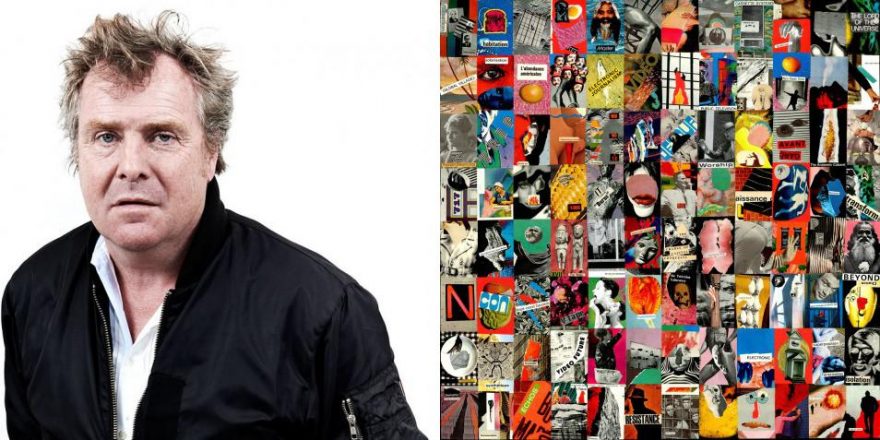




Will Brooks, aka MC dälek, is a rapper and producer, and one-third of the Newark-based experimental hip-hop group dälek. His latest record, made in collaboration with This Heat’s Charles Hayward, HAYWARDxDÄLEK, is out now.
Will Brooks, aka MC dälek, is a rapper and producer, and one-half of the Newark-based experimental hip-hop group dälek; Charles Hayward is a drummer and a founding member of the band This Heat. Together, Will and Charles are HAYWARDxDÄLEK, and they just put out a self-titled record at the end of last year. To celebrate the release, the two got on a Zoom call to catch up about the creation of it, the nature of collaboration, and more.
— Annie Fell, Editor-in-chief, Talkhouse Music
Will Brooks: I was thinking about it, and aside from if you’re creating solo work, isn’t anything that you do in a band collaboration? When you play with other musicians, even if it’s a band putting a record out, that’s absolutely a collaboration.
Charles Hayward: I totally agree with you. I’ve been thinking about it too, and I’ve been thinking, Where in life is this model? And ideally it’s in every model of every exchange.
Will: It’s the basis of society. Without it, this all crumbles. You know what I mean?
Charles: Absolutely. And that in itself involves listening.
Will: Yeah. We’ve been getting some of those questions where people ask whether or not either one of us held back, and I thought that was an odd question, because when you’re working together half of the game is listening. Otherwise, how would you know what to do next?
Charles: Exactly. And also, it’s not a territorial war. People are trying to go, “Is this 50/50?” And it’s not about that. It’s about 100% from both of us and from everybody else in the room to make the sound.
Will: Right. Because it’s not even just us — it was the engineers, it was the people that put the project together. All those working parts in the end create what this thing is.
Charles: Yeah, and in my experience, that’s been what I’ve encountered all the way through. And the only time that things don’t work is when people aren’t tuned into that or they’ve got an agenda about not what’s actually happening in the room. They want this thing that’s not actually there. So you get down to something sort of obsessive, like a snare drum sound — this idealized drum sound you’ve got in your head, this isn’t the same room so it’s not going to sound like that no matter what you do. Anyway, that’s a side issue. But this idea of people coming in with things that aren’t open to change and aren’t open to adaptation, when that’s happening, they’re not really collaborating.
Will: Right. I feel like we each came in with ideas of where to start, but the ideas were just the starting point. I don’t think any of those ideas ended up being what we thought they would be in the beginning. They just kind of evolved into what they should be.
Charles: For me, it’s always about taking on board the actual sound. So it becomes basically, we’re all agreeing on how we’re obeying the sound. We’re just following what the sound is telling us to do. You came in with some samples, right? And they had a certain sort of sculptural quality because they were like these edifices that already existed. And that’s as good a starting point as any other. I sent you those tapes with the low drones in them. I knew we were going to be investigating the low end.
Will: That’s what I mean: You kind of have these parameters that you both either agree on or know that they’re going to be there from the beginning, but I don’t think either one of us walked in with a preconceived notion of what the end product was going to be. Because how could we?
Charles: Exactly. And then people start also focusing on the length of time we spent on it. It’s like, “Well, actually, the decision making could either be that quick or it would have to be very much slower.” It’s one of the two; you’re either going to go in there with your initial response to the sound — and, I mean, I’m constantly playing with the clock of the sound. The sounds come with their own internal world, and I’m sort of pulling ahead, I’m pulling behind, Everybody’s got this orthodox clock thing going at the moment, and I’m trying to break that down a little bit.
Will: The anti-grid.
Charles: Well, it’s a sort of grid, but the grid we’ve got is very simple geometry where everything’s on a flat plane. And, in fact, time doesn’t work like that. Or at least it doesn’t for us as human beings; it’s got more of a glandular sort of breathing thing going on. So I’m just interested in trying to bring us back to our heartbeat.
Will: I 1,000% agree with you, because I keep forgetting when we recorded the record. It feels like yesterday and it also feels like 10 years ago.
Charles: [Laughs.] Yeah.
Will: Everything sounds so familiar to me now. Like, I know this record and I remember recording it, but I can never place what year it was. Also because I brought it back to mix it, I feel like part of that made it brand new to me again. So it’s like the songs exist in two different timelines to me in a weird way. But like you said, that really is how time works for us. It’s like these ebbs and flows, and you could transpose that to music and your rhythmic clock falling ahead and behind of certain beats or certain instances in the sounds, that’s what creates the groove and that’s what creates the beauty in the music. And the funny thing is, because I was manipulating the samples live as well in that granular thing, I’m reacting to your shifting and you’re reacting to mine.
Charles: That’s where the beauty is. And it involves actually quite deep listening.
Will: Yeah. And listening to the point of almost trance.
Charles: The record, when it’s working on me, is trancing me out.
Will: I was mentioning that to someone — they were asking me about the length of one of the songs, how it ended up being on the longer side. It’s the one with the melodica—
Charles: “Sojourn.”
Will: I was telling him, “It ended up being that length because it had to be that length. Quite honestly, it should be longer.” If it isn’t that length, it doesn’t work. You know what I mean? The beginning sounds cheap if it’s not long enough.
Charles: Absolutely.
Will: You need the song to evolve the way it evolves, because then all the parts and all the micro changes make sense, and the hypnosis starts to happen and you fall into that trance. Otherwise, if it’s too short, then it’s kind of like, What was the point of that?
Charles: What’s there that’s interesting only unveils itself if you let it happen over a long time. If you only do one little bit of that, you can’t hear how the thing changes. It’s how the thing sort of modulates on itself, really.
Will: And I think, bringing it back to the idea of collaboration, that’s the key. If you have two people that aren’t listening to each other — the key to the collaboration is to open yourself to those micro changes, to be able to change yourself and follow where the sound is going and create this moment. And that can be music or that could be about interpersonal relationships or politics or whatever.
Charles: Absolutely. I mean, politics — it’s almost like, let’s not even think, Left, right. Let’s think, Collaborate or not collaborate. Let’s cooperate, or are you being selfish?
Will: Back to the musical side of it: You were saying when it doesn’t work is if someone comes in with a set agenda, and what that is at the end of the day is selfishness. If you’re walking in thinking that, Oh, I’m this, I’m that, this is the way I’m going to do this, this is the only thing I’m going to do, then you’re setting it up to fail right there.
Charles: Absolutely. I mean, you get people who are only good in one setting, and then they go and find themselves in a different scenario and they bring what they are in that one setting and everybody else is expected to come back around this one thing.
Will: What I loved about our project was the fact that, in its initial construction, I was completely outside of my comfort zone. When we performed it, there was barely any vocals, which already is like a strike against us. [Laughs.] The crowd is kind of like, Why is this rapper not rapping? But I love that we went into it thinking, “Yo, let’s just create something new and see what we do with it.” I knew the songs were right. I knew that the live show was going to be ill because it felt right. But it was me understanding that what this needed was not me on the mic all the time, but rather me performing with you and creating this music with you. And I think that was the right move.
Charles: It was the only move that was going to get me interested. We had to build a new way of thinking between us, and the thinking wasn’t necessarily all the time about talking. It was about doing and listening.
Will: Well, like I said, I thought the most important work we did was when we had conversations over lunch.
Charles: [Laughs.] Yeah.
Will: I feel like that’s when the record was written. It wasn’t written in the rehearsal room.
Charles: No, no.
Will: It was written having tea and coffee together.
Charles: Absolutely. I think we got to the point where by the end of the first day, we were comfortable with our tools, as it were, in that setting. I was hearing the drums right in the cans, and I was hearing you right in the headphones as well. It was all making sense so that when we actually went and just did the thing, we’d be able to capture it. So then it was all about us being cool with each other and building up a picture of where we were going. After a while, you get, “OK, we’ve got four things that are doing this. Let’s do a couple of things that do the opposite.” And you don’t even really talk about that, you just do it.
Will: Yeah. Because at the end of the day, I think as musicians, we want to not be bored. We want to be excited about what we’re doing. So that’s what I love about working with different people and trying new things, that I get to do something outside of what I normally do. And I feel like in doing that — meeting other musicians, seeing how they work, learning from what they do — it all feeds back into yourself as a musician. You grow and you incorporate that in your own stuff moving forward. I feel like every time I’ve worked with anyone, it’s always influenced me in some way for the next thing that I do, and kind of just keep moving that way.
Charles: Yeah. Sometimes you steer that — you go, “Oh, I really want to work with so and so” — and sometimes you just let it happen. And sometimes you don’t even do that, it just happens.
Will: I feel like for me, I’d say that at least 90% of the people that I’ve gotten to work with, it’s just happened. It’s never really been one person seeking out the other or anything.
This project —we didn’t go into it thinking we were going to have an album. We thought we were going to record and perform it and see what it was. But all the pieces fell the way they did and we liked what we had and we were like, “Alright, this is more than just something that we play at a festival once.” I feel like some things are just live performances, a one-off kind of thing. And if it’s an album, it’s something that I want to be there for the length of time. You know what I mean? For however long the planet’s going to be here. And I just feel like those are two different things. I don’t feel that everything that I write necessarily needs to be an album.
Charles: Yeah. I mean, I’m working all the time, and yet the actual output that I share with the world is like 7% of that.
Will: Right. I have hard drives on hard drives of ideas and little recordings and full songs. But just because you recorded doesn’t mean that it’s something that needs to be out there.
Charles: No. I find, writing songs, that sometimes the song actually isn’t finished, and you sort of know it even though you told yourself it’s finished. And then because of that, you don’t actually share it because deep down inside, you know it’s not finished.
Will: I mean, I’m of the belief that no song is ever finished.
Charles: [Laughs.] Well, there’s that truth as well.
Will: You get to the point where you resign yourself to the idea that it’s going to exist in the world. [Laughs.]
Charles: That’s definitely true. There’s this French guy called Antonin Artaud, who hardly left any traces of his work behind, but he claimed that no text was finished, and I have taken that on board. But there’s this really weird moment when you record things and then they appear to be finished. So I’m, in fact, in the process now of re-recording an album with a couple of songs off it and a couple of new songs on it from 24 years ago.
Will: I’m definitely like a digital packrat. I can’t throw things away, so I have hard drive upon hard drive of all these ideas as if I’m going to revisit them one day, but I know myself. I also just keep working on new stuff, so I end up never going back. But at the same time, every once in a while I’ll play some of the stuff from 10, 15 years ago, and I’m like, Oh man, I forgot that that’s there. And then I’m like, Oh, shit, maybe I should work on that. But I never go through with it. But I have it there to listen to, also for inspiration. Sometimes, even if I don’t use it, I’m still listening to some of this unreleased stuff just as starting points for the next stuff.
When we re-released our first album, I did actually go back to tracks that me and Oktopus had had made in that era, in ‘97, and I found a couple that I thought were great that we just never finished vocals on. So I recorded vocals for a track from back then and I put that on the re-release of the first album. Which was interesting because it was like, Man, I made these tracks when I was a kid. You could hear it in my voice on all the other songs, and then the song that I recorded vocals on now, it’s my 50-year-old voice. It was an interesting juxtaposition. I thought was really cool.
Charles: Yeah, that sounds beautiful. I’m 74 and there was an energy that was very present when I was 16, and it’s not an immediate energy for me now. But it’s a musical flavor, it’s got this sort of puppy thing going on — it’s like this great big young dog. I want some of that. So I try and keep my body at the same level every day. I do the same stretches, the same exercise every day. I’m trying to keep myself at a place where I can access what it was like, and it’s more a question of spirit and memory. So I end up, in a weird way, collaborating with a younger version of myself.
Will: I guess that is what that was: a collaboration between me now and me from when I started this.