

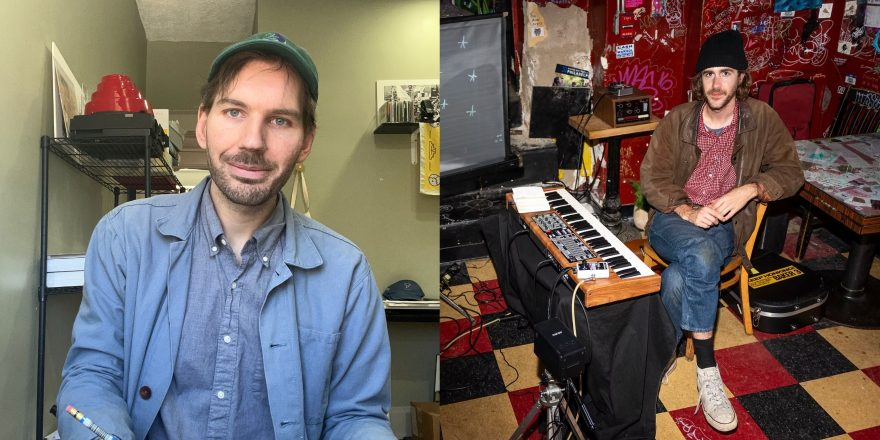
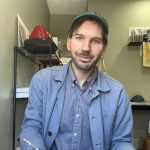
Mark Neeley is an animator, illustrator, and writer based in Cincinnati. Working at the juxtaposition of sound and vision, he makes analogue short films, music videos, and more. He is also a regular contributing writer for long-running music journal Aquarium Drunkard.
Mark Neeley is an animator, illustrator, and writer; John Andrews is a Brooklyn-based animator and multi-instrumentalist who fronts John Andrews & The Yawns. The new John Andrews & The Yawns record STREETSWEEPER will be out April 3 on Earth Libraries, and ahead of the release, the two artists got on a call to catch up about music videos, early animation influences, and much more.
— Annie Fell, Editor-in-chief, Talkhouse Music
Mark Neeley: John, I’m going to start with something that might embarrass you. When I was younger, if I was to tell myself what I wanted to be when I grew up, it would definitely be an animator and a cool indie musician. So what you do is what I wanted to be when I grew up.
John Andrews: [Laughs.] That’s cool. I wanted to be a magician or something. Maybe magician is somewhere between those two things, I don’t know.
Mark: There’s perhaps a magicianship — is that a word? — to creating some of this stuff.
John: Definitely.
Mark: Do you ever get overwhelmed balancing those two mediums, you know, in addition to personal life? I also ask because on your new record STREETSWEEPER, there’s a couple lines maybe about the latter. Like, “Keep on renting this house I’ll never own.” What’s the day-to-day like?
John: I probably started doing film first, so I think that’s what I usually return to the most. At this point, I probably work on animations more than I work on music. It’s not only balancing art and personal life that gets stressful; it’s also balancing commission work and your own personal projects. You have to pay the bills yet find ways to make meaningful art you feel connected to. Those two things aren’t always parallel. It’s always just a day by day attempt at juggling all of these things. Dipping your toes into all sorts of projects, it can be tough but you just have to take a step back and try your best.
But, yeah, music and film have always been intertwined. I love thinking about, before recorded sound for film, when an organist performed a live score in a theater. It’s always been connected.
Mark: It reminds me of this quote when I got to speak with Mark Mothersbaugh — which ultimately led to him providing the soundtrack for my film — lot of people don’t realize that early in his career before he became a major composer, a lot of the scoring was for animation before the Wes Anderson and bigger Hollywood soundtracks.
John: Yeah, I remember Rugrats. He scored that.
Mark: That was probably my first memory as well. With that last name and having my first name, it always stuck out on the credits. But he had this line that he actually animated for music before he made music for animation. It was a reference to this really primitive animation he did of a potato for one of the Devo music videos.
John: That’s so cool.
Mark: When it comes to that juxtaposition of music and animation, were there any early reference points that had a big impact? In our niche orbit, with getting commissioned to do stuff, I get a lot of references to The Point from others and, maybe less so, Yellow Submarine, which was a huge influence for me.
John: I think you kind of hit the nail on the head with Yellow Submarine. I was a huge Beatles fan as a kid. When I first saw Yellow Submarine, it felt similar to me as when I watched Disney cartoons and then later got to visit Disney World. You get to live in this other reality. That was similar to how it felt with Yellow Submarine because you loved these songs and then while watching the film you could travel through it and get lost in a completely different way with the art. I think that was 100% my earliest memory of music and animation living symbiotically. I probably didn’t get into Harry Nilsson until my early 20s and discovered The Point. Obviously I love that too.
Mark: In the ‘90s during the big Disney renaissance, my sister and I would go and see those movies multiple times in the theater. But I never felt inspired by it as an artist because it felt like something I could never replicate. I would go to the library and there would only be a handful of animation books, and one was called The Illusion of Life by a couple of Disney veterans. You would open it up, and you had to be like a master draftsman of anatomy to try to replicate those tutorials. [Laughs.] But this one called The Animation Book was hugely influential.
John: I have that one. It’s a great one.
Mark: Did you have any early materials or resources like that?
John: Not really. I loved early Disney short cartoons when I was a kid. That was basically my introduction to what a cartoon and animation was. My grandparents had a bunch of old VHS’s in the basement I watched over and over again. I was just inspired to make comic books and to be creative in any capacity. I also had this Fisher Price movie viewer toy that had these cartridges that you cranked and looked through a view finder and it would play, like, 30 seconds of cartoon frame by frame. I don’t think I ever even thought about making my own animations until I saw this interview with Sally Cruikshank on YouTube that was from another documentary. I’m blanking on the name of it.
Mark: Is it the documentary with all of the animators in San Francisco?
John: Yes, that’s it. I discovered that on a whim when I was searching for early Sesame Street stop motion or something like that. I just thought she was so cool, and I learned she was from New Jersey, I’m from New Jersey too. I was inspired to try animation basically from that interview.
Mark: What age was that?
John: Either 18 or 19. Prior to that, I had made stop motion animation with a camcorder and action figures when I was very young. And had also done some animation in Microsoft Paint when I was 15 or 16 and making skate videos with my friends. But it wasn’t until I saw that that I attempted drawing something over and over and putting it together.
John: What is your earliest memory of a cartoon?
Mark: I don’t remember the very earliest, but the ones that really made me cognitive was like the first wave of Cartoon Network shows. Dexter’s Lab. For whatever reason that imagery, I would just draw those characters constantly.
John: Those were so good.
Mark: And then when you get older, you realize that style and the backgrounds are referencing studios like UPA, all this nerdy animation stuff you can compartmentalize when you get older.
John: In my opinion, that’s the best kind of art. Something that kids can enjoy along with adults for different reasons. You have the golden ticket if you’ve created something like that.
Mark: And then a little later, there was this short-lived program called O Canada that came on late at night. It would show short films made by stuff like the National Film of Canada, and that was probably my first exposure to independent animation. There were no film festivals or anything like that around where I grew up.
John: Do you remember the show called Sheep in the Big City?
Mark: Oh yeah. That one kind of took that UPA style to the extreme. Super flat characters.
John: That’s what I’m talking about, where this weird and freaky animation was on these major networks and was embraced by pop culture. I feel like we can get back there.
Mark: Maybe me and you can do it, if no one else will.
I saw that recently you did some touring by playing solo shows while having the screen set up while projecting your animation. What was the impetus for that? How is it different from a normal gig?
John: I’ve been doing it for a couple of years now. I think the first time was in 2021 or 2022, so it’s relatively new. It just made sense. I book these tours in small coffee shops, book stores, people’s backyards and really whatever DIY space that will have me. I even played in a grocery store this past year in Cookeville, Tennessee. I set up a projector screen that my mom trash-picked for me, I have a battery powered projector and play keyboard along with the animations. When I’m performing, I’m not necessarily a big presence on stage so having something else for people to look at has helped me and lucky for me, I have almost an hour’s worth of animation. It creates a nice environment and I’m happy the animations can exist in the real world for a little. Somewhere other than on my computer or a phone. I don’t know, people just respond to it so I want to continue touring in that capacity.
I also sell the paintings from the animations at the merch table and I think it’s fun for people to flip through them and recognize them from what they saw on the screen. It creates a tactile element that I think people enjoy. Someday the dream is to animate a short film and score it live. That’s my long term goal or five year plan. Hopefully it gets done some day.
Mark: Some day I have this dream fantasy project in my head of doing some sort of traveling music and animation symposium, inspired by these specific reference points like early Roxy Music playing in art museums or Harmonia playing by this river in Germany. Kind of these makeshift venues and spaces. Anyway, I’ve also sold frames before. I think you inspired me to do it again once more, I had kind of stopped because you know… shipping. [Laughs.]
John: I like shipping and packing things up. I like repetitive tasks, it suits a lot of my hobbies. I didn’t sell my frames for years, I just threw them out. It just made sense.
Mark: It’s such a unique thing. I think for a lot of people it’s a foreign experience to think of owning a piece of analog animation, especially in the digital era we live in.
John: Well, people love buying albums at a show, because it’s owning a physical piece of what you saw. It’s not often you go to a movie and then have a chance to own a piece of it like that.
Something I’ve been thinking about lately is within the current animation community, there are so many talented individuals who are making amazing stuff, but I’m waiting for the mainstream and pop culture to fully embrace them all again. We grew up in this amazing time in the ‘90s when this freaky animation was so ingrained in pop culture. Call me crazy but I feel like characters Beavis and Butt-Head and The Simpsons were just as famous as like, Britney Spears and Justin Timberlake. It feels like we haven’t had those kinds of legacy characters and series, definitely not in the 2020s. Maybe some of that existed in the 2010s, but it’s not as romantic as it once was. I think of seeing someone wearing a Beavis and Butt-Head shirt in the ‘90s and thinking that person is really cool. But if I see someone wearing a Rick and Morty t-shirt now, I’m just like, I don’t know if this represents a “counterculture.” It was such an amazing balance. Mike Judge was really good at that. Beavis and Butt-Head was this countercultural representation that existed comfortably in the mainstream. That is hard to pull off.
Mark: That’s a good point. I feel like The Simpsons phenomenon led to that next wave of “adult” animation in terms of the episodic, 30-minute series which led to stuff like Family Guy and all of those iterations.
John: Right. The Simpsons was still thoughtful and warm and endearing as much as it was very funny and witty. Those elements are not really in these other contemporary cartoons. I know culture and the way we consume media is different. Even things that are hugely popular still feel like they’re niche, because when something is really big today, it’s more of a buzz than a long lasting legacy.
Mark: Or it’s on some streaming service that not everyone has access to.
John: Totally. It’s so fragmented. There could be something in the animation world I’m not aware of, but I feel like I would have seen it or heard about it. It just seems like the studios aren’t working with these artists as much as they had in the past. That’s something I’d love to see in the future. We are in this amazing renaissance of independent animators. There’s so many people doing incredible work, but it’s all kind of on an underground scale, generally speaking. The ‘90s were this beautiful era where a lot of these underground artists had the opportunity to work on projects with these major networks. Who knows, everything is cyclical. Maybe in the next 10-15 years, animation will blow up on that mainstream level again.
Mark: It would be cool to see that on a feature level. That’s really never happened, it has kind of always been the same handful of studios. I remember it was exciting when LAIKA, that smaller studio based in Portland, produced some pretty big stop motion films.
John: I remember being so excited when Fantastic Mr. Fox came out. All it takes is one film like that to be incredibly popular, and then other studios will want to make more.
Mark: Yeah. Wes Anderson was perfect for it, but I’m surprised we haven’t seen more directors try their hand at it. It almost reminds me of the music industry in the ‘60s. Like, The Fugs were on Warner Brother Records. Big labels would attempt to appeal to the counterculture and take these risks before everything seemed to just get shoved into niche underground circles.
John: Music will always be accessible and easy to consume anywhere at any given time. Film is not. With film and animation, you need to sit down and take the time to enjoy it.
Mark: No doubt.
John: What would you like to see more of in the animation world?
Mark: I think a better distribution method for independent films. I’ve made two personal shorts that I’m really proud of and now I’m currently making a third. Film festivals are great and I’m happy that my films have had some success on the festival circuit. But I also have kind of a love/hate relationship with them. Sometimes you don’t feel like you get much back from that. A lot of times they want to charge exuberant fees just to submit your films, and it’s nonrefundable. With the more prestigious ones, you don’t even know if they’re giving the film a proper look yet you’re paying for it.
So much goes into them, they’re so labor-intensive and such passion projects. And I wish it felt more fulfilling when they actually come out. I’ve drawn parallels to an album release, though obviously it’s not a physical entity. I don’t personally use things like Letterboxd, but it seems like there’s a vibrant film-centric community and I wish there was something like that specific to independent animation.
John: I can imagine a format similar to Criterion streaming platform, but also one that allows animators to upload their own work and have it organized in that way. Obviously as I’m saying this, it sounds like I’m just describing YouTube or Vimeo but those have been around for so long and have become so vast. I’d love to see something with more of a mission statement.
Mark: We both make music videos as well as short promotional stuff. I have to tell you, sometimes when I make something like a 30-second clip for social media, I realize how much more people will see that than the full, four-minute music video.
John: Definitely. It’s kinda sad but at the same time I’m OK with it. If there’s not a huge budget I can’t spend a whole month or more making a four-minute long music video. I’ll often suggest a 15-20 second promo animation for their album. At this point in my life, I’m very selective about what I have time for.
Mark: I could have said every word of that verbatim. And it’s sad, I mean, I’ll always love the music video format.
John: Same.
Mark: And it’s good that a platform like YouTube has given those a permanent home and archive. What’s your favorite music video that you’ve made for another artist?
John: I’m proud of this music video I made for the Drag City band Kamikaze Palm Tree. They actually sent over Sally Cruikshank as an inspiration reference so it immediately felt like we were speaking the same language. It was fun getting weird with that one. I also love the Homeshake video for “Sesame.” That was probably one of the first bigger music videos that I had been asked to make. Oh, I’m also proud of the video I made for this band Loving. They supplied me with Super 8 footage to splice in so it was less work for me. [Laughs.] That’s always nice. Those are probably my favorites.
Mark: That’s a great album.
John: What about yourself?
Mark: I think actually two of the most recent ones. I did one for Allah-Las a couple of years ago that I’m really proud of. I love those guys, and I think they were really pioneering in a way that they curated their artwork and aesthetic and the way it all intertwines with the music so seamlessly. And I thought it was so cool that they asked me to do a video, because I feel my own style is a bit different than that aesthetic.
And then I did one for Beachwood Sparks. That was a band that was super influential to me since I was a teenager. To have this band who was on Sub Pop but totally doing this Byrds/Burritos kind of thing which I was obsessed with, that was a huge revelation for me. It wasn’t really en vogue in that era, so it got accused of being retrofetishism. Though that kind of influence is everywhere now. So it felt like almost a full circle moment to do a video for them, and I really like how the imagery came out. They had thrown around some references to Neil Young’s Zuma, which is where all the bird imagery came from.
John: That’s awesome. They were pretty unique. It felt like Beachwood Sparks and Belle & Sebastian were the only ones making that kind of music in the early 2000s. Not too many others.
Mark: I wanted to ask about hockey and that imagery on the new album. The first video is out, and the album cover features two hockey players. It was also the first sport I loved. I grew up going to minor league games here in a league called the IHL that no longer exists. What’s your history with the sport?
John: I grew up loving hockey, my dad was on an adult league so I would see his gear and he just looked really cool to me, like a superhero or something and I loved superheroes. Got into it at a pretty early age.
Mark: Goalies especially were so cool looking. The custom masks.
John: I know, I know. [Laughs.] I used to wear my hockey gear out. When I was five or six, I would wear my hockey mask out to the grocery store and my mom would be kind of embarrassed. I played on some roller hockey teams as a kid. When I lived in New Hampshire, we played ice and pond hockey as often as we could, most weekends. It’s something I kind of miss right now. I don’t have the opportunity to do it while living in New York City.
I had Streetsweeper written for a while in a list of possible album titles, and it was around the time I worked this job for New York City Parks that it just made sense. I was literally walking around with a broom in hand sweeping leaves and trash up in Carroll Gardens park while people played roller hockey around me. It felt like I was playing hockey with the city. Around that time I also saw this photograph by a photographer named Arthur Tress of this kid playing roller hockey in what looked like the Lower East Side or something. I considered contacting the estate and seeing if I could use that photograph, but I decided to come up with something else inspired by it. So I asked Kyle Field from Little Wings if he would be interested in doing the artwork. He was down and I was surprised that he did it so quickly. I’m really happy with it.
Mark: It’s great. I’m glad it came out the way it did.