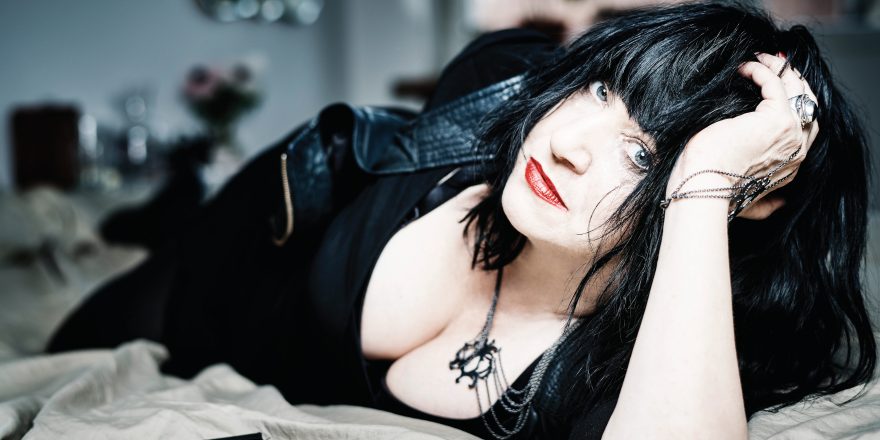



Hailed a “major vocal talent… with a trickster’s dark humor” by the New York Times, Joseph Keckler is a singer, songwriter, and author. His concerts have taken place at Lincoln Center, Centre Pompidou, Adult Swim Fest, and he has toured as the national support act for Sleater-Kinney in the US. He is currently working on a new EP, a TV special and new videos.
Joseph Keckler is a singer-songwriter and author based in New York, who last year premiered the performance piece A Good Night in the Trauma Garden, commissioned and presented by The Metropolitan Museum of Art; Lydia Lunch is a legendary musician, poet, actor, and so much more. Earlier this year, Joseph released his latest single “Believer,” and to celebrate it, he and his frequent collaborator sat down to catch up.
— Annie Fell, Editor-in-chief, Talkhouse Music
Joseph Keckler: Well, Lydia.
Lydia Lunch: Yes, Joseph.
Joseph: Here we are at our respective computers, but in the seats that we often inhabit in your salon.
Lydia: We’re often in my salon, yes, it’s true. There’s many performances that go on here that no one but we see. That’s for the better of the general public, I do believe.
Joseph: [Laughs.] That is very true. And you have just returned from Europe.
Lydia: I have returned from France, Germany, Czech, Sweden, Switzerland, the UK. One day home, and then to Canada with both my tribute to Suicide, some solo spoken word in libraries and bookstores, and the revival of Big Sexy Noise. Quite exciting.
Joseph: It has been a few years since you did Big Sexy Noise.
Lydia: Quite a few years. And In The Red has put out the Big Sexy Noise live [record] out. Also, the Suicide tribute has a live record out at the same time. So it’s been a whirlwind of grand fun.
Joseph: And you’re going to go out again with Big Sexy Noise.
Lydia: I’ll be going out with the Suicide tribute, Big Sexy Noise, Murderous Again. With possibly you and others, of course. The beat goes on.
Joseph: The beat goes on.
Lydia: Or Frank Zappa once said, “The torture never stops.”
Joseph: War is never over, the torture never stops, and the beat goes on.
Lydia: But you, Joseph, have also been busy in the studio recording and configurating from that fantastic performance you did with Grace Bergere, Kevin Shea, and various others at the museum, highlighting some of your new songs which you’re slapping beautifully into shape.
Joseph: That is true. Last year I did a piece called A Good Night in the Trauma Garden, which was commissioned by the Metropolitan Museum of Art.
Lydia: Congratulations on that.
Joseph: We are going to do that again, and I’m taking some of the songs that were in that piece but have their own identities and putting them into an album. I’m working on one of them with my friend Paul Wallfisch, and Nick Zinner played guitar on that one. I also released my song “Believer.”
Lydia: I love the new direction. It’s more mysterious — dare I say my favorite word? — creepy. Sexy, dark. Less opera. I mean, you — as I — there is no genre to define us. But it’s definitely a new direction for you, which I’m very, very impressed with, and find it not only mysterious and sexy, but again, a little bit creepy. Just like me. [Laughs.] I hope our salons have inspired that in you. I can’t take any credit other than inspiration on the fly.
Joseph: I believe that they have.
Lydia: Well, you’re a believer. [Laughs.]
Joseph: I’m a believer, yes. I think you put it well. There’s a vocal diversification in the sound, what I’m doing now. That song has a lot of vocal percussion.
Lydia: A little spoken word. You’ve often done spoken word singing in various languages, various styles. But I really like the input of these little snippets of spoken word, which I think adds another level of intrigue.
Joseph: Yeah, I hope so. I think I wrote part of it when I was either on the way to or from your house one day. It was hot, and I was near Grand Army Plaza and just sort of muttering to myself.
Lydia: As we often do. When we’re together, we’re often muttering to each other. An endless glossolalia that can go on for eight hours at a time, in our own IMAX…
Joseph: The theater of utterances…
Lydia: The theater of mutter, revelry, and revelatory concepts…
Joseph: The Mutter Museum.
Lydia: Not to be confused with the Mütter Museum, which is physical oddities. Here, it’s psychological oddities. When we engage in our salons, we sometimes might occasionally watch a movie, but more often than not, we become a movie. [Laughs.] As if many TV channels just continued to rotate, your remote got stuck on rotation. I find that one of the most engaging aspects of our relationship. With you more so than anybody, I feel I can be completely myself — which is basically a high-functioning, schizophrenic, multitasking, weirdo, and creep of the highest and lowest order. For some reason, I don’t know why, you — who I find a little bit shy — don’t fear me as The Creeper. Why is that, Joseph?
Joseph: Why is that?
Lydia: I mean, I feel I’m the cuddliest person on the planet… Maybe to Ted Bundy.
Joseph: I accept you in your multiplicities. In your…
Lydia: One-on-one performances.
Joseph: [Laughs.] I embrace you.
Lydia: Well, I embrace you, too. And I think that my being allowed to be as I am — because, let’s face it, I do have to reel it back in to be around most people — I’ve spent a lot of time just reeling down. But I think that way that you accept the multiplicity of my mania is reflected in the multiplicity of your musical mania. I mean, as a human one-on-one, I think you’re very steady. Now, you have reported — especially in Artists — Depression, Anxiety, & Rage, my documentary with Jasmine Hirst — that sometimes you are a triple threat of depression, anxiety, and rage. But to me, you seem one of the most steady people I know. I don’t know if that’s because my mania calms you down, or you’re comfortable with me, or just you’re very good at hiding your true hectic emotions, which may be bubbling at any time under the surface as you mumble down the street.
Joseph: I think I do find your mania not only normal, but soothing. Turbulence is often invisible.
Lydia: Exactly. And that’s a great talent. Your mania might be an introverted mania.
Joseph: As a teenager, I started out making portraits of where I would cast myself in different multiples—
Lydia: By the way, you’re an excellent draftsman. You made me a fantastic birthday card once. So, you would create these dualities?
Joseph: Dualities, yeah. Sometimes multiplicities.
Lydia: Saying that you you’re “bipolar” does not sum up any of our personalities. Just too redundant. That’s for amateurs.
Joseph: Yes. And then somebody said to me, “This is your systemic psychology where the self is split,” or something, so that’s always the way I’ve sort of experienced my existence.
Lydia: We defy categorization. Whether it’s genre, whether it’s gender, we just defy it. And we continue to expand and expound in whatever those dark crevices in the brain pan of our existence decide they need to come out at whatever time they need to come out at. And again, you with video, spoken word, written word, this is also where we share a lot of the same need to express in various formats. One is not enough, and sometimes even three at a time is not enough. I mean, I do find spoken word the most, for me, necessary form. Although I do love to have various: I love to do the Suicide tribute, I love to do whatever salons we do. But it all boils down to what the words are. And I think for you, part of it might be the same because the words are very important.
Joseph: Yes. And I like using my voice in different ways, where you know I might sound like a different singer in different songs even, and might even shift within that.
Lydia: How many octaves you have, I have no idea. I like to think of myself as a monotone. Of course, I’m not monotone, but I have resisted singing in the traditional way for many years because I just found it just…
Joseph: Vulgar. [Laughs.]
Lydia: Well, yeah. But then again, I love rock singing, and I can carry a note or a pitch. I can sing. Of course, not to your level. I always love to tease you by saying, “Well, Joseph, I know I can never sing like you, but you can never sing like me either. Why would you want to?” And then, of course, on stage I love telling women, “If you can’t sing like this, don’t start a fucking band.” If you know what I mean.
Joseph: Yes. You sometimes refer to the “kitty litter voice.”
Lydia: The kitty litter voice, baby, is in the house. I mean, we are very different in what we present to the public, but I think philosophically, we are very, very similar. What we’re expressing and what our ideals are, I think that we’re very similar, even though what comes out is very, very different. And I felt that from the first minute we met on Zoom. Thank you, Bibbe Hansen, for introducing us. You’re one of the early guests of my podcast, The Lydian Spin. That was when COVID was happening. I called you “the boy in the bubble” because we could not meet, but we had many conversations on the phone. That’s how our relationship began.
Joseph: It’s true. And I think we share certain taste in what we like as well, musically and in terms of literature.
Lydia: Clothing, movies, literature, music. I’m not going to go any deeper than that, because then we’d be revealing too much of ourselves. Use your imaginations.
Joseph: [Laughs.] And now we’re even singing a song together called “Backwater.”
Lydia: Which was the first song that the Anubian Lights ever presented to me, which did not make it onto my album Smoke in the Shadows. I loved it so much, but I just couldn’t crack it. And then 30 years later, we’re sitting in my salon and I’m like, “I have to record this verse right now!” And then a few weeks or months later, I’m like, “Joseph, we have to record this.” Then we worked on it and performed it live a few times. But it was like I was waiting — because usually, somebody sends me a song and I’m done in five minutes. I record straight into GarageBand, no mic, lyrics in five minutes. One take, that’s it. But this song, I guess I was waiting for you with this.
Alright. With that, I would say that this is Lydia Lunch in my salon with Mr. Joseph Keckler, where we often are doing what we often do: Stirring up the atmosphere, hands out, waiting to the heavens for a bucket of gold to fall in. And if not — well, we just carry on and carry on.
You can catch Joseph at TV Eye in Queens on March 30, opening for David J of Bauhaus.