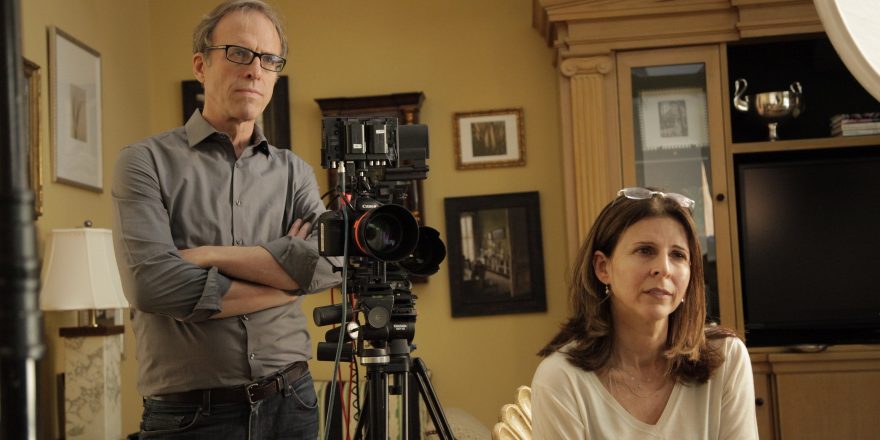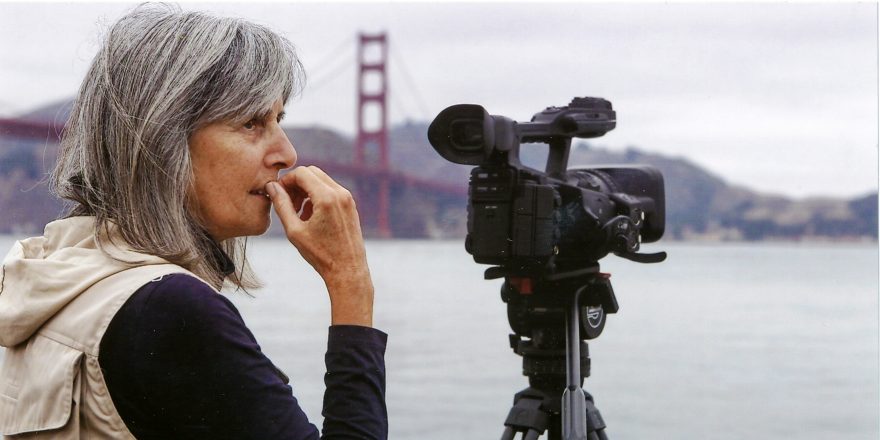



Amy Herdy’s new documentary, Parrot Kindergarten, about an attorney and cult survivor who heals by teaching her parrot to read, is in theaters from November 3. She is president and co-founder of Covetower, an investigative production company dedicated to high-impact storytelling across film and television, and has helped create some of the most impactful documentaries of the past decade. She first entered the film world as an expert researcher for the Oscar-nominated, Peabody-winning documentary The Invisible War (2012), her first, which exposed the epidemic of sexual assault in the U.S. military. With Dick and Ziering, she then produced The Hunting Ground (2015), that ignited the national conversation about campus sexual assault and reshaped school policies nationwide; The Bleeding Edge (2018), which investigated corruption in the medical device industry, catalyzing removals of dangerous devices from the market; On the Record (2020), a searing exposé at the intersection of Black Lives Matter and #MeToo; and the four-part HBO series Allen v. Farrow, which was nominated for seven Emmys. Before entering film, Ms. Herdy built her investigative skills in television news and newspapers, reporting in Florida and Kentucky before joining The Denver Post.
I went to film a bird and met a teacher.
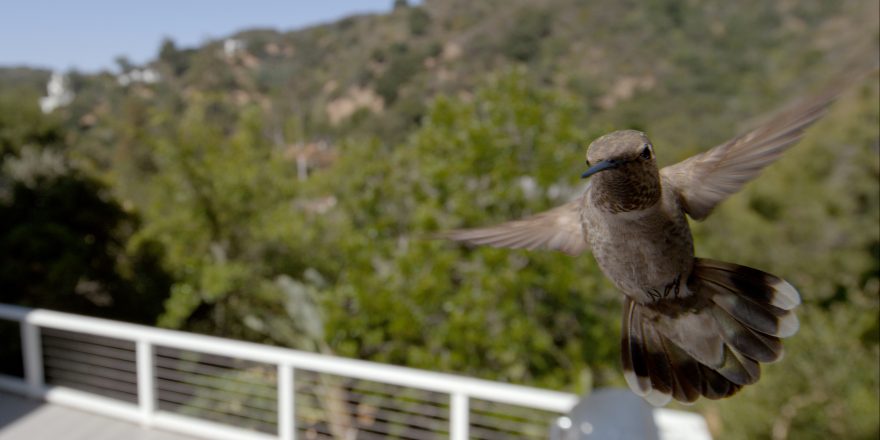
Ellie – the apple-white star of my new documentary, Parrot Kindergarten – is a Goffin’s cockatoo, solid white with a soft blush on her face and eyes bright as black buttons. Her person, Jen, is unhurried and observant, the kind of subject who calms a room just by standing in it. I arrived with a shot list the size of a novel and confidence in my ability to soothe anxious subjects, born of years of practice from producing projects like The Bleeding Edge and Allen v Farrow.
I had weighty experience and I was ready to direct.
But it wasn’t my set. And the director who took over weighs just nine ounces.
People ask what the film is “about.” Short version: a woman, a parrot, and the radical idea that cross-species relationships can be deliberate, mutual and joyful. Oh, and that a parrot can read.
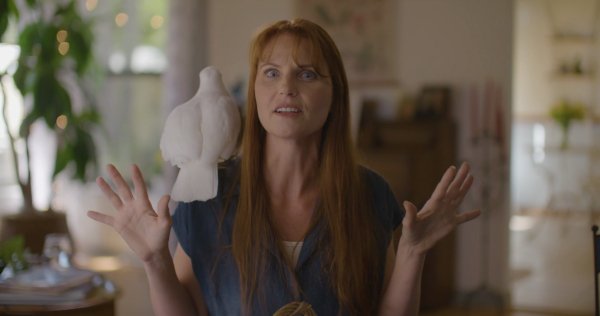
Longer version: That if we noticed the unrealized sentience all around us – parrots, yes, but also dogs, cats, squirrels, bears, elephants … and, if we’re honest, humans – we could trade control for connection.
Or, as Ellie soon schooled me: Shut up and listen.
1) Let Them Opt In
Day one, we arrived with cameras and lights and then … waited. We hung out. Time is money in the film world, but we had bird subjects who needed to be wooed. Our crew slowly set up while Ellie watched, head tilted back like a tiny suspicious foreman, body in nervous motion. So we waited some more, until she settled. Then we started.
Later, I was fussing with flashcards on a table for a shot – measuring, nudging, lost in my task. Ellie launched, came to see what I was doing, and I didn’t move out of her path fast enough. She gave me one sharp rap on my arm – precise, not panicked. I stepped aside; she marched forward and inspected the table with great professional interest. Message received: attention isn’t just looking; it’s yielding when someone says, “I’m coming through.”
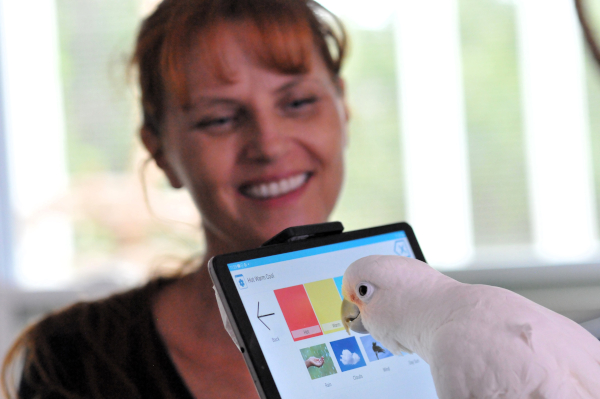
When I started yielding – changing my plan to fit hers – I could feel her quiet in a way the microphone couldn’t measure but my body noted. That quiet? Trust.
2) Bodies Have Grammar
Parrots speak in mixed media: sound, feather, gaze, tiny steps or an explosion of flight. Ellie’s signals became punctuation I could read. A relaxed foot felt like a comma; slicked feathers, a question mark; head low, feathers fluffed, soft eye – an exclamation point of “yes.”
When we moved too fast with the camera, she froze. Or fled. Once you see this, you can’t unsee it – dogs, cats, squirrels, horses, people.
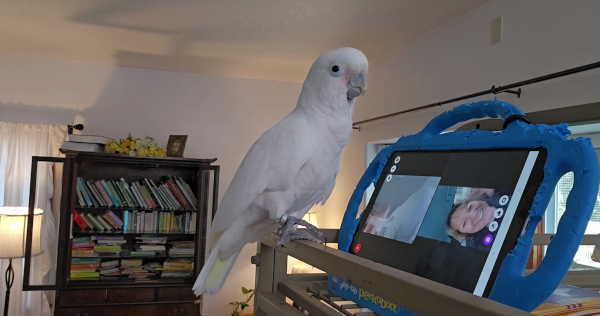
A few months later, we returned for a second shoot, and everything clicked. I walked in, said nothing, just looked. Ellie turned, locked on, and recognition bloomed across her face. Then she gasped – a tiny, audible intake I didn’t know parrots make. She swooped over to my shoulder, leaned her face to my cheek and gasped again. I swooned. She remembered me! It was a core-memory moment and later, I wondered: Do we ever listen to each other that closely? Do we notice recognition when it’s just a pupil, a posture, a sound you’d miss if you turned away at the wrong moment?
That gasp nailed Ellie’s ownership of my heart.
3) Skill Is Kindness (and It’s Efficient)
It’s easy to romanticize “natural” connections. What Jen and Ellie have is natural and also built – by consistency, clear criteria, short sessions, lots of breaks, loads of positive reinforcement. It’s craft. Think of a world-class athlete running practice that looks like play. Jen’s timing is a metronome. Ellie’s curiosity is a river. The “magic” is a thousand small choices made with mutual love, so curiosity can bloom.
This is where the “unrealized” part lives. In the wrong setting, intelligence hides to stay safe. In the right one, it shows up – with jokes, problem-solving, and that spark that says, I’ve got a thought, listen to me! Ellie is funny on purpose: she’ll steal a hair tie, offer it back, then whisk it away with perfect timing. Humor requires perspective-taking – you guess what others expect and tweak it. That’s not “cute;” that’s cognition, on beat.
Treating “no” as information turned out to be the real time-saver. We needed Ellie to raise her crest for what we called her “rock star shoot” in front of a black screen. We had carefully constructed a turntable that would pivot her in a full 360. Except Ellie knew where the camera was and kept shuffling her tiny feet to turn her body to face it. So we abandoned the pivot and focused on just getting her crest to raise. How do you get Ellie to opt in? Play “Sugar Sugar” by the Archies and have the entire crew and the neighbors dance with stuffed animals to delight her. She finally raised her crest. The question wasn’t “How do I make you do X?” It was, “How do we build conditions where X is worth doing?” That’s caregiving at its best and also a good way to run a film set.
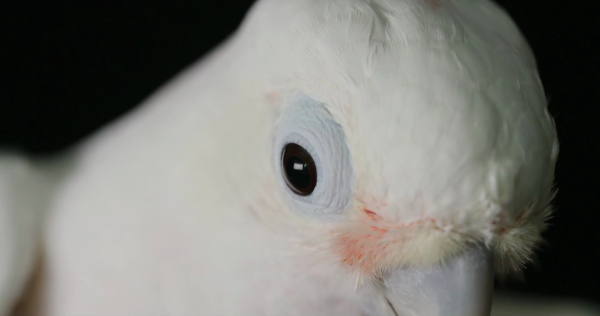
And here’s the part I’m not embarrassed to say: after watching Jen and Ellie together, I went home and learned to listen better – not just to my fur family, but to the humans in my life, too. I slowed down. Waited for answers I used to assume. Treated “no” – or a sharp retort – as just data. Apparently I needed a small white bird with a rosy cheek to tune up my human conversations.
If Parrot Kindergarten argues anything, it’s not that every animal is a person in disguise. It’s that every animal is an animal – with its own ways of knowing, wanting, tolerating, delighting – and our lives get richer when we reorganize ourselves around that fact.
Ellie didn’t learn English. I learned Ellie. And a bit more Dog, Cat, Squirrel, Bear, Elephant – and, unexpectedly, Human.
People ask why I made this film. I can sum it up in one sentence:
Parrot Kindergarten is joyful, and I’ve learned that joy isn’t a distraction from intelligence, it’s one of its signatures.
I went to film a parrot. I discovered a new language. And now I look for it everywhere.
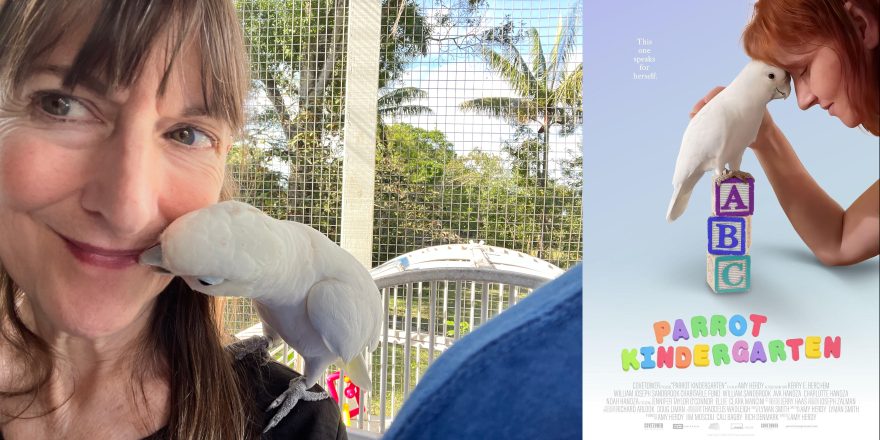
Featured image shows Amy Herdy with Ellie; all images courtesy Amy Herdy.