

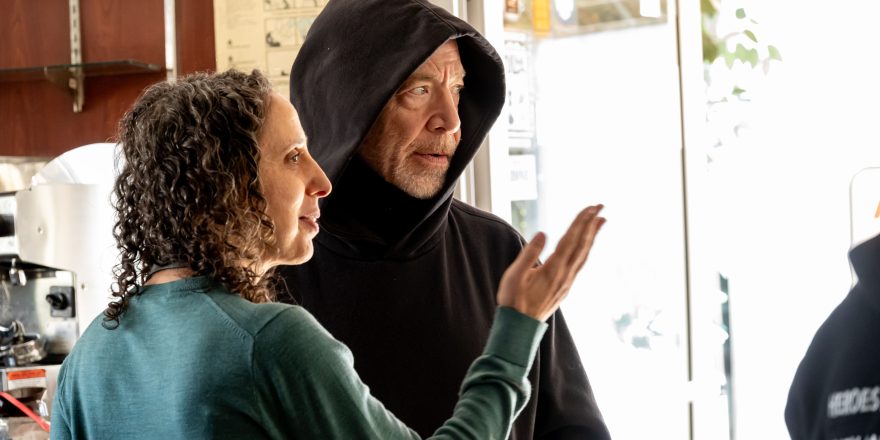

Ela Thier is a writer-director based in New York City who has been writing screenplays for nearly 40 years, and receiving pass letters for about that long. In carving her own path, she wrote, directed, produced and sometimes performed in her award-winning feature films, Foreign Letters and Tomorrow Ever After. In 2026, she’ll be releasing her new feature film, 109 Billion Followers, a comedy-drama with J.K. Simmons. Her first non-fiction book, How to Fail as an Artist: My Best Tips, is now available on Amazon and book shops everywhere. She has created numerous award-winning short films, and is the founding director of the Independent Film School. When she’s not working, she spends time with her nephew and pretends to be interested in baseball. (Photo by Jess Osber.)
After directing a beautiful proof-of-concept for a beautiful film, the actor I worked with wanted to be sure the feature would get produced. One phone call later: $200,000 was in the bank. We could spend it on the condition that we raised $1 million.
This was career-break #984,234 that led to absolutely nothing.
If I knew then what I know now, I would have drawn up a $200,000 budget and shown this investor how I would make the film for that amount. I would also have explained that recoupment and profits are a surer bet when the budget is this low.
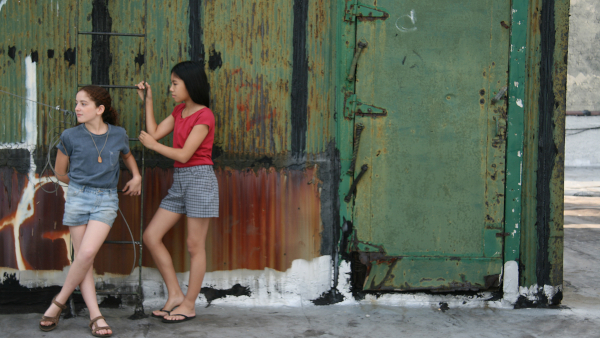
Alas, I didn’t know to do that. What I did instead was turn every stone to raise the rest of that million. And sure enough, that career break was a bride to nowhere. The money disappeared. The film didn’t get made.
What were the other 984,233 career breaks that led to nothing? I only remember the few that stung particularly badly: the A-list actor who took interest and then changed his mind; the A-list producer who fell in love with my script and then decided to have a baby instead (that’s fair!); the agent who sent me to Los Angeles, where I got offered a whole lot of water bottles, but nothing came of it.
Career break #984,235: After the $200,000 disappeared, I found two producers who loved my short film and were pumped to produce the feature film that would be based on it.
I felt like a grown-up who “finally made it” as they drew up a business plan and talked about how doable it would be to make my film for $500,000, and how easy it would be to raise that amount. (It would be easy to raise $500,000?! I was clearly playing with the big kids now!)
Less than 24 hours later, one of them called: the first $50,000 was in the bag. Boom. In two weeks tops, we would have our budget! But two weeks later, we still only had $50,000. And two weeks after that, and two months after that – we never raised more than that first $50,000.
We came together to discuss our next steps.
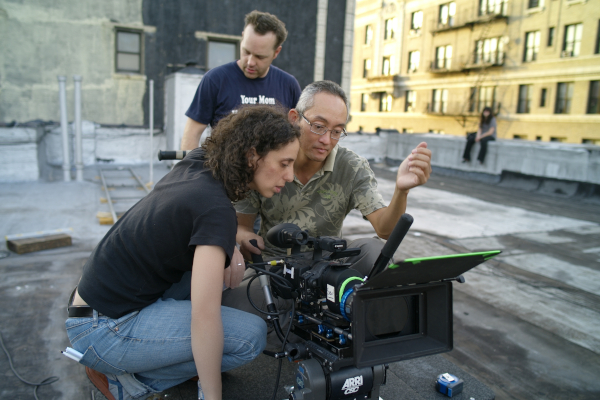
This time, I had wised up. I knew more than I did when I’d lost that previous $200,000. I tried to rally the troops: “Let’s make this movie for $50,000.”
Unlike me, these were rational, reasonable people. “We can’t make a movie for $50,000. We’re better off waiting to raise the rest and do this right.”
Except that by then, I had tried to “do it right” for more years than I care to tell you about. The script-peddling, door-knocking, pitching, querying, pitch expos, competitions, networking, more networking, following up, more following up …
By the time I had this particular conversation, I knew that “doing it right” wouldn’t lead to making a movie.
I kissed those two producers and their $50,000 goodbye, and went back to being a girl with a script and a dream. Oh – and a PayPal button. This was 2008 – crowdfunding didn’t exist yet. Not even the word existed. Someone told me about a site called Kickstarter, which no one had heard of. I checked it out. It had only 50 projects listed. Ah … the good old days of less than 20 years ago.
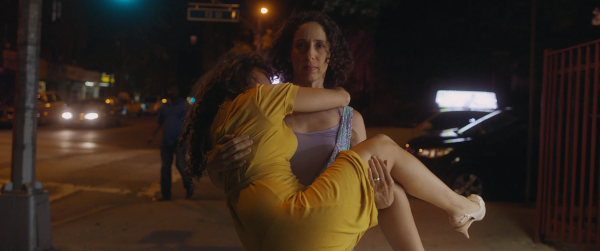
I’m pretty convinced that I invented crowdfunding. (To be fair: at around the same time, other people were “inventing it” as well.)
At this point, I had been teaching screenwriting (independently, because nobody hires a writer whose work has never been produced) and I had an email list of 3,000 people. I wrote to my list explaining that if every person contributed $100, I would have the budget to create my debut feature film. The conversion rate wasn’t impressive … Of the 3,000 people I wrote to, one person made a donation. It was my sister.
So I wrote again. And again. Until I figured out what to write that would actually compel someone to contribute.
I raised $25,000 and, more importantly, I “raised” favors. People donated food, locations, vehicles, parking spots; crew volunteered their time. That was the year I learned that money doesn’t make movies. Locations, equipment and people make movies. Money is just one way to get those things, and not necessarily the easiest way.
I directed Foreign Letters, my debut feature film, that year (2009), and I completed and sold it two years later.
After that, my career took off!!! Just kidding.
After that: rinse, repeat. I moved on to career break #984,236. Another star took interest in one of my projects, but despite her attachment, I couldn’t get it financed. Another break, and another break after that – all of them so incredibly glamorous and exciting, but leading to absolutely nothing. I also crowdfunded Tomorrow Ever After, a feature film I wrote for my actor friends (who are amazing in it, by the way). I went on to create a film that I’m absolutely in love with. Tomorrow Ever After had a 100 percent rating on Rotten Tomatoes during its very limited theatrical release, which we paid for ourselves, obviously – by asking all our friends for a hundred bucks.
What a weird life we live.
My third feature, which is coming out later this year, is a similar story. But I’m too close to this one to share the gory details (yet). Suffice it to say: break whatever didn’t lead to the movie. Me making a movie with whatever I had is what made the movie.
Artists are a lot like parents. The harder we work, the less money we have. But our greatest pain isn’t the lack of resources, or financial hardship, or the exploitation of our work, or the fact that an entire profession exists for the sole purpose of criticizing what we pour years of our lives to create. Or the isolation, or the world telling us that the arts are trivial, or the resulting self-doubt that plagues us daily.
What pains us most is not getting to do our work.
Fortunately or unfortunately, that part is up to us.
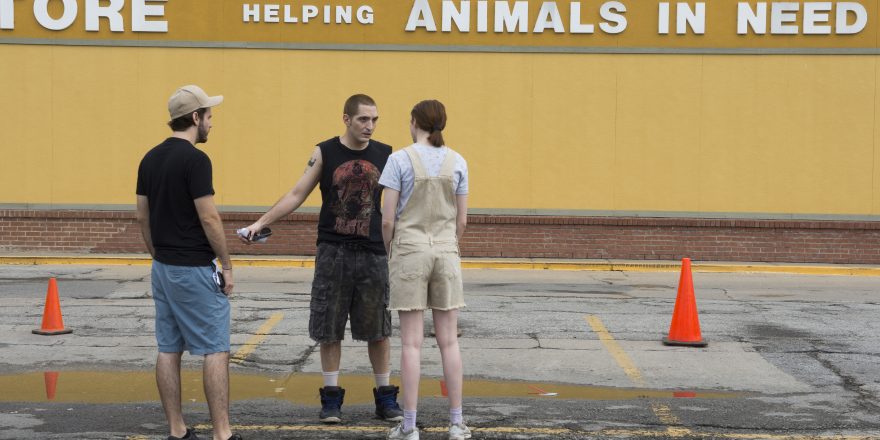
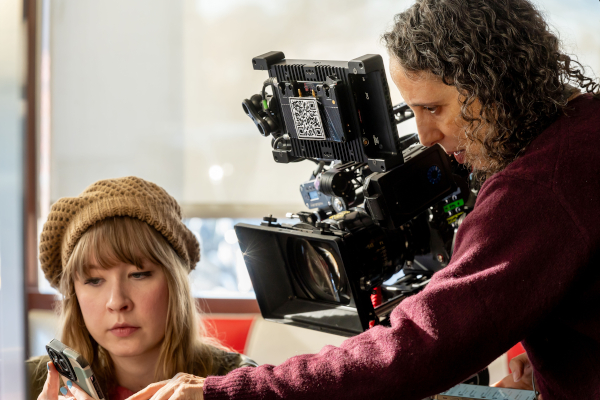
Featured image, showing Ela Thier and J.K. Simmons on the set of 109 Billion Followers, is by Uri Thier; all images courtesy Ela Thier.