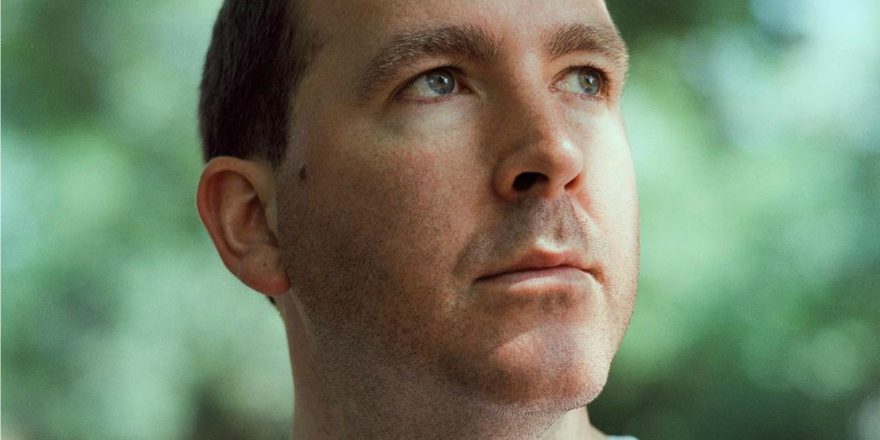


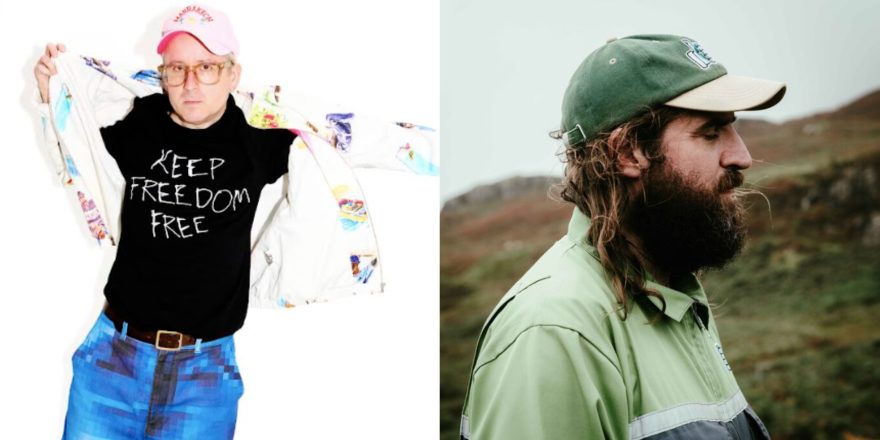

Pictish Trail, the alias of Scottish pop sensation Johnny Lynch, has resolutely furrowed his own path, steadily creating a unique catalogue of recordings and performances, while eschewing the blueprint of the predictable singer-songwriter in favor of something untidily intriguing.
(Photo Credit: Stephanie Gibson)
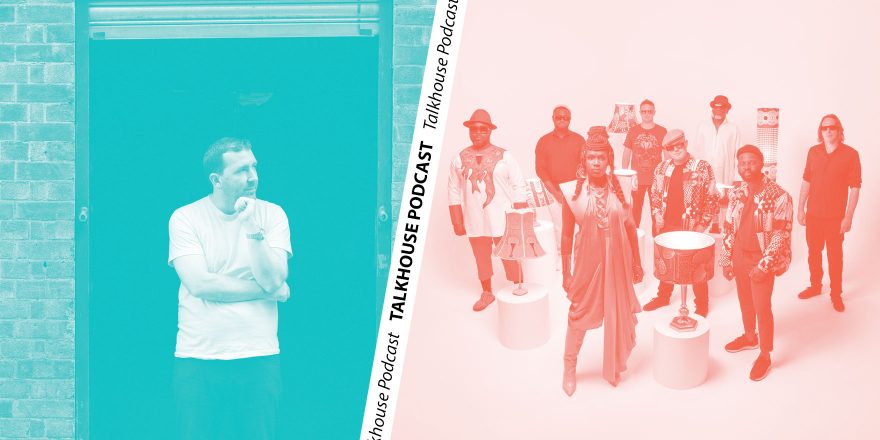
Alexis Taylor is a singer-songwriter who co-founded the band Hot Chip and performs solo under his own name; Johnny Lynch is a singer-songwriter who performs as Pictish Trail. Alexis’s latest solo record, Paris In The Spring, was just released last month, and the new Pictish Trail record, Life Slime, will be out this Friday via Fire Records. To celebrate, Alexis and Johnny got on a call to chat about it all.
— Annie Fell, Editor-in-chief, Talkhouse Music
Alexis Taylor: Before you had your tonsils removed, [your voice] was different, was it?
Johnny Lynch: Yeah, it was, and I don’t think I realized how different it was. I’d always been told, “Oh, you’ve got a lovely singing voice, Johnny…” and I never really thought about it. And then I had my tonsils removed because they were absolutely massive and they exploded. It took about a month for my throat to recover. And then my voice — it didn’t change, but it got better. I’m not gonna lie. When I was listening back to previous recordings, I was like, Oh, my god, is that what I actually sounded like?
Alexis: At what point in your life did the tonsils explode?
Johnny: Well, I recorded a project called Silver Columns with Adem [Ilhan] in 2009 and toured it in 2010, and it was early days of touring it that I had to get rid of them because they were swelling up every three weeks. I had them removed during that tour, which was good because there was a lot of falsetto stuff going on. But on the record, that’s me with tonsils.
Alexis: Have you thought about, instead of, in relation to tonsils being removed and falsetto — you could probably see where I’m going here. Castrato.
Johnny: Oh, I thought you were going to suggest adding tonsil implants and going and going deeper.
Alexis: I was thinking, if you’ve worked out that things have improved with the removal of something.
Johnny: I should go the whole hog.
Alexis: Exactly. To use the technical term, when you go to see the doctor for that operation.
Johnny: You know, I’m almost afraid to ask the question, because you’ve got a very high voice: Was there some sort of accident that you suffered?
Alexis: [Laughs.] Like Lady Gaga, I was born this way… It’s funny because, I will admit and acknowledge that my voice has a certain kind of tone to it that people associate with a high singing voice, and when I was younger, people sometimes would say, “Is that a girl singing?” on a recording. But I actually think I can’t really hit proper high notes. And I don’t think I sing in a falsetto that much. I think that maybe the sound of the voice is a bit more androgynous, sort of leaning towards the female sound of the voice. Not that there is a “female voice,” but what we stereotype as a more female-sounding voice, rather than it being that I’m singing in a higher register.
Now, obviously I do sometimes go to some high notes, but I was thinking about this in the studio with Joe [Goddard] recently, where I swear he was saying he was going to sing an octave below me, and then he just sang the same register as me, but his voice has a different sound to it. I mean, we weren’t overthinking it; he might have not been particularly conscious that he was not singing an octave lower. But I was like, “We’re actually just singing in the same register as each other, but my voice sounds different from yours.” It has what we think of as a high sound.
Johnny: I’ve noticed this with you, actually, because I sing along to your records quite frequently. I’m trying to go for that same range, but it does sound different. You do have some sort of frequency range that is occupying a different space, but it sounds higher. I’ll tell you what, I do also like it when Joe sings in a higher register.
Alexis: Yeah, me too.
Johnny: It’s very soft and tender.
Alexis: That’s the other thing: I think he’s quite good at singing falsetto, maybe better at singing falsetto than I am, and yet I’m the one who’s thought of as having the high voice.
Johnny: I mean, you do have a high voice. I’m sorry. Despite everything you’ve just said.
Alexis: Yeah, I suppose I’ve been lying.
Johnny: [Laughs.]
Alexis: My first impressions of your latest album were based on you playing live acoustic guitar and vocal for some of the songs. And some of them, you would have more of a track playing, and sometimes you would have your naturally quite high voice—
Johnny: Oh, here we go.
Alexis: I would say similar to mine in range — sometimes you would be using processing on your voice. But despite all of that, the overall impression I got was I’m hearing these songs in a more stripped back way. And hearing the tracks that have come out so far on the album, I’m really enjoying the full production. I remember that moment where you and Adem did Silver Columns — am I fair in saying at that point you were trying to embrace more electronic elements and some influence from pop and dance music production?
Johnny: I mean, I think it’s fair to say we’re heavily influenced by Hot Chip. But, yeah, I’m a huge Erasure fan, I’m a huge electronic pop fan…
Alexis: So then to hear this, quite a long time later — it seems like you’re really skilled at producing, and it seems like it supports the songs. I knew the songs first in this acoustic way, but I was really enjoying all of those extra details in the production, the drum programming, the synth and the vocal sounds. It was quite nice to hear another record which I think is coming from a quite similar place to me. It’s like songwriting, but then trying to make the production as interesting as it can be to support the songs.
How have you found the production side of working on your music has developed or changed over time? And is that something that you work with others on, or do it all yourself?
Johnny: Well, initially, the first few records I put out were called Secret Soundz, and a lot of that was just me recording on a Zoom 8-track machine and using the first generation Kaossilator as a drum machine and putting stuff through guitar pedals. So there were no computers involved at all, really. I wasn’t interested ever in making music on a laptop. I just wasn’t able to engage with it. I think maybe it’s a slightly competitive thing, because I saw other musicians do it, and I realized that I didn’t have the software, and if I did, it was going to take me time to get to grips with it, and I felt that that was too much of a barrier of getting the songs together.
Alexis: This is so similar to how I feel about using a laptop and production and software and everything. But, carry on.
Johnny: I use it so rarely now. So for the most part, from Silver Columns onwards, every album I’ve done with a producer, and it’s usually just been the two of us working on everything together. It’ll be a case of me writing songs on my 8-track — I still use a Zoom 8-track — although it’s a 24-track now, I upgraded.
Alexis: That’s what you’ve used on the new record?
Johnny: Well, in terms of demoing and writing parts, the R24 from Zoom. When I’m writing songs, I’ll be recording parts into that thing. Then I’ll take everything from all the stuff I’ve recorded on an SD card and go to whomever I’ve been working with on the album. On this new album, I was collaborating with Rob Jones initially, and then Mike Lindsay from Tunng. I’ll have seven or eight stems, maybe, that will be the core of what the song is, and we’ll upload that onto whatever they’re using. This last album we did was Pro Tools, but all the previous stuff had been Ableton, I think. And then it’s just adding stuff around it, and sometimes taking away what I had initially recorded.
I try not to be too precious about specific parts in the short term. Because the way I write and record songs is, I’ll take a demo down, I’ll spend three or four days with a producer, and then whatever we come up with in that time — which is maybe two or three songs — I’ll then go back home and I’ll be thinking about what we need to change. And those recordings will inform what the next songs will be. So I only ever write three songs at a time, and just sort of jigsaw it together. Then I’ll have another session with that producer a month or so later, and we’ll do another three days and it’ll be sort of like a puzzle at that point. It’s working out what feels right for what we’ve got recorded specific to the song, and how does that influence how the next track might sound?
Alexis: The different stages of creating a song can be quite interesting to think about. There’s that initial stage, where there’s something that feels exciting that’s only currently in my head, it’s not yet made it out and onto a piano or a keyboard or anything. And then there’s the bit where you’re trying to capture a bit of that idea — I’ve had this thought, this phrase, or these lyrics I’m going to type in my phone or write down on paper. Then there might be immediately after that another stage of, what can I do with that melodically? How can I conjure up a musical phrase that takes hold of that lyrical idea? What chords can I play underneath that, and does that lead me to more ideas like the next sentence or the chorus or whatever? Right at the beginning when it’s just forming, if I think it’s a good idea, that’s quite an amazing feeling. You’re on the edge of something new, but you don’t yet know whether it will turn out to be a good song, but you just feel confident because it’s exciting.
Then I think the bit where you actually record it, whether it’s the demo into your phone or on your Zoom or if you happen to be having the idea in a studio, the sounds that you choose at the beginning can make a big difference to the development of the idea. So you might have heard it in your head one way, but not got that far through the process, and the moment that you’re playing a synth pad or a particular sound that just happens to be what you have access to can inform the journey of that new idea from its embryonic stage to its final stage. I always find that quite fascinating because you might do something where the first sound you play happens to inspire you further, happens to be a bit surprising, happens to do a thing that was not really prescribed when you were first coming up with the idea. So those bits of chance interactions are quite important. You obviously can’t just force that to happen every time — you can’t just force some chaos or some surprise — but if you’re only ever writing on one instrument and it’s always your piano and your voice, or always your acoustic guitar and your voice, I do think as good as those songs can be, it still can mean you might not get outside of yourself and your ways of writing or playing or improvising, and not being surprised as a result.
Johnny: I agree so much with that sentiment. And I think it’s funny because I think there’s often a perspective that music has to come from this pure place, that it can be stripped back to just voice and guitar and that’s what the true identity of a song is. And actually, very often the excitement for me in a song is being able to experiment with something and pretend to be something else. Play, a bit. The first song on the album is a song called “Hold It,” and it was the first song that I wrote for the for the project, even. I had been in a relatively depressive state up until that point, and this was an evening where I was just sat with my guitar, and it’d been the first time in about two years that I’d really attempted to properly write a song.
Alexis: When was this?
Johnny: This would have been early 2024. I was strumming the guitar and I had a synth loop, which is still on the record, that I made up in, like, three seconds on this other Kaossilator thing. I had that going through a pedal, started strumming some chords over it. And I used this vocal processor, this TC-Helicon VoiceLive Touch 2 — which you can no longer get. They’re really cumbersome, huge things, but they’ve got so many different effects built within it, and it has this autotune effect. I was strumming the chords and I just got lost in this little loop, and I was singing really direct lyrics that I felt were quite exposing in a way, but because I had the autotune going on, it felt a bit more liberating. It felt like I was able to sort of pretend that I was someone else a little bit. It kind of gave me a bit of distance. I was imagining the song as a sort of daft little country tune.
Actually, I was thinking about this song yesterday, having had a look at the lyrics on your new album. The song “Hold It,” I swear in it. To me, that instinct to swear on a song, I don’t think I would have been able to do it had I not had the autotune. I don’t normally go in that direction when I’m writing lyrics. I mean, I can swear like an absolute cunt. I fucking love swearing. But on a song, I’m usually quite polite. And I noticed on there’s two songs back to back on your album which also contain the F-word.
Alexis: Yes.
Johnny: It made me wonder, when was the last time I heard that? And I had to really think. I can’t remember much swearing on your records. I’m not dissing you for cussing, but it made me wonder if that was a deliberate impulse.
Alexis: It’s funny that you mentioned this because I really noticed that same swear word in your opening song when I was listening.
Johnny: [Laughs.] Did you tut?
Alexis: I might have tutted, but at such a high frequency, in such a high range, I don’t think anyone other than a dog would have heard. [Laughs.] No, I didn’t tut. I basically thought, I hope Johnny’s alright. I know what your record is partly about from conversations we’ve had; I don’t know the whole record, I don’t know if it’s always on one topic, and also songs are not just confessional or straightforwardly autobiographical. You have to invent things a bit as a songwriter. But at some level as your friend, I felt the pain of what you were saying, and I felt that acknowledgement that you were making of, “I have fucked up,” or whatever the phrase is. I suppose I can relate to that, given that I’m singing the same thing in one of my songs, in the song “For A Toy.”
In terms of where that comes from, I think I use that language myself when I’m not singing, and so I didn’t have to give it loads of thought to check whether it should be there in my song. But at the same time, there’s a power to being colloquial or straightforward in your choice of language and not too poetic. I also was conscious that when these words came out — because, to backtrack a second, the original demo of “For A Toy” is close to that final set of words and melodies and chords, and it all just kind of came out whilst sat down at this CP-70 piano in my studio. So I didn’t really have a chance to second guess it, really. It felt good, it felt cathartic, and it also felt like I’m onto something in terms of making a song that I like. It’s not just a process to make me feel like I’m working through something. It’s like, Oh, I think that could be a good song.
Johnny: It is a very good song. I absolutely love that track. It stopped me in my tracks. Because it’s so sweet sounding, the production and the delivery on it. There’s such a measure to it.
Alexis: Thank you. I think that it was important that the song was a bit like… it made me think of Neil Young’s song “Fucking Up,” where he’s got literally the same phrase, “Why do I keep fucking up?” But it’s a very different song. I thought maybe it’s interesting if my song is a bit like that in one way, but it’s a bit like a Barry Manilow song in another way, like “Mandy.” Very pop, very mainstream, almost middle of the road anthemic…
Johnny: It’s comforting, I think. It reminded me in places of — you might not like this comparison — I really love “Stop Your Crying” by Spiritualized.
Alexis: Oh, yeah. I do like that record.
Johnny: It sort of feels like it’s trapped in this time capsule almost. It’s like a beautiful, sweet, perfect moment.
Alexis: I really liked, the last time I came to see you play, the way that — you have a bit of a background in stand up comedy, so you’re able to be incredibly funny and confident and get the crowd involved with what you’re doing from a spoken point of view, and then switch into playing a song, which is often quite a shift in gears emotionally. I came away thinking, I’ve experienced some of the best songs I’ve heard live and a comedy show all at once. I wouldn’t really know that I’d get to see that normally in people’s gigs.
Johnny: Thanks, man. The hope is always that the gear shifts accentuate the humor and the emotional aspect of some of the songs. I’ve never been able to do that earnest singer-songwriter thing. I don’t have it in me to do something that’s a plaintive thing from start to finish I can’t take myself seriously enough to even want to do that.
Alexis: I find it really hard the other way. I don’t really want to be the plaintive, earnest person, and in conversation, I make quite a lot of jokes and I’m quite silly. But on stage, I find that I go into some intense mode where at best I might be able to say one thing between seven songs and break the ice. But other than that, it is basically quite an earnest thing. And I don’t really like that in other performers. I like there to be a bit of humor and I like things to not be taking themselves too seriously. So I feel a little bit embarrassed of myself sometimes, that I’m like that. But I also think it’s nerves. It’s not just, I’m so serious about these songs. It’s just concentrating.
Johnny: I think you express it in a different way though, because you’re one of the only artists that I know — and this is an aspect I really love about your performances, solo and with Hot Chip — what you are wearing and how you present yourself on stage is really considered. And it’s often fun, oversized clothing and very colorful. That’s what offsets the emotional aspect of the music.
Alexis: I think that might be true, yeah.
Johnny: Because I think it’s also not what people expect. There’s not anyone else that I can think of who does that in the same way. I mean, David Byrne comes to mind with the oversized suit, and big pop stars will. But that’s something that you maybe don’t expect so much if it’s you solo, a singer-songwriter performance. Your sense of fashion, I’m sure you’ve had a lot of people tell you it’s second to none. There’s a real commitment to how you present yourself, which is always engaging and really fun.
Alexis: I think there is a commitment to that, and maybe committing to it is part of partly why it comes across OK. But also, sometimes I’ll look back on what I’ve worn and think, Oh, that didn’t really suit me. Or, I don’t feel like that person anymore. But mostly, I do want to overemphasize something in a visual way so that it’s very striking. I never thought of it like this until you said it, but maybe that is some kind of protective armor to deflect from what the lyrics are about to say…
I feel like I could talk to you for a very long time, but I’m also wondering if you want to call it.
Johnny: [Laughs.] I’m going to pause this now — it’s been great to chat to you, man.