

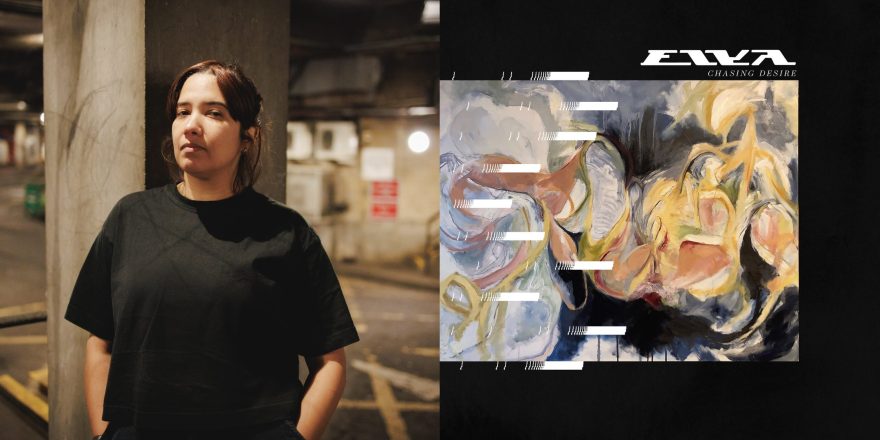
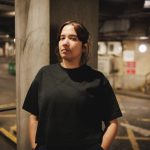
ESYA is the solo project from Glasgow-based musician Ayşe Hassan, of Savages, Kite Base, and 180db. Her debut album Chasing Desire merges Hassan’s signature bass playing with electronics to create a unique blend of industrial pop, and is out now on AOK Records.
(Photo Credit: Neeq Serene)
As a teen, I always knew when my mum had arrived to pick me up from my friends’ house, from the music emanating from the car outside. Back then I would have probably blushed — embarrassed by the sounds being emitted, that by association represented me. My family home was similar, as music played throughout life in our household. My friends thought it was cool. I, however, had an adolescent cringe, not wanting to stand out.
My parents had me very young at the age of 16. I was born in South East London to a Cuban/Jamaican/Scottish mother and a Turkish Cypriot father. This offered me such a rich combination of musical cultures, that intertwined with the chart-fuelled musical zeitgeist, equally as important an influence on our family soundtrack.
Around 12, I began to experience overwhelming, wild and repetitive nightmares. To alleviate these horrors, I developed the ability to control my dreams, later realizing that this was called lucid dreaming — something I still do to this day. My parents tried to help by allowing me to fall asleep listening to the radio. Unbeknownst to them, the songs of the moment would serve as fertile land for my dreams.
In my teens, much of my music taste came via our family tradition of going “for a drive” in the English countryside at the weekend. My parents would play a spectrum of albums on these trips — Tina Turner, Madonna, Nirvana — which then became the inspiration for that evening’s dreaming, storylines evolving in different ways inspired by that day’s listening.
For magical dreaming, I would play Kate Bush, Mazzy Star, and Enya. For exciting adventures, the futuristic pop sensibilities of Depeche Mode, Prince, and David Bowie. I entered random unfolding worlds via Fleetwood Mac, Simple Minds, and Echo and the Bunnymen.
The way in which I was experiencing music — in the dead of night, dark and with no distraction ‚ had a primal intensity that I later grew to appreciate was akin to the approach Pauline Oliveros formulated in her practice of deep listening. This technique of attuning yourself to the details of the world around you catalyzed my love of nature and field recordings leading me to Chris Watson’s work, via my love of Cabaret Voltaire. Recording the sounds of the everyday and incorporating them into performance became part of my creative process, such as when I recorded the sound of a fridge backstage, which I then later used as atmospherics between songs during my own live show.
Through my entire listening life, I was unconsciously drawn to songs with lots of low end, prominent bass pounding through my thoughts year after year. It was hard to match the emotion and excitement I felt when hearing or playing a driving bassline, it would take me to a heightened state of elevation. Experiencing a band through the love of bass, gave me a keen understanding that a band is the sum of all its parts. It brought an understanding of the importance of bass, sonically, structurally — being the cohesion that holds together a song, be it through a bass guitar, double bass or synths.
Some of the badass beings whose work sat beneath so much of the music I grew up with include Gail Ann Dorsey, Peter Hook, Tina Weymouth, Guy Pratt and JJ Burnel. But the apex low end link that is most prominent within my dreams — for as long as I could define them — would be the playing of Carol Kaye. Entering my subconscious through her contribution to music, a woman, an innovative bass player. Without releasing, I had found the being that made me want to dance, cry, and sing, whose basslines had propelled a lifetime of lucid day and nighttime adventures.