

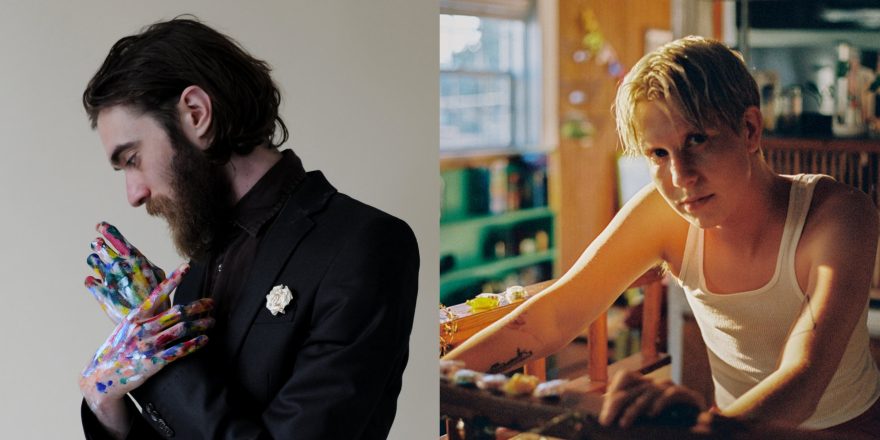

Keaton Henson is a musician and visual artist based in the UK. His latest record, Parader, is out now on Play It Again Sam.
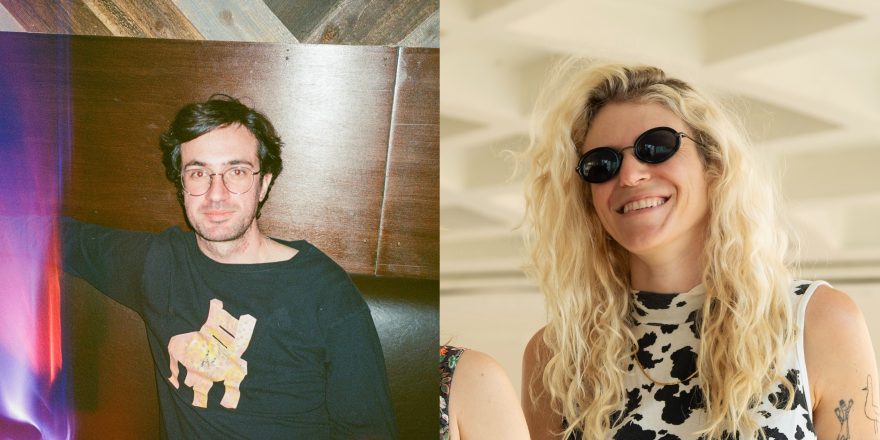
Keaton Henson is a musician and visual artist based in the UK; Al Menne is an LA-based musician who fronts the band Great Grandpa. Keaton’s new record Parader is out now on Play It Again Sam, and to celebrate, he and Al got on a phone call to catch up about it, and much more.
— Annie Fell, Editor-in-chief, Talkhouse Music
Keaton Henson: Honestly, thank you so much for doing this. I hate press so much, and I felt like talking to a musician would be less scary.
Al Menne: [Laughs.] I really feel you. Having to hype myself up for press stuff, it never fully works. But I’m so stoked that you asked me and I’m honored to be a part of your press cycle.
Keaton: [Laughs.] How was the rest of tour?
Al: It was good. I was so bummed to have been sick. I went on vocal rest — but it’s hard for me to go on vocal rest, especially with my partner Nick [Levine] on tour with us.
Keaton: Just, like, constant silent treatment.
Al: [Laughs.] We’re chatting away every second of every day, so it’s hard for me not to, as a reflex, be like, “So I was thinking…”
Keaton: This is super nerdy, but you have one of my favorite vocal flips. Is that one of the first things that goes? Is that tough when you’re sick?
Al: Yeah, it can be tough. Also, since my voice has been changing, it’s gotten a lot easier at this stage to flip, but earlier on, the first year of vocal changes was like, Oh, my god. It’s gone. It’s never coming back. And now I feel like I’m getting the hang of what new part of my range I can do the flip in.
Keaton: Good. Did you discover anything about England? Did you find a new favorite part of England, or were you were just sitting silently in a bus?
Al: It was a lot of just sitting in a van. This was my first time going to the UK — going to Europe at all — and I realized that tours that are not routed for sightseeing or doing cool stuff.
Keaton: Or sanity.
Al: Yeah, you said it. I have a real fondness for the architecture over there, so it was cool to see that with my own eyes. I feel like I expected there to be more of a… I mean, there was a bit of a cultural, Oh, yeah, I’m definitely in a different country. But there were times where I was like, It feels like the same as home, just alternate universe-y. Which is fun. Have you done much traveling in the States?
Keaton: No. I lived in LA, and I’ve spent a little bit of time in New York, so I’ve only seen the poles. But I really, really want to see something in between. I was trying to think of interesting things to talk about, and one of the things that I genuinely am interested in is something that I didn’t think about until I did the press for this record and realized how much I’m talking about America — but America as a mythical place, the mythological suburban America that I didn’t realize was such an important part of my artistic awakening. I actually think that you and your music are a really great example of it; you typify, for me, the sound of this mythological place that doesn’t exist. And the record I’ve just made I think is the first time where I’ve really allowed myself to play within that space, but do my own circuitous version of it. But do you know what I mean about this sort of mythical suburban indie America?
Al: I mean, there’s such a scene — or an idea of a scene — built around American suburban indie music. And I could imagine when it’s something you haven’t seen with your own eyes, it would be more fun than seeing it in real life, to build your own world around the sounds that you’ve heard.
Keaton: The fantasy of [a place] is never going to exist if it was where you grew up. I grew up in suburban England, and it was grey. I grew up in Surrey. It’s the outer burbs of London. I think all young teenagers mythologize their own environment, but for me, it was always with my headphones on, listening to Death Cab and imagining, I don’t know, things as stupid as lawn sprinklers. I could imagine the sound of lawn sprinklers as this kind of dreamlike, mythical thing, and then when I went and lived in America, I just realized it wasn’t real, but it kind of became more beautiful for me that it wasn’t a real place. I wasn’t disappointed in any way. I was like, Oh, of course it’s mostly Walmarts. But it’s amazing how much music — not even lyrically, but just the sound — created a landscape that I wanted to live in so badly. Do you think, as someone who grew up over there, there’s an equivalent this way? Is there a mythical England that you think of?
Al: I think so. In my mind, maybe not in a musical sense as much, but I feel like in media and TV, the idea of going across the pond for me, especially as somebody going over there for the first time when I was 30, it was like, Wow. When I was a teenager, I remember watching TV and being like, Ah, they’re really just living the life over there. Like The It Crowd.
Keaton: [Laughs.] That’s where you wanted to live? You’re like, “They’re really living” — this really bleak basement office?
Al: [Laughs.] I think any place that you haven’t really gotten to see with your own eyes, or you’ve only seen or heard through something that you really deeply enjoy, where it’s just different from your day-to-day life, it’s easy to be like, “Yeah, that’s the thing.”
Keaton: Yeah.
Al: I really like your album. The sounds of it and the content, and your voice is very soothing.
Keaton: Thank you.
Al: I was just giving it another listen this morning, trying to think of cool things to say to you. I feel like as I’ve gotten older, I’ve become way less eloquent and I’ve lost my ability to have a normal person conversation.
Keaton: Me too. Or not even a normal person, but I feel like when I was younger, I could have a performative conversation, and I can’t do that anymore.
Al: Yeah. I don’t know if it’s because I take Benadryl every night, and they say that that is linked to dementia. [Laughs.] Or just that, I think a lot of people forgot how to socialize or turned off that part of their brain during COVID. Maybe when you haven’t flexed the muscle of bullshitting as much, it’s hard to…
Keaton: But I also just think when we get older, our desire and ability to bullshit gets less. Also, the older I get, the more I surround myself with people who don’t care if I say things poetically. So I just say normal things normally most of the day. Also, that’s what songs are for, right? You are very poetic, and I would say that you’re lyrically very esoteric.
Al: I’ll take it.
Keaton: But if you spoke like your lyrics all the time, that might be exhausting for everyone.
Al: People would be like, “Shut the fuck up.”
Keaton: [Laughs.] Yeah, I feel the same way about myself. And I think that’s why press stresses me out so much, because the only way I know how to speak with any grace is in songs and poems, and as soon as I’m having a conversation with someone, I tend to just sound like a dum-dum.
Al: There was one interview that I did when Great Grandpa either had put out our first EP or the first album, and it was one of the first interviews I ever did, and the person interviewing me quoted me verbatim — like, left in all of my “ums.” It was devastating, in a way where I was like, Oh, OK. This has freed me. I might be more self-conscious about how many times I say “um” and “uh” in in a sentence, but…
Keaton: The amount of times I say “stuff,” which is maybe the least poetic word of all time…
Al: I get caught on “like.”
Keaton: Yeah. But when you’ve put something together and you’ve pored over the best way to say something… I see songwriting as boiling a complex idea down to its most essential, and I think the great thing about the music that we write is that you can either use esoteric, sort of ephemeral language and be hyper-poetic, or you can also just say, “I miss you.” We have that option. But I still see it as like reducing a stock, trying to get it down to its most potent but simplest thing. And then I hand it over and someone’s like, “Cool. But could you talk about it at length with loads of ‘ums’ on the spot?”
Al: You can really beat the life out of it by talking about it for an hour.
Keaton: Yeah. To continue the cooking analogy, if you’ve reduced your stock down to this thing, it’s kind of like if someone served it but with a bowl of all the stuff that had boiled away, just like gross grey water that you didn’t need. Sometimes I feel like I can get really frustrated. But what I’ve been learning recently is that it can be dangerous to only show people your purest self like that. Actually, the thing that probably makes our friends like us is a lot of the unrehearsed, messy stuff.
Al: Yeah. Our little fumbles do hopefully make us endearing to the people who like us. Not to make you do what we literally were just talking about, but do you have a favorite song on the album?
Keaton: I have ones that are really personal to me. “Furl” is with my wife [Danielle Fricke], and that one’s really personal. The song “Operator,” I did with Alex Ferrar. Those feel like me inhabiting that world that I was talking about at the beginning of this. The scene and the world and the music that I aspired to as a young person, it feels like me inhabiting that in a confident, me way. I don’t feel like I’m ripping it off in the way that I would have if I had done it as a teenager, but it’s just me passing it through my filter. And I really like that. But I also think it means I don’t sound too much like me, which I think allows me to listen to it without feeling physically ill.
Al: I know what you mean. I feel like listening to my own solo music can feel so different than listening to music I’ve worked on with other people, like the Great Grandpa stuff, where I’m like, There’s so much less of me in this.
Keaton: Also you can hear the people that you admire and work with. I can listen to tracks on that record and just be like, Oh, that really sounds like Laurence [Hammerton] or like Luke [Sital-Singh], who produced the rest of the record. There’s stuff that sounds so Luke that I can just listen to it as a fan of his.
Al: I love that you have Julia Steiner on one of the tracks. Your voices sound so beautiful together.
Keaton: I love that, too. That’s another one where I actually listen to it. I never listen to my music, but I just have to wait for my verse to finish, and then I’m just like, Oh! Her voice is so evocative and it really transports me to that world.
[Your] song “W/ Arms Wide Open” reminded me lyrically of my song “Furl.” I felt like we were both talking about a real love, or a positive feeling of love but in a real way that is kind of blood and guts love.
Al: [Attempting to write] a love song, whether it’s romantic love or what have you, [I’ve felt] like, Wow, I’m a cliche and no one will ever love this song. I feel like I’ve been talked out of shelving a few songs because I’ve been like, “Well, this was an experiment, and I can’t write a love song because it’s an annoying song.”
Keaton: If I’m gonna tell someone I love them, I have to simultaneously kick the shit out of myself lyrically in order to let it pass through for me. I also think that’s maybe why there’s a bit of a stereotype when people have kids, and they start writing songs about their kids that it can just feel like — because that love, I imagine, is so overwhelming and so pure and not complicated in the way that romantic love or friendship is, that I think that’s maybe why so many people have an aversion to those songs. Because it’s just pure, uncomplicated, saccharine love. I’m totally with you. And that is what I wanted to avoid with “Furl.”
Al: I think you you successfully avoided it. I thought it was really beautiful. And your voices sound so good together as well.
Keaton: Yeah, I just walked past the bedroom and she was playing the beginning of that riff on the guitar, and I was like, “What’s that?” She was like, “Oh, no, I’m just messing around.” I was like, “Give it to me!” [Laughs.] I feel bad because I was like immediately like, “That’s mine now.” So we wrote it together.
Al: I feel like that’s such a high compliment, though, for somebody to hear something you’re working on and being like, “I need that.”
Keaton: That’s true. I think we both find it really uncomfortable to listen to, because the mic is like this close and we’re both very vulnerable, fragile voices, so it kind of feels like just two raw nerves. But I like that about it.
Al: I have to say again, your album is so beautiful, and I know that it can feel so uncomfortable to talk about — well, maybe I’m projecting. But I feel like it just feels uncomfortable to be asked a million questions about your art. And kind of to the end of what you were saying earlier, don’t the songs speak for themselves? I don’t need to ask you any specific questions about your songs, but I’m stoked to have learned what you’ve told me, what you’re clueing me into. So thank you.
Keaton: Not to be super uncool about it, but I think this is the first time I’ve made a record and thought about — usually I’m very present, I’m very much writing about what I’m experiencing at the time, but this record, I feel like there’s a large part of me that was writing it for and with my younger self. Like, my raggedy Converse-wearing teenage self. And I think that guy would be so over the moon with the idea of you liking this record.
Al: Thank you. I take that as a very big compliment. A mythical creature from the mythical land your former self dreamed of…
Keaton: Yeah, exactly. The mythical land of Walmarts. [Laughs.]