

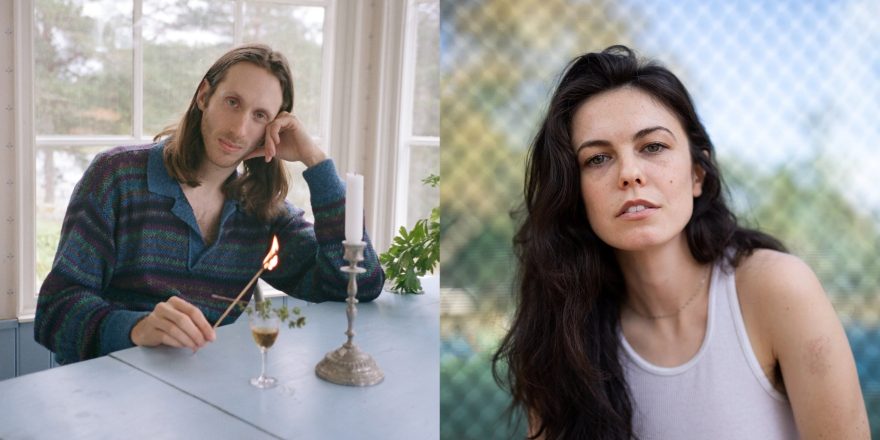

Will Epstein is a singer-songwriter based in Woodstock, NY. His latest record, Yeah, mostly, is out now on Fat Possum.
(Photo Credit: Linnéa Gad)
Maggie Millner is a poet whose work has appeared in Best American Poetry, The New Yorker, The Paris Review, and who is a Senior Editor at The Yale Review; Will Epstein is a singer-songwriter based in Woodstock, NY. Will’s latest record, Yeah, mostly, just came out last week on Fat Possum, and to celebrate the release, the two friends sat down to chat about it, and much more.
— Annie Fell, Editor-in-chief, Talkhouse Music
Maggie Millner: One of the things in my mind that differentiates [the album] from some of your previous projects is this feeling of lyrical intimacy. There’s just more texture and specificity to the lyrics. I have a greater sense of the contours of the self that is behind the writing. And it’s just occurring to me that you were reading a lot of autofiction.
Will Epstein: Yeah, and I have always been drawn towards that style of writing, even in music, like Lucinda Williams. And I think it was the project of this album — or, I guess it started before I was thinking about an album — but [I was] really wanting to find a language in my lyric writing that felt personal to me and like I could be myself in the language when delivering it, and feel like it’s connected to my being outside of music. Because coming from a place of abstract music, from playing the saxophone and improvising, music for a long time was a music of the spheres, sort of; something that’s transcendent or spiritual.
Maggie: In a way that defies language?
Will: Yeah, or in a way that doesn’t have to engage in language.
Maggie: It’s like a different system of meaning.
Will: Yeah. I think Coltrane was the harbinger of that for me. Getting really into his music was when I got into playing music, when I was 16, maybe, or 15. I think Love Supreme was the first Coltrane album I was into. I remember being in a very dark place in high school and listening to Coltrane and reading this poem that he wrote, that’s the fourth part of Love Supreme, that he’s resuscitating with the saxophone, and connecting with that. It’s a religious poem that he’s sort of vocalizing through the horn, and connecting those threads and understanding that was actually very helpful to me. It was a solace to me.
Maggie: That there was language?
Will: Yeah, or that there was intention in the language. I hadn’t really made that connection. And I was always into Dylan and stuff too, but was never really focusing on the language that much, more just focusing on this kind of incantatory being. But I guess I had gotten to a point where I felt like I would lose interest in the song too quickly without feeling like I could connect in a deep way to the words I was singing.
Maggie: Well, I also wonder if there’s a discrepancy between how much skill you had. You could express yourself so fluently, almost prodigiously, in music. And no matter how virtuosic a writer you are, it’s one of the rare art forms where you do get better as you age, because your consciousness expands as you age.
Will: I think that must be true. But I think also, to me, what it actually felt like was just being OK with it being embarrassing in some way. [Laughs.] Speaking to your other point, with the autofiction — I had read all the Karl Ove Knausgard books, and he talked a lot about how he had been in a big block before writing those books, and for him it was all about lowering the bar.
Maggie: Right, of what could be.
Will: Right. Because he would write this stuff and be like, What is this garbage? But it actually had this incredible energy to it. And I think was drawn to — he did this Norwegian adaptation of the Bible and he was desiring this kind of spiritual, special thing, but really where he excelled was writing about the most mundane stuff. I read those books some years before I even wrote these songs, but I think that aspiration really resonated with me. And I think I was on a quest to lower that bar for myself, how to be comfortable with that. And really, what it was for me was writing outside of music. Just writing in the morning for 10 minutes. And then I would look at what I had written and pick out phrases and words while sitting at my keyboard, and that was pretty much my process. I think it was also just helpful to have a starting point, to have something to pull language from.
Maggie: An image bank or a word bank.
Will: Yeah, as opposed to trying to pull it out of my hair. A lot of these songs came together with the music and the words at the same time. And it wasn’t always my favorite melody I’ve ever written, but it worked because the language is what makes a melody great, right?
Maggie: And language dictates a certain series of stresses and phonemes and sounds that the melody then has to kind of contour itself to. Which is something I think about a lot when I’m writing. I think a lot about prosody.
Will: What is prosody, again? Because I read Ben Lerner and he’s always saying “prosody.”
Maggie: [Laughs.] That’s my guy.
Will: I love him, too. But what is this word?
Maggie: It’s like the rhythm. It’s a musical term and a linguistics term, and it has a different meaning in music, but [in linguistics] it just means the pattern of stresses, the rhythm. It includes meter — a meter is a kind of systematized pattern of stresses. But everything we say has prosody, right? Everything we say has a regular or irregular system of accents and tonalities, and you could kind of diagram it like an EKG. I seem to think more about that than most other poets writing today in free verse. I don’t really know why that is. But it’s kind of like what you’re saying — I can’t put words in just the most semantically appropriate order, I have to put them in the order that also creates a kind of music. And sometimes the writing would be clearer, or in some sense maybe better semantically or logically or rationally, if I weren’t to do that. But it’s the combination of the sound and the sense that actually makes it transcend.
Will: Exactly, and you feel that. I was saying before we started that I opened up your Couplets book and read the first 10 pages just before coming over here, and the music wraps around you and brings you into this viscerally intense emotional experience — but gives it this kind of elegance and grace that makes it feel like you’re just floating in a really beautiful way.
Maggie: That’s really nice. I wanted to ask, do you keep a dream journal?
Will: No, but I write most mornings, and dreams are sometimes included in those.
Maggie: I feel like that comes through a little bit. There’s a somewhat dreamlike sensibility. Do you remember there being a song where you were like, “Oh, this can be my process now”?
Will: Well, there were a couple of things. I think the first prelude song to this whole thing came a couple months before I started writing in this style, which was a song that we worked on a bit together.
Maggie: “Salad Bar”?
Will: Yeah, which is not on the album, but I did record it. It’s called, “I Hear The Salad Bar Is Great At Heaven’s Gate.” Or, actually, earlier that year, I had done a song-a-day thing where the first couple days of doing it, I was having such a bad time and felt so frustrated.
Maggie: Why?
Will: Because I just was struggling over the words. I had the song, the melody, the structure, but it felt arduous to [write the lyrics]. I was like, Fuck this. But one day, the day before I had run into this guy that I just could not remember his name, and was then up in the night feeling really bad that I forgot this guy’s name. And so I woke up and just sat down at the keyboard and wrote a song called “Josh.” The first line is, “Oh no, I’m sorry, I forgot your name.” I was sort of writing it as a letter to him. And then it ends with the reveal that his name was Josh. I wrote it in, like, 20 minutes. Describing it doesn’t quite do it justice, but it was so easy to write and so joyful to record. I made a fun, weird Beach Boys, tripped out recording of it, and it was just such a pleasant process. But then I couldn’t replicate that. I had a couple more that were in that vein and were kind of easy, but I hadn’t totally figured it out. And then there was this “Salad Bar” song, that you were upset I left off the album.
Maggie: Yeah, I have questions about that.
Will: It’ll come out eventually. But I think there was something in that phrase which was — speaking of dreamlike — something that just was in my head when I woke up. “I hear the salad bar is great at heaven’s gate.” It made me think of going to visit my grandparents in Florida. It felt like this Jewish kind of death song, and made me think of a friend of mine who had just had a really intense loss in his life, and we share a lot of these loves of Jewish culture.
Maggie: Larry David, Terry Gross.
Will: “You’re the ones we need the most,” is a line in the song. [Laughs.] So I felt like, This is something new. And not long after that, I wrote a bunch of songs that are not on this album but that are in this mode. And then I started to feel a little more confident in it, and I wrote a lot of these songs in another kind of song-a-day thing.
Maggie: A realization I just had: “the salad bar is great at heaven’s gate” is perfect iambic pentameter with a medial perfect rhyme. It’s like the mysticism of why certain things stick or sound right.
Will: When we were working on it, I was playing you the song and you were helping me fill it out, and I remember we talked about this kind of thing. You didn’t say that about that phrase, actually, but you were mentioning other things using the precise language, and I think remarking, “Isn’t that amazing that it is this academic specific thing, but it also is this deeply felt thing?”
Maggie: It’s so primal, actually.
Will: And it’s about being just tuned in to rhythm and form…
Maggie: I was also stoned. [Laughs.]
Will: [Laughs.] But I was like, “Oh that’s interesting!” I mean, I was also like, “I don’t want to get into that thinking place.”
Maggie: It’s too mechanistic sometimes.
Will: Yeah. But those things can be useful. Like anything, they’re tools. And if you’re confident in what you’re doing, you can use tools for what they’re good for, and leave them if they get in the way.
Maggie: Well, my theory is that “Salad Bar” would still be on the record if “That’ll Be Me” had never been written.
Will: Yeah, I think that’s probably true.
Maggie: Because they’re both kind of elegiac. They’re both songs about death and loss, lyrically, and they also have a similar kind of immediacy and baldness. The language is very frank, in a way that disarms you as a listener. But I think also, they musically aren’t so dissimilar that you could have justified putting both on.
Will: Yeah, they’re both sort of waltzes, and have this backbeat kind of feel. I think that’s probably true. I mean, I had five other songs that we recorded that didn’t make it on the record. And I like all of them.
Maggie: When you were talking about abstraction and music of the spheres — I’ve always enjoyed more abstract and experimental writing, and music and other art forms, and I have been completely baffled by how those artifacts came into existence. Because for me, the thing that’s motivating me a lot of the time is a compulsion to be understood. I really, desperately want to be understood, first by myself and to myself, and then also intersubjectively to some other kind of anonymous group of people.
Will: Which is an internal feeling.
Maggie: Yeah. But that desire for intelligibility — I was thinking about the trajectory of your music moving from abstraction to concretion — and that’s a simplified story, but in a way that is what has happened.
Will: In that thread of my music.
Maggie: Yeah, lyrically. And I’m always fighting the urge to be incredibly concrete and literal to the point of utter mundanity and hermetic specificity. So for me, the challenge is always to let myself play and free associate, and let these other kinds of more dreamlike or intuitive or affective or sensory logics come to dictate the composition of the work. The latest thing I’ve written, this forthcoming poetry book, which is called My Funeral, is explicitly about that. Why am I so obsessed with being intelligible? And why am I so obsessed with language as primarily an instrument of transparent comprehension? I don’t know.
Will: Maybe you feel similarly, but for me, I find it very grounding. There’s an urgency to feel grounded. And then the thing of taking these things that are so banal or minute and transfiguring them into something concrete, it’s like…
Maggie: Defamiliarizing the mundane.
Will: Yeah, exactly. So it’s both about these very specific things, but then also about trying to see things clearly and freshly. And that is, I think, very good for my psychology. I think that’s the thing I’m grateful to — that process, or to creating a more intimate relationship with that process.
Maggie: And when you cultivate that habit in art, you catch yourself in the act of living, perceiving, feeling. It’s an enlarged consciousness for what’s happening.