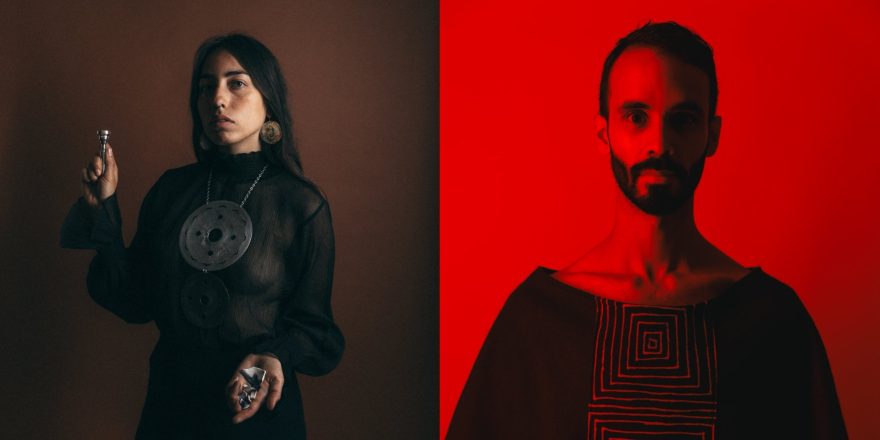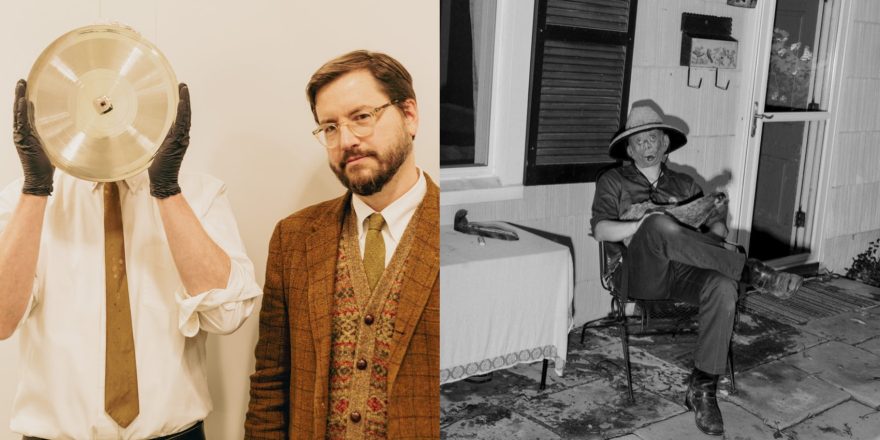


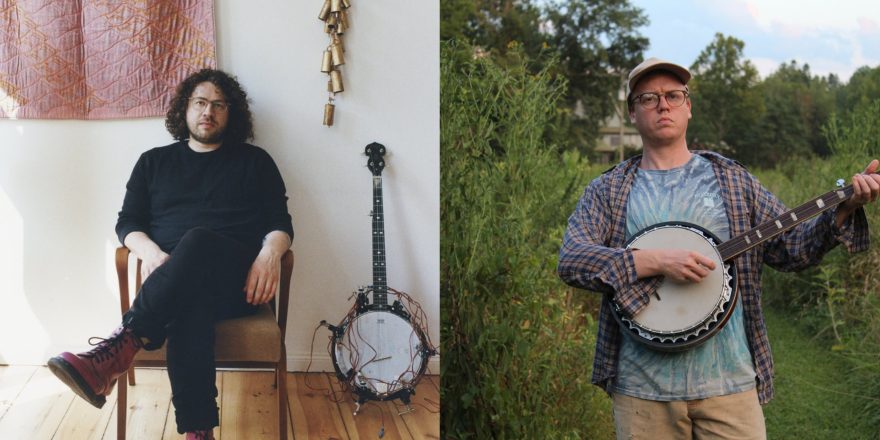

Weston Olencki is an artist and musician from South Carolina, living now in Berlin. His latest record, Broadsides, is out now on Outside Time.
(Photo Credit: Cy Klock)
Daniel Bachman is an artist and musician based in Virginia; Weston Olencki is an artist and musician from South Carolina, living now in Berlin. Weston’s latest record, Broadsides, came out last fall on Outside Time, and Daniel’s Revolutions just came out last week, and to celebrate it all, the two got on a call to catch up about their musical origins in the South, and much more.
— Annie Fell, Editor-in-chief, Talkhouse Music
Daniel Bachman: I think the best place to start for both of us is with brass instruments. Do you want to start with that?
Weston Olencki: Yeah. Basically, the short story of it is that I’m from a small town in the South, in upstate South Carolina, and my first inroad into music in a substantial way was through marching band. I marched Drum Corps International when I was 14. And from there, brass — I fell in love with it, and it was more or less my ticket to the world. I auditioned and went to conservatory, studied classical music on trombone, and got super interested in contemporary classical music and free improv. A lot of the solo work that I’m doing now is obviously not using that, but still in other collaborative projects, it’s very much a part of my life.
Daniel: I had the same entry point. I think I started in sixth grade. I don’t know why I chose the trombone, but I loved the fluidity of — I mean, it’s that classic thing when a kid picks up a trombone and goes [mimics playing with a trombone].
Weston: [Laughs.]
Daniel: And you get that out of your system and you say, Oh, this is actually an interesting instrument. But I fell in love with music through it, too. I mean, I liked AC/DC and Black Sabbath, but getting to play in the jazz band at my high school — even though it was a very strict, formal style of jazz, and reduced to the point where kids can understand notation and improv and stuff — I really do think that was my jumping off place.
I definitely had years in the marching band as well. I’m very curious about the influence of empire and colonialism on drumline music, and I was wondering if you could speak to that.
Weston: When I was 14, 15, marching in DCI felt like, This is just a musical activity, we’re really interested in rigor and being really precise. But then as I grew older, realizing , Oh, this is a descendant of imperial music. Just flat out. It’s not simple though; it’s quite complex in the sense that you can’t deify it or damn it. But the history of the marching band and of these organized groups of musicians that move around in these parade formations (at least in the US) goes back to Veterans of Foreign Wars, American Legion posts, back into Civil War histories into the American Revolution — all of this stuff also being taken from Britain and the Ottoman Empire. [It’s] this assembled group of loud instruments moving around as this musical pantomime of imperial battlefield movements.
A lot of my interest in noise music and free jazz, and the values that those things have, or the states of being — usually pushing one’s body in some way — that a lot of these musics share, actually make sense in light of this early education Because I really loved that energy and precision, but also that part of marching music is inextricable from its own history. And so I think these symbols or these states where it’s inextricable from all of these different things that are around you, I’m drawn to these things. It’s not inert material which you then shape; the material is already so loaded.
Daniel: Yeah. I feel like I’ve been coming to this same place of realization over the last maybe 15 years of my life, of what culturally I have normalized from where I grew up, the narratives that I normalize, the highly propagandized history that I was given. So I really do feel a kinship with your work in that way. We really both are attempting to investigate these things sincerely.
Weston: Yeah. Obviously we can’t choose where and when we’re born — or maybe that’s a spiritual question for another time — but what do we do with this upbringing? If one is brought into this world in a particular history and particular worldviews and particular biases, you could run away with that, or you could try to understand it and try to change that course of sedimentation. What does one do with being from these, on the one hand, very beautiful and obviously very meaningful places, but also with a really, really brutal past that a lot of the people that looked like us before us benefited from?
Daniel: I believe it’s going to be a challenge that I’m going to be working on my whole life. One of the techniques that I like, when I’m reading history texts, is to read the text in the same time frame that it occurred. A recent one I did was for the enslaved person Gabriel, who’s also known as Gabriel Prosser, and his rebellion. I read it in August and you can feel the heat and you can hear some of the same sounds that they might have heard, from the bugs and the animals at that time of year. When I’m working with sensitive historical locations, I have been trying to portray a realism in that way. And obviously if you’re dealing with some stuff that’s over 200 years old, there are animals that don’t exist anymore, the rivers have moved, we have different weather patterns. But I feel like portraying things as literally as I can is a good way to combat a lot of the propaganda. And even just letting some of these places be known — because some of these places are still unknown, you know?
Weston: That’s a lot of the hard part about growing up in the way that we did: it’s almost what you’re not told. What are the truths that aren’t being shared? That’s how the propaganda machine is built. I mean, there’s obviously things that are told, but it’s all these things like, “You conveniently left that part out,” or, “You conveniently dehumanized all of these people.” That’s the kind of scaffold that this whole thing is built on.
Daniel: Absolutely. I can’t speak so much in South Carolina because I’m not as familiar with the history there, but here in Virginia, truly the most heinous colonial violence that you can imagine, of poisoning and extrajudicial killing and wholesale genocide and murder, all have been happening here since the 16th century. Even before the English. I feel like we’re at another one of these reckoning moments right now in American history where you either recognize the patterns of violence and power ways, or we are bound to repeat them again.
Weston: Yeah. Because now especially, the mask is off, fully. I mean, obviously for many people, the mask has been off for far longer, or the mask was never put on in the first place. But it’s true for the general populace, too, the shit has hit the proverbial fan.
So then in the context of all of this realism about this place, how does, quote-unquote, “‘American’ playing ‘American’ music,” play into this? How has that trajectory for you changed, or where do you want to go with that?
Daniel: Well, in the beginning I had a more sentimental approach, that I don’t regret now because it’s been part of my own journey of self-discovery and creativity. But these days, in terms of strictly the kinds of tones and music that I’m trying to explore, I’m really trying to avoid it. I’m looking towards more modal sounds and tunings and harmonies that I can explore, that don’t provoke that sentiment.
Weston: Interesting.
Daniel: I have learned a lot about technique and the lineage of some of this music, and I feel like that has been the most important role that it’s played up until now. I’ve really tried to research some of this stuff over my life, I feel like I understand it alright and how to play it, and now I’m not so hung up on trying to replicate stuff or play stuff perfectly, and really just emote. Which also does get tricky when you’re trying to interpret historic sites. I’m trying to be very sensitive of that, too. I’m not trying to have my own emotional watermark.
Weston: Yeah. The presence of the observer is obviously a very complicated thing.
Daniel: Yeah, and that is something that I revisit each project… I don’t know where I’ll be in 10 years, but I really try to keep an open mind about processes and learning, constantly being humbled by the history itself and the people I’m lucky to interact with. At this point, I cannot imagine making any other type of music. It makes me feel like I am constantly learning and constantly challenging myself, and that’s kind of what it’s about.
Weston: Yeah, keeping that flame alive. I mean, I left South Carolina when I was 17 and never really went back. I would go back for family, but spiritually, I never really went back, until around 2017, 2018 when I would visit home more and started to actually play down there, and then making work about it.
It’s also been a way, after I left the region and then left the country, to keep me grounded in this way of not forgetting where I’m from either. I feel like I spent 10 years running away from that and being like, “No, I’m not from down there,” getting made fun of in school for having the accent. I’m a kid from a lower middle class family in upstate South Carolina like, “No, no, I’m interested in modernism and the avant garde and blah blah blah…” And then at a certain point it was like, No, I am actually from down here. And that was an interesting thing, then trying to bring these two worlds closer together. When I started to play down there, it was this mind-blowing moment of these two sides of my life, of one’s upbringing and then one’s early adulthood [colliding]. And now it really feels like this work and this music is a way to keep connected, whether with people or with a sense of place or history, in this way that feels really genuine.
Daniel: I feel the same way, and I’ve had almost the same experience. I had very, very few opportunities or interest in anything that I was making as a teenager. And for me, Philadelphia was the scene that was closest that I had connections to. I moved around the town that I was from and had a bunch of spots downtown, and then I got the guts to say, “Nah, I’m going to Philly.” I experienced very similar things that you’re talking about — not necessarily shame, but I worked in manufacturing when I was there and I did get made fun of by my coworkers. They would be like, “Hey, you got a goat at home?” And I was like, “What are you talking about?” I also grew up solidly middle class, outside of the Fredericksburg area.
Was that a main factor for you leaving home? Just feeling like you had no way to connect creatively with people around you?
Weston: No, and at that time, too, I was actually more into visual art. Then I did music and was was talented at music and studied and practiced a lot. At 17 or 18, I don’t think I had the same kind of self-deterministic creative drive that maybe you did. I was starting to write my own stuff, but I didn’t start to really take that side seriously until I was maybe 23, 24. I really did study as an instrumentalist and as an interpreter and not a creator of music. I didn’t feel like I could give back creatively. The thing that I was interested in was just, “Get out, go far, go to a major city, go study.” I was just like, I want to just get the fuck out of here as soon as possible. But then after a period of time, it was just like, What am I running from?
Daniel: God, I had the same experience. It’s so funny: I sometimes can’t believe that I can play the banjo, because when I was growing up, I hated that stuff.
Weston: I despised it. I was like, “This is the most wretched…” [Laughs.]
Daniel: At the old high school downtown, they used to have a bluegrass series. I remember going to that a handful of times, and I hated it. Maybe it was the smell of people smoking cigarettes around me or something, but I just had this nausea over some of that music. And it has dissipated to the point where now I fully embrace it. Some of it, at least. [Laughs.]
Weston: Maybe at that age, too, you’re just not able to separate things — you’re not able to be like, “I really don’t like this part, but I really like…” You’re working in these bigger planes of emotion. Because I had the same thing. I was just like, “I hate country music, this shit’s awful.” I was interested in art and music, I was listening to Stravinsky and Aphex Twin. And then I would see all the people I was going to school with, at this rural high school, having Southern Pride parades and flying Confederate flags on the pickup trucks covered in mud and then going and playing Johnny Cash. And I was like, Oh, I hate all of this. And that is obviously despicable, but then you learn about especially older forms of country, and old-time and bluegrass, and it’s like, Oh, this is not homogenous at all.
Daniel: Your current process with how you’re making banjo and music related to traditional cultures, is the emphasis on live [performance]? Or are you also processing in a work? Is it a little bit of both?
Weston: It’s definitely both. Basically up until COVID, I was working in this super abstracted, experimental, very focused way. Then starting in 2021, I had a record called Verd Mont that was kind of the first step outside of that, of bringing together this false binary of the “avant garde,” quote-unquote, and the traditional, and finding ways in which the traditional has been experimental all along, and the ways in which experimentalism has also been its own kind of tradition. I’m really interested in this dialogue, so that was when I feel like I found a process of working, starting with that into Old Time Music — which is where I started working with the banjo for the first time.
With the banjo, what I was most drawn to it with originally was the charged quality that it has as a cultural object. It’s this really incredible sound device — it’s a drum strung with strings that is meant to project over mountain valleys. It’s so loud for an acoustic. It is this kind of chimeric beast: It’s this monster that’s been born from the violence of America, this instrument has witnessed every chapter of the formation of the American myth. So then it really was like, OK, what do I do with this thing? I don’t really play it, but how can I use this as a sound object, or in a kind of more sculptural way? So I work a lot with recording — I use Max MSP quite a bit — and also since 2020, working with a lot of things like transducers and mechanical things. So it’s really coming from a computer music background, but then using acoustic instruments almost as the thing which all of it is channeled through.
It has been a really interesting way, as a trained instrumentalist, to be like, I’m going to still use all of my knowledge of working with instruments and finding new sounds, but then also really working with, what does this mean to lay a banjo flat on a table and arrange a bunch of motors on it? Because a bunch of this material was coming directly from bluegrass. The kind of motoric, permutational quality of this music — I love it, and it reminds me of all this process-based algorithmic music like [Iannis] Xenakis, computer music. So how do you take that little germ and twist it out and make it go farther? Then embedding that into the poetics of how you make a piece… Doing that a bunch led me to this way of working, where it’s really just using it for all of the different sounds that it can make and all of the different voices and facets that it has. Musical instruments are so loaded. A guitar is fundamentally different than a banjo for what you can play on it and what it signifies, and to honor that has been really productive. So I guess the process is really starting from that: What really is this thing? Why is it still around? Why do people project these ideas and fantasies and aspirations or demonizations? Why is this so important?
Daniel: Well, I just love it. With the really skilled old-time players, whether it’s guitar, banjo — especially clawhammer style, but also a three-finger style — there is almost a mechanized quality, although there is still variation and room for improvisation. Which I also hear in your work.
Weston: To finish, you have a new thing that will be out by the time that this is out. What’s going on?
Daniel: I am really in a place right now where I am just cranking stuff out. And I’ll be honest, I am a little nervous about life in the US. I have a lot of ideas for stuff, and I’m trying to get them out as quickly and as consciously as I can. I have a record that is kind of my first stab at the cantareel recordings that I’m going to keep exploring that’s coming out on Friday. [Revolutions was released February 6.]
Weston: That’s the little device, right?
Daniel: Yeah, it’s just a little hand turned wheel that has two thin 3D-printed rubber bands that go around it and it makes contact with four strings. The most exciting part for me is that it works with the slide guitar seamlessly, so I’m able to create drones and then play a melody string. So I’m very excited about that.
I am so glad for this, because I really feel like we’ve become friends.
Weston: Yes, absolutely.
Daniel: I’m really looking forward to everything that you’ve got coming, and seeing where this takes us.
Weston: Likewise!
You can catch Weston on tour this month and next:
2/15: Lafayette, LA — Freetown Boom Boom Room
2/16: Houston, TX — JSB Music Room
2/19: New Orleans, LA — Zeitgeist
2/20: Jackson, MS — Innards
2/21: Birmingham, AL — Sweet Wreath
2/23: Atlanta, GA — eyedrum
2/24: Nashville, TN — Random Sample
2/25: Chicago, IL — Constellation (with RAGE Thormbones)
3/1: Chicago, IL — Constellation (with TAK Ensemble)
3/2: Indianapolis, IN — State Street Pub
3/4: Huntington, WV — HACkS
3/5: Whitesburg, KY — WMMT station/Appalshop
3/6: Knoxville, TN — Pilot Light
3/7: Blacksburg, VA — The Cloak Room (in Newport)
(Photo Credit: left, Cy Klock)