

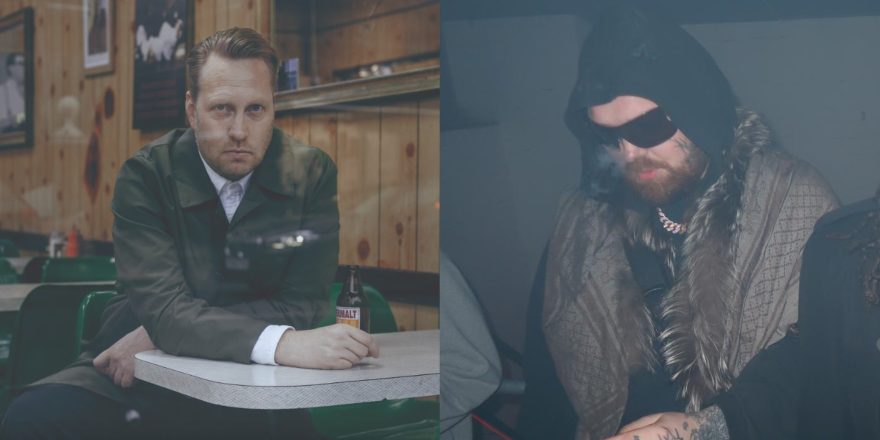

Christian Stadsgaard, also known as his solo moniker Vanity Productions, has become a crucial figure in the contemporary Nordic electronic and experimental music scenes in the past decade.
Standing at the helm of the label Posh Isolation with Loke Rahbek, Stadsgaard is responsible for one of the most consistent and compelling labels to both define and elaborate the many productive sides of the underground in the last decade. As a performing and recording artist his work with Rahbek as Damien Dubrovnik was a critical project in the contemporary noise milieu throughout the 2010s. More recently his collaborative work with Jonas Rönnberg (Varg2™) and Isak Hansen as The Empire Line has gained significant notoriety.
However, it’s in Vanity Productions that the full breadth of the emotive intensity of Stadsgaard’s work is expressed. His collaboration with the seminal artist Merzbow in 2019 led to his Coastal Erosion album for iDEAL Recordings, prefacing a recent series of works that take their cues from minimalist composition.
The latest Vanity Productions record, The Vanity Project, is out now on Northern Electronics.
Christian Stadsgaard, aka Vanity Productions, is a Danish electronic artist and the co-founder of Posh Isolation; Varg2™ is Jonas Rönnberg, a Swedish electronic artist and the founder of the label Northern Electronics. The new Vanity Productions record, The Vanity Project, just came out on Northern Electronics earlier this month, and to celebrate, Christian and Jonas got on a Zoom call to catch up about it.
— Annie Fell, Editor-in-chief, Talkhouse Music
Christian Stadsgaard: OK, how we met: if I remember correctly, we met at this festival in Sweden called Norberg. I think it was in 2014. Jonas was wearing this Mayhem Deathcrush t-shirt and looked like a complete psychopath. Long hair, viking style… Which, nothing has changed much.
Jonas Rönnberg: [Laughs.] No, I look the same.
Christian: And I was wearing a white shirt all the way through an outdoor festival, so I guess I looked quite psychotic too.
Jonas: I remember you were sitting on a hill and I had a big duffel bag filled with champagne bottles. I had Bollinger and Moët — like, 40 bottles in a duffel bag. You were like, “Where the fuck did you get those?” And we shared those bottles. We drank a lot that night.
Christian: So we bonded over champagne and broken sounds, basically.
Jonas: That festival was so fucking fun. I really miss those days of the scene, to be honest. I think it was the same year Ättestupa was playing — or maybe they were the year after. Anyway, I remember that show so much. It was three guys, one reel-to-reel recorder with one tape loop for, like, 30 minutes, and it was fucking great. I miss those kind of performances. They really died out.
Christian: I just talked to Cem from Herrensauna and he just played Rewire festival, and he wrote in an Instagram story that when he saw Einstürzende play at the last one, it was actually quite a relief, because it was just some guys doing very limited things, but it had a much more impactful effect than 40 guys with a laptop doing, you know, more or less, crazy sound design.
Jonas: For something to die out, it has to reach its full potential, and then it will come crashing down. And I kind of feel like it’s been a while now where technological music is failing and people are longing for the old, more easy way. Even if rap is getting more extreme and digital by the moment, even there now they want the music to become more minimalist and genuine sounding. For example, last year when I was working on that Skrillex album, I was listening to a lot of Mika Vainio sound design to bring into Skrillex sound design world.
Christian: I think also, we have reached a point where we are so advanced in technology and it’s become so easy to make something that sounds quite impressive, that what is lacking is the human factor. And I guess that is what people are longing for. Even if it’s just a guy banging on a can, it still makes it something that you, in one way or the other, can relate to. Rather than, you know, crazy fancy sound design.
Jonas: Bro, I think it was 2013 when we met at Norberg.
Christian: Probably.
Jonas: Because I think 2014 in February, we did the Posh Isolation/Northern Electronics Valentine’s Day. I remember it was like a buffet, briefcases filled with cigarettes and condoms and candy for all the couples coming in. [Laughs.] But at the soundcheck — I think about this so much — I’m not saying it’s wrong performing with a laptop or anything, but it was so fun because everybody had just been at home with their tiny little toolbox preparing their little live show, scrambling together, and performing it for a circle of friends. And also fans — even then, people would travel from, like, Lithuania and shit. I think people are missing this. It’s a very necessary part of music culture that really just disappeared.
Christian: Yeah. I think also back then, we made do with what we had. Whatever gear we had, we just made it happen. Which I guess made it sound quite unique because, at least I didn’t know anything about computer production back then. Nothing, zero. So we had a different approach to it because it was just these untrained noise musicians, punks that started making electronic music in whatever way they could figure out, which was very unorthodox. And I think since we are now all pretty skilled with computers, it is one of the things that we, to some degree, lost. Or, I know that both of us are trying to incorporate old school lo-fi techniques again.
Jonas: Because it’s important. I feel like that’s been the backbone of both Posh Isolation and Northern Electronics. And it hasn’t been that long of a time you’ve been releasing on Northern, but it’s very logical that you do. Everybody on Northern is doing hardware and lo-fi shit. Everything is really mucky and you can hear in the soundscape what is Northern Electronics and what is not. And you’re very much a part of that sound — one of the originators of that sound.
I’ve been listening to the album, actually. It’s fucking good, bro. [Laughs.] I was sampling some of it yesterday.
Christian: Perfect. I was sampling someone else making it, so. [Laughs.] I really try to take some of the things we did back then and incorporate that in what I do now. Because, for example, with AI, in two years it’s gonna be like you can make a track that sounds exactly like whomever you want to sound like.
Jonas: You can already do this. It’s so ridiculous. I have a friend that said a few years ago that he really wanted to be a shoe repairman. I was like, “That’s a very random thing.” And he was like, “No, bro, it’s a dying art. Nobody wants to be a shoe repairman. First of all, we need it — if people have some old, beautiful leather shoes, they don’t want a machine to fix that. They want to go to a person that can do it and can give you real advice and communicate with you…” I feel like it’s the same within music. It started with the computer power being too much and people being too nifty with it, so the music escalated into this very impersonal and almost clinical way of creation. It kind of was more like a jingle than actual music, you know? You can also see that with the attention span of the listeners. I feel like the length of music is coming back. For example, people are complaining that my ambient music is too short these days, because I only make four-minute long tracks.
Christian: [Laughs.]
Jonas: But I think it’s really coming back, the craftsmanship where you can hear that someone actually made this, as much as you can feel when you eat food that a human being cooked it. It’s a very big difference from industry to personal and emotional. And music is just that — it’s just emotion at the end of the day.
Christian: Yeah. And that also leads me to believe that in the future, it’s not so much about your musical skills, it’s more about your ideas and your ability to actually have this sound as you as an artist. I’m not saying that your skill completely doesn’t matter — of course it does — but it has to have a signature. It has to carry something more than just, say, an impressive sound design.
Jonas: But this is the thing — I mean, I work on so many different levels of music here. Words like “A&R” are very new to me. But I’m starting to realize what an A&R is, and I realize I’m a really good one. And I’ve also realized that’s a very rare talent. [Laughs.] Most A&R, they don’t really know what to do with the music. If you actually take a look around and you think about what the best music in the world is, there isn’t that much on the higher level that is actually interesting. You know what I mean? Everything kind of feels generated and like you can expect it. And I feel like this is what these A&Rs’ and labels’ jobs are, to pave the way that is already paved. Before it used to be derailing, like Sex Pistols — poof, Crass. Stars shoot off the given trail and give way to new shit. Now, when you go to label meetings, they’re like, “This is great, but we’ve never heard something like this before. How should we market it?” It’s like, “Fuck off, man. Put some money into it.” “But what TikTok dancers are gonna dance to this?” It’s insane that a make-or-break for artists today is not about, like you say, the beauty of the idea. That is what it should be. But mostly these days, I just feel like it’s how you get as many people as possible to keep up with it for 15 seconds.
Christian: Yeah. I mean, that part of the industry… I’m very far from. [Laughs.] But I believe you. Even, for example, in experimental music or in noise music, people can be very genre-oriented. “This is cut up noise,” or “this is wall noise,” and so on. Trying to make something that sounds like what people were doing 40 years ago just makes it so genre-oriented that it becomes regressive. It just becomes self-referential and locks itself in its own chamber and doesn’t challenge anything. And I think if it comes to experimental music or punk or so on, it’s completely the opposite of what the point was back then. It’s a complete misunderstanding of what it was about.
Jonas: But this is something that’s so interesting, because this genre policing — micro-micro-genre policing — is kind of the same divide we always see. It happens with left wing groups — always internal battles about shit. It’s the same with music: Every kind of nerdy subgroup always becomes an internal battle. But that’s when it loses the point. The strength in all of this weird or experimental music is always unity. I think that’s the strongest weapon in this.
Christian: Yeah. But my point is that it seems like people are so genre-oriented from the smallest underground on up until the biggest superstars, in a way that it’s regressive.
Jonas: But music’s also changed so much. Imagine when rap music came out first with NWA — even Public Enemy at some point was considered really provocative and crazy.
Christian: [Laughs.] I love Public Enemy, man.
Jonas: [Laughs.] Or like WASP — it was considered outrageous to listen to Twisted Sister. And now, if you think about drill music and what rap music is now, a couple of years ago the main reason why a song would sell was because you would basically admit a recent murder on the song, and name the victim. When we’ve gotten that far… Nothing is really shocking anymore. We are at a really stagnant point. I guess that’s why people are looking back so much now to nostalgia, when music still had some kind of oomph to it. Everything’s very timid and Nickelodeon now. Everything is mixed and mastered in the same way. You can’t even smoke inside in most studios these days. Tell me one record that’s been made in a smoke free studio that’s good. I fucking dare you, bro!
Christian: [Laughs.]
Jonas: Music became boring and square and it became really a business. Some friends of mine from the north of Sweden, they released a seven-inch on some grindcore label in New York in the ‘90s, and they got kicked off the label because their seven-inch sold so bad. It only sold, like, 10,000 copies or some shit like that.
Christian: You can’t move 10,000 copies today of a seven-inch.
Jonas: Bro, you can’t move anything! It’s really strange days. But it’s difficult for me to say, too, because I don’t really buy vinyl either these days.
Christian: I don’t know if it’s just this sort of endless scroll has made us completely indifferent to anything — we don’t give a shit about anything, because it’s just news after news after news, people shouting after shouting after shouting, and all of a sudden we are just numb. A new track by someone? We don’t care.
Jonas: It’s crazy because I don’t even put the time in to listen to a record like that these days. It’s rare. I’ve been listening to your record, the one we just put out, and I’m like, “Damn, this is really good.” But it’s been taking me time to find that moment to actually sit down and enjoy a record that I’m even looking forward to. That used to be every day before…
I’m just really fucking happy that we still have the power and are still willing to put all this energy into doing it for the small amount of fans that still buy the physicals and still care about this shit.
Christian: It is, indeed, strange times. I do think, for example, that Kanye made some stuff where — I mean, he most definitely also went a bit far. [Laughs.] But he did some stuff that I was like, “Ah, OK, here is something interesting…”
Jonas: I mean, good and bad, he’s one of the few that doesn’t have a filter to the world. And there’s something admirable in that, too. Many people call it narcissism, but it doesn’t really feel like it. It kind of feels like he’s trying to do the world a favor by giving out his crazy ideas. And sometimes it lands and sometimes it clearly fucking doesn’t. [Laughs.] But he’s always attempted to do something with music anyway. He’s not insecure, and many people are. There is so much insecurity in artists these days because they need to please a label. It’s a lot harder to make money by yourself these days. We always made a living — even running a shoe box tape label from your apartment could pay your rent and food and equipment back in 2015.
Christian: Not anymore.
Jonas: You could make an easy thousand euros a month from just dropping a few ambient tapes by yourself.
Christian: Yeah, those days are over.
Jonas: Those days are over. And I think that’s the sadness, that artists stopped communicating artist-to-artist. Now it’s fully algorithmic and you need to prove data to labels in order to get your music out and get your music actually heard. I stopped using Spotify — it’s not like a radical political action, it’s just I changed my accounts when I had to upgrade my car details and I couldn’t be assed. But honestly, I don’t miss Spotify. Because it always pushed stuff on me. Of course, I’m a music nerd, so it was really nice when finally all the Coil records started getting on there — I’m like, “This is great, I can have all the Coil music downloaded on my phone when I travel.” But at what cost? Nobody’s getting anything from this. Artists ain’t getting shit, and they’re not getting discovered. All of these fake ass playlist things — like, “Ooh, Industrial Music” — you can for sure know that they’re gonna put some random ass TikTok guy from America on there and claim that it’s industrial. It’s bullshit, man.
Christian: Yeah. Plus they will generate stuff themselves. I’m sure they had a production team before making all these easy listening or ambient playlists. Half of the music, you’ve never heard of it.
Jonas: For sure, bro. But now twice it’s happened in Sweden that the top of the charts has been an AI-generated song. That shit happened twice, bro.
Christian: [Laughs.] But, I mean, the future is now. Because that shit is gonna only be more and more and more. Especially here in Denmark, I see some of the industry people being very against AI. But I feel like it’s a lost cause. It’s like when they tried to fight Napster. Yeah, they fought Napster, and then we got Spotify and all the streaming services.
Jonas: Or even the war on drugs.
Christian: Exactly: You are going to lose. So instead, maybe figure out, “OK, how do we use this new tool creatively?”
Jonas: Yeah. Of course you can utilize AI for your music — resampling shit. But the way AI generates music is really fucked up. The way we make music is that we start in a room of silence, and we raise up the oscillator. How AI generates music is, it’s a wall of fucking sounds until the song is there. That shit is scary as fuck to me. That’s making music in reverse. It’s starting with all sounds of the world at the same time, and then with the word you prompted, it subtracts it down, to some idiot shit that some old person can post on Facebook. But of course you can use this because it will bring weird sounds that we would never create, and you can resample it and make it music. But you can’t trust it to be your become your ghost writer. That’s bullshit.
Christian: I tried yesterday in bed to make a five minute drone track via AI, and it came out fine. But it’s not something I could release in my name. It has no personality. There’s no signature to it. It’s completely generic. You could take parts of it and then build something out of it, but you can’t release it as a track.
Jonas: That’s the thing. But what I feel is happening now is an uprise of real arts and cultures again. I feel like the computer age is slowly coming to an end, and I’m all for that. It’s time for fun again. I think more people should start releasing physicals again, just for the mere fact of keeping in touch with each other. I think that’s the real strength of the internet: You can find any kind of person all over the world instantly. But it’s pretty beneficial sometimes to just be the neighborhood freak. You know, I grew up in a tiny ass town listening to black metal music and Jamaican dancehall, because that was the music with most the most bass I could find in the north of Sweden. That created who I am, and that gave me my signature. And I feel like today, why people are lacking a lot of this unique signature, is because it’s so much easier to find your identity, but I don’t think it’s actually that you find your identity. Your identity needs to be shaped. You can’t just do a mix-match of, “I like this and I like that. I’ll go on Vinted and buy an outfit that matches this,” and now you’re that person. In order to be actually anti-culture, you need to live an anti-culture life, and most people aren’t down to do this these days. Most people, even if they’re edgy and even if they’re on the outside, I bet they’re still on TikTok, you know?
Christian: [Laughs.] I mean, you can’t fight the internet. We are where we are. I grew up before the internet, and it was such a fucking hassle. You would read about some punk rock stuff and then you’d have to go and find the record, and you’d buy it, and then you’d come home and it wasn’t that great.
Jonas: Exactly, bro. But you would still listen to that shit back and forth because you paid for it.
Christian: Yeah, it was the only thing you had. I mean, of course there is a liberation in having all this music available that you have now, but it also ends up in, as I said before, endless scrolling. And with a new release, for example, you are not just competing with other new releases, you are competing with every release that was ever made in the entire universe, because everything is available at this very second. What some dude did in Cambodia in the ‘60s, you are also competing with. So I think it’s both exciting, but it’s also very fucking difficult.
Jonas: Yeah, it’s too much. And consumers are not ready. I see people get clowned for dropping digital albums — like, “Oh, you think I would pay €8 for this shit? Fuck you, bro, put it on Spotify.” It does not make sense. But with that said, this communicational thing — when I was 14, 15, I used to still send letters to other producers and DJs in Stockholm, and they would send me their DJ mixes on cassette tapes. So doing those kind of exchanges, I think it’s still active. I have younger friends that I work with that are 18, 19 that are still on SoundCloud and shit, and it’s a small community there.
But I think a physical thing — this is where it needs to circle back to. I think people need to start that outsider community again. Real anti-culture needs to come back.
Christian: Yeah, it would be interesting to see. I have a hard time seeing it, but I really hope it would happen.
Jonas: Yeah, I have a hard time seeing it as well. But, you know, music lives forever. I just hope that it comes back soon with the real art and the real feeling of real creation.
Christian: That would be great. And the whole, something came out in 50 copies and if you didn’t get it then you won’t hear it — there is something very cool about something that is so contemporary that, if you didn’t get it at the very second it came out, you just completely missed out.
Jonas: Yeah, man. You have records like this — I have records by you that I wanted that I never got to hear because the tapes sold out. I miss those days, bro.
Christian: Well, it is going to come out in a repress very soon…