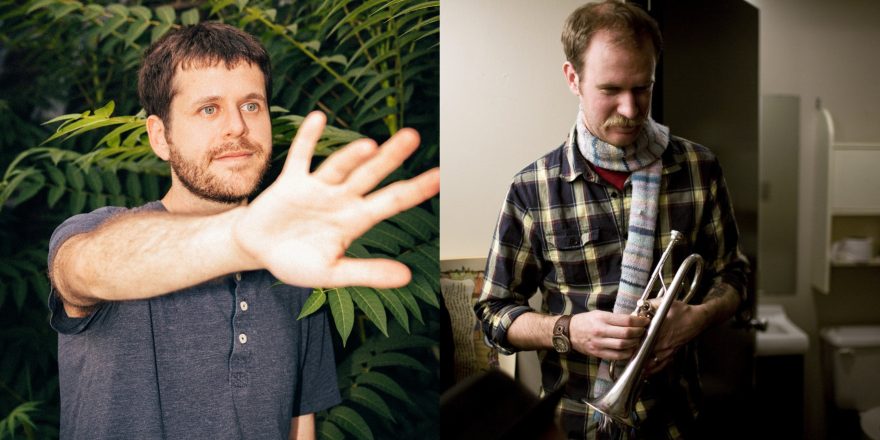



Tōth is a project of Brooklyn multi-instrumentalist songwriter and producer Alex Toth, known for collaborating and writing with Kimbra, Alexander F, Rubblebucket, Caroline Rose, and others. As Tōth, his latest record, And The Voice Said, is out now on Northern Spy/Egghunt Records.
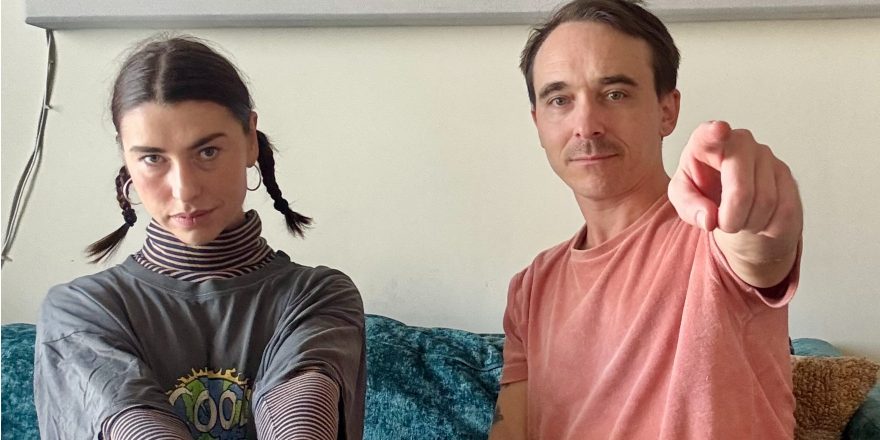
Alex Toth is a Brooklyn-based multi-instrumentalist songwriter and producer who co-founded the collective Rubblebucket and performs as Tōth; Kimbra is a New Zealand-born singer-songwriter. Kimbra features on “Touching,” a track off of the new Tōth record, And The Voice Said — out today on Egghunt/Northern Spy — so to celebrate, the longtime friends sat down to catch up about it.
— Annie Fell, Editor-in-chief, Talkhouse Music
Alex Toth: That was a great little dance party we just did.
Kimbra: We’re both a little puffed.
Alex: Yeah, we almost canceled the interview.
Kimbra: Well, I think it’s the perfect way to go into an interview, because I’m always overthinking myself before I go into any kind of interview or conversation in general. But because we just got in our bodies, I feel like I’m really aware of all the sensations inside me in this moment and I feel very present with you.
Alex: Yeah, I’m still catching my breath. Kimbra put on a 10-minute long soul, prog, R&B song.
Kimbra: It was a journey.
Alex: We really fucking danced.
Kimbra: Let’s talk about your album. I was listening to it on the way over here.
Alex: Thank you.
Kimbra: It’s one of those records that gives names to many of the emotions that I feel day-to -day, but don’t feel like I necessarily have the vocabulary for in my own head. You’ve written songs that very much appeal to people like me who have that combination of existential angst and longing for the divine, but severe limitation in their own skin and thoughts — limitation in the sense that we get in our own way a lot. And something I appreciate about your music is just how honest it is about that experience of desiring freedom. That’s what I hear a lot in your work: the desire for freedom and the total raw experience of being so human at the same time. The animal and the divine, wrestling within the person.
Alex: I don’t think of you as somebody who’s severely limited in any way. [Laughs.] You’re like a radiant superstar.
Kimbra: Well, thank you for saying that. I feel like that side of me comes to life through art. But when I’m just moving through the world day by day… That’s why I write. I’ve been thinking about this recently: a part of our friendship is that we’re always looking for ways to better accompany ourselves through this journey of life, to be a better friend to ourselves. So what I mean by “limited” is that some of us feel like our brains aren’t always on our side when we make art.
Alex: I think maybe one of our commonalities is there’s so much energy in our bodies, and that can create an overwhelm.
Kimbra: That’s a good way to put it.
Alex: Yeah. It’s not a limitation as much as, I’m overwhelmed by the amount of electricity or energy moving through. It can be painful. Because like every human being, there’s childhood wounds and messaging that’s imperfect and that is very critical. And when that is combined with a lot of moving energy, it’s pretty intense. We’re coming up on 10 years of friendship in March, and I feel like a lot of the people closest to me — there is an eccentricity to us, you know? There’s energy. Like, we went from sitting at the kitchen table calmly drinking coffee and eating oatmeal and talking about life, to angular, convulsive, 10 minutes straight of dancing. [Laughs.]
Kimbra: [Laughs.] Totally losing it. Actually, it was a lot like the music video. I was thinking about how natural it was in that music video, “Touching,” to be making shapes with our bodies. Because I feel like I’m one of those people that — I’ll come back to the word “limitation” again — I feel like I only have so many words that I can use to explain my experience, so when I get to use movement or melody or sound or texture, suddenly I feel like those voices that are maybe in your way or fear-based or conformist get freed, because I’m able to put that voltage into something that can hold it. The moving and our music — it can hold that voltage [from] day-to-day life, interacting in a world that is kind of designed to keep people within their fears. The more afraid someone is, the more likely they are to stay small. And artists have always been outside of the norm there.
Alex: The thing you said about the desire for freedom in my music — this has been the case as long as I can remember. In Rubblebucket, it was always the goal, to break that fourth wall between the audience or the listener and to shake people up and help them find their freedom, their feeling, their joy.
Kimbra: Tell me more about that with this album. To me, it goes into so many things that I know about you as a person that we talk about so much, and then it’s in the music so strongly. But did you go into it with an intention to talk about certain things, or did the songs just kind of unfold as you went?
Alex: Yeah. I think the thing that can be really troubling for any human being is when we’re in pain and and we’re attacking ourselves — it’s that terminal uniqueness. We think we’re the only ones that are going through this, and we are worthless or I shouldn’t be here sort of feelings. And the thing about that is, it is pretty universal. From an early age, I was really interested in psychology and understanding my friends; I was always drawn to people that were more tweaked or going through something and like, Well, what is that? And what is that in me? I think I’ve learned over time that whatever’s happening in me, I’m touching on something that’s universal to the human condition. So by exploring that in myself, by witnessing that, it doesn’t matter how specific I get in certain songs. I have this trust that the feeling will be understood.
It actually reminds me of the book that we’re reading together, the Thích Nhất Hạnh book, Living Buddha, Living Christ. He talks about the importance of paying attention to what’s going, paying attention to our bodies and what’s happening inside, noticing our own judgments, our own inner violence. That is the key. The more we’re with ourselves in that, the more we can be compassionate to our, quote-unquote, “enemies” and to others, and the more we can show up activistically in a really effective way. And so I think that on this record, it is a goal. It’s a goal when I’m writing songs to reach down deep.
Kimbra: That’s so beautiful. It’s exactly what I feel. I think of a song like “Ice Cream,” how you go from talking about the very commonplace experience of just getting ice cream, and then also accompanying a friend to the psych ward. And that chorus, “There’s mountains that don’t have names, they don’t have names, they don’t have names. So many folks are insane, they’re going insane, they’re going insane. I don’t want to die alone.”
Alex: [Laughs.]
Kimbra: I mean, this is coming out of talking about just buying ice cream. To me, so much of life is this combination of these things that are just so mundane, seemingly, or rooted in seemingly no real larger meaning being smashed right next to things that are just crushingly real and heavy. And when someone sings about this to you on a song, it just puts it so bluntly. That is the ultimate fear of human beings: death itself and dying alone. That combination expresses so much that we long to be connected, we long to understand death as well.
Alex: To be held in our pain.
Kimbra: And yet we also have to wake up tomorrow and put on clothes and do our teeth and go to work or go back to a song that we’re working on. There’s something so tedious about the daily ordinariness that we have to engage with while also holding these massive longings, fears. That’s the thing that comes out when we were dancing before, right? It’s that tension of, I can’t find an answer to these things, but they live in my body as these question marks that I have to get out somehow. Basically, what I’m trying to say about your music is that there are other people who would ask those questions, but do it in a very heavily poetic, overly ornate, decorated way. That’s also beautiful — that’s the great classical pieces like Debussy, drenched in that sort of emotive longing, questioning of the human experience. But when I listen to your music, I do feel like I’m in your living room here having these sorts of talks with you. It’s the relatability of your voice and the relatability of your putting it as it is, not dressing it up too much. That goes a really long way for people, I think.
Alex: Thank you. I think about… for some reason, Thelonious Monk is coming to mind.
Kimbra: Oh, yeah?
Alex: Thelonious Monk talked about music coming from the body, and most of his practicing, from what I understand, was listening deeply to music. And when he played, just the importance that nothing is intellectually thought of, that it’s all released from the body. That’s always been really important to me. That’s how I make music. I think it’s the part of music that makes it really cathartic and healing for me. If you let the ideas speak through you — they’re not my ideas, they’re just coming through and it’s so physical. I love that about it because I don’t ever know what’s going to come out. The process of creating is one of discovery. And similar to therapy or journaling, you can really work stuff out as you’re doing it.
Kimbra: That, I think, is very much true, that music is the vehicle for doing the self-discovery. So much of music is where I learn where my fears are, and then I learn to take risks. And through the use of the body being so completely committed to something — it’s why I have to use my hands when I sing — they are gestures that help me to let go of analysis.
Alex: Watching you sing, I love how your hands are, like, tracing your voice. It’s so cool.
Kimbra: But I am following the spirit. It feels like that. I mean, you’re right, there’s a channeling thing. My hands are moving according to instinct, and the instinct that’s flowing through the body is that sense of maybe spiritual momentum, because it’s coming seemingly from somewhere else or deep within you. And it’s the thing that’s animating what you’re doing, and you’re not making it happen through force; you’re trusting that it has something. Like you said, I’m trusting that if I say this really deep, journal entry thing, someone else will also know that, because it’s something so essential, isn’t it? It’s like trying to find the purest version of gesture or human emotion. The more pure it is — not performative.
Alex: Authentic.
Kimbra: Yeah. When you get out of trying to perform for people… then it maybe makes you more available to be used in the moment. I think my whole goal in life is to be in collaboration with that spiritual essence, that thing that animates us, that thing that ultimately seeks to harmonize in the world, to create wholeness in the world. That’s what we’re doing with music as well, giving life to things that need to be felt.
Alex: Yeah. That’s why I think the daily practices for me around spirituality are essential. They’re essential to, as you say, harmonizing with that spirit. And that energy within is a double-edged sword: While there’s a gift to having energy that makes you want to dance and sing and write poetry and and perform and try to bring joy to other people, there’s just so much ouchie with it.
Kimbra: Oh yeah.
Alex: There was something around the biological selectivity of different mental illnesses and how there’s only maybe 1% of the population that are bipolar and, like, 90% of them are in the poetry, music field. Don’t quote me on that… [Laughs.] But it’s something like that. So as a result, all throughout history, there’s been incredible poets and artists and musicians [with bipolar disorder]. I have my own version of that thing that tries to pull me under. And over the years — I’m now 12 years sober, going on meditation retreats and getting better and better at my daily meditation and journaling and exercise and therapy and recovery meetings and dharma groups and talking with friends — I’m able to harness that angularity, that ouch, in a way that’s it’s beautiful. I can actually be a musician and enjoy being a musician, too, if I’m lucky. I’ve really been coming into that more and more recently.
It feels cool to gradually show up over the years in this ritual disciplined way in a world that’s so wild and volatile. You’re touring all around the world and just manipulating compressed air. The money’s really erratic and sleep can be erratic, and the whole thing is just weird. So to find your own consistency through spiritual practice and self-care, it’s just been crucial. And I’ve found that journey has exponentially deepened my relationship to the music and my ability to hear more and more subtle and more authentic or pure messages that I’m less in the way of. because of doing that.
And you’ve been a huge part of that over the last 10 years, because you came into my life only two or three years into that journey. I just had gotten off a meditation retreat and was going through a breakup of 11-and-a-half year relationship and I’d just started a punk band. You were immediately connecting with the punk band and the “I Am Sensation” thing.
Kimbra: That song is a mantra for me with my own spiritual practice, remembering that I am just a series of nerve endings… OK, keep going.
Alex: But then, as I was going through this breakup, I was writing these new songs, and I didn’t have a home for my punk record yet. I was like, “I don’t know what these songs are… Kimbra, do you want to sing this?” And you loved the songs, but you were really encouraging to me, “You should make this record, Alex.” You really encouraged me to start this project that’s coming to fruition today. I’ll never forget that.
Kimbra: I’m so glad that I was honest with you about that when I said that, because I knew that you were looking to find how that song could come to life in different ways. And I just remember thinking, There’s only one person that can bring the song to life. There’s only one point of view that’s coming across from the song. It’s your story to tell. It’s so clearly such a singular perspective, and it is due to so much of the shared experience that we felt, even on that day. I was like, Oh, the person you are in normal conversation and who you are on the record, there’s very little, if anything, between those two experiences. I think that’s what’s really powerful about certain artists. And that’s the greatest compliment I can receive as well about my own music, when people say they feel so close to you on the record. I mean, performance is not bad, of course. There’s a heightened exaggeration to what we do as artists. But it’s almost like that’s the entry point. And then when you’re on the track, you can get to that point where you can be so completely there with people. And that’s what I felt. I was like, This is a through line. The person who’s walking in the house here and the person they’ve captured on the record is one.
Alex: Yeah. That’s what we want.
Kimbra: And that’s why the erratic, eccentric sides, putting that into the work too, it finds a home. It finds an expression. Because that’s how humans are meant to be. We talk about bipolarity — we’re told it’s not OK to surf these extremes, because at times it is really worrying when we have to live in those spaces for too long. Super high, super low. But the way that we feel that that is somehow wrong, in a sense, it becomes like an alien experience for people to go into those heightened states. It becomes like something that is very, very wrong, when really it’s very human to have that. And I think what maybe is the thing that makes it so difficult to hold it in our bodies is that we’re not given spaces within our society to actually safely go into that. We were talking about the power of ritual to hold us and keep us aligned with higher power — I think it’s the foundation that allows for us to explore those spectrums. Within reason.
Alex: I am curious what you mean about the certain highs. Because from a medical standpoint, some of the bipolar highs can actually do permanent damage, like burning synapses, if you stay in them. So that’s also the importance of finding various means, whether they’re Western medical or Eastern or otherwise, to ground it, so that you can experience some form of that without doing long term damage.
Kimbra: That’s the thing: this industry — talk about artists and poets — has a high kill rate. It has an intensely short lifespan for a lot of people. Because for a lot of artists — and myself, having been on this journey — to help that side of us can be a fear that it will lessen our creativity.
Alex: What has your experience with that been? Do you have any reference points for being not necessarily in a super low or super high, but also feeling creatively aligned and happy?
Kimbra: [Laughs.] “Can you be creatively aligned and happy?”
Alex: [Laughs.] No, like in the neutral, or just a little bit high.
Kimbra: It’s increasing your ability to tolerate that space, to give yourself the support systems. And they do often, for especially severe mood disorders, include medication. But they also include so many other things that give us the ability to increase your window of tolerance for those experiences, so that you can touch them but not have to believe that they are necessary and required for great creative work. I always used to be more drawn to melancholy and, like you said, people who had been through hard things, because sometimes you think that there’s more value or weight to those experiences because of their intensity. But that’s the same thing: It’s the voltage in the body looking for a way out, so it’s drawn to intensity. And that can be not good, because we take ourselves into situations that create more of that voltage that actually needs to ground. So nature is a huge one for me — when I touch trees, I’m able to actually feel all of that in my body root down into the tree, and observe the stillness of things, listen to things deeply and listen to my own internal ebbs and flows without seeking to attach to one more than the other. I think the life of someone who swings severely can feel sometimes like you are losing the ground. So I’m grateful as well that we have had each other to walk through that journey with.
Alex: I absolutely love the tree thing. I have this image of you just hands and head on the tree. I haven’t really done that.
Kimbra: I do it all the time.
Alex: Do you ever hug them?
Kimbra: Yeah — kiss them, actually.
Alex: You kiss them?
Kimbra: Yeah. I hold the the trunk and then I kiss it. And what you’re holding is this entity that is so deeply rooted in the ground. It’s an actual living symbol of rootedness. To hold something that is so deeply grounded, you’re actually taking on some of its energy when you do that.
Alex: I love that. I want to do that. Let’s do that.
Kimbra: [Laughs.] We should! It’s a beautiful practice.