


Tony Njoku is a London-based composer, producer, and multi-instrumentalist. Tony’s latest record, ALL OUR KNIVES ARE ALWAYS SHARP, is out now.
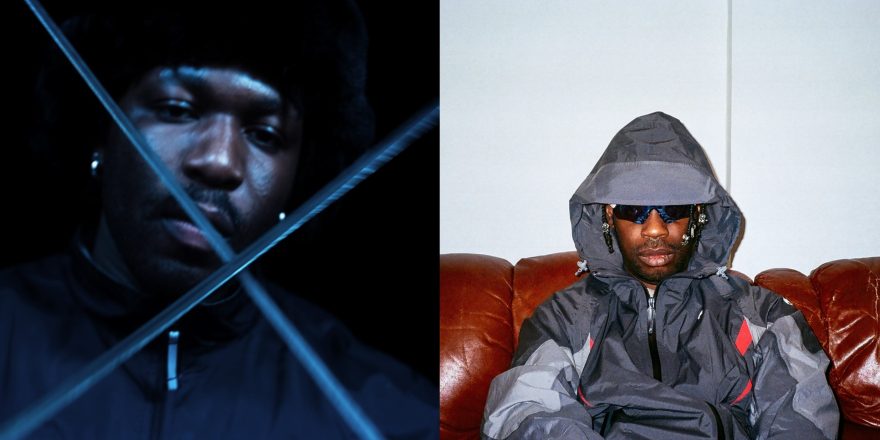
Tony Njoku is a London-based composer, producer, and multi-instrumentalist; Gaika is a singer, songwriter, and rapper also based in London. Gaika features on Tony’s latest record, ALL OUR KNIVES ARE ALWAYS SHARP, and to celebrate its release, the two artists got on Zoom to catch up about the state of the music industry, AI, and more.
— Annie Fell, Editor-in-chief, Talkhouse Music
Tony Njoku: Where are you?
Gaika Tavares: I’m at my house. How you doing?
Tony: I’m good man. I’m at our place in Margate, just settling in. I’m glad we made the move here but I miss the craziness of London too much.
Gaika: London’s cooked, though.
Tony: [Laughs.] Yeah…
Gaika: [Laughs.] So don’t miss it… It’s a difficult thing right now. A lot of people are hitting me up because I’ve been someone that’s made spaces, and people are like, “What do we do? How do we do it?” And for the first time, I’m like, “Yeah, I don’t know. I’m out.” Which isn’t entirely true. But I definitely feel like it seems harder than ever.
Tony: That’s exactly what I wanted to chat about as well, this idea of, how can artists make space for each other? Make spaces, infrastructures, build community that is self-sustaining? It does feel like in London it’s just harder and harder to find good spaces that you can do recurring things — independent spaces. I remember we had that conversation and you were telling me about all the trust fund kids buying up festivals, and it’s all just EDM fuckery. You know what I mean? I’m wondering, especially the experimental, the alternative side of things, what are things that we could do that could benefit us?
Gaika: It’s interesting — I watched Sinners last night, and it really made me think about this. Because when they create the juke joint, they created a essentially a working ecosystem. And in the short time they have there, they’re kind of creating the rules of engagement within this ecosystem, which is a creative space, and it gives people the necessary respite from the rest of their lives and it serves a community purpose. And then it all gets ruined because they don’t protect it enough. They don’t they don’t gatekeep it enough. They don’t understand its value in and of itself as a working system. Do I think it’s funny that Ryan Coogler is saying that on his millions? Yes, I think that’s very funny. But the point isn’t lost on me. And I think what I’m taking from that is: What we need to do is understand our own power.
Like this week, when Warner has done this deal with Suno for all this AI music, I ended up doing a deep dive and trying to research it. It’s kind of interesting insomuch as there’s very little real demand for AI music. I’m an electronic musician, you’re an electronic musician. I’ve got my connection to technology, in a serious way. But I don’t use AI for music. I don’t know anybody that does. So I started looking into, OK, who are the users? And the majority of them who are paying for a subscription are people who are doing so in order to speculate. They’re doing so in order to try and earn money from streams. So Spotify and all of those systems have got flooded with AI stuff, which 75, 80% of it is fraud. And so at the same time, you have this financialization, which is pumping money into something that is not backed by any real demand from the music listening public. It’s like an abstract notion that the Suno bosses have — like, “We need to democratize music making. People don’t enjoy it. It’s too hard. Everyone’s going to want to make music.” And what’s so funny is, electronic musicians — which you would have thought might be the first group of people to engage — are the ones who were the most virulently against it.
Tony: Mhm.
Gaika: So ultimately, what that thing becomes is a kind of assault on the publishing and library music business masquerading as something else. “We’re going to create a new music utopia,” and all this stuff, which is a financial model that will fail. And what will happen is the publishing world will aggressively defend their economic ecosystem by legal and media methods. But what all-too-often happens on our side, as a composers and people that are involved in live music or underground or avant garde music, is we’re so grateful for any money that we let the vampires in. And that’s why it brought me to that film.
So I feel like, to answer your question, one of the things we can do is understand our value and understand that we can lean into economic systems that continually benefit us. I.e., we’re going to support each other, we’re going to create events, and people are going to come and play for each other’s events and support each other’s things. People are going to buy each other’s records. We can plough our energy back into a kind of community or a scene rather than just watch it get extracted and moan about it. There’s no point getting mad about people selling out, because that’s what they’re going to do. None of those people were ever musicians. Why did we expect anything different? I ain’t gonna name names, but those guys, they’re doing what I knew they was going to do from the beginning. And I don’t think crashing out on the internet really is going to make any difference.
Tony: Yeah, for sure.
Gaika: I feel like instead, let’s try and make actual spaces that the public can come directly engage with the music, and reduce the amount of steps between the people that are paying to hear the music or buying the music. If you can reduce those steps to as small amount as possible, and support each other, I guess it’s mutual aid. I think that’s the way forward.
Tony: Absolutely. Completely agree. What I’m hearing is collaboration, basically — and not just on a creative level, but also, I wonder how artists can collaborate in terms of giving each other an opportunity to release music. I talk with artists who have a bit more infrastructure than I do — artists that have labels and so on. And for me, it makes perfect sense to — especially if you have a big audience yourself — give other artists the platform to build their audiences through your channels. I guess the argument there is that the business model, if you’re investing money in somebody else’s work, how do you make that back? I get that. But I think in the long term, when you build this ecosystem, if you’re at the center of it as a bigger artist, what often happens is that, whatever artists you invest in, the more attention and audience they build, that filters back to you in a way.
It’s one thing I always think about also in doing shows. Instead of one artist clamoring to sell out a venue on their own, how do we do it in a way where I get the venue — or whoever gets the link with the institution — but then instead of just doing Tony headline or x-person headline, it’s a collaborative thing. I’m trying to really push for that, and trying to find ways that I or the artists around me can do things where it’s artist-led. It’s not institution-led, it’s not promoter-led. Hopefully next year, we’ll start doing these improv nights. The ultimate goal for me with that is, you start building an audience with smaller nights. You do it every month, you do it for a couple years, and hopefully by the end of those two years, you have enough people that will want to come and see a small festival. Obviously that’s a long game, and it’s expensive and difficult to pull off. But it’s just one of the things, instead of waiting to be bamboozled by the [business] — because they don’t give a fuck.
Gaika: I look at it like this: I’ve done a lot of things trying to create spaces or trying to do shows and stuff like that, and honestly, I did it because I’d come from doing that before I became an artist myself. But not just — it’s really just about the art form. For me, when we don’t have any foundation of our own institutions, whether that’s in this particular niche of music — we’re talking about Black experimental music, and we don’t have a store, we don’t have an award show, we don’t have a magazine, we don’t have a record label, we don’t have anything — at this point, somebody needs to be putting in rather than just extracting. Irrespective of the fact that, I’ve found that a lot of the time people are really susceptible to taking the shape of the container. For example, I’ve had open studios. People come in and they’re using them, they’re making stuff. But everyone’s more concerned as to whether I can get them into Dazed & Confused. And I’m like, “The only person who wins from that is Jefferson Hack. And that’s not the point of this.”
Music, in the West anyway, seems like entertainment, and I don’t think that it is. And entertainment has a particular structure around race and gender that I don’t really want to participate in. You see that replicated in professional sports and other forms of entertainment, which is about, “You’ve got to be on your own and run your own race. Watch out for this guy who’s going to try to take your spot.” It’s competition, competition, competition. But I don’t know if that is the point of music. I don’t think that it is. So I don’t even view it through that lens as, “OK, it might cost me this money, but how am I going to get it back?” Yes, there’s a sustainability issue in terms of being able to replicate it, but that’s a cash flow issue, right? I can solve that in other ways.
Tony: Right.
Gaika: I’m going to put a portion of what I earn into this. And I always do so because on a fundamental level, I want the thing to be good. I believe in culture. I believe that it’s important. And when culture becomes purely about commerce and turning shareholder value, then we get a situation where actually there’s no critical assessment of the state of society. There’s no voice on the other side, there’s no counterculture. There’s no other hand on the seesaw of, I would say, justice or fairness or even love. And music takes a back seat. It’s only got utility if x, y, z hedge fund thinks that it does. We can’t simultaneously be like, “Hey, we don’t trust all those people,” but then hand them all our power. People don’t have as much trust in neoliberalism or those economics as they used to, but at the same time, scarcity is making us all run to participate in the creation of the very thing that is able to actually convince people that there may be another way. And that’s what I mean: We just don’t have to let them in. And, you know, so many times I’ve crashed out because people have said to me, “Well, don’t you want to be famous? Don’t you want to be more?” And I’m like, “Maybe you’re not listening to what I say in my lyrics.” At no point did I say I was a high growth capitalist. In fact, I said quite the opposite. And, OK, I got nice clothes. But you’re missing the point of what I’m trying to do. What I want is to be meaningful and to serve a purpose to my peers, my community, my people.
I personally think that when you can build a structure that isn’t based on the exploitation of everybody by a tiny amount, and you can do so within your own artistic community, you’re actually engaging in the change that you can make as an artist directly. You know. You know what I mean? Yes, for sure, you can convince people by what you say. But it’s really about by what you do. And everyone has different reasons for doing things. My thing is really simple: I just don’t want music to be shit. I told you once before, too many people make things for money.
Tony: A hundred percent. I think about that a lot. It always irks me when I engage with a creative person, and their sort of M.O. is, like you said, “What I can get out of this?” Like, “I want to sign to this label because this person got this brand deal,” that kind of thing. That always weirds me out, when the music isn’t the center. But then too on the other side of that, too — I don’t want to say I get it, but it’s like what you said earlier about how it’s so hard to make money, that becomes like a motivation. Like, I need to survive…
I wanted to ask you, too — when I encounter these kind of creatives, especially the ones that are closer to me in my life, it’s always been a clashing. Because there’s some sort of shame and guilt of selling out… My question to you is, have you ever found a way to have that discussion? To be like, “Actually, no. If you channel your energies into creating good work and investing in the people on your level, rather than trying to reach Jay-Z or be at the Eusexua party or whatever…” Is there a way you can change an artist’s mind, to give an artist the courage to know your community is the most important thing?
Gaika: I would love to say that there is. But my experience has been that the moment you say that, you’re presenting somebody with a fork in the road, and more often than not, I have found they take it as a personal insult. When I have that conversation with people who I feel like don’t get it, I have to sort of preface it with, “Listen, I fell into music. I came into it after years of running venues and all that stuff. So I’ve got my own support network, my music or my art is across different mediums, so I can afford to crash out of the music industry and still be able to make my thing and have a career. So I understand why you feel the way you do…” And the reason I preface it with that is because I know that the moment I question any of those decisions that seem to me to be counterintuitive to their long term success, or the validity of their work long term, they’re going to take that in a way that I’m looking down at them and I’m taking some kind of moral high ground. When the truth is, I’m not really even thinking about it like that. People always take that a difficult way, because they’re like, “Well, hey, I want a house, I want a car, I want to have a nice life. I want to have these things. I want to be seen, I want to be heard.” I just read something a minute ago on the internet, and I think it’s really true. It was like, “A lot of people don’t make it through music, not because they don’t have talent, but because they do not have the mental ability to not be heard.” They can’t take that no one cares.
Tony: Wow. Yeah.
Gaika: So they’ll do anything. It matters to them that people are listening. Which I understand, but I think it gets in the way of thinking about it as an investigation of your own emotions or of sound or of trying to find new ground. And this idea that people are selling out because they need to survive? I don’t think it’s true, because that’s not been my experience. They’re doing it because they want more and because they want to be viewed as a particular point in a hierarchy. And when I say to them, “Listen, you’re going to do this thing and you’re going to end your own career. And unless you’ve got £20 million out of this, so you never have to work again, there’s no point. You’re going to go do that thing that’s just antithetical to what you claim to stand for, and you’re going to do it for a little bit of money, and then you’re going to keep on doing it. And in five years time, I’ll still be here and you will not have a career.” And there’s not one person that I’ve said that to and that hasn’t been the case.
To answer your question directly, I don’t know if there’s a way. Because what you’re doing is you’re butting up against the whole infrastructure, which is designed to separate musicians from each other and make them compete. I don’t think there’s any words that you can say to somebody who wants to be part of that, because they believe in that. It gets into an existential question: Can you defeat evil? I don’t think you can. I think you can create another space where it can’t reign amongst you and your people, but I don’t feel like you can ever convince people who are set on that path. And I’ve wasted way too much time in my life attempting to do so. I’d rather now just engage with those people that I’ve never needed to have that conversation with. We’ve never needed to talk about that, right? That’s a more useful, positive use of my time.
Tony: What’s the best advice you’ve gotten on this sort of thing?
Gaika: This guy who made a lot of music for The Prodigy back in the day, I once had a session with him and he said to me, “It’s a marathon, not a sprint. If you want to be doing this for a long time, just think about the integrity.” It sounds like a cliche, but it’s really that simple. Obviously we need to survive and so on. But is fundamentally what you’re doing authentic to you? Is it true? Is it good? Are you trying your hardest, or are you just doing things because of the result, or because of the army of people who are invested in eating from that? I always look at the music industry as quite close to sport. It’s competitive. Especially rap — it’s like boxing. Horse racing, greyhounds, boxers, and rappers all end up in the same place. Do you know what I mean? So I’ve always been like, Let me make sure I am doing what I want to do as an artist, and in practical terms, don’t go broke trying to make music videos. Don’t go broke in the attention economy. Spend your money on a buying a studio so you can make more music.
Tony: Yeah, for sure. And spend your money putting your people on as well.
Gaika: Yeah. I think the other thing I’d say is… Just don’t be a prick. You know?
Tony: Amen.
Gaika: In music, I think we’re too OK with this idea of the tortured genius.
Tony: Yeah, I don’t buy into that at all. I always say, even when it comes to just a simple thing like emails, I get back to everybody. Anybody that sends me a message, I get back. If I can help ‘em, I help ‘em. If I can’t help ‘em, I just say, “Sorry, man, appreciate you but this is not the time.” I just hate that feeling of somebody making the effort to reach out to you and not giving them anything back. That always feels weird to me. But just in general, to pertain to what we’ve been talking about, I do agree that it is a marathon and it’s important to take the time to really understand yourself, your morals, your virtues. Because those things are ultimately what’s going to help you in those crunch time decisions you’ve got to make. Whether it’s how you present your art, how to present yourself in the business of it…
I’m also curious, moving forward, how do you see creative music presentation? So many people are going off of Spotify and obviously with AI, the veil is being opened on all of that stuff. What do you think the next frontier is in terms of presenting work? Especially for artists who want to just present their work to their audience and not have the whole circus involved with it?
Gaika: I think for me, I’m just trying to release my own music on my own website, and moving forward, you just download it from there and you buy vinyl from me when I decide to sell my music. I do see the value in these other platforms that are collectivized and artist-led. I think that the streaming bubble of the mid-’10s is a completely crooked economy and it’s falling apart. I think it’s all going to get absorbed by Universal. I think that you’re in a situation where they constantly need new users and to justify the price of a streamer or bundle of streams as an asset… It’s now concentrated because realistically, the value of library music is impacted by AI. People want names attached to their music or their film projects or whatever. But, you know, the film industry is in a state of flux also because of AI. Things aren’t getting made, so music isn’t getting synced. So that can’t even really factor into the calculation as to what this asset is worth. So it’s just like the housing bubble; those things are getting commodified more and more and more into more complicated financial products that are far away from the base value. And as artists, we set that because we can decide whether or not we keep pouring music into that system. And increasingly, the middle class musicians are not. They’re rejecting those systems, and they’re going to go back to things that don’t have 30 steps and 30 hands in it. Like, I make my record, you come and buy my record or you come to my show. I think those things are going to grow because the basic worker who’s been making the music gets no value from participating in streaming. I’ve got, what, 15, 20 million streams across all platforms? I’ve never seen a red cent from streaming.
Tony: Man, I wish there was more time. I love these kind of conversations. And there’s no one answer to these things, I guess.
Gaika: I think you are the answer.
Tony: Amen. We are the answer.