

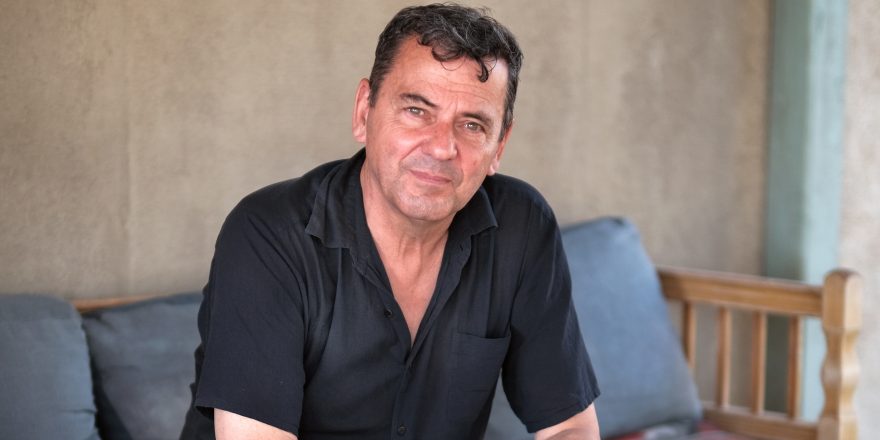

Christian Petzold’s latest film, Miroirs No. 3, is out now in theaters through 1-2 Special. He was born in Hilden in 1960. After studying German and theater at the Free University of Berlin, he studied film at the German Film and Television Academy Berlin (DFFB) from 1988 to 1994. He directed his first feature film in 1995. Made in 2000, his film The State I Am In won Gold at the German Film Awards; he was awarded the Berlinale Silver Bear for Best Director for Barbara in 2012. His previous film, Afire, won the Berlinale Silver Bear Grand Jury Prize in 2023. (Photo by Christian Schulz, courtesy of 1-2 Special.)
Three Great Things is Talkhouse’s series in which artists tell us about three things they absolutely love. To mark the current theatrical release of Miroirs No. 3, the mysterious new drama from highly acclaimed German auteur Christian Petzold, the award-winning writer-director shared some of his favorite things in life. — N.D.
Watching Street Scenes with Music from My Fourth Floor Window
I’m a big fan of musicals and in the morning I like to stand at the window of my room, which is on the fourth floor, listening to musical numbers. One morning, maybe 30 years ago, the sun was coming in and I closed the curtains and started to play some songs by Shirley Bassey. I didn’t know construction was going on and that men were working on the outside of the house. As I was listening to Shirley Bassey’s “Who Can I Turn To?”, I saw shadows behind the curtains and heard one guy say, “I think a homosexual is living here …” I was totally depressed about this, because I just wanted to listen to music!
When I’m playing my music, I like to look down at what’s happening on the street. Just very ordinary things, like a person walking their dog, someone trying to park their car, or two people in conversation. But the music makes a story out of it – it’s like a scene from a movie. And I love that. Sometimes I’ll go to the turntable, change the music and watch the same scene again – but now it’s a comedy. I like to change the world through music. I seldom use score or non-diegetic music in my movies to manipulate the emotions of a scene, because I use it in my private life!
There’s a movie from the ’80s that’s completely made up of video footage from surveillance cameras that reminds me of what I see from the fourth floor. A German director, Michael Klier, collected this material and paired it with music by Gustav Mahler. It’s about a rich man who owns a big house in Hamburg who goes out into his garden at night to smoke. The Mahler music makes him almost like a film noir protagonist, evoking the loneliness of a guy in the night with his cigarette. He could almost be Humphrey Bogart. But the interesting thing is that the title of the movie is The Giant, because the surveillance cameras are always high up, looking down on human beings. And also because the cameras are not very skillful in their movements when they try to follow someone. The giant is sad because he cannot be part of the world. He’s an outsider. He doesn’t understand human beings. The Giant tells us that to make movies, you have to be come down and be amongst the people. You have to find them. You have to be empathetic. You have to be on their level.
Horror Movies in the Middle of the Night
My second thing is when my whole family goes to bed and I stay up alone. At one in the morning, everybody in my family knows I am watching a horror movie with the sound very low, because they are all sleeping.
In horror movies, the horror frequently comes from the sound, not the pictures. When my daughter and I went to see It Follows in the cinema, I told her if a scene was too intense or scary for her, she shouldn’t close her eyes, she should close her ears. Most horror movies work with the acoustic space, and there are few movies in the history of cinema which make you anxious by what you see, except maybe a film like Murnau’s Nosferatu. So I love to be up at two in the morning watching a movie like MaXXXine with the sound turned way down, knowing my family is in harmony and sleeping, and I’m on the other side of the world … or the other side of dreams.
I think the cinema has a lot to do with dreaming. Cinema was invented in 1895 by the Lumiere brothers and dreamwork was invented by Sigmund Freud in the same year. And so cinema and dreamwork have something to do with one another, and fear is a major component of our dreams. Good horror movies are a little bit like a dance. Horror movies are about bodies and the fear of losing control of our bodies, and sometimes it hurts to see that. For example, I watched X at two in the morning, and the opening scene, where you see the first murdered body, is cinema at its very best. When I saw it, I wanted to wake up the whole family to show it to them – but instead I restrained myself and just watched the film to the end.
Sunday Morning Soccer Matches
My third thing is to bicycle through Berlin on a cold Sunday morning to watch two nameless teams playing on a nameless soccer field on the outskirts of the city. The reason I love this so much is because I was a soccer player for 40 years in the same circumstances: small soccer fields, Sunday morning, 11 a.m., very cold showers afterward. But it was always the highlight of my week.
For more than 25 years, I played on the right wing in a real team with real jerseys. My speed was my greatest asset, rather than my technique. When I would make a movie, I would always make sure we would not be shooting between Saturday at 11 a.m. and 8 p.m. on Sunday. I was forbidden by the insurance company to play soccer – because if I broke my leg, it could have shut down the movie (and been my own fault!) – but I still played anyway.
The greatest pleasure of playing in these football matches was when I was on the pitch, I was not an individual; I was part of a collective. To me, soccer and cinema definitely have something in common. Movies and soccer matches are both about 90 minutes, but it’s more that during a soccer match, you are simultaneously there and not there. And when you are in the cinema, you are there with your body, but your imagination and your mind are somewhere else. So you are in two parts, which is such a big comfort.
Now when I go watch other teams play, it’s a sentimental journey. I’m watching something I can’t do anymore myself. But when you see others are having the same experience, then everything feels right with the world. When I go to watch my favorite German team, Borussia Mönchengladbach, the team is also playing for the audience. But those soccer players who have a game on those soccer fields on the outskirts of Berlin, there really is no audience. They are playing for themselves.
I love to see people who are doing things for themselves, who don’t need other people. This is great, and again it has something to do with cinema. When you watch a movie, sometimes you understand that some scenes are made for the audience and there are others which don’t need the audience. And those scenes that don’t need the audience, they respect the audience more than the others.