



Julia Marchese is a filmmaker, actor, podcaster, cinephile and film programmer living in Hollywood, California. Her first film was the award-winning documentary Out of Print, about the importance of revival cinema and 35 mm exhibition to culture, and she is currently the co-host of the popular horror podcast Horror Movie Survival Guide. She recently crowdfunded on IndieGoGo for her forthcoming Dollar Baby short film I Know What You Need, based on Stephen King’s story of the same name from Night Shift. You can find her on Twitter, Facebook and Instagram at @juliacmarchese.
When people ask me what my favorite Christmas movie is, they’re often perplexed by my answer – Terry Gilliam’s 1985 masterpiece, Brazil.
No, they say, what’s your warm and fuzzy Christmas movie? I tell them the furthest I swing in that direction is Gremlins (read my Talkhouse piece about my introduction to that movie here), but Brazil IS my favorite Christmas movie – I feel warm and fuzzy about Halloween and horror movies, but Christmas brings to mind forced frivolity, the pressures of buying the perfect gifts, the same songs repeated ad nauseam for months, the world’s thirst for capitalism instead of connection brought to the forefront in its roaring glory.
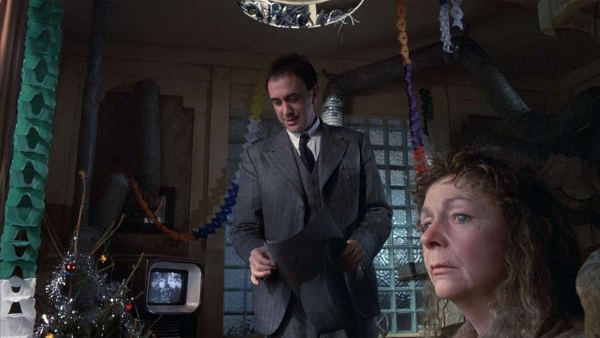
Brazil captures all these feelings and more – suggesting to the viewer that the characters within the film are stuck not only in a grim world of dystopian surveillance, but also a world where Christmas is year-round – where you are caught in a constant cycle of gift-giving at every meeting, where the same songs echo around every shopping center 365 days a year, and where the magic of Christmas has become, instead, a nightmarish prison.
Can you imagine?
In true Terry Gilliam fashion, the making of Brazil was an incredible accomplishment, overcoming hurdles of every kind – casting, production, they all became an exhausting tussle. Because his visions are so grand, Gilliam sometimes seems to be battling the reality of filmmaking itself. While all of his films are certainly worth watching, I consider Brazil to be his zenith – a genius’ vision wholly realized, with incredible performances and imagery unlike any other film. It’s in my top five films ever made, and also one of my very favorite endings in cinema, full stop.
Universal Pictures, warring against Gilliam every step of the way while he was making this movie, got the last laugh by releasing their “love conquers all” cut of the film, trimming minutes away and changing the ending. The director’s cut is the only cut you need to watch – as bleak and dark as Orwell’s 1984, and then some.
The film’s central character, Sam Lowry, is played to perfection by Jonathan Pryce. Lowry is an isolated and lonely man, escaping into films and his grandiose daydreams of love and heroics, satisfied with his low-level job because it affords him both anonymity and the secret safety of rescuing his inept boss whenever he calls. He spends his days in drab gray suits, but daydreams about being a heroic knight in shining armor, with wings that allow him to soar above the grimness of his life. There is a woman he dreams of often, and he’s in love with her, even though he knows she doesn’t exist.

But when Sam finds the girl of his dreams in real life, he bravely dives deeper into the soul-sucking corporate world in order to find out more information about her. His stoic romanticism weaves its way throughout the film, but it’s ultimately crushed by the strict, gray dystopia that surrounds him – both in reality and his daydreams as well. He is drowning in a world covering him with tubes, ducts, paperwork and professional torture.
On top of the daily nightmare that Sam lives in, he’s also plagued by his vain mother, forever trying to worm her way into his life, constantly shoving promotions and women he doesn’t want on to him, deaf to his pleas that he’s happy as he is.
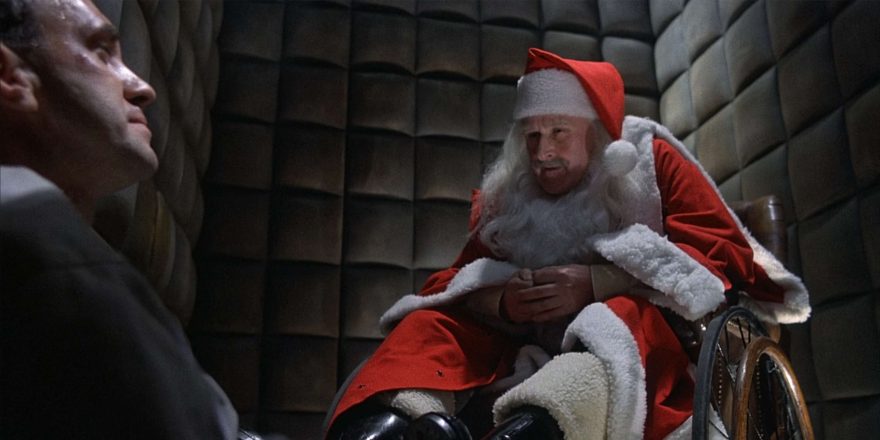
Utter dystopia is swallowing the world of the film, with terrorist bombings becoming increasingly frequent (though completely ignored) and at every meeting Sam has with his mother, at restaurants and at parties, there is the gaudy, artificial joy of Christmas. Sam exchanges gifts multiple times throughout the film (everyone gets him the same useless present), and we see joyful decorations in the streets, Christmas shoppers and trees, holiday music and even a Santa Claus thrown in.
Although there are many hideous realities that Sam Lowry has to overcome in Brazil, it’s the mind-crawling horror of a perpetual Christmas that gives me the biggest willies. With the Christmas season starting earlier and earlier every year in real life (stores don’t even wait anymore for Halloween to be over before they start promoting Christmas), I see in Brazil the terror of the world’s biggest commercial holiday taking over and becoming a mandatory event to “celebrate” all year long.

Look, I’m no Scrooge – I love celebrating Christmas with my family, and adore spending the day with them, chatting, watching them open presents and connecting to folks who I don’t get to see as nearly as often as I’d like. There is undeniable joy that comes with Christmas, but it doesn’t necessarily outweigh the constant drain of constant, inescapable advertisements and the infinite ways that the holiday is tweaked to sell. I love what the holiday represents as its ideal, but that ideal is most often lost within the modern cash grab that the holiday has become.
And within Gilliam’s film, Christmas is now a daily role the characters have to facetiously play, slapping festive cheer right on top of the ignored, gaping dystopian wound oozing below it. Sam must be endlessly grateful for the gifts given to him, without a second thought from the giver about whether or not he would actually enjoy the present – it’s only the show of gift-giving that matters.
So during this holiday season, when the over-sweetened Hallmark rhetoric begins to chafe, pop in Brazil and marvel at a perfectly made movie, flawlessly skewering the heart of what “Christmas really means.”
Because sometimes a little bitter coal makes the cocoa taste even sweeter.