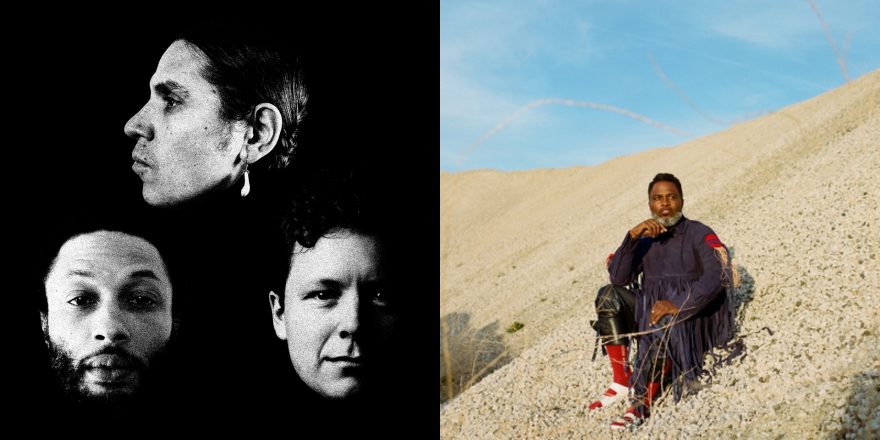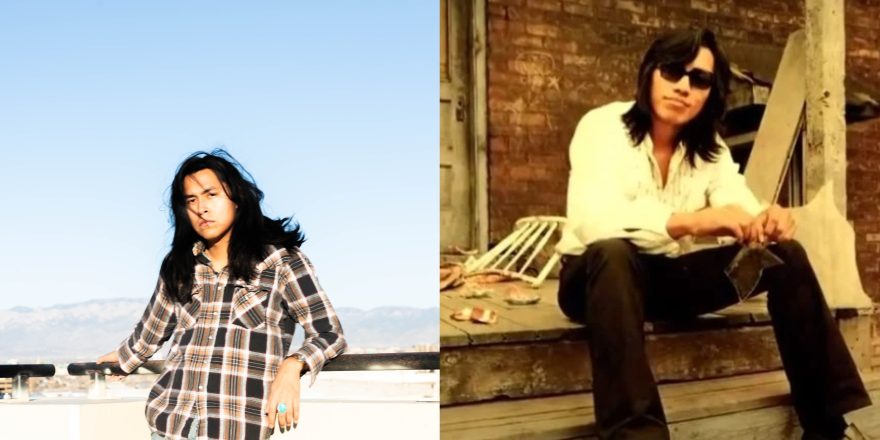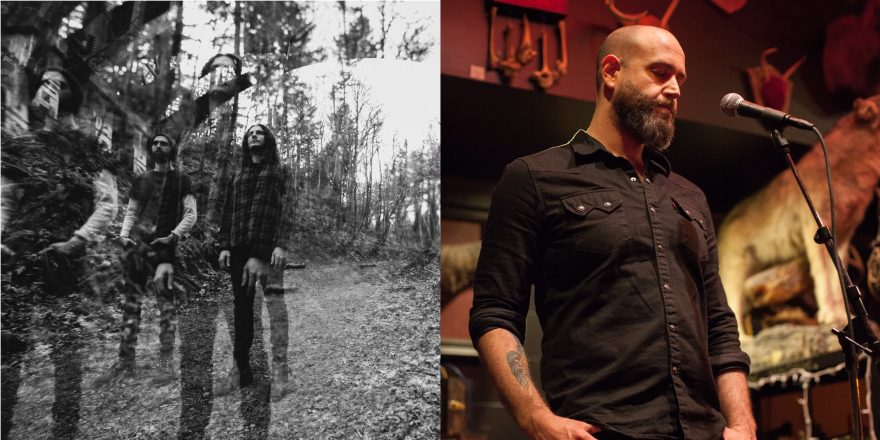


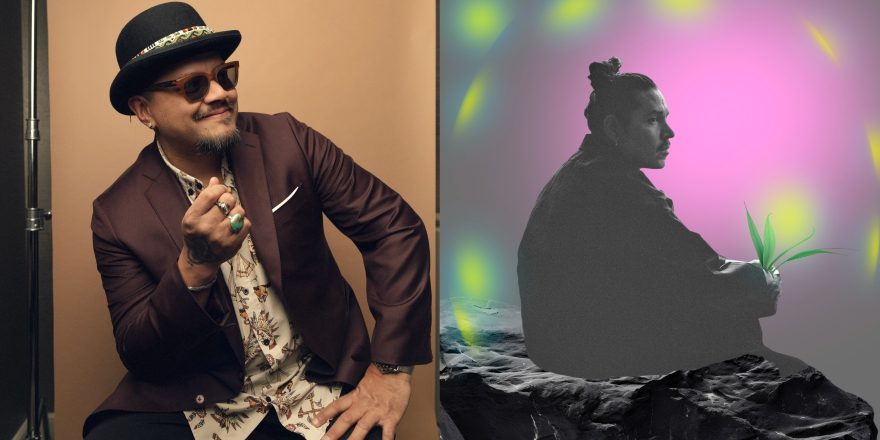

Nicholas Galanin is one of the most vital voices in contemporary art. Born in Sheet’ka (Sitka, Alaska), Galanin is Tlingit and Unangax̂; he creates from his perspective as an Indigenous man. His work calls for an accounting of the damages done to land and life by unfettered capitalism while envisioning and advocating alternate possibilities.
His debut as Ya Tseen (“be alive,” and a reference to his Tlingit name Yeil Ya Tseen) is Indian Yard, his first album for Sub Pop. Rich with emotional range and sharp awareness, Indian Yard explores love, desire, frustration, pain, revolution, and connection through the magnetic expressions of an Indigenous mind.
This is not, by any means, Galanin’s first album. He has released a steady stream of records under a panoply of aliases, including Silver Jackson and Indian Agent. He has worked with the likes of Meshell Ndegeocello, Tanya Tagaq, and Samantha Crain. And for the better part of a decade, he’s also been part of the revolutionarily borderless art collective Black Constellation alongside Shabazz Palaces and THEESatisfaction.
(Photo Credit: Merritt Johnson)
Sterlin Harjo is an award-winning filmmaker based in Tulsa, Oklahoma, and the co-creator, executive producer and showrunner of the FX shows Reservation Dogs and The Lowdown; Nicholas Galanin is a musician and multi-disciplinary artist based in Sitka, Alaska, who fronts the project Ya Tseen. The new Ya Tseen record, Stand On My Shoulders, is out today on Sub Pop, so to celebrate, the two artists got on Zoom to catch up about it, and more.
— Annie Fell, Editor-in-chief, Talkhouse Music
Sterlin Harjo: I don’t know what happened to my Zoom, but I noticed today everything’s really quiet.
Nicholas Galanin: It must be a a setting or something.
Sterlin: But I didn’t change it… I don’t like when things change without me. Like aliens. I started watching this documentary last night about aliens, and I had an edible and I almost got a panic attack. I had to turn it off.
Nicholas: [Laughs.]
Sterlin: [Laughs.] We’re definitely not alone.
Nicholas: I gotta watch it. I’ve been following this comet.
Sterlin: Is it past yet? Are we in the clear?
Nicholas: It’s just funny how the internet will take everything and make it a conspiracy.
Sterlin: Oh, yeah. It’s like, there’s people on it, it doesn’t have a tail or something…
Nicholas: Yeah, and it’s got boosters and slowing down, speeding up.
Sterlin: And then it just goes by and everyone’s like, “It was nothing.” It’s like Y2K. You remember that?
Nicholas: My aunt was a prepper for it. She had printed out pages from Yahoo!, had the list of things, and everything that was going to happen.
Sterlin: The checklist. I was at my friend’s in Reno, Nevada, and we didn’t think anything was going to happen, but better safe than sorry. So we drove up into the mountains and we watched the city as it count down, just to see what went down. And of course, it was nothing.
I like your new album, man. It’s awesome.
Nicholas: Thank you.
Sterlin: We’ve been friends for a while, and it’s been cool seeing your style and everything grow and change and form into what it is now. I was listening to the Silver Jackson days, and it changed. All of it’s great. But this one feels like everything.
Nicholas: Every record is two to three years of my life in some form or fashion. That’s kind of the gestation period of it. And things progress, you get access to new collaborations, new space, new tools, and skill sets along the way.
Sterlin: And inspiration from different places.
Nicholas: Yeah, all that.
Sterlin: So, I inspired this album, right? [Laughs.]
Nicholas: [Laughs.] I mean, this is what I was getting at. I didn’t know if you’d pick up on that.
Sterlin: Yeah, I heard it in the first bar… Have you been playing this one live yet?
Nicholas: We just got off tour. We did a West Coast tour with Portugal. The Man, and that was amazing.
Sterlin: That’s cool. I saw some photos. A couple friends saw it, too, and they said that they were really loving all your new stuff that they hadn’t heard before.
Nicholas: Yeah, it was fun. It was the best venues around, and they were full because we were supporting successful artists. So it was a big opportunity for us. But more importantly, just playing the songs live and having an audience respond strongly without ever knowing anything about it…
Sterlin: Did the Portugal. The Man crowd seem to get right into it?
Nicholas: Oh, man, it was a good fit. It was a good vibe.
Sterlin: So are you going to do some videos or what?
Nicholas: We’ve done a few. January 16, we’ve got one more video drop to do. Music’s wild, man. It’s so different than the art world.
Sterlin: So how do you juggle all of it? I mean, you’re an artist, you have your giant pieces that you do, and then even bigger installations. How are you fitting music in? Do you travel with equipment? Do you just do it when you’re at home?
Nicholas: It varies. We were just in LA and we did a little studio session there with some folks. For me, I think music’s so collaborative; it’s really about community in a different way where you get to either perform it with community or collaborate within the musical and creative community. That’s my favorite part about it.
Sterlin: Was this recorded in Alaska?
Nicholas: Yeah, my studio. My spaceship. Have people fly in, we record there.
Sterlin: How does that work? When you have people collaborate and stuff, what do you do there? Because I’ve been to your studio — you’re not by the airport. [Laughs.]
Nicholas: Yeah. [Laughs.] If you were going to show up and we were going to start working, we’d probably just fire up the instrument, maybe eat a meal, hang out a bit, go do some things in the community, on the land or whatever. But once we get in there, we just start capturing things. I’m not a classically trained musician, so I’ll do weird shit with the instruments and the studio space. Experimental. Sometimes I’ll work alone, and then bring people in once I have ideas that are far enough along to make sense.
Sterlin: But is it a concept or a feeling, or you go in with it mapped out?
Nicholas: No, this is like free, see-what’s-happening. This record that we are releasing now, there was probably 80 songs or ideas along the way, and it became very apparent which ones work for this record. And those ones survived.
Sterlin: So if you look at all of the songs, does it feel like a concept?
Nicholas: This one does for sure. I think there’s a side A, side B. There’s always these moments of time and life that music marks for me, whether it’s in the storytelling, the lyrics or whatever. And the title of this record, Stand On My Shoulders, and the album art is really a reference to my father.
Sterlin: That’s what I was going to ask about, your dad.
Nicholas: My father was really influential to my love of music and art in a lot of ways. I never made the music that he made, but I never really set out to. This acknowledges that. So that print, that photo on the cover, is based off a photo of my father in his customary Ceremonial regalia. In our community, those things live on like names. They’re references that we get to fill; those that came before us, we get to fill their role as stewards of culture, caretakers of knowledge of the power that they’ve transmitted through their work into our work. So for this, there’s a real side A, side B, and partway through the record is samples of my father speaking about the continuum of creatives in our family, from my grandmother and my grandfather and uncle, and how we all are doing this work. This is embedded in that record in a way.
Sterlin: He taught you how to play, right? When you were young.
Nicholas: Yeah. I worked with him on everything musically. He was self-taught. He bought us our first instruments.
Sterlin: And what did he teach you? Did he teach you Delta blues first?
Nicholas: It was Delta blues. I guess really early on, I learned basics — “Suzie Q,” all these other songs. We just knew that music was important.
Sterlin: And how old were you?
Nicholas: I think I got my first guitar at 13. But I have childhood memories of us singing songs with him on the guitar. I remember — this is a funny story, because, my father was known as a Delta bluesman — we only heard a lot of music through him. He was playing, like, Neil Young, “Old man, take a look at my life…” And he could do it well. I was walking into this little store in my community, a mini mart or something, and that song was on the radio, and I was like, “That’s my dad!”
Sterlin: Neil Young got up to Sitka! [Laughs.] But I feel like when your dad teaches you, you learn what you need and you break away and do your thing as soon as you can. As a teenager, it feels like, Alright, I’m getting the basics from my dad, but also he’s listening to old music. I’m into this, I’m going for this. And then early on, that splits, and then eventually you kind of come back.
Nicholas: Yeah, absolutely. There was a huge moment where it was Delta blues, and my love for Delta blues was through my father and his passion for it. I wonder if there’s ever going to be a record in that vein of open tunings and that kind of instrumentation. But I’m not forcing it. And, you know, I think he always thought I did weird shit.
Sterlin: With your music?
Nicholas: Anything — art, music.
Sterlin: He was just always kind of shaking his head and supportive, but like, “I don’t know…”
Nicholas: [Laughs.] Yeah.
Sterlin: But he was also an artist, too. He did jewelry and he did carvings as well. Was part of that teaching you, too, all of that?
Nicholas: Yeah, he’s a huge reason I went to higher education for art school, because of working with him in that space.
Sterlin: It’s interesting thinking about your dad, because those artists back then — A., there was this explosion of expressing ourselves from our communities. But then also, you had to feel kind of alone, because all of our communities are so remote. I mean, specifically yours, there’s some traveling you gotta do to be in conversation with other artists. For instance, you and I will FaceTime and have a cigar now and again, but we’ve probably seen each other in person, like, twice in the last six years. But on FaceTime, we’ve had many cigars together and we’ll just talk about art and what projects we’re working on. It’s interesting to think back to your dad’s generation, because they didn’t have that necessarily. It was all real face time.
Nicholas: Yeah. He had a moment where he explored the world — he lived in New Zealand for six or seven years and built his own relationships with Indigenous people outside of our community space. And it’s a little more accessible for us now with social media, and the work that travels to communities. Like Reservation Dogs — that’s everywhere.
Sterlin: Or you were watching on a plane the other day — which I loved — The Lowdown.
Nicholas: These things travel now. It’s great. It brings us together in different ways.
Sterlin: When I think of my kids — and you have kids — as a father, there’s no roadmap to, “I’m going to get my kid into this.” You just try to be there for when they want to get into something. My kid right now wants to learn Black Sabbath, “Iron Man” on guitar, so I’m dusting off my old chops on the electric. And we’ve been hunting, and you try to give lessons in art. But there’s no true guide to sharing with the younger people how to do it, how to make a spark happen. Personally, I hope that they do find art. I think they will — it’s just the nature of our household. And I think that’s probably the same with your dad. There’s not much forcing or teaching that you can do, you just set the environment up and there’s art around, and eventually the kid’s going to be like, I want to do that.
Nicholas: That’s real. For me, it was always there. I was always around it. I was watching it being made, I was watching music being sung, and it was just continual. But a pivotal moment in my focus was working a non-creative job.
Sterlin: That’ll do it right there.
Nicholas: Yeah, and being told I couldn’t, in my downtime sitting at this desk where I had nothing to do, work on my native Formline Indigenous design studies. That was my last non-creative work, essentially. I have children in university now, and it feels like such a responsibility in the conversation to their envisioning of their energy towards what they want to focus on. I always try to lead with, “Sometimes the answer is not going to be there, but you’ll know what you absolutely do not want to be part of or focus on, and that’s just as important.” My daughter, Nova, is being mentored by Meshell Ndegeocello on bass right now, which is incredible. These other creative powerhouses that are helping nurture the creative spirit of children, it’s such a generous thing.
Sterlin: That’s happened with my daughter — Joy Harjo notices that she’s a writer and a poet and then just brings her to do things with her as a young girl. And we’re both Harjo’s, but we’re not related. But she took her under her wing a bit and had her do stuff. And then when she was the Poet Laureate — three time Poet Laureate — her last stretch, right at the end, they have a ceremony when they’re saying goodbye, basically, and she asked my daughter to come and represent indigenous youth and read her own poem. Which was a crazy cool thing to do, and that goes so far.
It’s interesting because that’s also a reflection of you — because you build those relationships, and then sometimes in the village, or in a tribe or whatever, it’s the other people’s jobs to step in and take up the thing that a parent can’t give them. Sometimes they need that, and I think it’s a really beautiful thing. It’s interesting just to think back how our people used to be, and that was a part of it. And in some way, we still do that a lot, because we have community.
Nicholas: Yeah. It’s real. It’s important. In the last episode of The Lowdown, there was a scene of poetry. Who wrote that?
Sterlin: I did! Well, me and my friend Liz. But it was this moment of reflecting on my marriage breaking up and trying to think of it from my daughter’s perspective and what she was going through, and also holding myself accountable for things. Because a lot of that show is really inspired by this period of time when I was like, I’m either going to be successful at this or I’m not, but I’m going to grind right now and be a dad. So we were always in weird living situations, like borrowed houses. I always had a home, though, and my daughter was always like, “Well, I guess we’re in this place now.” We moved a lot at that time, and for better or for worse, I was like, I’m going to just keep being a dad, though, and make sure that I’m still doing that and also balancing art. And you know what? What she learned out of that — she’s told me this — is she learned how to be an artist, how to struggle, and how to do it and not stop. She watched me do that. She was riding shotgun for a lot of it.
But one of the things that I wanted to write in that poem, that moment in that story, was having an artist kid and a poet, sometimes you’re going to hear things that you don’t always like. And you have to be OK with it. Your ego could get beat up, but you have to be OK with it, because you’ve encouraged them to speak their truth through their words and through their art. And that has happened to me multiple times with a poet daughter, where I’m at a reading and I’m like, Why did you just write a poem about your mom? I do stuff too! [Laughs.] Ego gets in the way. So I was reflecting on those moments a lot. And basically, Lee, the character, has to sort of put his money where his mouth is. It’s like, do you really care about the truth? If so, you have to be OK with people talking about you as well, people that you love talking about you. But, yeah, I’ve had that moment a lot.
Nicholas: Yeah, it was great. That still stands out to me, that scene. Maybe because I’m a father, too.
Sterlin: It’s definitely a dad thing. It’s funny because I was talking about how you could show The Lowdown and One Battle After Another at the same festival programming and it would be fine. There’s something about, like, disheveled dads trying to be good and to their shit, both of them. I’ve started calling it “dad core.” I think “dad core” is a thing right now. [Laughs.]
Nicholas: [Laughs.] I think you’re on to something.
Sterlin: Are you going on tour again for this album?
Nicholas: You know, nothing on the scale — that was kind of epic, what we just came off of. I’m actually going back home soon to work on this totem and do some projects in the studio, and then in January we’re doing a live KEXP studio session, which will be just a different version of our album. We’re hoping to have Lori Goldston on that studio session. Lori was on the record playing cello and — a little nostalgia — Lori was on Nirvana’s Unplugged.
Sterlin: Oh, wow, that’s cool. You gotta come to Tulsa, man.
Nicholas: I know! We’ll figure it out…
(Photo Credit: left, Chris Loupos; right, Nick Walker)