form is no other than emptiness,
Emptiness no other than form.
Form is exactly emptiness,
emptiness exactly form
— The Heart Sutra
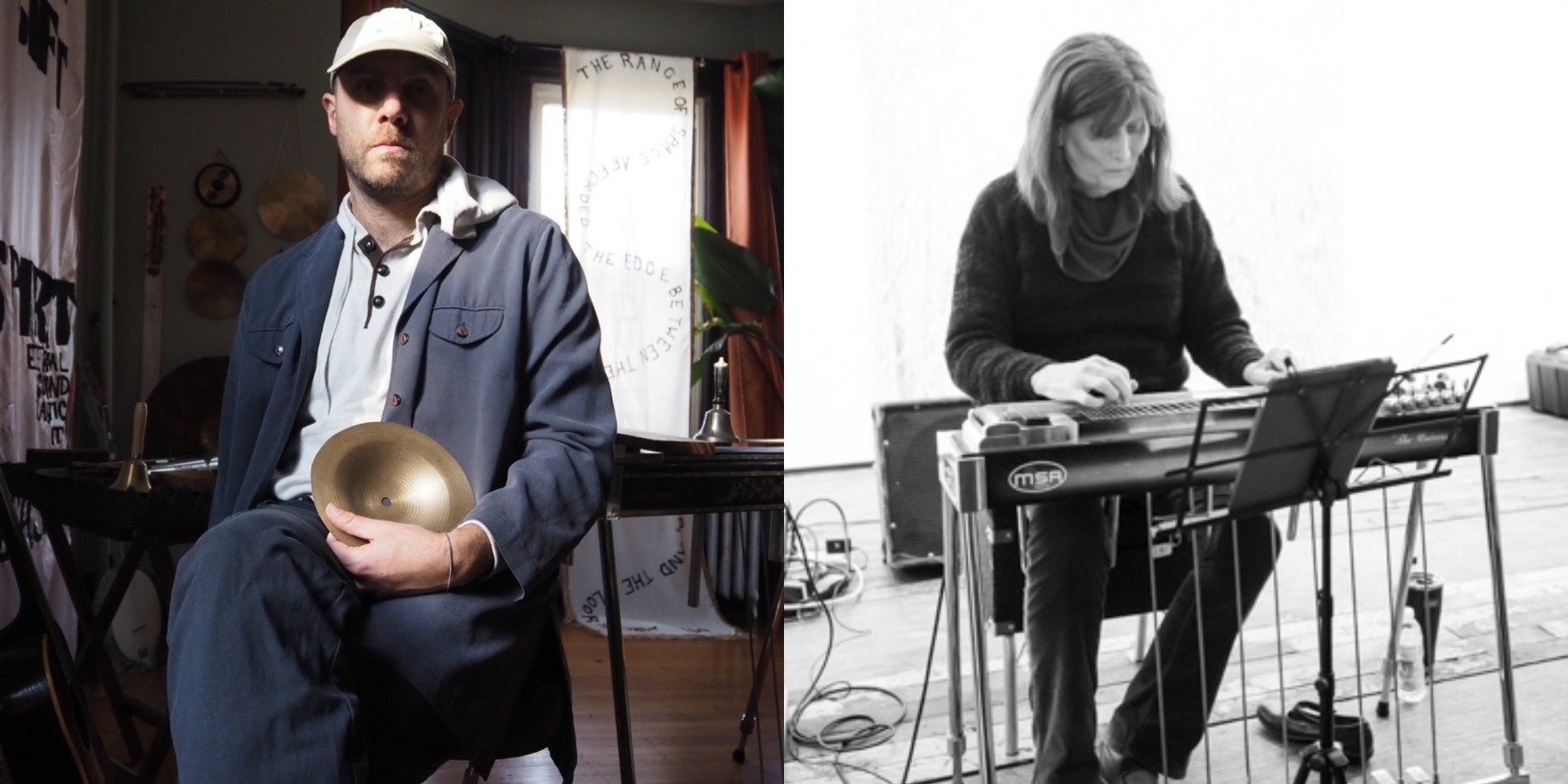
The pedal steel guitar, optically, can be quite identifiable. A horizontal, rectangular body, rods protruding from beneath the body, extending downwards towards the ground, where they connect with an array of pedals. And just as the very form of the instrument can connote a specific sound, the sound can connote a particular form.
And yet, the instrument came to being through a deconstruction of form: Hawaiian bottleneck slide guitar, early-mid 20th century electraharp, and to this very day, the instrument lends itself to various forms of ingenuity (just look at the innovations of Chas Smith).
It is within that spirit that I’d like to discuss the late Susan Alcorn. Susan, a friend and mentor to me, passed away last year at the age of 71. It came as a shock to many and the outpourings of remembrances serve as a testament to the depth of her work as an instrumentalist, composer, teacher, friend, collaborator, and artist. I opened this piece with an excerpt from The Heart Sutra, an ancient buddhist chant extolling the boundarylessness of existence. That what it means to truly live a human life is to confront that which appears in front of us as merely appearances, impermanent and ceaselessly changing. What we take to be a fixed form is actually gone before we know it. Much of our society is structured around corralling form, fearful of this inherent slipperiness. And it makes sense, it's a cruel world and having some fixed form is of comfort. But before I get too deep in the weeds here, I’d like to bring this notion back around to the work of Susan.
Susan had a piece entitled “The Heart Sutra” and years later, the piece was rearranged for string ensemble by Janel Leppin. The piece builds from a droning picking pattern, heightening a tension and dissolving expectations that what we are going to hear is your run-of-the-mill pedal steel tune. It’s as if she is breaking down our expectations of form with each string pluck, existing on the edge of uncertainty. Susan herself, letting her fingers do the work of deconstruction. The track fittingly precedes the track “And I Await the Resurrection of the Pedal Steel Guitar” — I mean, c'mon. Deconstruction, Resurrection… Are these concepts one would typically associate with an instrument that is often relegated to “accessory” status? For Susan, these concepts lived at the heart of the instrument. But also at the heart of her artistic spirit. I’d often hear her say, as a pedal steel guitarist with decades of experience, that the instrument appeared new and fresh to her constantly. It was the space between the strings, the way the slide and pedals allow you to live between notes, outside of expectation. It's a constant voyage, and one that brought her back to the instrument time and time over. The instrument is alive. It lives in formlessness.
The spirit in which Susan approached the instrument was alive in every performance, lesson, and interaction. A widely recognized and accomplished artist, she was just as likely to perform at the Berlin Jazz Fest as she was at Normal's Books & Records in her beloved home city of Baltimore, MD. She’d often pepper her sets with heartfelt stories, discussing origins of particular pieces that she was about to play (her story about coming to the work of Olivier Messien’s “Quartet for the End of Time” is a constant). Many sets of hers included what she dubbed as the "Liberation Suite," which featured covers of Victor Jara, Sergio Ortega, Astor Piazzola, and Oscar Peterson. She understood the responsibility that exists in not just being a performer, but a human existing along a continuum of man-made suffering, and that it is our responsibility to confront the suffering, disarm it of its intended goal to subdue the human spirit, and choose generosity, care, depth, and innovation in spite of it.
I spoke with Susan a week before she passed away. I was preparing for a tour in Japan which would be the first time flying with my steel. The banality of our conversation is something I look back on now with great warmth and humor. She directed me to the type of case she flies with for her overseas performances. A rigid shell of plastic with two large buckles with TSA approved locks (TSA gives you some crazy looks when you travel with a pedal steel). But it wouldn’t be a recommendation from Susan without a little bit of homework. The case was hollow, so I needed to source some foam to insert into the case and cut out a cavity where my steel could rest safely. I hacked away at a four-inch thick cut of packing foam with an Exacto knife, ending up with a truly Frankenstein-looking case. A week later, I was on the Amtrak from Philly to NYC and saw the news of Susan’s passing while scrolling on my phone. I let out an audible gasp, “No!” to the surprise of the passengers in the quiet car. I looked out the window at the quickly passing smoke plumes and marsh fields of central-north Jersey, tears filling my eyes.
At the time of Susan’s passing, I was in the middle of recording the album which would become Language At An Angle. I was feeling an energy I had not felt in prior albums. This music felt embodied in a way I had not yet known. My body, itself morphing with my pedal steel guitar, boundaries exposed, erased, and reconfigured in one moment and shifting in the next. Scraping metal, balancing wood, striking mallets, chiming bells, resonances ringing out to corners they hadn’t yet. I wanted to show Susan this album. We had performed together at Normals in Baltimore a year prior, where she heard the beginnings shapes of the material that would become Language At An Angle. We embraced. She had kind words to share. She had critiques to share (what good teacher wouldn’t). She told me to keep exploring, keep being curious.
The Heart Sutra goes on to say:
So in emptiness there is no form, no sensation, conception,
discrimination, awareness;
No eye, ear, nose, tongue, body, mind;
no color, sound, smell, taste, touch, phenomena;
No realm of sight, no realm of consciousness,
no ignorance and no end to ignorance,
No old age and death and no end to old age and death,
No suffering, no cause of suffering, no extinguishing, no path,
no wisdom and no gain
No gain and thus the Bodhisattva lives Prajna Paramita.
With no hindrance in the mind, no hindrance therefore no fear.
I think about how these words resonate in our world today. I think about the suffering inflicted upon untold populations by those who can only see through a fixed lens. Through hardened definitions driven by fear, avarice, and ignorance. I think about figures like Susan. I think about the (life) work it takes to confront the suffering and meet it with humility. To live in a way that embraces the not knowing, the emptiness of form. Susan was a courageous individual, a gifted artist, and caring mentor. I am grateful for my time knowing her and am forever changed as a result.