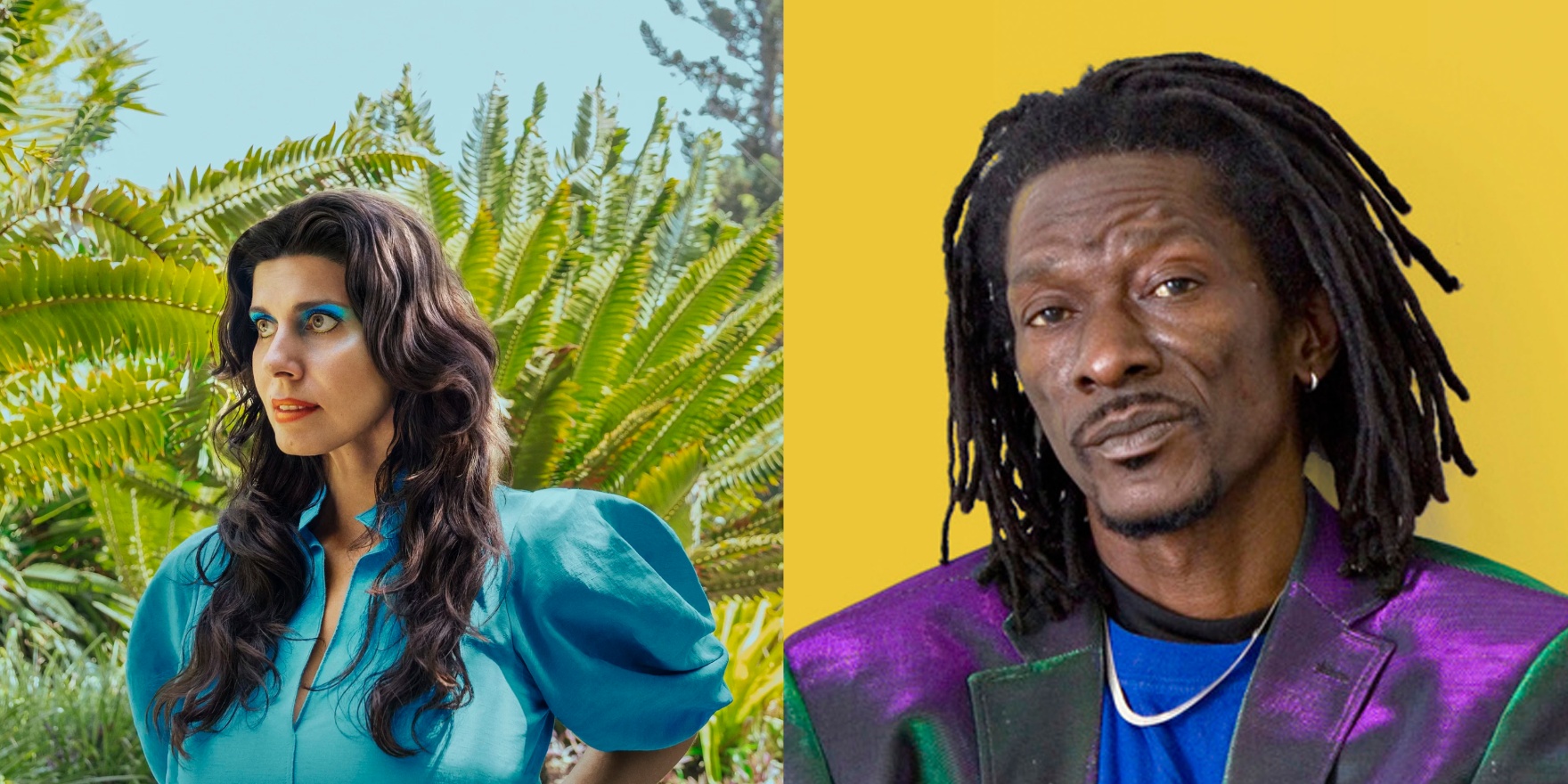
I met Ahmed Janka Nabay in 2009 at Zebulon, back when the venue was in Williamsburg, Brooklyn. The cultural temperature at that time was cool — the coolest — as DIY spaces prevailed, with spots like Silent Barn, Glasslands, 285 Kent, Death by Audio, Secret Project Robot, and the hilariously misleading Shea Stadium providing spaces for a real musical counterculture. While more mainstream bands like MGMT, Chairlift, and Vampire Weekend were gaining traction, there was a scene happening in Brooklyn which saw the art-indie aesthetic collide with more global influences and a raw, underground energy.
Enter Janka Nabay, the Bubu King of Sierra Leone. My friend Pupa Bajah, also hailing from Salone, invited me out to his show where Janka would be a special guest. My other friend Carlos Charlie Perez was working on some music videos for Janka and told me I had to come out to Zebulon and see what had captivated him. All roads led to Janka that night, a night which would forever change the course of my life.
The music was fast, polyrhythmic, trance-inducing, melodic but slightly dissonant. The beat throbbed as Janka bounced around in a raffia skirt he had made himself, singing in a scratchy but velvety baritone. His lyrics slipped between English, Krio, Temne, and the occasional Arabic phrase. I caught fragments — John Kennedy, Ro-merica, good governance, multi-party democracy. The tracks felt like smashed out Casio keyboards. The beat was relentless but nuanced, hypnotic. The bass was a counterpoint, never parroting the kick, but dancing with it. The whole thing moved along like a pulsing snake, echoing the processional style that birthed it. The audience was stunned, excited, moved to dance under Janka’s infectious encouragement.
Later that night a bunch of us ended up jamming in the basement. Janka taught me my first Temne words to the song “Eh Congo,” the one with a shout-out to JFK (who was responsible for the school where Janka learned to read and write as a child). I just aped him, I didn’t know what I was singing. It was liberating — I sang so much better without the weight of meaning in my brain. Janka was pleased. Wills Glasspiegel, the PRI producer who discovered Janka’s music in a bag of CDs and was now his manager, took down my information. Janka was in Brooklyn and Wills was helping him assemble a band. It was on.
The original American Bubu gang had a punk ethos — not about distortion or safety pins, but about urgency and raw honesty. It had a DIY spirit where expression mattered more than polish, and every part was taught, felt, and shouted into being. Michael Gallope, Jon Leland, and Jason McMahon came from Oberlin and the beloved Brooklyn band Skeletons. Douglas Shaw brought his brand of psychedelic West African guitar to the project. I was coming from an eclectic background of Arabic, pop, punk, indie, and reggae influences. Janka didn’t read music or involve himself in notation. He shouted the parts at you, and you had to really listen to get the correct syncopation and pitch. He did this with every element of every song, often getting frustrated when a highly trained ear couldn’t catch the subtleties of the part he wanted. The band would expand and contract over the years, and I would watch Janka teach one person after another. I was soon learning and teaching some bass lines myself before just taking over on bass to save us money on personnel. I still credit Janka with getting me to play what would become my best instrument.
What followed were years of struggle, drama, catharsis, hilarity, and above all, education. The revolving door of the Bubu family in New York ushered through no less than 37 people. We would learn the history of this singular style of music; how Janka had gained fame in Salone in the ‘90s by modernizing and digitizing the processional style of Bubu in the studio; how the origin story involved a “Bubu boy” who stole the music from witches and brought it to the people, dying in the process; how the music had become culturally charged with a joyous party energy, only to be appropriated by rebels during the civil war to lure people from their homes and conscript them. We heard stories of Janka getting captured, only to be freed when the rebels realized he was the Bubu King. It was hard to know what was real and what was myth, but it didn’t matter. It was a labor of love for everyone involved. We became enamored with Janka and his whole universe of mythology. We suffered under the constraints of the reality it kept hitting. We started in the Brooklyn DIY circuit and would end years later at Bonnaroo, the Kennedy Center, the Getty Center, and stages across Europe.
Audiences felt this direct pipeline to his musicality and message. They couldn’t resist it, and neither could we. There was no distance here, no curled lip or shrouded meaning.
Multi-party democracy give rights to de women dem.
We got to jump high, we got to live in combination.
I would later learn the meanings of the Temne and Krio words I was singing when Michael Gallope patiently sat Janka down and transcribed the translations of our first album En Yay Sah.
They seize advantage on the Bubu boy.
Cat Shit! Cat Shit!
The child doesn’t look like me.
Eh Waya, I believe in God. Hey man, I’m scared of this world.
What was it that captivated us all? Looking back, I have come to recognize it — the collapse of a certain kind of distance, the dissolution of what I would inwardly call the “indie shield” which was ever-present in music made by college kids in Brooklyn. The luxury of stepping back, of obfuscating, of saying one thing while meaning another didn’t exist in Janka’s orbit. His music was a direct transmission from lived experience, from war and displacement, faith and perseverance. Even trivial moments could become anthems (see “Santa Monica,” where a minor exchange with a cop regarding Janka smoking in front of a no smoking sign became an interrogation). He embodied his art completely. He said he was inspired by “Bob Marley, Michael Jackson, and God.” He called himself a “Black cowboy” and pursued his version of the American dream with stubborn intensity in the face of endless setbacks. “Game ova” was his mantra, his “aloha,” meaning different things depending on the circumstance. It could mean “great job” or “we are done here” or “this is amazing” or “we did it” or “let’s get the hell out of here.” He mythologized, hustled, talked until his voice gave out, complained, and performed while we worked our day jobs and struggled to make this dream a reality. I would quit the band in frustration and come back years later. I would question my involvement in someone else’s dream only to realize it had become my dream too.
The shock of his death in 2017 remains. I think about Janka every day, every time I write a melody or play a show or decide what to wear on stage. I ask myself what would he sing over this beat, what bass line would he shout into my ear if he were here? When I returned to the ironic world of indie, with a heavy heart, I was changed. I had lost my snark — happily. Some lessons I learned: syncopation is groovy; you don’t need a degree; perform with your all; music is a blessing and a responsibility; never stop hustling, be grateful for whatever privilege you have; shout your melodies and your truth with conviction; you can bootleg your own record in the Bronx for cheap; you can smuggle weed in your luggage in a raffia skirt if you’re careful; sarcasm is a rickety refuge; you should get paid for interviews; you should get paid for your art. Art is life. Pick your feet up and dance. Game ova.
It’s an ancient style of music
And when you find it, you never leave it
Everybody, everybody dance to the Bubu
Yeah, premu, yeah pe-premu, yeah premu, yeah pe-premu
Yeah, Bubu music, na number one
Shoe come up, shoe, shoe come up!
Shoe, shoe come up!
Janka and I singing “Bubu Dub” in 2017.
The only surviving video from the night I met Janka at Zebulon in 2009 at Tony Lowe’s Cool Places party.
We invited all our friends and shot this video for “Somebody” on the hottest day of the year in Brooklyn, 2012.