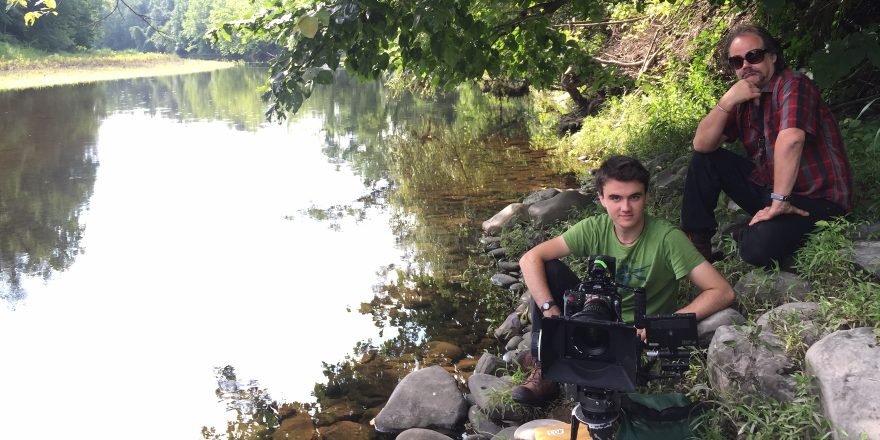



Elliott Hasler is a 24-year-old award-winning British filmmaker whose debut feature, the historical biopic Vindication Swim, is out now in theaters. Hasler’s passion for filmmaking began at a young age, with the production of WII: The Long Road Home. Made whilst at school and completed in 2017 when Hasler was just 16 years old, the film garnered praise from New York film critic Graham Fuller, who described the film as “a miracle achievement for a schoolboy director.” In 2017, Hasler also founded the UK-based independent film company, Relsah Films. (Photo by Gabriela Matei.)
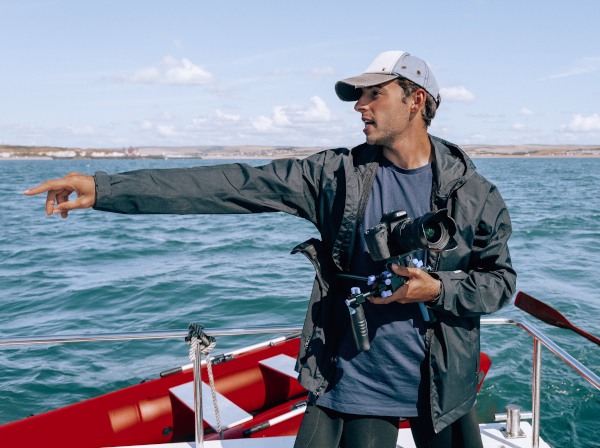
There’s an old English legend about King Cnut the Great, a Danish ruler who became King of England. The story goes that he set his throne on the seashore and commanded the tide to halt, saying, “You are subject to me, the king of all the world. I command you, therefore, not to rise onto my land or wet the feet of your lord.” The sea ignored him. The waves rolled in and soaked his feet. At that point, Cnut is said to have leapt back and proclaimed, “Let all men know how empty and worthless is the power of kings, for there is none worthy of the name but he whom heaven, earth and sea obey.” It’s a story I thought about often while making my debut film, Vindication Swim, which I wrote, directed, and shot myself. Because when you’re floating two miles out into the sea, four hours into a shoot, the water temperature at 60 degrees Fahrenheit, you realize Cnut was right. The sea doesn’t care who you are.
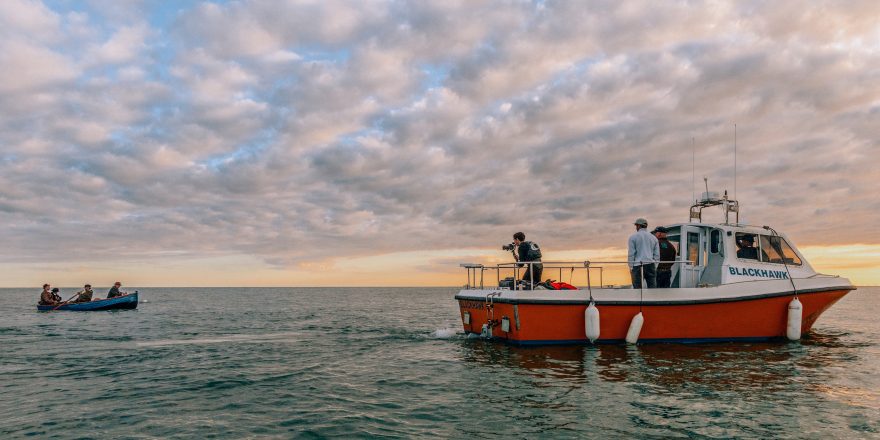
When I first discovered the story of Mercedes Gleitze, the first British woman to swim the English Channel, in 1927, I was struck by the sheer audacity of it. Here was a young, working-class woman of German origin, swimming not for fame or money, but to prove something elemental: that she could. She didn’t have sponsorship or support; she had determination. That same determination guided us through the making of Vindication Swim. From the start, I knew we couldn’t fake this. No studio tanks, no digital waves, no body doubles. We would face the real Channel, just as Mercedes had, or there’d be no point in doing it.
Filming on open water is an act of humility. The sea dictates everything; the light, the pace, the safety of the crew. One moment, it’s glassy calm; the next, it’s surging, white-horsed chaos. You can plan every shot as rigorously as you like, storyboarding shots and battening down every minute detail, but in the end, Mother Nature has final cut. Looking back on the eve of the film’s North American theatrical release, it all feels like a surreal dream, born out of a strange place and time, in the middle of the pandemic, that I don’t think we could ever replicate. We also now know far too much about the challenges of such an undertaking to attempt it again on this scale. But it was precisely that naïve determination that got the film made.
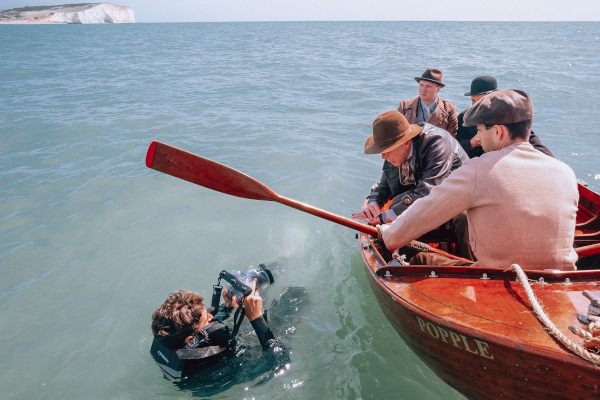
That same spirit carried through to Kirsten Callaghan, who plays Mercedes. Every stroke, every kick that you see in the film, she really swam; no stunt doubles, no soundstages, just raw physical commitment and a belief in the story that matched Mercedes’ own. Watching her brave freezing waters for hours at a time, I realized we weren’t just recreating history, we were reliving it. In honoring Mercedes’ story with the integrity she embodied, we inevitably faced many of the same challenges she did: the biting cold, the relentless waves, and, as an independent film, much of the same doubt and dismissal from the “establishment.”
On the very first day of principal photography, the conditions were far from ideal, but our excitement to start rolling outweighed any doubts. Within half an hour, nearly everyone was struck down by brutal seasickness. Still, we pushed on. Matt Wyn Davies, playing one of France’s most experienced rowers of the era, had to be carried from the filming boat into the support vessel and thought we were calling it a day. Instead, we spent the next three hours battling the waves, trying in vain to capture even a single usable take. John Locke, who plays Harold Best, would deliver his lines to camera on one side of the boat, then turn to the other and offer up his breakfast to the Channel. Meanwhile, Kirsten and I bobbed helplessly in the water. For me, that day perfectly captured both the challenges of making this film and the extraordinary dedication of everyone involved. Moments like John “soldiering on” reminded me that, despite the obstacles, we were all united in celebrating the life of this remarkable woman and bringing her story to the screen.
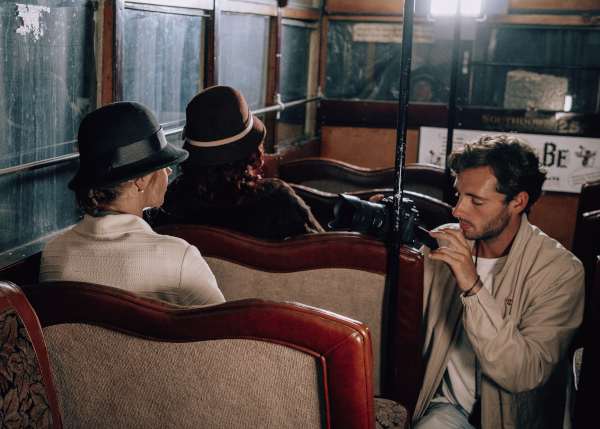
And bring it to the screen we did. Four years later, after countless hours battling the ever-changing elements of the Channel, an intensive on-land shoot recreating 1920s Britain on a tight indie budget, and a year of post-production at De Lane Lea Studios in Soho, the film finally premiered at London’s Curzon Mayfair to rapturous applause. Sitting in the stalls, watching Mercedes’ story unfold on the big screen, I was struck by how far we had come. From a ragtag family of creatives working outside of the establishment, battling against wind and tides, to seeing every painstaking detail come alive in full color and sound. In that instant, every moment of hardship, every sleepless night and every challenge on the water felt justified. The audience wasn’t just watching history; they were feeling it, breathing it, and celebrating it alongside us.
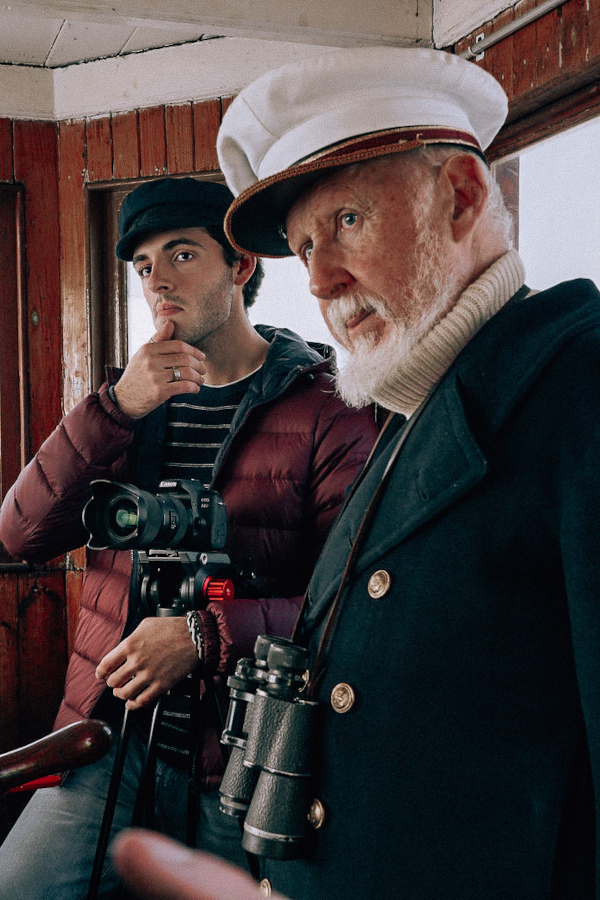
In many ways, directing Vindication Swim felt like setting your throne at the edge of the tide. You can’t command the sea, but you can listen to it. You can learn its rhythms, respect its moods and find beauty in its unpredictability. What King Cnut understood, and what I came to understand too, is that mastery doesn’t mean control. This film taught me that the most powerful stories don’t happen when you dominate the elements, but when you let them in. As Vindication Swim reaches international audiences, I hope American viewers will feel the same pulse of the tide and the same unyielding defiance that defined Mercedes; a spirit of pioneering courage that resonates deeply with the ideals America was built on. Mercedes Gleitze’s story isn’t just a British one, it’s universal, about courage, persistence and the timeless pull of the sea that dares us to go further into the unknown.
Featured image by Janet Brown; all images courtesy Elliott Hasler.