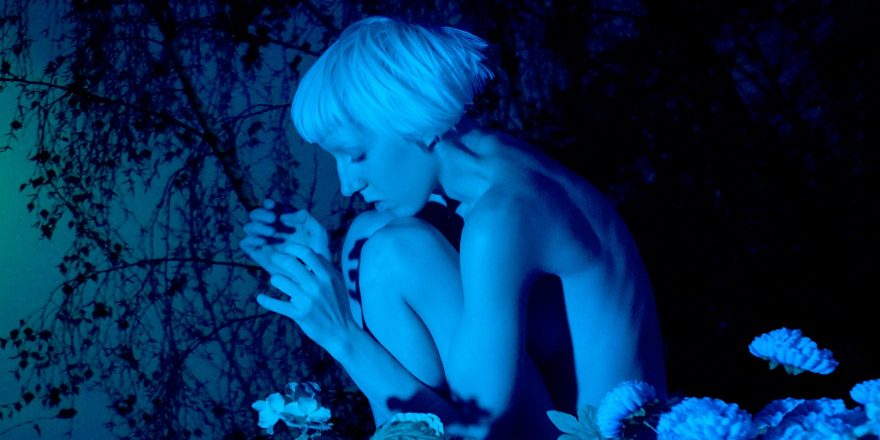



Vanta Black is the debut album from Rare DM, the solo project of Brooklyn singer, producer, and multi-instrumentalist Erin Hoagg. Following in the shadows of the previously released “Almost a Year” and the more recent single “Caracal,” Vanta Black tackles subjects and moods fit for the titular hue, itself the blackest manmade pigment (currently under exclusive license to artist Anish Kapoor’s studio). Erin’s Billie Holliday-indebted croon lilts with the relaxed calm of someone whose already cried away all the tears they could muster long ago — too exhausted to fret and now comfortable enough in the darkness to blend in with it. She sings tales of relationships damaged by distance and destructive tendencies, somewhat reluctantly relieved by freedom yet ridden with separation anxiety. Her pulsating, twilight-lit productions that accompany recall mid-aughts-to-modern-day takes on goth, post-punk, and new wave. Perhaps in a nod to the still-burgeoning live synth and dance scene in her hometown of Brookyln, Hoagg prefers to play her concert sets fully live, all analog, seamlessly blending Octotrack, Machinedrum, triggers, and synth.
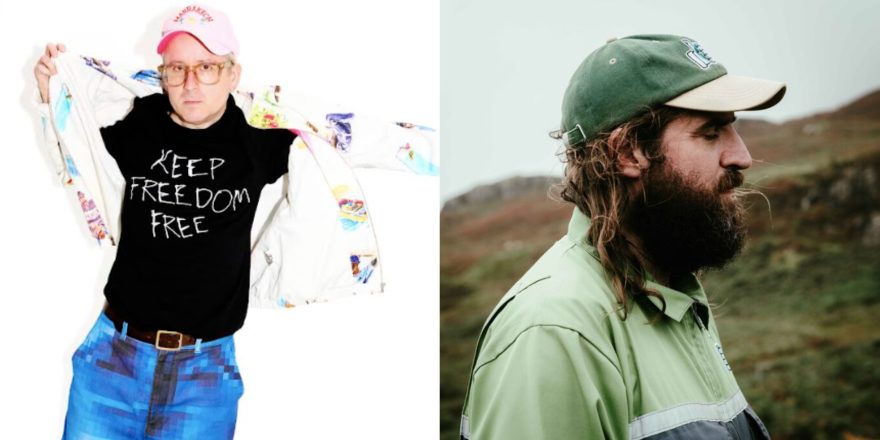
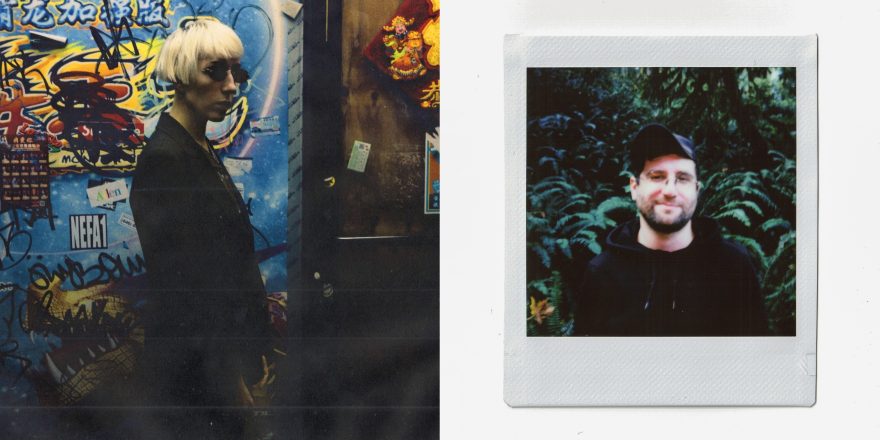
Ross Fish is an audio engineer and synth designer based in Portland, OR; Erin Hoagg is a Brooklyn-based singer, producer, and multi-instrumentalist who performs as Rare DM. Ross helped produce the new Rare DM record Attention — out this Friday, May 29 — and to celebrate the impending release, the two of them got on a Zoom call to catch up.
— Annie Fell, Editor-in-chief, Talkhouse Music
Ross Fish: How’s everything going with the new record?
Erin Hoagg: The new record is off to a fantastic start. I would say that “Honey” is kind of the biggest alley-oop I’ve had in years. People are really liking it, which is interesting because when people have been listening to the record, a lot of people mention the “Compliment” song. But I think that maybe “Honey” touches on something that you and I have talked about before, which is the vagueness versus relatability of songs.
Ross: Lyrically, I like when people write music that the listener can insert themselves into. I think that’s very important for people — relatable, generic topics. Because I also think that we’re moving towards a point where there’s so much personal branding in the world, and ego and everyone is an influencer and an artist, and I think people are kind of tired of that and they want to connect more with other people and listen to music that is not just about someone’s personal experience. Maybe I’m wrong about that, but I think that’s where things are moving.
Erin: Do you think the song “Honey” moves the dial on that a bit more than, say, “325,” because people can’t drive manual? [Laughs.]
Ross: [Laughs.] I think you’ve done a good job of that with a bunch of the stuff. But I think it could be even more vague, personally.
Erin: OK. More Vague 2026.
Ross: Whenever I listen to my favorite songwriters from any genre, it’s always like that. I mean, even The Carpenters — “Rainy days and Mondays always get me down…” Everyone can relate to that. It’s not like, “I went to work on Monday, my boss was mean to me…” It’s a really simple song with a really simple message.
Erin: That one sounds more like a country song.
Ross: [Laughs.] It’s a very simple song, and a lot of her lyrics are like that. And this goes back to the thing we always talk about, about karaoke — you and I talk about karaoke a lot — my very simple, stupid karaoke theory is, if a track bangs at karaoke night, it’s a universal hit everywhere. And the thing that’s really funny about that, when you start going to karaoke nights, is it has nothing to do with the genre of the music at all. There’s no consistency in a lot of ways. If a song is a bop, it’s a bop. People get crazy for System Of A Down and people also get crazy for Michael Jackson, and they also get crazy for Karen Carpenter. It literally doesn’t matter. If a song is good, it completely transcends all the boxes people try to stuff it into.
And, tying into the vagueness thing, I think one of the common threads that ties all those songs together is leaving enough space for the listener to insert themselves in the song, and having a topic that is applicable to a variety of life experiences. Because someone might write a song for a breakup, and someone else listening to the song might think it’s about losing a family member, and they connect with it over grieving. They’re both loss. It’s an important thing to think about. Karaoke does a great job at that.
Erin: My most recent karaoke song was “What You Waiting For?” by Gwen Stefani.
Ross: Which one is that one?
Erin: The, “Tick tock, tick tock…” I discovered, first off, I don’t actually know the lyrics well enough, so it was a really good challenge to try to keep up with the pace because I knew the melody. But also, I think that one is just a cathartic song for me. When the album was announced, I listened to it while riding over the Williamsburg Bridge, which was a nice full circle moment because I was tearing up a little at the fact that I’m finally releasing an album for the first time in six years. Which is makes me feel like I’m a little behind on the times, taking a little too long between albums, so I’ve been told…
But back on the subject of karaoke, my most consistent way I keep in touch with you from afar is watching your karaoke playlist update.
Ross: [Laughs.] I have a shared karaoke note—
Erin: And I’m on “Viewer Only,” which makes it especially funny. I can’t contribute.
Ross: I’m very deliberate about that. So, I’ve shared this note with I think five people. I go usually on Sunday nights until two in the morning, and it makes Monday mornings at work really terrible. But I really love to go to a karaoke bar when it’s empty, for the heads, not the people who are there with their work parties and bridesmaids or whatever. There’s a cohort here in Portland of, like, 15 people on a Sunday night, and they’re there every single week.
Erin: And you’re one of them.
Ross: Yeah. And they’re there only for karaoke — they’re not there to get fucked up and drink and party or whatever. You don’t go to a karaoke bar on Sunday unless you actually want to sing. So I have this shared note that I update usually at karaoke night, but a lot of times when I’m walking around department stores or grocery stores or something, because I’ll hear a track and I’m like, Oh, that’s a fucking banger. That’s going on. There’s stuff on that list that is extraordinarily mainstream pop. A lot of it, people look at it and they’re like, “That’s objectively terrible.” But then you do it at karaoke night and it’s a ripper. So it’s kind of like this worksheet of things that I think would be good karaoke songs, this database.
Erin: Some of these seem controversial.
Ross: A lot of them are terrible songs. Not all of them are bangers at all. Also, I’m kind of a karaoke terrorist sometimes, and a lot of them are songs that I actually hate.
Erin: My punishment song that’s not on here is, I like to whip out “Gloomy Sunday” by Billie Holiday, just to change the pace. But it gets fucked when you show up to karaoke and you realize there’s a posse of, like, six punishing theater kids — I never pull it out on a night like that, because all of them are doing, like, a circle jerk of ballad songs from modern musicals…
Ross: My buddy was in town, and it was the most hype I’ve ever seen — we went to one of the karaoke bars that was all bridesmaids and stuff, and it was pretty brutal, but my friend did “Axel F,” the Crazy Frog song—
Erin: I didn’t know there was lyrics to that.
Ross: There isn’t. It’s literally, “Bing bing bing bing bing, bong bong bong bong.” He did it and was hopping around, and people almost flipped tables. Oh, my god, it was such a smash hit. But that’s the thing that’s so funny about this — I’m sure that song must have gotten an absurd amount of revenue and has been streamed hundreds of millions of times. So it’s like, do I think it’s a good song? Do I like it? No. But it’s the karaoke litmus test: If it bangs, it bangs and it doesn’t matter. If it makes people enjoy their life for five minutes, then it’s served whatever function.
Erin: You have Eiffel 65, “Blue” on here.
Ross: That’s also a big hit!
Erin: That’s my first CD I ever got. Do you think that’s impacted my music? Can you hear the Eiffel 65 in me?
Ross: I think the Eiffel 65 I hear in you is this longing to be a bleached hair Euro guy.
Erin: Excuse me, I am bleached hair Euro guy!
Ross: [Laughs.] Did you ever see the documentary about Eiffel 65?
Erin: No.
Ross: I think it was Vice, who did the behind the scenes for Eiffel 65. It was like a sausage factory, basically — they were in a really high budget studio and there was eight songwriters in there, and all they did all day was crank out Eurodance hits like that around the clock. And the interview with them is just insane because it’s this guy talking about “Blue” as if he’s, like, John Lennon talking about writing “Imagine.” That dude’s commitment to his craft is so awesome, because that guy and all of those people in Eiffel 65 were just having fun. And the way they wrote that hook, he was just working on the track and I think he had the piano part, and then the guy who sings on it with the autotune came in and was just like, “I’m blue…” And they were like, “Yeah, that’s cool. Just put it on the track.
Erin: [Sings,] “I have a blue house and a blue window…”
Ross: I think this is the other thread that ties all these karaoke jams together — even with really serious artists, they’re all just being themselves and having fun. Like, I’ve got “360” by Charli XCX on here. Absolute banger.
Erin: You also have “Apple” by her, which I think between the two, “Apple” is a bona fide, predictable karaoke one.
Ross: I mean, these are blatantly obvious things here. There’s “Psycho Killer” by Talking Heads. One of the ones I do all the time is “Superman” by Goldfinger, from the Tony Hawk [Pro Skater] soundtrack. Everybody loves that.
Erin: There’s “Africa” by Toto on here. Honestly, doesn’t that song, like, wash over you and you just feel hope for the world? It’s this really uplifting song…
Ross: But all these people are just being themselves. I always slay Björk at karaoke. I do “Hyperballad” every time. Björk is always just being Björk. It’s another thing you and I talk about — I think authenticity is very important. I think people need to listen to whatever their inner voice is telling them. I don’t think it matters what they’re doing, if they’re genuinely doing something that they believe is a reflection of their expression and they’re being honest about it, I think that will always translate. And I don’t think it matters what type of music you’re making — electronic, acoustic, instrumental music — I don’t even think you need to have lyrics for it. And I think that’s the golden thread of the karaoke experiment. It also transcends demographics and age groups. I see people of all different backgrounds and ethnicities sharing love for the same songs. Like, I saw this really reserved, tiny, little shy woman go up and just shred Rob Zombie.
Erin: Oh, wow.
Ross: I was like, Woah. This is where she gets her rage out. I think that’s part of the invisible universal magic of music right there. I think it’s authenticity and trying to open it up to other people beyond yourself.
Erin: Out of the songs that we worked on, which one do you think is the most authentic of me?
Ross: I think you’re pretty committed to being authentic with all things. I think you’re doing what you think you should be doing because you want to do it… But I think “Skater” might actually be your most authentic because that one seems to come from a very real place with a real story.
Erin: Oh, yeah.
Ross: Not that other ones don’t. But when you were talking to me about “Skater” and about “The Ring,” they were both coming from… the feels. You were having feelings about stuff, and you wrote a song about it.
Erin: Well, I think when I was talking to you about the story behind “The Ring,” you might have given me one of my quotes — because sometimes another thing I do with the Apple Notes is I write down little things, and I think one of them was, “That’s how you get barnacles under your boat.” Which is what you told me after talking to you about “The Ring.” [Laughs.]
Ross: I feel like in the world of doing anything creative, you run into people that are really just interested in what they can gain personally from interacting with you. And I feel like there’s some people that you interact with that would just do anything to step over you and get ahead. That’s kind of what we were talking about. But I don’t think those people get very far, to be honest with you. I think the people who just view other people as transactional, that energy emanates out of you. And outside of the world of creativity and career, I just don’t think that’s a very enjoyable person to be hanging out with.
Erin: Absolutely not.
Ross: Back to the karaoke bangers again — because I have a feeling this is going to be an anchor — a lot of the groups making these songs really like each other. I just watched an awesome Beastie Boys retrospective that they did where it was this almost TED Talk about the Beastie Boys by the Beastie Boys. The whole thing was basically just about how they’re all best friends and that always superseded everything else. Every decision they made creatively, every decision they made career-wise, they always tried to prioritize their friendship over everything else. And when you watch the music video for “Sabotage”— which is also an absolute karaoke banger — it’s just these dudes having fun and running around New York with a camera and being goobers, you know? … I heard a long time ago, and I don’t remember where I heard it, but this guy said, “Relations before transactions.”
Erin: Oh, that’s a nice one.
Ross: If you’re starting with transactions, you’ve missed the plot completely.
Erin: That is very true.
Ross: I know in Japanese business, it’s days and days and days and days of relations and hanging out, and if you lead out of the gate like a fucking arrogant American, like, “Let’s get down to business,” it’s pretty faux pas and weird.
Erin: That’s part of the reason that going to Europe is so nice. Everyone is so, “Oh, no, we don’t work on that right now. We take a nice long lunch and then we’ll go…”
Our relationship technically started with a transaction. You just didn’t know it. I bought your synth!
Ross: Well, yes and no. You didn’t buy it from me, you bought it from a store.
Erin: That’s true.
Ross: You is you posted about using one of my synths, and then we stayed in touch on Instagram. And then our relationship actually started from me giving you Ableton lessons.
Erin: Yes.
Ross: For free. That was not a transaction.
Erin: I went to Perfect Circuit for the first time, I think it was 2019, and they were showing me the Stargazer and I was like, “The name is sick. I do not have a drum synth. This is beautiful and it sounds awesome.” And then I wrote a score on it and posted about the score, and they were like, “Do you know the creator of this? He’s really funny. You should send it to him. His online presence is ridiculous.” So I chatted you up, and the rest is history.
But the Ableton lessons were fucking clutch. There’s a lot of things that I don’t know still that you know, so I have my text-able dictionary who has no office hours.
Ross: I don’t think knowing stuff is even important, to be honest with you. A lot of my favorite music is made by people who have no idea what they’re doing.
Erin: Oh, thank god. So I’m your favorite musician?
Ross: [Laughs.] I think you’re being a little too humble. I don’t think you have no idea what you’re doing.
Erin: That’s the first time I’ve ever been called humble in my entire life. And now it’s going to be notated in an interview! I’m sending this to everyone. [Laughs.]
Wait, tell me what it is that makes a banger, in the most concise way. Like, outside of karaoke.
Ross: A hook that is easy to digest. You think you know where it’s about to go, and then it does something slightly different. I think the hook is obviously the most important thing. I think lyrically, it goes back to the thing I was talking about, about being digestible and vague, insert yourself into it and it’s memorable. I think a banger also has a lot to do with song structure. I think it’s about giving contrast between sections and about setting up, rather than just throwing a hook at people. I think the best bangers kind of pull back and then give you a space to hang out in before the hook hits you over the head.
I think we talked about it when we were doing a sound design thing for one of the songs — it was probably for “325” — I went to school for sound design for film, and one of the things that I learned is that an explosion in a film has way more emotional impact when you have a big gap of silence before the explosion. This is really common in space movies. Obviously there’s no sound in space, but if there’s a big space explosion — one of the things you see in Star Wars movies all the time is they do this thing where they go, [makes a quick whoosh noise].
Erin: Oh, I love that sound.
Ross: Yeah. So that’s a dynamic range thing. You know what I mean? It’s a sensitivity to sound. It’s a contrast thing.
Erin: We do that for the “hop in” moment in “325.”
Ross: I sneak that in as a cheat a lot. It’s a very cheeseball kind of—
Erin: I love being cheeseball.
Ross: Me too. It’s a cheap trick that I love doing. And I think it’s not just a sound thing, it’s also a musical thing. It’s an arrangement thing outside of this specific explosion analogy. If you have a verse that’s stripped back and chilling for a second before the big hook, when the hook comes in, it’s more powerful. So I think contrast is really important in a banger. You hear it a lot with really good club tracks and pop tracks: They have a big loud hook, and then when they get to the verse, they kind of cool off and scale back a little bit. I think that’s a really important element.
Erin: That’s something that we do a lot. I think it’s become less of an issue, but when we first started working together, I would have six different bass sounds at the same time. And now it’s, like, three instead of six. [Laughs.]
Ross: My friend Marcus, who’s a music producer in the UK, gave me this other metaphor for arranging and mixing — he calls it “playing Jenga with your mix.”
Erin: Oh, I love that.
Ross: Again, this is very similar to what I learned about film audio. In film audio, there’s the editors and there’s the mixers. A sound team is a huge group of people. The editors’ job is to put in a sound for every single thing that comes up in the spotting session — every single movement, every single thing. The Foley is cover to cover with fabric and footsteps and everything. There’s hard sound effects cut for everything, piles and piles and piles of sonic information. And then the mixer’s job is to pull it all away and leave only what’s relevant. So I try to approach composition and arrangement in a similar way, where if you give me a session with 64 tracks on it and there’s cover to cover sound, I like to do the musical Jenga thing where you try to pull away as many bricks possible so that you’re only left with the least number of bricks necessary to keep the tower up. Because if you’re hearing everything all the time, it doesn’t give your ears a chance, and it doesn’t give your emotional self a chance, to focus on anything. It’s like having musical scaffolding that doesn’t have cover to cover curtains and frippery. If you’re going to do that, do it for 20 seconds during the hook, or do it at the end when you’ve heard the hook four times and now you’re just waterboarding people with sound.
Erin: Definitely… Have you put out the klezmer pop album you’ve been working on?
Ross: [Laughs.] No. So — I don’t even know why I did this — I made an organ, Napoleon Dynamite, cheeseball klezmer record. I finished an entire record and I emailed everyone you could possibly email in the klezmer world to put it out, and nobody answered me. Which leads me to believe that it’s either as bad as I think it is, or it might actually be a really cool thing.
Erin: It’s definitely really cool.
Ross: If anyone is reading this and has any interest in putting out a klezmer record… But, yeah, I’m totally OK with rejection, but it’s hilarious to me that nobody has answered me. I take great pride in that, to be honest with you. That means I’ve done something so offensive and indigestible that nobody even warrants a response to it.
Erin: I’ve been told recently by my European booking agent that people, quote-unquote, “don’t know what to do with me.”
Ross: Here’s something they could do with you: they could just listen to your music. [Laughs.]
Erin: Yeah, right. I mean, it’s got to be something, right? Because we both like the Rick Rubin book, and LCD Soundsystem’s little philosophies in Meet Me in the Bathroom — “lean into what makes you the most you.”
Ross: “Shut up and play the hits.” That’s the other James Murphy thing. Do you know what Rick James called it? “Broke notes.” If you were in his band and you were doing something too flashy, he’d be like, “Stop playing those fucking broke notes.” Like, “you’re gonna be broke if you keep doing that.”
Erin: That’s funny. I mean, that makes me think of sometimes my biggest critique of a song, in more of a rock music setting — I’ll just be like, Damn, the drums are too, bro-y. “Bro-y” just kind of means “broke notes” sometimes. You know what I’m talking about.
Ross: It’s too flashy, too much.
Erin: I think sometimes, you just want something that sounds more lo-fi. Unless I’m listening to some sort of really weird noise record that you’ve sent me that’s got a thousand different cool pannings—
Ross: Like Mark Fell.
Erin: Yeah. Otherwise, I don’t think I need to hear things individually that well.
Ross: This is tying back to what we were talking about before — I don’t think technical execution matters as long as you’re getting the sound you want and you’re doing it in the way you want to do it. It wouldn’t make sense to take an artist that does lo-fi stuff and record them in 96k, 24-bit in a fancy schmancy studio.
Erin: I didn’t even know that it could go that high.
Ross: Yeah, it can go 96. It goes even higher than that on some stuff. But that’s the other thing, the authenticity thing we’re talking about. It’s a thread that needs to travel its way from the conception of the song and the conception of who you are as an artist, all the way through the songwriting, to how you actually physically record it. Then also obviously what you do with it after you record it. And I think as long as that thread is consistent, all of the variables in between don’t matter.
Erin: I think that’s an interesting thing when it comes to vocal takes specifically, because sometimes I’m like, “I can’t do it better than that. That was the one. Sorry it’s recorded kind of bad, but…”
Ross: Just own it.
Erin: I think that happened with “The Ring.” We tried to re-record the vocals and it was like, “Oh no, I don’t know how to do the shout like that.” Because I had the really dynamic mic, so when I was trying to make it louder, I was clipping every time, and I don’t know how I did it and I can’t replicate it.
Ross: There’s the Miles Davis thing where he was in the studio and he was shuffling around sheet music and the engineer is like, “Miles, we gotta redo the tape.” And he’s like, “Yeah, man, just keep it rollin’. It’s all part of the music, man.”