

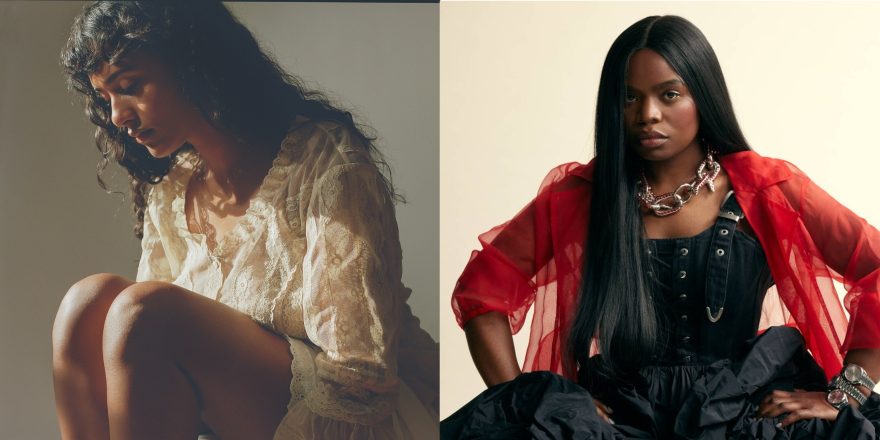

Marem Ladson is a singer-songwriter born and raised in Spain, currently based in NYC.
(Photo Credit: Nuria Rius)
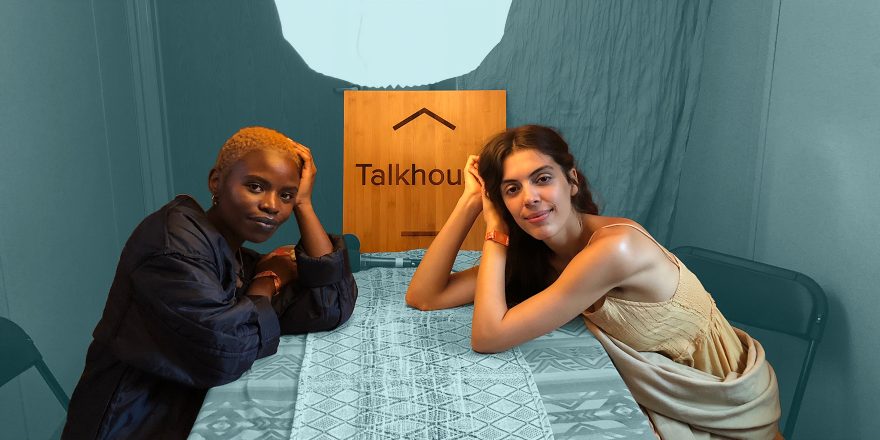
Vagabon is the NYC-based singer-songwriter Laetitia Tamko; Marem Ladson is a singer-songwriter from Spain who’s now also based in NYC. Marem’s new track “Alone Forever” is out today via Mtn Laurel Recording Co., and to celebrate it, she and Laetitia got together to catch up about their origins as writers, giving themselves space to process their experiences into songs, and more.
— Annie Fell, Editor-in-chief, Talkhouse Music
Laetitia Tamko: We don’t actually know how we met, do we?
Marem Ladson: I feel like we met through the internet, when I was still in Spain.
Laetitia: OK, I didn’t know that you still lived in Spain.
Marem: I mean, I didn’t know where you lived either. That’s the magic of the internet, that you’re just weirdly connected to the world. But, yeah, I was still in Spain. I was just a big fan of your music. And then when I moved to New York, we reached out and met in real life.
Laetitia: I feel like it’s a testament to community. We have friends in common. There were all these different threads that, even though we hadn’t met yet, there were people that we know from all over. Making friends through the internet in that way — you know how mushrooms run threads through the forest and they all communicate with each other? I feel like that with me and my friends. [Laughs.] It’s like an introverted person’s dream.
Marem: I never thought about it that way, but you’re right. It’s beautiful.
Laetitia: And obviously, I still remember the first time we hung out in person, the Lower East Side. It was really, really fun. And I remember you telling me about how much you wanted to move to New York, and how you feel really at home here.
Marem: Yeah.
Laetitia: Do you feel like it’s impacted your music, your writing?
Marem: I think so, yeah. I’ve found so much freedom being here. I also feel like that first time that we met in person, I was new to New York — and it still feels very new — but that feeling of just excitement and everything feeling so new, it’s very refreshing and inspiring when making music. I’m sure you feel the same way. It’s just very exciting. There’s so much going on all the time. And finding community, finding other friends that are also going through the same thing, it’s something that I always longed for — that feeling of belonging and feeling very understood by other people around me. And that is a new thing for me, for sure. I’m from a very small town in the north of Spain, and I never really had that sense of community or feeling like I could see myself reflected in other people. I didn’t really have many friends pursuing music as a professional career. And then when I moved to Madrid and I lived there for six years before moving to New York, I had friends that were also making music, but I feel like the type of music that I was making didn’t really fit in the place where I was. I feel like in New York, there’s room for everyone, there’s a little pocket for everyone, and you just gotta find your pocket. And I feel like I found it. It’s been three years since I moved here, and I’m just very grateful.
Laetitia: Well, it’s been it’s been fun as your friend watching you. I find it to be such a privilege to be able to see something as it’s being figured out, whether it’s music, whether it’s your friends, whether it’s yourself or an album or song. It’s such a cool position to hold when you’re up next to something like, “I see where it is now versus two years ago.” Or even seeing you enjoy New York in not just in a social way, but in a personally developmental way. Obviously I have grown up in New York, but moving back here [from LA], I feel a lot of the same ways. I always say that I have a career because of community in New York. It was only through my little scene and everyone doing everything together that I even was able to have a career in the first place. And that all happened here. And so after a few years in LA, coming back here, it almost feels like a homecoming. And the way that it’s affecting me as a person and the work that I’m making is really exciting.
There’s always wars about what the best city is, but I will always think New York City is best. Even if we dabble in other places — obviously we both travel a lot. You’ve just been playing a lot of shows, and you have all these shows coming up. We were just talking about travel and airports and airplanes. I feel like for musicians, airports and airplanes are a very important place. We were talking about how emotional being on an airplane makes us. Have you ever written a song on an airplane, or had a breakthrough with a song you’re working on, on an airplane?
Marem: I always write when I’m on a plane, whether it’s journaling, or maybe it’s just a little thought that I have and I write it down in my notes. Sometimes if I have an idea for a melody, I will do a quick voice memo. But I feel like more than just musically, I have a lot of thoughts and breakthroughs when I’m on the plane because it is a place where you’re kind of isolated in a weird way, up in the air for hours, sometimes without internet. You have a lot of time to think. And I usually just end up crying. [Laughs.]
Laetitia: Same. [Laughs.]
Marem: It’s so crazy to cry in an airplane when you have so many people sitting right next to you. It’s just so intimate.
Laetitia: Yeah. I mean, crying is in the top activities I do on an airplane.Obviously there’s a link with your song “Alone Forever.” And there is [an element of], I’m dramatic. Like, I’m an African girl who is dramatic. So I do sometimes feel alone forever. [Laughs.] But that’s how I feel in an airplane. Even if obviously there’s so much love in our lives, it is a true sense, especially in the modern era where, with the internet, we feel so close to people all the time. But on an airplane, you are truly aware of your presence as an individual.
I’ll let you say what [the song is] about, but I just loved the part where you said that we sometimes spare others pain, and there’s an untruth about how we can show up in love because we want to spare others. Am I getting that right?
Marem: Yeah, yeah. I wrote a little note about the song, and I was just saying that this song came from a moment of clarity from watching love dissolve before my eyes and knowing there was nothing I could do to stop it from happening. Writing it was my way of observing and dissecting the situation and leaving room for all these thoughts that I was only half-ready to admit, and saying all the things I couldn’t really say out loud at that time. And sometimes I think what keeps people together isn’t love anymore, but fear — that fear of being alone or of causing pain. And out of that fear, love can turn into a kind of mercy where you both start performing versions of yourselves to protect each other from the truth. And love can be cruel when it’s performed out of compassion.
Laetitia: That’s really beautiful. Maybe this is a weird question to ask, but are you often the one who has that fear? Are you more of a confront-it-head-on person with that kind of fear? Or are you like, I’m going to take the back seat and take time to parse it out?
Marem: I think writing this song made me realize that I had this fear. And it’s a very existential thought of just knowing that you’re born alone, you’ll die alone, and you go through life and you meet people and you experience love if you’re lucky, and you can build community, but there’s always that fear of just being alone. Or it’s maybe me with my abandonment issues. [Laughs.] But I think thinking about this and writing this maybe made me confront that fear a little more, and just being able to put words to it and question why do we sometimes stay in certain situations when maybe the best thing that you can do is leave… Yeah, I don’t know.
Laetitia: It’s interesting because as songwriters, we get to choose what position we take in the storytelling. And in my writing as of lately, the songs I’m writing for my next album, I’ve been confronting the fear of being… not necessarily the “bad guy,” but admitting my parts in certain tense situations. Because often as the songwriter, I get to choose whether I say my part or not. As I should. I’m writing about the ending of a long friendship and saying, “I’m going to say the ugly thing. What if I do that?” And it doesn’t mean that I’ve done something ugly. But it’s been an interesting writing practice for me lately, [confronting] the fear of portraying yourself as the writer in a light that’s not favorable…
Marem: There are things that you can say in a song that you can’t say in real life. Or you can, but maybe you’re not ready to, and song is the first form of doing that, and having some sort of breakthrough. I mean, it’s kind of like therapy as well, right? I actually feel like with a lot of the songs that I’m also writing for my new album, some of the themes are things that I’ve talked to my therapist about, things that we’ve discussed for years before I was even ready to write about them. And then once you’re ready to write about them, then maybe you’re also ready to deal with them in real life.
Laetitia: It’s true. It’s such a powerful mode of processing. I heard this writer — I forgot his name, but he’s a novelist. He was saying that the reader gives meaning to his text. And I think that’s a very humble thing, because it is this therapeutic experience when we write the song, and then once you share it… Even when I see the lyrics to “Alone Forever,” the meaning I give it might be slightly different than the meaning you intended. And that’s why I love writing songs.
I hate when people ask me this question, but I feel like you’d have a good answer. I was curious, who are your songwriters? You’ve mentioned Vashti…
Marem: Oh, yeah, I love Vashti Bunyan. There’s so many songwriters that I admire: Sibylle Baier, Karen Dalton…
Laetitia: Were you always into songwriting? Like when you were a kid — this is also just something I want to know as your friend — did you learn guitar first, or were you writing?
Marem: I was writing before I even got into music. I was always really into journaling, and I remember when I was in middle school, I would spend a lot of time in my bedroom just in my own little universe writing things that, I’m sure if I go back now and I read them, I’ll be like, Oh, my god, this is so cringe, so intense. But at that moment it was serving a purpose for me. I really needed it. And I think it was a very healthy thing for me to do, because I was trying to navigate so many things. In school, I always felt a little misunderstood and I had a really hard time fitting in or finding my group of friends. I was bullied in middle school. I was also one of the only Black people in my school. Maybe there was one or two more, but… I couldn’t really see myself reflected in other people. And I think I really turned to my own inner world to find that sense of belonging.
And then when I was 10 or 11, I had been asking for a long time for a guitar. I would always get toy guitars, but eventually my mom got me for Christmas a nylon guitar — a very cheap one from Carrefour, which is a store in Spain. I started teaching myself guitar in my bedroom with internet tutorials, learning other songs that I liked at that time. Then I started putting together the those lyrics, little poems and angsty things that I was writing with these new chords that I was learning. And that’s how I started writing my first songs. But I think writing came first, just as a way of trying to make sense of the the world.
Laetitia: I really relate to that for sure.
Marem: How was it for you?
Laetitia: Exactly same. I was always into writing in my diary. But I come from a very academic family, so I was always in advanced classes and it was all about school. And when I graduated high school with honors, my parents got me, as a graduation gift, a guitar from Costco.
Marem: Nice. Carrefour is literally Costco’s equivalent. [Laughs.]
Laetitia: Yes, exactly. And they were like, “You have three months of summer before college to play that thing. And then when school starts, that’s it.” I think I always kind of was juggling two worlds. At home, it was all African, Cameroonian culture. We spoke French, we ate food from Cameroon. And then outside of the home, it was American culture. At school, it was all about school, and in my private life, I would sneak and play guitar. So there was always this balancing of two different people almost. Depending who’s witnessing me, I would show up a little bit differently. And I wrote songs to make sense of that, too. It’s not a switching; those two things are me. But it was like, how do you cope with not being fully yourself in any one place? So I started writing songs mostly about making sense of that as a really young person. And I actually look back now and I’m so in awe of the girl who wrote Infinite Worlds, my first album. I’m like, Damn, you really said that. That’s what keeps me writing songs, even if they don’t end up on an album, or even if they don’t get heard. Because I find that, now that I’m working on my fourth album, I’m hoping and excited to reference my old stuff. I’m looking at it back like, Oh, I wouldn’t dare say that now, but that was me. I did say that, I was that vulnerable, I was that open. I think we have a lot to learn from our angsty, younger, less afraid selves.
Marem: Yeah, I mean, it lives inside of us. It’s always there.
Laetitia: Yes. And I think that’s what youth is like. Obviously youth is an age, but I also think there are, like, 65 year old women that I admire because they continuously are curious about how to keep in touch with the versions of them before they were scared, the more courageous and brave versions. And I feel like New York as a city also does that to to an artist, at least for me. Every time you leave your apartment, you are confronted with the world. You can’t pretend it’s not there.
So, are these [new songs] part of an album?
Marem: Yeah. “Cavity,” that came out in early October, and “Alone Forever” are going to be a part of my new album. They’re very different songs. They talk about very different things. It’s just taking a lot of time for me to be able to write from such a vulnerable place and be open to talk about my traumas, and things that I had never even imagined that I would be able to talk about. It’s been a very healing process for me, I think, as well. And it’s all going to be on an album that I’m still working on, and hopefully will be finished soon.
Laetitia: Oh, I’m excited.
Marem: Some of these songs talk about mental health. I also feel like when we met, we bonded on many different things, but also just our journeys with dealing with anxiety and depression, and always trying different things and kinds of therapy to get better, and how writing music is also a part of that process. It takes time.
Laetitia: It takes time. I think music, when it feels really close like that, you mentally want to be in a place to, one, be ready to talk about the subjects, and two be able to talk to other people outside of the song about it. And then tour it and sing it every night. That’s a process. I feel like that’s what takes time. We’re writing songs all the time, we’re processing stuff all the time. But then there’s a layer of sharing that. It takes a lot of courage.
Marem: It’s so scary. I feel like it’s also been so different playing songs here versus in Spain, because I write songs in Spanish and English, but mostly in English. When I was in Spain, I felt weirdly protected by a language barrier. And since I moved here, I feel really seen and people are really understanding what I’m saying. That is a very positive thing, because it allows me to connect with people on a deeper level. People have come up to me after shows to talk about the lyrics or ask me questions about the songs, which is something I’ve never experienced in Spain. But at the same time, it’s so scary. It’s like, Holy shit. People actually understand what I’m saying? I guess that’s how it feels anytime that you show up in a vulnerable way. It allows for connection with people, but at the same time, you’re putting yourself in a very vulnerable place.
Laetitia: Yes. That’s so real. I mean, I’ve made full albums out of… Not in a way to necessarily create distance, but I have felt very intense emotions, like grieving the loss of a good friend. Someone actually leaving the earth is a pretty intense emotion, and there was no way I could write songs about that and then think of performing them. I wasn’t ready then. And some of the songs I’m writing now touch a little bit on it. But just speaking to taking time, I refuse to force myself to do it outside of my timing. Because I’m sensitive, and I think you are too. It is a very visceral reaction to share certain words with people. You have to do it when you’re ready.
Marem: Yeah. Otherwise it will also not make sense or even work. Because you can’t force it. You need to come to certain realizations in time.
Laetitia: Yeah. It’s interesting about the language barrier, too. I never thought about it like that. I only have a few songs where I speak French, but I’ve never really given much thought to the closeness of language. For every word to be understood, it’s like, Damn. [Laughs.]
Marem: Yeah. I mean, it’s really crazy to be able to connect with people in two different languages, not just in music. You know how it is. Your brain is wired differently when you speak different languages, and you can tap into different emotions even. You communicate in a different way. There’s something about writing music in Spanish and in English that I really like, even when I’m playing shows. And I feel like there’s people in the audience that are also bilingual, and it’s nice to be able to connect with people in that way.
Laetitia: Totally. I love that. Well, I’m excited to hear the song. You should play it for me right after we press stop.
Marem: [Laughs.] I will play it for you!
(Photo Credit: left, Nuria Rius; right, Phillip Chester)