

Terence Nance is an Artist, Musician, and Filmmaker born in Dallas, Texas in what was then referred to as the State-Thomas community. Nance wrote, directed, scored, and starred in his first feature film, An Oversimplification of Her Beauty, which premiered at the 2012 Sundance Film Festival and was released theatrically in 2013. In 2014, he was named a Guggenheim Fellow. In the summer of 2018, Terence’s Peabody award-winning television series Random Acts of Flyness debuted on HBO to great critical acclaim, and was renewed for a second season by the network. His latest release as a musician, Vortex+, came out in early 2025.
“This level took an awful lot to reach
Applied pressure for the diamonds that you see glisten
Heavy metal, every piece precious
Let’s watch the belly of the beast hemorrhage”
– Earl Sweatshirt from “Heavy Metal aka ejecto seato!”
When I heard in late December 2011 that my first film, An Oversimplification of Her Beauty, would play at Sundance, I had a typical experience for a first-time filmmaker, 20-odd years earth side. I thought it was now possible for me to be a part of a lineage. The act of dragon-slaying that is making a feature film had been spurred on for me by celluloid dreams incepted by the lore of Spike making She’s Gotta Have It, Julie making Daughters of the Dust, Wendell making Chameleon Street, Haile making Sankofa, Charles making Killer of Sheep – my elders’ films were Black and “art-first,” as I used to say. At that time, I also had Michel Gondry, PTA, Soderbergh and Wes Anderson in my heart, and many other filmmakers who had expressed themselves with a hypothesis for cinema that felt through the dark to express the unseen.
I only partially arrive to my creative practice through a lineage of filmmakers – most of my pursuits previous to Oversimplification were more “fine-art forward,” so I was only partly conscious of the coattails I was hanging onto. I had been working on my film for seven years, pouring every ounce of my spiritual and material resources into it, and wanted to land on something that would stand the pressures of the temporal and the infinite, some cinema thing that would incept itself in the consciousness of the next aspirant – given that’s how I had been possessed.
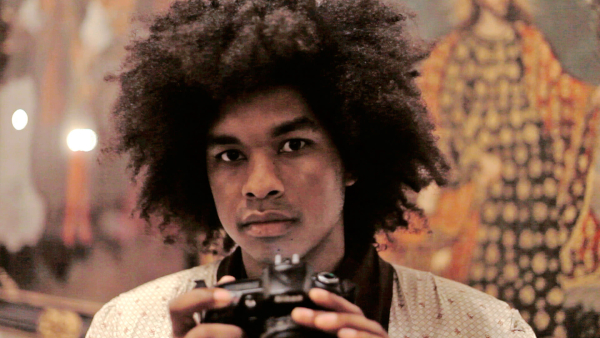
Movies imprinted their energetic configurations onto our consciousness as kids, then as aspirants, then as adepts. Filmmakers are people who will endure unsustainable modes of day-to-day life (you know, “production”) in order to play with symbols in liminal fields of light and sound ’tween wave and particle – cross above and below – hypersigils – anti-scholastic and rhythmic, but not songs – photons moving – Mach cones with cymatics infra and supersonic. These players function as a priesthood presiding over the 20th and 21st centuries’ most dominant semi-institutionalized religion: the moving image – what we typically call “the media” (read: the church). Identical to its progenitor, it is the great myth-making machine. The media: physical and ethereal – the set of subterranean wires to land-traversing antennas, and over air waves which make the connections between the collective dark and so-called light – which finds its self on screen. Along with economists, filmmakers are the best liars money can buy, unlicensed psychosocial clinicians who largely charge nothing. These priests, we’re a blip in the epistemological timeline of the modern world, after actual priests, whose myths end in an apocalypse we are now in the denouement of – after economists who have told you capital accumulation will solve suffering, and before transhumanists who (despite their experimentations) are simply self-styled “chosen people” mutated into self-proclaimed robber barons – filmmakers never got a hold of this “build” of world before it ended.
As a place for these priests on a holy mountain, it helps that Sundance’s brand is a Lakota initiation, a prayer to the sun, exclusive to the people who tended to life with this land in and out of an encircled space-time where “end” and “begin” hold light but not water. The Sun Dance draws a blood sacrifice from the initiate who, as I understand it – through pain to transcendence – forges a profound relationship with the fire in the sky and its life-giving nature, our closest star. So I’m in these mountains within these mythos and many synchronicities and sparks happen. It’s 2012, and I hug Ava’s neck – she was the Best Director that year with Middle of Nowhere. I dapped up Ryan – he was building an honoring of Oscar. Brad is Brad, so his light was everywhere, but I don’t think I saw his body – in the midst of a storied run. Five films, five years in a row, if my memory serves me: Pariah, Restless City, Middle of Nowhere, Ain’t Them Bodies Saints, Mother of George – there we were.
2012, y’all remember: hope on our tongues, we felt like we just might win the West and win in the West, on stolen land, in the binary cult, with lingua franca. You know how it was for a second for many of us – delulu supreme, having briefly made secondary the resistance commitment of our most immediate elders and ancestors. As Mike sang, you can’t win, you can’t break even, (and most pressingly) you can’t get out of the game. This verse is from “The Crow Anthem,” one of my favorite blues, from the The Wiz – a movie as Tarot spread (card one, the hanged man (reversed); card two, the Anima; card three, the Tower) In it, the scarecrow can’t do his job effectively because his brain is made of quotes from the pop stars of modern knowledge production: Confucius, Einstein, Ben Franklin. This parroting of knowing keeps him on the pole, shivering and stuck. He must be reminded that his intelligence is in his body. To understand this, he must first collapse.
Today’s collapse’s most visually articulate feature is the brutal genocide of Palestinians by all of the nations who constitute the modern world (West, Middle and East), led and funded by the Europa/American empire and carried out by Israel. All empires fall, all worlds follow, as they think themselves universal and thus invulnerable, and this empire-cum-world collapse is producing, directing, and distributing the final installment of the Abrahamic Epochal Myth. We clearly have sequel fatigue and Babylon should fall any minute now. Empire will fall to the resistance and what will happen after is our choice – some denouement / subplot of which will be how we avoid the empirical aftershocks which seek to reclaim the material(isms) they lost – aftershocks as allegorical to the chain reaction that detonates a nuclear bomb (the modern world’s diamond-encrusted medallion) may be a metaphor for the annihilation and extinction of the diverse, sentient, ambulatory form of life we currently enjoy, one that is always already out of this world.
This chain-reactive psycho-spiritual annihilation has already sparked and spawned inside the beating hearts of the settler(s), the agent(s), the president(s), the prime minister(s), the senator(s), the emir(s), the citizen(s), the judge(s), the lawyer(s), the university administrator(s), the creative executive(s), the investor(s) – a networked ego feeding on a well-worn yet titillating cynicism which casts “resources” as “scarce” – acting in alignment with the forebears of the Western world spell/software – the incarnated and willfully universalized and historicized fable of the Garden of Eden. A place where “the man” must labor to dominate any and every thing/body – as he is both condemned and selected to do so. He is after all some – one.
Apocalypse, a change of age – the end and a beginning. The “movie” is a commodity and is light in the drawers, as the old folks say, and it thus – absolutely – will not be consequential to this transition between ages. The project of cinema, however, is inspiring – maybe it’s the phonetics of the word “cinema;” it resists connoting itself as commodity, feels more like a ritual object or sanctuary space, a happening. Produced by the circus-ness of its French progenitors, a gypsy vibe, the stage is on wheels and is drawn from town square to town square to play a dream for everyone seeking an awake-ness in the dream time, a lucid meet-cute with an emergent symbol. This uncanny liminal invocation of the experiences the word “cinema” conjures means that the project of cinema may be consequential to our current change of age. The cards have been dealt, they are solid state and hold a finite amount of data – what will we read, record, assemble and screen?
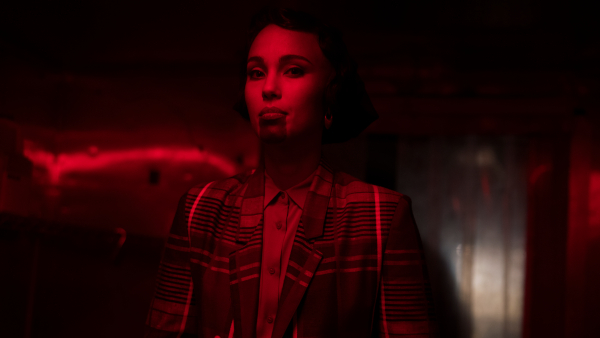
Thirteen years on and Kahlil screened BLKNWS: Terms & Conditions for the first time at Sundance 2025. Needle-dropped on his first record and the anticipation was a quantum charge like few I’ve experienced. The heads were primed, because he has been making the film for many years and earlier versions of it (an art work in the form of a company that grew a root system to support the groundbreaking of its present manifestation) have been out, amongst the people, on the corner, in the barbershop, the biennale, the fish spot. I’m hoping if you’re reading this, you had a chance to catch the OG version – it was unamended, without the terms and conditions that have been agreed to – here, in the space between world and earth.
The movie began with the first time Kahlil has – in any explicit way – named himself as his own subject. The film brings forth the muses in his family: brother, mother, father, grandmother, and unknown grandfathers. The effect is at once grounding and elevating – a deeper rootedness facilitating a more vibrant bloom. To witness the moment that the film premiered was an uncannily synchronous revolution in the spiral cast within the XYZ-T(time) field of the cosmos: the Egyptian Theater 2012, An Oversimplification of Her Beauty premiered; the Egyptian Theater 2025, BLKNWS: Terms & Conditions; the Egyptian Theater 2037 – what will it be? Ironically, it won’t be. This particular locale – inspired by Giza, the place the modern was, in some way, born – will no longer be somewhere celluloid dreams will manifest. Going forward, Sundance will be on Hinonoʼeino land.
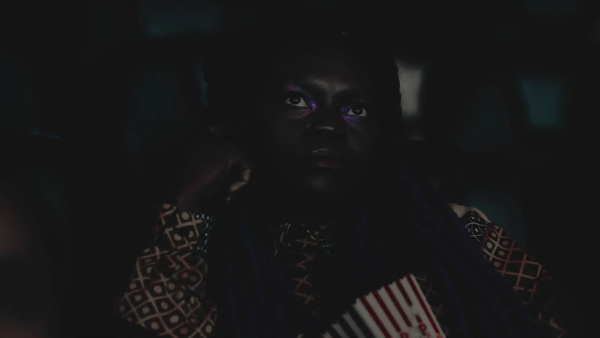
We all love to hear of the sociality that produces transcendent art: Zeinabu, Charles and Julie watching each other’s kids on set, or a convo Kubrick had with Spielberg after the former’s first watch of Schindler’s List, Soderbergh cutting some fat from a Fincher movie, Ornette walking Coltrane through esoteric harmonies in the green room at the Five Spot. In these traditions, BLKNWS endeavors to “share the ball.” The film is Khalil as bandleader / point guard, behind the back to AJ, a breakdown so Garrett can trade four counts with the rest of the band – this is all displayed in the track list inside the gatefold, a list of features that will make any lover of cinema run to the theater. BLKNWS is the showing and proving of the feeling of Black music’s social process hypothesized as cinema process – AJ and Ben have not been preaching to the choir all these years. It’s the interdisciplinary party, meal, science, speculation, improv, theater. The moving on and below water of the BLK ST*R LINE – rendered by Jatafa. This vessel carries us through our mythologies, our Drexiyas and Double Consciousnesses, our wayward living and Gender play(s), the encyclopedia of ways of being that goes the places our flesh wanders … and other spots too, I’ve found.
The reference points blur with the team assembled to make the thing: Godard must have been there in the room, Bradford, Malik, AJ, John Akomfra, Aja, Avila, Fela, Dilla, Moten, Hartman, Sharpe, Coltrane, Dubois, Bradley, Schoolboy, Kubrick, and on and on. The “what if they were all in a room together” gets amended to delete the first two words of that sentence, because they were and even more are there to make an offering of cinema for the masses. When I say the masses, I mean all of us who consume “content” (some distant great-grandchild of cinema – third cousin twice removed; parents: the radio commercial, the photograph, the music video, the TV show) for between two hours and eight hours a day via a tiny, tiny, tiny, tiny, tiny, tiny screens. We now know our feeds to be poisonous unregulated doses of dopamine, an always moving clip-o-sphere of our most inane impulses, which mirrors the inanity of the movies in most theaters and the shows on most platforms. BLKNWS formally makes its medicine out of this venom – as I understand it, this is how most medicines are made.
I imagine for some, the restraint may have been difficult – to keep this much cleverly and carefully sourced material withheld from social media accounts so that they could operate here, in this theater, amalgamated as the transcendent reliquary that the film has become. So tender is the stitch of it all, where the bass hits concomitant with a portrait of the denouement of Dubois’ life in Ghana, or Funmilayo Kuti’s mother’s journey back to Yoruba land. None of that is on YouTube, and to craft it at the level of fidelity necessary for it to transcend, one must love oneself, our planet, and its people. “Kahlil” means friend. “Anyanwu” means “the sun is giving photons” – to melanin. Under the ground, the fungi find ways to get the light (source) to the dark. Transcendence is what the cinema chases – fractal particularities in a whole, the evidence of an infinite amount of choices – if that, then this, a code called “love my family” – we may in loss find selves missing many of us. What could have been, what was. Wus happnin’ next?
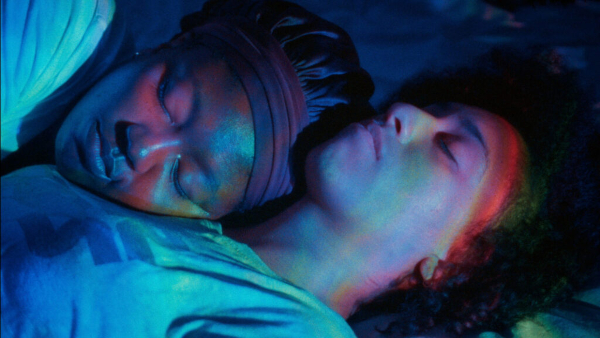
Sundance has a reputation for discovery. It’s where you go to see the new voice, the first or second film, get out the cold of the familiar and find a journey in the dark. In the stumbling over coats to find seats before the documentary shorts program began – my mind wandered to its counterpart. I’m thinking about how the heart evolved – the idea of the heart at a DNA level, electricity giving a dynamic rhythm for a plumbing system. When did its voice emerge? At what stage did it begin to speak – “Hold Me Close” – was the title of the second film in the program and it struck me as an urgent command for affection, the coinage in the currency of love. It’s a film in which we behold these holdings. It follows Corinne and Tiana relating in a shared home, their voices bouncing room to room slower than the sunlight. Love in the air is rendered phantasmagoric and pronounced – the camera seeing the spectrum, breaking white light into its chroma parts and back to its unified form again. Directed by Aurora Brachman and Latajh Simmons-Weaver, the film impressed upon me the feeling of cinema doing some loving thing quantum to my being. This is a familiar somatic experience to those of us who have that record we need to hear to get us prepared to work, or to hold us down when we can’t move a muscle. The back and forth of Aurora and Latajh in what I imagine of an edit and capture, in whatever out-of-time order the cinema chooses to happen, is portal-ed through seeing a document of a relationship of these Black womxn in a packed theater, a place where we can fully hear and see them.
The film had me thinking about voices, timbres, registers, humans. I’m thinking about short films within longer films, features, reels, clips. Orson Welles (I’m reminded of one of those cute videos I saw on Instagram not long ago) says that people should not steep themselves in watching films. He was riffing on the fact that “the homage,” to hear him tell it, is the greatest sin a director could commit. Essentially his point was “stop biting,” get your own style, get your own voice, because that’s the only way we’re all gonna find our interest in the capacity of the medium renewed. At another level, this re-animating of the capacity of the medium is a necessary inoculator to the practitioner, as it is a way of challenging the intended effect of the thing one is making. Without this dynamic challenge of the many-voiced chorus of cinema makers, one cannot stay on the dīn of delivering their medicine.
It’s a tall order – the notion of evolving – the form with the best parts of its fundamental traits. The Legend of Ochi is another vial of medicine which found itself unveiled at Sundance. To my eyes, this evolution is its pursuit. Isaiah worked on it for the better part of a decade. He first told me about the film in 2018 and the way he described it was that of a germinating seed planted in the dark of the unified field: A child braving an Eastern European forest – Brothers Grimm, but not that at all – a spirit animal in tow, no speaking, only movement, inclement weather, a going back to that which we all experience, our infant eyes on the setting sun, or child hands in the dirt, an adventure with mythical simian beings (formerly and presently us) who – through primal song – forge an initiatory relationship with the girl, in the absence of present and attuned parents. The film delivered on all aspects of its seed form, as you can imagine for someone whose voice is so dialed in to the spectacle inherent in visceral rendering of nature, the wide eye of the feeling child, and how to imagine the moving image with respect to techniques old, new, rigorous, refined and rough. Even with that said, there is much more beneath the surface consciousness of the film’s text. For instance, there’s a moment in which Maxim (our lead’s father, played by the chiseled visage of Willem Dafoe) in order to enter a vulvic stone orifice, the only portal to the most central fertile part of the forest, must put down his weapons and remove his jagged, rusted metal armor. The dark unknown requires he arrive unadorned by all that is phallic and shielded – all that Übermensch shit must loosen and fall away. Instead, he has to go in willfully vulnerable, play with his life – submitted to the path of the young girl who he follows: his daughter – cinema.
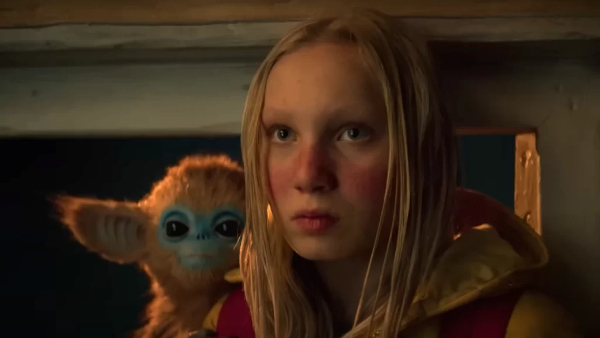
Jung is popping right now in the zeitgeist, people are using the words “anima” and “collective unconscious” more freely in their Substacks, podcasts and dinner convos. I would venture to say that the medicine Ochi deploys – is a clarity on how to use symbols in a film for children growing up in the mediascape that characterizes this wave of the modern world’s conceptual collapse. It clarifies how to re-envigorate canonical symbols and archetypes and re-embraces the pursuit of inviting the archetypal energies that inhabit us in the audience (the toxic paternal, the primal/advanced other, the surrogate sibling) into the experience of watching and discussing the film. Speaking in symbol is what remains farthest outside the discourse of these films, when in fact we must learn to speak back to their invitation to do so in this terrible place, this unrepentantly stolen land, this brutal corporation of a country presently intoxicated by the stink of its plunderous evils. I’m grateful there was a place for a time that operated as such, principally.
When I ran into Shari, we had a lot to catch up on. Life has changed in a myriad of ways since last I saw her. She gave me my first shot, and my second, and my third. She has been a constant source of support and inspiration as I endeavor to make things that are Black and in the cut. New Frontiers has been a home for those things. The name, a nice reminder that a field of the unknown moves around and goes above and underground, in and out of view. Sometime before we hit the dance floor, she reminds me that this is maybe the last time we’ll do this dance here near these mountains, going somewhere else next time. “Oh, word? Where are we going?” When I get back home, I begin to imagine this new place, less a locale than a riff on what the energy could be. I imagine there will be fewer brand sponsors, less keeping up appearances, less advocates of genocide, more constellations than stars, ones that reconfigure each time you turn away; “more comets,” as Andre 3000 says, more keeping it moving. It’s cool to see an institution move, freshening up. Ironically, I was just starting to get used to it here. Being at Sundance this time after being here so many times made me feel paradoxically like I’m at the end of it all and just getting started, which is a cold thing to feel. I don’t really know anybody, but recognize everyone. I look around and everybody has gotten not quite old, but just a little bit seasoned. There are so many unfamiliar new faces and they all seem maaad cool, not pressed at all. Anecdotally, my observation is that the Sundance 2025 first-time filmmaker seems zen; no one is getting gassed up, no one is grasping – they don’t seem like they’re reaching for “it,” in the way that I was. I remember the weekend before my premiere – I went to Uniqlo in Atlantic Terminal in Brooklyn and got all these warm clothes. I landed and came to the Q&As wearing shit with tags on it. In the absence of the time to plan my archetypal presentation, I was trying to mold myself into a “filmmaker.” I guessed filmmakers wore button-ups, flannel ones. In cold weather and under the shade of large trees – we dress appropriately. I love that guy as I laugh at him, especially in contrast to what I’m observing here now – it seems to be nobody else “putting it on.” The spirit is emanating from within, steeped in a truth that a priest does not dress as such and is less someone than some place, open to the message – their “why” more clearly drawn in the now.
I think a lot about what is called of us – what are we supposed to be doing? I’m putting that question out to the world. What is on the shared consciousness of the filmmaker? Recently Dogma 25 dropped, a renewed effort to center our efforts on cinema as a channeling, as an earth-based spiritual practice, made with and by hand, through and with devotion, a ritual practice that resists the facile containers of commodity and the wannabe capitalist’s deification of the commodity as some sort of literal philosopher’s stone within an imagined expression of “human nature” called bondage-subsizdized-capital-accumulation-for-those-who-call-themselves-white.
What’s the process to actively imagine / channel through something that should operate like a dream? A series of images and sounds that use what’s beyond the edge of the frame and in the dark of the cut to render a baited breath, a goosebump, a look to the person to your right – “Did we just see that?” an “Oh shit!” A laugh next to a cry. What can that communal emotive catharsis do? And what can I do? What liberations must these films manifest? What’s called for? What are the moves? Are we moving? Who’s playing bass? Who’s gonna make food? In I Corinthians 12 (I think), Paul goes into all of the roles in the church: prophet, messenger, channeler (person who speaks in tongues), interpreter of said tongues, zealots (super faithful types), wise people, miracle workers, healers. He then says some wildly misogynist thing before landing the plane on a useful piece of guidance. He says that none of those gifts are of any real use without the gift / skill / capacity for love. He doesn’t use the word in the way we use it. He was writing in Greek, so the “love” he speaks of is Agape. Agape, the one that’s hard to do: to give without any expectation of receiving anything in return. That love that just wakes up and does its thing.
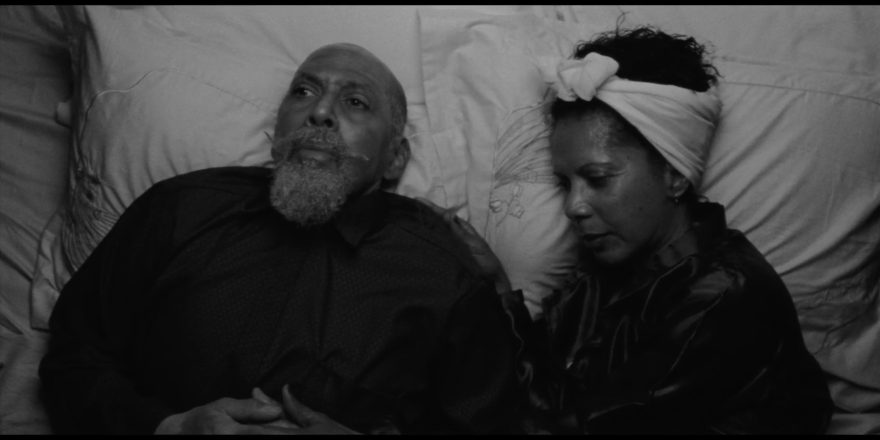
Featured image shows Peter Jay Fernandez and Penny Johnson Jerald as W.E.B. Du Bois and Shirley Graham Du Bois in BLKNWS: Terms and Comditions.