

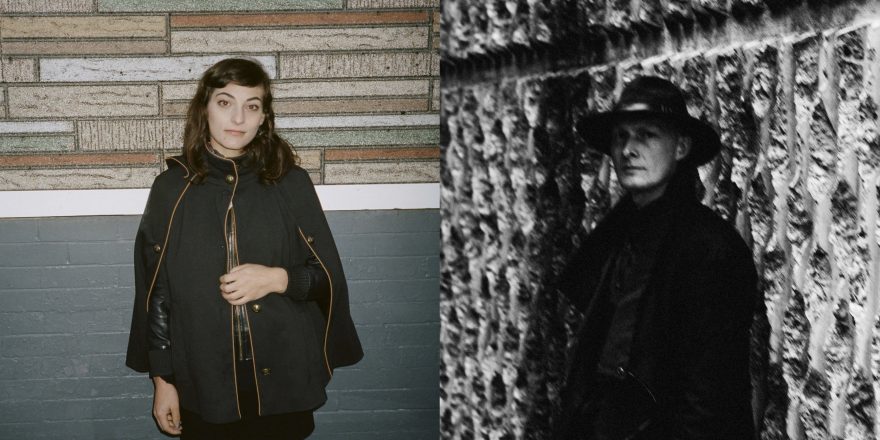

Lea Bertucci is a NYC based experimental musician whose work bridges performance, installation and multichannel activations of acoustic space. Her latest record, The Oracle, is out October 17, 2025.
Lawrence English is an artist and composer from Brisbane; Lea Bertucci is a composer and performer based in NYC. Lea’s latest record, The Oracle, will be out tomorrow, and to celebrate, she and Lawrence got on a call to chat about it and much more.
— Annie Fell, Editor-in-chief, Talkhouse Music
Lawrence English: Good morning from Australia.
Lea Bertucci: Good evening from North America! [Laughs.]
Lawrence: We’ve just got a large ocean between us and and a bit of landmass, but that’s good.
Lea: It’s nice to talk to you after quite a while.
Lawrence: I know. I was trying to think of when I last saw you. It was probably when we had you down here in Australia. Right?
Lea: Yeah. God, two years ago or something like that.
Lawrence: Really, that long? That’s disconcerting. But I think that also summarizes the experiences of this sort of life, which is that you have these periods where you see people a bunch, and then maybe you don’t see them. And the sign of someone that you can spend time with is that you can get on a call or see them in person and it’s like it was two weeks ago.
Lea: Totally. I was just in Chicago with Olivia Block for a little bit, and we did some shows together.
Lawrence: Golden human.
Lea: Oh, man. After really spending some quality time together, I feel like Olivia is truly one of the greatest artists working in this medium of experimental music. And I don’t say that lightly or to be aggrandizing. I think that she’s so thoughtful and so good at what she does.
Lawrence: I’m with you 100%. I actually can’t think of when I last saw Olivia, but I remember this particular instance where we did a Room40 anniversary event in Stockholm, and Olivia did this diffusion piece that I remember I couldn’t even understand how the sounds operated in the space. It was like magic. I love when you get people that are like sound magicians, and I think she has that way of appreciating not just the kind of textural and timbral component of the sound, but also this sense of weight or pressure or dimension. But it’s not to do with the volume or with anything that’s familiar. It’s somehow all of these things pulling at each other all at once. It’s quite incredible, actually.
Lea: Yeah. To tap into the dimensionality of the sound in this way, it’s quite a skill.
Lawrence: How did that collaboration come about?
Lea: She and I were invited to have a conversation in 2017 by Steve Smith — he was doing a thing called The Log Journal at the time — and I had known her work, so we just started talking and realized that we were kind of kindred spirits in terms of a lot of our fascinations with music, and otherwise. Also with cinema and with light and natural phenomena. So then I asked her to come to New York to do a show, and it just snowballed from there. And then we remotely made the record that you so generously put out on Room40.
Lawrence: I always think that the stage and the studio are two very different places, and the kinds of relationships you can maintain on stage are sometimes really different to how they might be maintained. In fact, sometimes they don’t work in one setting or the other, or they work more efficiently in one setting or the other. So I’m curious, when you had that first exchange, performatively was there already a language?
Lea: Our process was that we kind of sent sounds back and forth, and would record some overdubs on a track or a sound that we would send to each other, and assemble the world that way. Yeah, performance is really massively different than working in the studio, and we are working semi-improvisationally this time around. The music has transformed a lot, actually — she was doing these spoken-sung verses of very discernible words, and then I was kind of articulating those through repetition and abstraction through electronics with voice. And it’s been a while, so I have a different palette of stuff. I have this ocarina that I’ve been obsessed with for a couple of years, but I never really knew how to integrate, and she was really into the crazy sound of that. So the music transformed a lot in live performance. We’re working on another album, but we started recording it in her studio together, and then we’ll build it out remotely. So it’ll be a combination of the live and the studio worlds.
Lawrence: Nice. I think when you’re pulling on that experience of the moment to moment accumulation of sound in a performance, and when you’re improvising, one of the great pleasures is that you are so heavily attentive. But in the studio there’s kind of a breadth almost between the sound and how you approach it. At least I find that, that there’s an opportunity for separation. Because you can revisit in a way that isn’t so temporally bound.
Lea: Yeah, the studio is like a crystallization of the music. It’s something that is paced differently. The thought process behind it is totally different. And live is instinct and responsiveness to not only what somebody else is playing, but also what somebody said to you five minutes before the show started, or the acoustics of the room, or any of these more intangible things.
Lawrence: Well, sometimes very tangible, when you’ve got a PA that can’t do what you want it to do. [Laughs.]
Lea: [Laughs.] We’ve all been there.
Lawrence: Which, I mean, it’s kind of amazing in a way, because you do recognize that effectively the PA is the instrument for all of us.
Lea: Right. And that’s just part of the context of the moment. So relying on instinct and intuition becomes more at the forefront. And the studio is this thing that’s memorialized in time, that’s designed for multiple listens.
Lawrence: So do you have a preference for which environment to be present in more than the other?
Lea: I go back and forth, because I do love playing live, but I kind of have a fraught relationship with it. It’s not always great for me. Some musicians are really musicians in the sense that they thrive on live performances. Like during COVID, I was kind of OK not to perform and to just be in my studio. So I go back and forth. I think it’s two parts of a holistic practice. I like to have both elements in balance.
Lawrence: Yeah, it’s interesting. I have had a very, very long break from solo electronics performance. When we met together in Brazil, I think at that point I hadn’t really played solo for a year, or hadn’t done a solo presentation. I mean, that was a kind of diffusion, so I see it as a different stream of the work. But I haven’t played a solo electronic show for seven years.
Lea: Wow.
Lawrence: Which is kind of crazy. I took a break at the end of 2018, because I felt like I’d really run the course of what performance was. I thought, I’ll take a couple of years just to kind of recalibrate, think more about the questions. Part of the reason I stopped was I couldn’t quite get my head around — and I was probably just overthinking it — but what the relationship was between the stage and the audience, and this kind of shared experience of the sound, and what were the things that I needed to be engaged with to feel a sense of connection? Occasionally I had had shows where I felt quite disassociative, almost, which I don’t love.
I have done a couple of tours with Loscil, actually, with Scott [Morgan], and I was a little bit anxious to see, Am I even still interested in the idea of performance? And it was it was a delight. I mean, he’s an incredible human being to spend time with, and if you’re gonna cry in an airport at 4:30 in the morning over bad coffee, he’s the guy I want to cry with. It was just a really interesting moment to be like, Does the time away make you more fond for something, or does it make you recognize you maybe don’t need that in your life? So I’m always curious about how people feel about those two spaces.
Lea: I mean, life is long, I think.
Lawrence: And short.
Lea: And also maybe kind of short, so who knows? [Laughs.] But I think that if you have had the experience of performing, it’s always there for you to come back to if you feel called towards it. But we also live in an era where the recorded object is very crucial. I mean, Kate Bush never toured. She did, like, one tour and then just released these crazy albums. So her lack of live engagement never stopped her from being influential.
Lawrence: I have to channel more of my inner Kate Bush.
Lea: I would love to see you do that.
Lawrence: [Laughs.] It’s strange, because the other thing I’ve realized is I’ve started making music that I think is completely not geared towards performance. And that’s actually part of the reinforcement of this thing. I’m having too much fun making this work that is really probably not geared towards anything apart from people listening in their homes. I’m sure it could translate somehow, but I haven’t either given myself the time or the confidence to really know how to translate that. So it’s interesting.
I’m partway through a new record right now, and part of that has been thinking about that intersectional space between performance, because there’s a lot of people performing on the record — it’s a quite a lot of acoustic players on the record — but it’s still very electronic sounding. I’m thinking already, Can any of these pieces actually be turned into something that could be presented as a live work? Because I’ve sort of set myself the task of returning to playing some solo shows next year, so the pressure’s on. I just need to set a hard deadline and then get in there and do the work.
Lea: Well, you might find also that having other people up there with you that are playing your pieces gives you a sense of, I don’t know, solidarity or community with other people. Playing solo is really different than playing with other people.
Lawrence: Totally. I want to ask you about — I know you’re working on this new piece with medieval flutes, which is as a composer, and someone else is performing, right?
Lea: Yeah. I’m going to live deploy samples that I recorded from my collaborator Norbert Rodenkirchen. He has this amazing collection of archaic flutes, pre-baroque, so Renaissance and medieval and even Neolithic. He has a swan bone flute that’s an exact replica of one that was from 50 to 60,000 years ago.
Lawrence: Wow.
Lea: Yeah, and it sounds absolutely insane. So for that piece, I’m using fixed media, but I’m deploying the samples live. And then he’s playing flutes live, and it’ll be an eight-channel piece.
Lawrence: Obviously there’s the material part of the instrument itself that sort of predicates a certain way of approaching the way the composition might work. But as a composer, are the sounds already in your mind, or is Norbert part of the process of uncovering the potential sounds that exist in the instruments?
Lea: Oh, yeah, he’s totally part of the process. Because he’s also an early music scholar. I wasn’t just recording, like, straight pitches on the flute, I was also recording fragments of melodies that relate to the history and original usage of each flute, so it engages that. It also engages Norbert’s improvisational facilities. I would give him these prompts like, “OK, you are on a Viking boat and you’ve been out to sea for the last six months and you finally caught the first glimpse of the fjord, and the nibble of the Amanita mushroom that you just took is starting to kick in. Let’s do an improvisation on that.” And then he’ll rip for a few minutes.
Lawrence: [Laughs.] I love it.
So, I’ve got a question about The Oracle. Actually, no — before that, I’ve got a question about light and shadow. Because I’ve realized that it is a recurrent theme in the titling of your works. I think four or five records or pieces now that focus on this idea of light and shadow. So I’m curious to hear why there’s an interest in that other spectrum — the one that our eyes use, not our ears.
Lea: I mean, it’s all just waves, man. [Laughs.] I find that light has similar characteristics to sound in a lot of ways, in terms of it can be diffused, it can be reflected. The different colors correspond to different tones in terms of wavelengths. On a purely physics level, sound and light have this intertwining relationship. I studied photography as an undergrad; photography is a medium of light. I did film photography like a crazy person. So I think that is a continuation of the same interest of the phenomena of waves. And lighting can so dictate a mood, and so can sound.
Lawrence: Particularly with the way some of the horns operate, for instance, in some of the pieces there is this sense of, they become “acoustic shadows.” Because they begin to cast such a strong presence over the sound that other things are kind of caught in that shadow. [And they’re] not necessarily diminished, but you’re drawn to a certain kind of contouring of that acoustic space.
Lea: Yeah, totally. An acoustic shadow is a phenomenon in psychoacoustics, where if sound is traveling over a landscape, there are dead zones. You’ll hear a sound if you’re above a certain point of the horizon, and then if you’re lower, you don’t hear it. So I thought that was an interesting term that bridges the audio and the visual gap, where sound is functioning just like light might… The relationship between topography and a sounding object can be really incredibly powerful.
Lawrence: That’s been part of the interest for you, when you present work in galleries or really reflective environments, right?
Lea: Yeah. Just using the acoustics of the space as an extension of the instrument can be amazing.
But I wanted to ask you about the new record that you have that just came out, [WhiteOut]. We were talking a little bit about this before we started the interview, but what was the process of letting something ferment for 15 years? That must have been quite a heady pickle.
Lawrence: It’s interesting how time affects the way that you can re-approach materials. I mean, it’s not like I had done nothing with that material. I’d made this collaborative record — I went to Antarctica with Werner Dafeldecker, and when we came back, we made this piece, Shadow of the Monolith, that was much more like an electroacoustic reading of that material. Werner is an incredible bass player, an incredible improviser, and has a really great sense of concrete sound and working with certain elements in these naturally occurring sounds that bring about a certain other quality to them which is really unexpected. I’m always surprised when we work together; I think he’s a genius.
And so we made that record, and we did some presentations, like audiovisual pieces. But all of those were about this much more transformative sort of space. And the thing with these larger field recordings projects — it was a little bit the same with A Mirror Holds the Sky, the Amazonian recordings that I’ve made — when you’re in those environments, you’re working every day and you’re recording sometimes many, many hours a day. So there’s not always a chance to instantly come back to the material. And I actually find it’s really helpful to have distance because you aren’t the same person. And particularly now, I have to say, it was really striking to come back. I started relistening to the recordings last year, and it was so weird to recognize how much I wasn’t that person that had gone there, that there’d been such a lot of changes in my personal life. I mean, simple things like age, and some of the decisions that I made there, I look back on and recognize, I’m really lucky I’m not dead. You know, I got into the water to rescue equipment with leopard seals. It was really some stupid stuff. But I’m still here, thankfully.
Lea: You know, it’s funny — I think that people have a kind of idealized vision of nature, that nature is giving and there to support you, and that it’s just a thing of beauty. But I’ve also been in situations out in the wilderness where it becomes very apparent that nature is totally apathetic to you. It doesn’t care about you. [Laughs.]
Lawrence: There is a great quote — I was obsessed with this author called John Alec Baker. He wrote this book called The Peregrine, and somewhere in that book is this line that essentially reads like, “If we could actually see the true way of nature, we’d be so shocked that we could barely look.” It’s this really kind of melancholic reading in a way, but also really truthful. The world isn’t there for us. We’re these very insignificant little grains here. And it’s important to realize that. And actually, one of my favorite experiences is being in places where there’s not a lot of people, where you recognize just how small you are. Antarctica was one of those; the Amazon as well. There were a few days where I was out in the jungle, and there was no one around me for probably several kilometers. And what is so humbling, I think, about those moments is you recognize you’re just another thing. Because we are just other things. And this idea of human exceptionalism is really toxic in the world. It’s the root of many, many problems that we’re facing right now.
Lea: For sure. I mean, I think it’s the whole thing about the Anthropocene, that we’re going to maybe look back and be like, “Oh, weren’t we stupid?”
Lawrence: Yeah, totally. And we are. And it’s OK sometimes to not know.
Lea: Well, it’s humbling. And it’s good to be humble.
Lawrence: Yeah. And I’m OK not knowing, because I’m curious and I want to learn. I will never know everything. I’ll never have the chance to embrace all of the joyous, weird complexities of the world. But I want to be available to the opportunities where there are moments to not know, and I don’t want to be ashamed of not knowing. I want to be excited about not knowing. That’s what I love about sitting down with anyone and having a conversation: They’re going to have a little perspective on the world that I don’t have. And, in fact, I would argue that’s the pleasure of something like collaboration. The reason that we have had the opportunity to work together is partly because I think we share that interest in the opportunities that someone else’s brain brings to something.
Lea: Yeah, totally. There’s a constant searching.
Lawrence: In terms of this idea of searching, how does that tie into something like The Oracle? Because for me, that record feels like — it’s a strange way to describe it, maybe — it’s a hungry record. It feels like it’s seeking somewhere.
Lea: Definitely. The approach to the vocalization was, it’s a technique of stream of unconsciousness. So I’m kind of tapping into the unconscious, the subconscious. I describe dreams that I’ve had. I would read certain books — there’s this book on Greek mythology that I kept coming back to, where they would describe all the different types of oracles that there were. So just kind of channeling that a little bit. I think that it’s been a deeply human desire to try to make sense of the world around us. And so it was a kind of going inside to generate the words.
But then the other sounds come from the world around me, like a lot of field recordings. The sustained drones were from a residency that I did where I was working in this old derelict gymnasium with this half-broken organ. I would make binaural recordings of the organ diffused throughout this gymnasium space. So there’s an exteriority and also a really intense interiority that is informing how that record came together.
Lawrence: I do sense this very… It’s almost like the situatedness of humanity in the record, like these very internal thoughts and experiences. And not even real — some of them are imagined. They’re these kind of echoes of the daylight hours trapped and captured in the night. And at the same time, though, there is this sense of, no matter how deeply we go inside, we still have to come back to the lived world. It’s always there, and maybe it haunts sometimes, but other times it kind of commands, and other times it humbles.
Lea: Yeah, definitely. And our perception of the external is informed by the internal, and vice versa. There’s like this real kind of slippery relationship there between what’s out there and what’s inside. So that was what I was hoping to illuminate with that.
Lawrence: Mission accomplished.
Lea: OK, good! [Laughs.]