

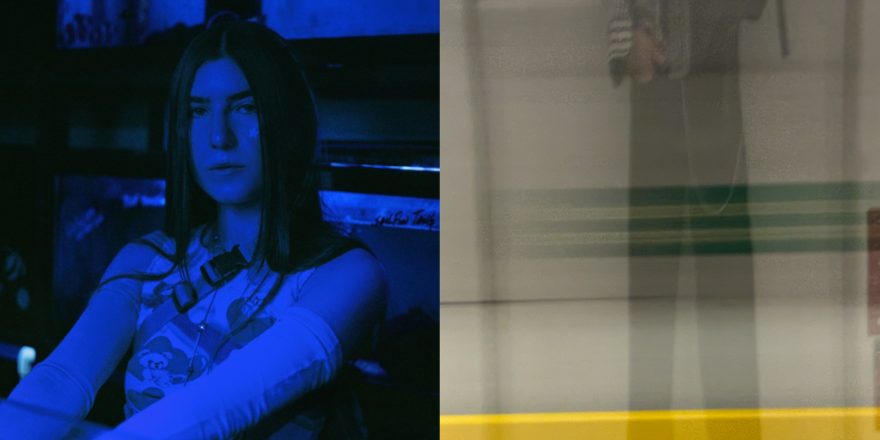
A version of james K was born. Comprised of bones, reactive metals and a larynx with freckled eyes that catalyzes that mix. She produces her music and makes temporary haven for indomitable lyrics — and these are in constant flux. You can check what they are here: [917 908-1173]. It’s only a part of her ultra-detailed world. A world that she abandons and then builds upon.
Jamie Krasner, aka james K, is an artist and musician based in NYC; Huerco S is the project of Brian Leeds, a Kansas-born, Philly-based musician who also performs as Pendant, West Mineral Ltd., and Loidis. The new james K record, Friend, is out September 5, so to celebrate, the longtime friends got on a Zoom call to catch up.
— Annie Fell, Editor-in-chief, Talkhouse Music
Brian Leeds: When did we meet? It had to be in Berlin, right?
Jamie Krasner: No, I don’t think so. OK, this is my memory of how we met — and you might not remember this, and I might even be remembering this wrong — I was at a party, and I honestly don’t even remember the space, but I remember you were at the bar and I came up to you. You were like, “Are you James Slay?” And I was like, “Yeah.” That was my name in 2015 or ‘14 on Facebook… But maybe we also met in Berlin. I don’t know.
Brian: I have a weird feeling that we met in Berlin, in Alt-Treptow or something. Someone from the US had an apartment there, and I remember maybe going to a party and you were there. But anyway, it’s definitely been over a decade.
Jamie: Yeah, it’s been over a decade. I remember you saying you have some questions — I was kind of jotting down some questions too.
Brian: I wrote some really funny questions down. Nothing too crazy, but… I don’t think I realized that your first album was on Dial?
Jamie: Yeah. I had been releasing with Uno, which is this label in New York; in 2012 or 2013, I released an EP and then some singles. And I guess my first technical release on a label was on Hippos in Tanks —I did a single with Physical Therapy on that label in 2011, 2012. I formed my own label, She Rocks, in 2015.
Brian: She does rock.
Jamie: So my first album, I was going to self-release it on my label. And then my friend was working with David [Lieske] and Pete [Kominek] who run Dial, and she showed them the music. Then they were like, “We’re happy to help fund this, we can do a co-release.” So we co-released it.
Brian: It was just interesting because I was listening to a lot of Dial — and I think they also had a sublabel, Laid — but it definitely stands out on the label. I’ve never really heard other stuff like that on the label, but I thought that was really cool.
Jamie: Yeah, for sure.
Brian: On this record, there’s probably a huge amount of collaborators on it, and you also mentioned some of these shows you have coming, you have people performing with you. Is that stuff you’re trying to do, more band kind of stuff?
Jamie: I feel like the record itself is kind of one-man-band. I mean, it’s produced — some of the songs — with live drums, and with guitars. So it just translated really nicely, and for a few of the shows that I’m doing on the North American side of the tour, I’m going to have a guitarist and a bassist with me, and then I’ll do the electronic stuff as well.
Brian: Do you have to rethink a lot of the performances when you do that?
Jamie: Not really that much. The songs definitely change slightly — some of the live drumming, I have versions of those that are just a bit more sampled, so there’s still live drums but done through an MPC. I don’t have a live drummer, because there aren’t enough songs on the record to constitute to have a live drummer the whole time. And the sound is so electronic that I feel having those drums being just electronic felt right to me. So I just tightened some of those drums up, the ones that are live. But everything else is kind of just replacing the bass and bringing in a live bass, and then replacing some of the guitar parts, but also just layering guitar on top of the guitars that are already there — which is something that I already do. I play guitar in my live set, layering my live guitar with guitars. There’s tons of layers of guitars in the music.
Brian: Do you have time to practice before, or is it kind of just showing up to the gig and rocking it?
Jamie: I practice before I go on tour. I don’t really practice before a gig. Obviously, once I’m on tour, I’m on tour. But we’ve been practicing. We have to tune the set to the band for sure, and I’ve been working on that for the past couple of weeks. We’re just going to do five shows. Hopefully it will be something that I could do more of in the future, but, you know, it’s expensive.
Brian: Oh, for sure. Already it can be expensive just for one person, and involving other people, it definitely racks up.
Jamie: I was going to ask what your setup is live, because the Huerco S set that I saw last year was on a computer. I was wondering what your DAW is.
Brian: I’ve just used FL Studio forever — aka FruityLoops. I’ve said this before, but it’s more of an audio presentation than a live set. Because nothing’s really live. I don’t really make live music. It’s process-based, and it can be a month or two on just one song, or one sound even. So trying to break that down like, How do you make that live? Honestly, it’s not my favorite thing. I think it can be a bit boring. So it’s more of like a presentation. I’m just presenting my latest work to people.
Jamie: I’m kind of similar with how I set up my live set and how I make music: I’m really processing every sound and it’s super edited, so there’s always a moment when I finish the songs having to think about what elements are going to be live. My solution is that I run everything through Ableton. Well, first of all, I’m triggering some samples, so I’m letting some things be live triggered. But then I have some backing, and then I’m running samples out through my modular synth. I like having something gestural, like the modular synth now, just to basically tinker with. They’re mostly just used as effects modules. I used to carry around a two rack thing, but now I just have these two small 64hp little cases with a couple effects. But they’re running through those so I can do things live, and then I run that back into Ableton. I mean, obviously I sing live, so that’s a major element.
Brian: Yeah, that’s a big component for sure. So it’s like, maybe you don’t want to distract yourself too much.
Jamie: But I get bored if it’s just me on vocals. I always need something to use. I love using my hands. I need to tinker just a little bit.
Brian: I’m definitely just kind of fucking around with effects, you know? I just kind of break things down into stems as best as I can. Because some things, I don’t even have an editable project file. It just might be a recording, and that’s the final version of the song. So sometimes I’m kind of limited with that. But yeah, I’m really just fucking around with effects, trying to stay a little busy while I’m up there.
Jamie: Totally. Do you enjoy DJing more than playing live? And how do you feel like DJing informs making music?
Brian: I was in bands in high school and that was cool, but once I started getting fully into electronic music, it was always DJing was first. I didn’t really start doing live until later, maybe after my first album or two, because that was what you’re supposed to do. But also, a lot of the music that I was listening to was house and techno, so that kind of was influenced by DJs. With the latest stuff, the influences, at least on the production side, is going to see DJs play or just listening to old DJ mixes, and then envisioning my take on that sound. So lately it’s really been influenced by going out. I think that can be such a big resource. For a while, I would just be pretty by myself, isolating a bit and not going out much. And it can be really inspiring, just hearing people just play music and wanting to get home and try and do your thing.
Before we did this interview, I was just thinking about how I’m so fucking tired — I just got back from touring. You obviously you have a big schedule ahead. Do you ever work on music while you’re on the road, or is that something you have to separate?
Jamie: That’s a question that I was going to ask you as well. I don’t find it possible to work on music on road. In terms of collaborating, I’m down, and that’s what happens on the road — someone’s like, “Come over!” — so maybe I’ll start some ideas sometimes with people that flesh out into something. I’m always open to meet up with people if there’s space to do that. But hunkering down in my studio and just working on things, I really need to carve out a big chunk of time to give myself the space to zone in. Because for me, I’m also a homebody. I definitely get recharged when I’m home. But it takes me a long time. I need to be alone. I need to get the voices out, just be in my own head and see what I want to do. It’s not even like being inspired — I feel like I’m always inspired — but it’s just the space to have the desire to put pen to paper, so to speak, and make the music happen.
Brian: Do you ever start with lyrics or is it always music first?
Jamie: I don’t, it’s always music first. Lyrics are one of the last steps, I’d say. When I’m writing melodies, I’m maybe throwing some words out there, but for the most part, it’s kind of just fake — I call it “noodle language.”
Brian: Just vocalizing, yeah.
Jamie: Just vocalizations, with some words here and there that will probably shift anyways, just to get the emotion. Because for me, I’m just trying to channel emotion with my voice, and even with the music, obviously. I’m just trying to get that emotional base down and not put too much constraint on, “This is what this is about.” You know? I don’t even know what things are about, if I’m being honest.
Brian: I feel a similar way about titling songs and albums. I can’t do any of that until it’s all done.
Jamie: Same.
Brian: I know some people are probably sitting down and before it’s even done like, “This is the song,” or whatever, and I’m gonna be honest, I don’t really know how I feel. I have to almost contextualize it after the fact. My project files are just basically, like, keyboard smash.
Jamie: My working titles are so dumb. I mean, some of them are so dumb that I use them in the end because I’m like, “That’s just funny and I actually need to use that.” But that’s a good way of putting it. I don’t want to say what it’s going to be before I feel like it’s finished, sonically or musically or whatever. I need to contextualize it at the end as well.
Brian: But that being said, sometimes ideas will pop into my head like, Oh, that could be an interesting topic, or, What if I made an album kind of like this? What were you thinking leading up to this album? Did you have some kind of rough base or guidelines or that you were going towards? Or was it all just tunes, and then you have enough and you’re like, “This is the album.”
Jamie: No, there’s definitely a guide that I’m giving myself. But when I start writing music — and this is how this record happened, and every record that I’ve written — I just start making music, and then I start seeing connections. I’m like, Oh, that kind of fits with that. And then there’s a point where I’m like, OK, this is going to be an album, and this is what the through line is.
In 2019, I had just finished grad school. I went to this art grad school, and it was all pushing yourself to the weirdest sounds possible, like, “Be weirder, be more experimental.” And I kind of hit a wall with it. My record Random Girl was kind of that time. I had hit a wall where I was like, I’ve done the sound design thing. I’ve done really experimental, out there stuff. I’d gotten kind of over it. And then I realized that I wanted to get back to some kind of roots, which was writing things on guitar and having the guitar be a through line for the record. So that’s definitely the whole record. Every song has guitar in it.
I’m obsessed with the way I make music. I just love creating textures, and I need to push the limits of the sound. So I’m making a sound, putting it through some hardware, putting it through some software effects, whatever. I’m just pushing the sounds until I get a sound that I’m like, OK, that’s cool. And then I’m building layers on top of that and collaging ideas together. So it’s not that all the guitars are straightforward, but there’s guitar in every single track. I want it to be super textured.
Brian: For sure.
Jamie: That, and then me just wanting to get back to songwriting and it being more direct. Because Random Girl was really more for me about the noise scene that I had been a part of in my late teens, early 20s. I went to RISD and there’s a big noise scene there. So I think that record was a bit noisy, bit industrial, but then there’s also this sound design experimenting to it. And I was just like, I want to make something more direct, really melodically driven, and the guitar is how I started really writing songs when I was a kid.
Brian: It’s kind of a return. I mean, honestly, I feel like more pop adjacent things, it’s so much harder to conceive and execute than writing some very experimental, avant garde piece.
Jamie: Yeah. I think the hardest thing with pop is that it’s kind of simple, but you have to be in the right mindset with yourself and trust yourself and believe in what you’re doing to be vulnerable in that way and direct. So [with this record] I think I was in the right place to get there. But actually, I would say it’s easier for me in a lot of ways to write melodic pop songs than it is for me to be experimental. And I felt like I was a little bit like, Alright, I’m kind of not myself right now, with the last record. There was a breaking point where I was like, It’s not me anymore. I think that’s where I’m at now.
I have a question before we end — because I just don’t know this — what actually brought you to New York?
Brian: I think it was 2013. I had been coming up for shows periodically when I started making music and living in Kansas City. I probably played some shows with Matt Gardner, Tariq, and got tapped in with some of some of the L.I.E.S. dudes. Through that, just randomly playing shows — like 285 Kent, or definitely playing early Bossa gigs — I think at some point I just had to be there. I think that time in particular in New York was really special. I mean, I’m sure every generation probably has, “Oh, but New York in this time…” But I feel like for techno and house and noise, it was this weird cross-pollination of things.
Jamie: It was.
Brian: It was really cool, and there were so many venues and people making interesting music that I just felt like I had to do it. And being from the Midwest, I had never really left, so I felt like if I was going to keep doing this, that was the thing to do. I was like, If I want to do this more seriously, I gotta be up there. I was working in a vegan restaurant in Kansas City, and that was my last job. I was a line cook, and pretty much ever since then, I’ve just been living off music.
Jamie: That’s amazing. It was a special time. I still love New York for all the cross-pollination, as you said. There’s so much going on at all times. But that time was really impactful for me as a musician, being exposed to different scenes and being able to perform in different scenes and release on the labels.
Brian: The same night, you would have some crazy no input mixing noise set, and then someone would play a deep house set, and then someone would DJ some fucking Balearic shit after.
Jamie: It was sick. The diversity is important… Well, I feel like there’s a lot of connection, even though we were clearly friends.
Brian: I think about that all the time, the amount of people that I hang out with now — we were definitely all at the same events and we just didn’t know it…
(Photo Credit: left, Juan Camilo Diez)