

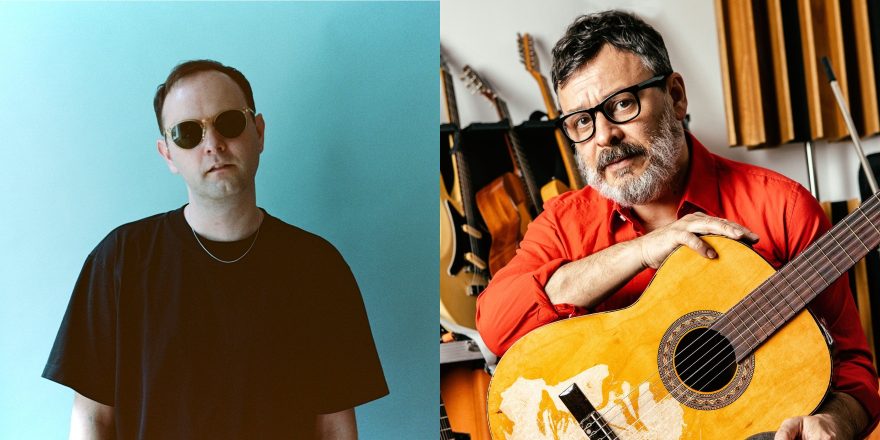
Griff Lynch is a Welsh singer-songwriter who performs solo and with the band Yr Ods. His debut solo record Blas Melysa’r Mis is out now on Lwcus T.
(Photo Credit: Carys Huws)
Griff Lynch is a Welsh singer-songwriter who performs solo and with the band Yr Ods; James Dean Bradfield is a Welsh singer-songwriter who fronts the band Manic Street Preachers. James features on the track “Same Old Show” off of Griff’s debut solo record Blas Melysa’r Mis — out today on Lwcus T — so to celebrate the release, the two got on a call to catch up about it, and much more.
— Annie Fell, Editor-in-chief, Talkhouse Music
Griff Lynch: Obviously, you’ve appeared as a guest vocalist on one of my songs, “Same Old Show.” I remember the conversation we had at the very beginning and you said, “Maybe a good reference would be Badfinger,” and that understated thing. You don’t sing understated on a lot of the Manics stuff. Have you ever been tempted to do a full acoustic album or an understated album?
James Dean Bradfield: There is a perception that I sing over the top of anthems quite a lot, and I have quite a big voice. But obviously there are always moments in records where the singing is lowercase. Even something like “Tolerate,” the verses are pretty softly sung. So, not my first rodeo when it comes to being slightly understated. But, yeah, when you played me the track and had your vocal on it, I understood that there’s no way I could go full blast on it. It would just be entirely inappropriate. And I think we did use a reference of Badfinger — I was thinking of something like the verse of “Take It All,” which is sung in such a soft way. If it’s not in the right key, then I have to spend time locking into it. So that was a good reference point, a good touchstone for us both. It didn’t help that your guide vocal was so good — and I’m not just saying that to just butter you up.
Griff: [Laughs.]
James: But I think I locked into it eventually in the studio. It is nerve wracking singing somebody else’s song. Because you’ve heard it so many times in your head that when you hear somebody else sing it, you can almost offend your sensibilities.
When I was young, I was a massive Springsteen fan — still am — and I had that corny notion of doing something like Nebraska. Obviously it’s so famous now, that he stripped everything back down and he went back to the source of being in the room with just him and his guitar. I had that dream a long time ago, but I think that ship has sailed now. Because it’s quite clichéd to do that now, isn’t it? Back in 1990, when we were just putting our first single out, we already had a dream of doing that. But there’s a film being made about it now, and a lot of people have their folksy moments — and they’re entitled to it, obviously. I’ve liked the idea of perhaps just doing a album with just my voice, perhaps, but that sounds quite vainglorious, to focus something on just your own voice. You’d have to convince people that you weren’t being a complete big head.
Griff: Everything is like a battle with the ego when it comes to doing stuff like that. You have to put it to one side and say, “Alright, if I do a vocal only tape or an acoustic, you have to do it for the art and not try and think too much like, Oh, gosh, what am I doing here?”
James: You’ve got to stop worrying about what people might be perceiving of you.
Griff: Yeah, exactly.
James: But I have a very good standby mode. I can just switch off. I am like an old fashioned TV, can be on standby for a long time.
Griff: Springing from the single, “Same Old Show,” it’s one of the first times — if not the first time — that you’ve sung on a record in Welsh. You’ve learned Welsh later in life. Do you feel that doing the “Same Old Show” and could spring you on to do more stuff in Welsh? Has anything changed in the last year or two since you’ve learned the language, musically?
James: I like being asked to do stuff, and I like guesting on stuff. This has been a lovely experience for me, so thank you. And I was quite surprised that you did ask me, to be honest.
I think when people talk about language, whichever country it is, perhaps especially in Wales, it’s a very personal thing, isn’t it? I am the classic South Walian; I was in choir from a very early age, as such a root for people, but it was massive to me. My mum encouraged me to join choir — and I found my old choir itinerary from I think around about 1980, and at least half of our concerts were in Welsh. So that was good for a South Walian kid like me… I think you have to earn the right to record an album in Welsh. I really do think that. I don’t think you just come along and say, “Hey, I speak the language to some degree now, and now I can record an album in it.” I think I would understand why somebody would be annoyed if I did that, I would be annoyed at myself.
Griff: Yeah, I know what you mean about earning the right. But because you have learned the language and your contribution to Welsh culture over the years, do you not feel that maybe you have earned that right?
James: No, I don’t think I’m even close. Perhaps a another five years in it or something. I think that’s down to confidence, too… But it was always something that I just wanted and I enjoyed. I didn’t do it for a scout badge, I didn’t do it to become more Welsh, or to try and appease any inadequacies. It literally was, I want to return to that one day. Because, for me, being musical started out with my mum singing now and again in church, but mostly in the kitchen — she was a really powerful singer — and being in choir. I always swore I would return to it. And I swore to my uncle when he died that I would take his place in his choir, but I haven’t done that yet because I subsequently had kids. You know, life gets in the way. It was always about something that I really enjoyed. If I just approach something because I enjoy it, that’s much better for me. I wasn’t doing it to prove anything to anybody.
But I was going to ask you — I became a singer in a band because it is all singing at the end of the day, and nobody else in the band wanted to sing. Or, they didn’t feel as if they could sing. So I was kind of forced into that position. Did you become a singer because you felt as if you could sing, or you felt as if you wanted to express yourself?
Griff: Yeah. I think with me singing, and being in a band in general, I was always attracted to the social scene of it, especially singing in Welsh because that kind of ‘90s thing of Big Leaves and Super Furry Animals, and even after that, the smaller Welsh language scene around me was really attractive. And coming from a Welsh language family and being drenched in Welsh language culture and poetry and music, I wanted to write that stuff. So it made sense for me to be singing that stuff as well. So being a lead singer was attractive. I wasn’t forced into it.
James: It was a natural conclusion.
Griff: It was a natural thing for me to do. And I was kind of pushed at an early stage into being a performer, so I think I had a very quiet ego in school where I wasn’t a popular person and I wasn’t doing loads of stuff, so when I kind of went to college and found my own voice, I decided, Alright, this is the time for me to do it. So that’s when it all all started.
James: It was a compulsion for you.
Griff: Yeah. I kind of fantasized now about being a session musician in someone else’s band, where it’s less about my expression and less about my songs, but I think I’m a better composer and songwriter than I am a musician, to be honest with you. So I think I have to just keep on doing what I’m doing.
James: I think there is a loose distinction between Welsh singers from the south and the north, where I think there is a bit more emotional incontinence from singers in the South. I think there’s a little bit of that choir influence, where we feel as if we need to rise above the actual arrangement, we need to nail it to the wall. Did you become aware that your voice was fitting into that North Walian kind of dulcet tones, a bit gentler?
Griff: Yeah, probably. And I wonder where that comes from. Is it because of the music and the bands I was listening to? Or does it come natural? But to be honest with you, James, a lot of what I was listening to between when I was 16 and 20 was the Manics as well. So maybe your voice and your type of songwriting has influenced the way that I approach, especially, my voice. Maybe subconsciously rather than consciously, but definitely. Do you think I’m more of a South Walian singer?
James: I think you straddle it a tiny bit. But I definitely think the language affects the notes that you choose sometimes. The phonetics of it, the vowel sounds, everything. I think that line has become quite distinct since the ‘90s. It was there before that, and I actually personally I like that difference. I like the variance of it.
Griff: Let’s move on to the cycle of releasing an album. I’m interested to hear what you think about this, because you’ve released so many albums with the Manics, and a couple of solo albums. This is my first album in a while; I released a few with Yr Ods as well, and I think the game has completely changed. And to be honest with you, I’m not sure if I’m enjoying this cycle of releasing the album, because there’s so much. I have to push myself on Instagram, I have to push myself on TikTok. It’s just me constantly telling people to like my stuff, rather than having somebody else tell people to listen to your music. Have you felt any of that? Or with the Manics, is it more of the same when you’ve got a bigger structure around it ?
James: I think you’re right in terms of you have to push yourself all the time, you have to offer yourself to the world. I remember the first album we did, everything really banked upon the first single and the second single — and obviously in the ‘90s, even the third or fourth single — you had to have a plan. But it was based around the record, it was based around two killer singles, and everything else would follow. Now when you’re in the studio, you’re constantly becoming aware that you’ve got to have the demos ready to go in a different format, you’ve got to do some filming to show the making of the thing.
Griff: How do you feel about that as well?
James: I mean, that’s the bottom of the list. There’s so much content that you’ve got to come up with apart from the record itself, and you’re thinking, Wow, this is just about content content, content, content. It’s about giving so much free stuff away. It’ll be an interview or a signed guitar or even, “What about a demo of the demo?” [Laughs.] Oh, geez. That has changed, you’re right. I think that’s rapidly caught up with us all. And it’s mad. You know, I’m 56, I’ve got two young kids, and to get an album out is an achievement these days, because life is quite complicated for us all. To have to put all this other stuff in the mix and to say that you’ve got to do this deal for this digital company — sorry — and this other digital company and this other digital company, all these deals are set in place so you can get a banner on some platform and all that, it’s like, Fucking hell.
Griff: It’s not simple.
James: No. The digital world was supposed to be more democratic, but it’s just a different world in itself. But it does devour things. It can devour you, and it can devour your enjoyment of just putting a record out and going on the road. But, like I said, I think you just got to get a bit more Teflon about it and take the hit and keep going. I think that is the trick. If you like it and love it enough, you will keep going. But there’s no doubt that I preferred putting records out in the ‘90s. Even the noughties, to be honest. But if you’re as old as we are — we’re on our 15th record — you get to see a bit of everything. You get to see things wither and die, and you get to see new things take their place. But, yeah, I come from a time which I think was pretty special.
Griff: Yeah, definitely.
James: Let me ask you another question. I wouldn’t say I’m Amish in my dislike of technology, but I’m not very good with technology. There’s no doubt about that. So whenever I’ve been in the studio, I’ve always needed a good collaborator, a good engineer. I really value good engineers. And when an engineer just dovetails with being a producer, it’s just golden for me. I need somebody in the studio that can facilitate what I hear in my head. You’re very much more tech savvy. I couldn’t do that. I need to step away from the control room, I need to just record and give somebody a loose framework of where I’m going. But I was given advice by Mike Hedges once — he said, “You don’t always need to be in the room,” which is a way of saying, “Back the fuck off, James.” [Laughs.] I think you may be going in the opposite direction. You love being in the room. You love being there at every juncture. Or am I overstating that?
Griff: I understand why you’d think that. I think I went into the engineering and producing routes maybe out of necessity at the beginning. And also, maybe I’m a little bit of a control freak, and it meant I could work on my own. It starts out with just putting these ideas and demos down, but it developed into, “You know what? Why would I bother going into the studio to remake this? Because I’m actually quite happy with what I’m hearing.” It kind of snowballed like that. But if you’d ask me to be a producer and engineer for someone else’s vision, I’m not sure if I could do it, because I work slowly and I work on my own particular vision. And if I had the time and an unlimited budget, I’d always prefer to have someone else do it and have a vision. Because the first producer we worked with was David Wrench — I think he’s done stuff of yours as well — a fantastic mixer and producer. That was with my band Yr Ods, but I don’t think we’ve ever been able to recapture what he was able to recapture. But saying that, it’s a different experience. I do enjoy the producing and the engineering, but it came because I had to do it at the beginning.
James: I think I might be getting to that point because the hours in my day are disappearing. I have to learn how to do something in my little office at home.
Griff: But have you always been like that with technology? Like, even in the 90s?
James: Oh, yeah. Absolutely awful. I am horrific with technology. There’s no other way to describe it. I mean, I’ve tried producing in the studio, and it’s a tough job. It’s a really tough job watching, like, the guitarist and the drummer argue. So I have newfound respect for producers.
Griff: The aesthetic and the music of the ‘90s — it’s never really gone away, but I think it’s come back stronger than ever now with Oasis, and just fashion in general. Do you feel anything about that?
James: Obviously we’re in the midst of Oasis touring the world. I went to see them in Cardiff, and I thought it was magnificent. I remember when people said they were doing the gigs and somebody said, “Oh, they’re not that visually interesting on stage. No one really moves around.” But that’s not the point with Oasis. It’s a wall of sound, and they are the band that make the entire world sing.
Griff: Yeah, exactly.
James: It was astounding. People sang B-sides as well — a lot of times, it was 60,000 people singing at the same time. I think that’s something to behold. I don’t think that’s something you can ever take for granted…
There was an aesthetic about the ‘90s where football and what you would call terrace anthems intersected with each other, and it became another version of indie. I think it was a good time. When I was hearing “Patio Song” and “Road Rage” against Oasis and everything in the same charts, I didn’t find it very unhealthy. A lot of people lose their shit over Britpop and Cool Cymru, and I get people being annoyed at labels, but a lot of really good bands were selling quite a lot of records. I thought that was a good thing. So I’m happy with it. I’m watching my kids reflect on what a ‘90s ascetic was — they can’t even fucking believe I was part of it, because they think I’m so awful and old. [Laughs.] But I got no problem with. I’ll listen to anybody that thinks that it’s codified in old manners and ways, and they seem to think it lacks some kind of diversity, which I understand in the present age. But I don’t think that the bands that were getting in the charts in the ‘90s were as toxic as they say.
Griff: Yeah. I think the only thing is that the amount of people that want to go to a huge stadium gig like that against what the grassroots music scene is at the moment, that’s the only sad thing. You’ve got that dynamic pricing at one end of it, and then you’ve got kids who can’t sell 20, 30 tickets because the algorithm doesn’t work. But that’s more of the state of the industry.
James: I will say, for our generation — and you’re part of that generation, too, but you were younger obviously — we were going to a lot of gigs. I still go to a lot of gigs, and sometimes I do think post-COVID, I see a lot of tickets at the grassroots level which are really reasonably priced. This is not a criticism.
Griff: Yeah, no.
James: And I would say this generation doesn’t go to as many gigs as us. They go to festivals. The event-izing of stuff is — well, what Guy Debord would call “the society of the spectacle.” This generation loves a spectacle, especially when it’s an American artist.
Griff: Yeah, I completely agree with that.
James: Somehow it becomes authentic all of a sudden if it’s American. But I was going to see gigs all over Britain, different sizes. So I think post-COVID this generation — and not despite the prices — don’t go to as many gigs as we did. Music was such an active part of our life. It would be nice to see if we could change that.
Griff: Yeah, definitely. OK, we’re just going to do a tiny bit in Welsh now…
Mynd yn ôl at yr iaith, a ti’n dysgu’r iaith yn ddiweddar – wyt ti’n teimlo bod ti wedi dysgu mwy am hanes cerddoriaeth a hanes pop Cymraeg? [Going back to the language — since you’ve been learning it recently, do you feel you’ve learned more about the history of music and Welsh pop music?]
James: Wel, dwi wedi bod yn gwrando lot ar Radio Cymru wrth ddysgu Cymraeg, ac felly mae ysbryd cerddoriaeth a hanes cerddoriaeth Gymraeg wastad yna yn y cefndir. Ond dwi wastad eisiau edrych ymlaen yn hytrach nag yn ôl yn ormodol! [Yes, because I’ve been listening a lot to Radio Cymru, so the spirit of Welsh music and the history of Welsh music is always there in the background.]
Griff: Wyt ti’n meddwl bod ti’n clywed cerddoriaeth Gymraeg rŵan yn wahanol i’r hyn oedde ti’n clywed cyn dysgu’r iaith? [Do you think you hear Welsh music differently now compared to before you started learning the language?]
James: Na, achos mae sawl ffordd o siarad Cymraeg mewn gwahanol ardaloedd o Gymru, ac felly dwi dal yn gwneud synnwyr o’r iaith hyd yn oed nawr! [No, because there are so many ways of speaking Welsh in different parts of Wales, so I’m still making sense of the language even now!]
Griff: Fyswn i’n hoffi gorffen y sgwrs James drwy ddweud diolch yn fawr i ti am berfformio ar y gan Same Old Show. Mae wedi bod yn anrhydedd i fi gael ti’n rhan o’r albym. Mae wedi bod yn help mawr i fi, a mae cael dy enw di’n rhan o’r prosiect yn werthfawr iawn. Felly diolch eto. OK?[I’d like to end by saying a big thank you to you for performing on “Same Old Show,” James. It’s been an honor for me to have you a part of the album. You’ve been a big help to me, and having your name attached to the project is really valuable for me. So thank you again. OK?]
James: Pleasure.