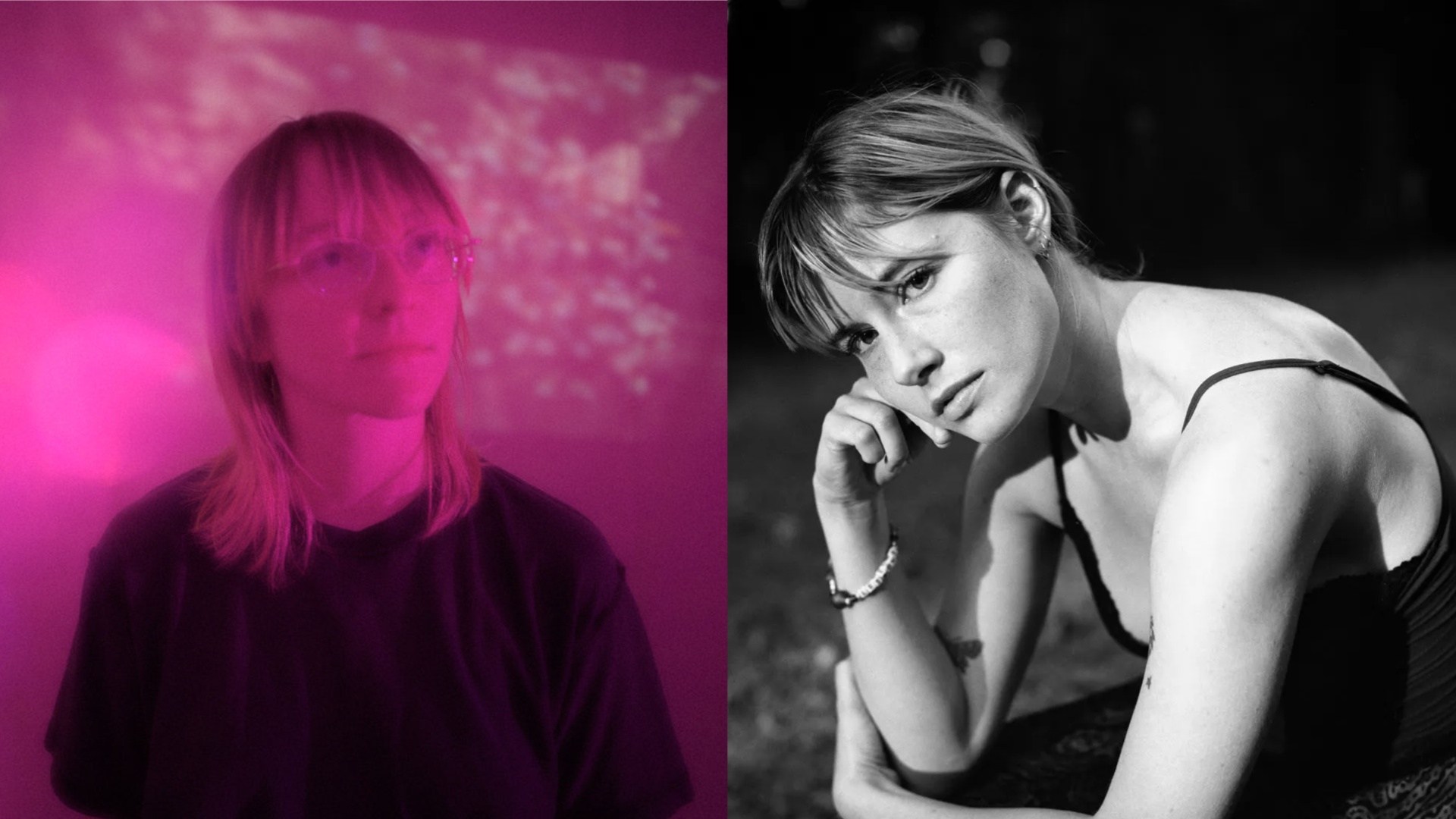
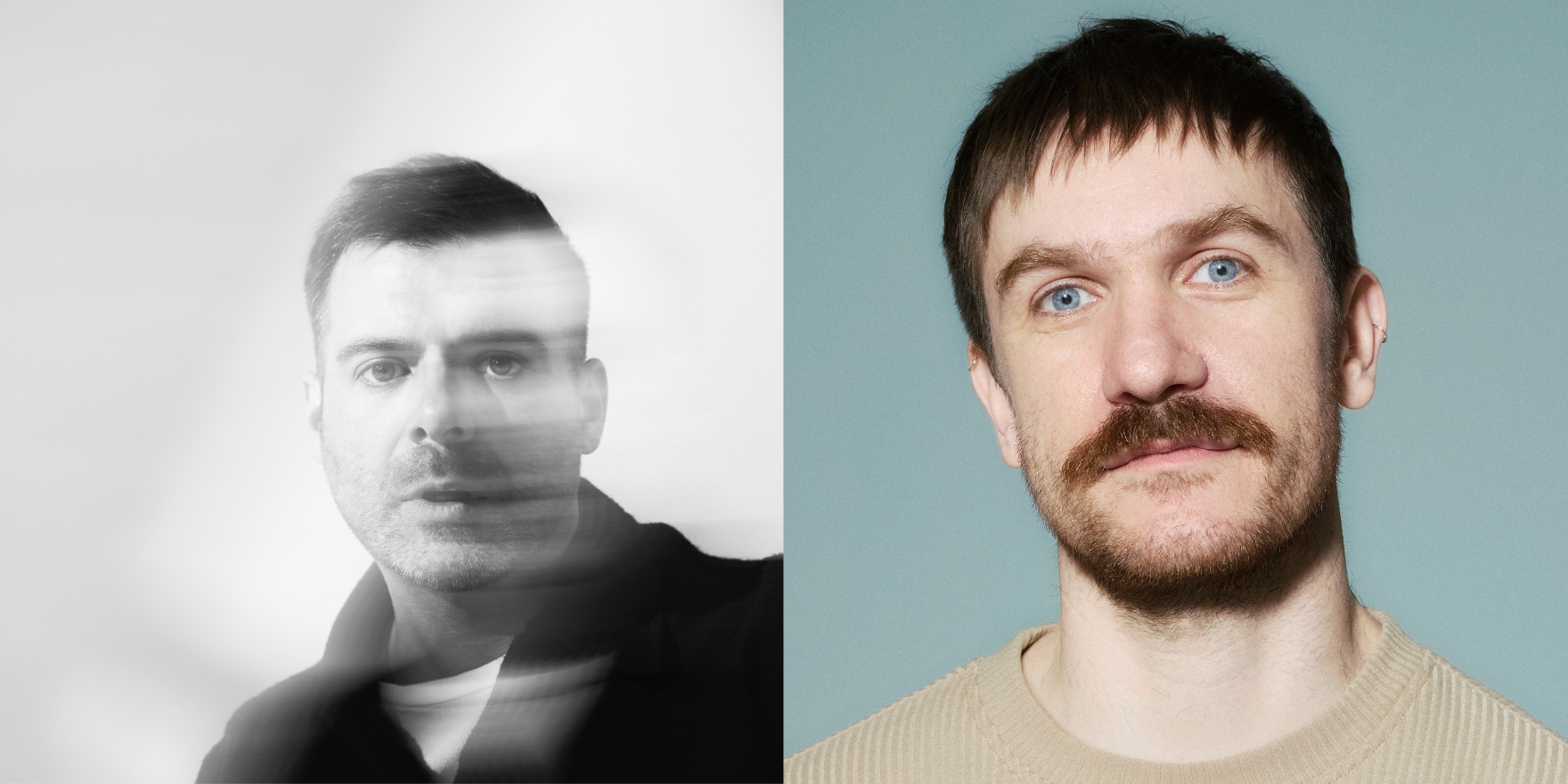
Chris Barnes is a pianist and songwriter who records as Gem Club; Charlie Engman is a photographer and filmmaker. Chris and Charlie have been collaborators since around 2011, starting with, as they tell the story, a set of press photos that ended in a federal arrest, and continuing through music videos for Gem Club’s songs “252,” “Polly,” and most recently “Aperture.” On the release day of Gem Club's new album, Emerald Press, the two caught up about it all over Google Meet.
— Annie Fell, Editor-in-chief, Talkhouse Music
Chris Barnes: I'm very happy to be here with you, Charlie.
Charlie Engman: I'm so happy to be here with you, Chris.
Chris: I thought it was appropriate today that we got to pick our own filters, and since it's release day for me, being a mustached strawberry felt right. Also surrounding myself in red.
Charlie: I’m a birthday cake for the birth of this album.
Chris: Thank you. I appreciate you celebrating. So, I’m just going to kick off: I was thinking about how we met. I remember seeing your photography on Flickr and it stopped me in my tracks. I remember writing you a message. You were so kind and gracious — you sent me some prints, I hung them up, and they were always talking points in my home. You went above and beyond. Then I remember asking you to do press photos for Breakers, for Hardly Art. I came to New York and we went to — what was it, an airfield?
Charlie: Floyd Bennett Airfield, yeah.
Chris: I remember the photos that eventually came from that. I loved them — they were beautiful. Was there any particular reason we were there?
Charlie: So, you really called me at the beginning of my career. I was a little baby photographer. This must have been 2011 or 2012—
Chris: Right around there. 2011.
Charlie: I had just recently moved to New York and didn't really have much of a career or even a life to speak of. I was probably 22. So I was in this mode of just trying to squeeze as much as I could out of the city without any resources available to me. And Floyd Bennett Airfield is this very evocative place — it's a former airfield that's been reconstituted into a state park, kind of like Tempelhofer in Berlin. But they haven't done anything to it. I don't know what it's like now; I haven't been in a few years. We traumatized ourselves with it.
It's a spooky location: Ot still has all these old hangars and a open concrete fields. It's this big empty dilapidated space, and it just has a vibe. At that young age, I was chasing vibes.
Chris: I'm still chasing vibes in my old age.
Charlie: So that's kind of how we ended up there. This is long enough ago that I don't fully remember my thought process, but I think I just thought it was a cool place and I was excited to make stuff there. New York City is a very well-picked-over space. So it was nice to have somewhere that felt a little different.
Chris: I came fully prepared. I also remember it was super hot. I had my dog with me, and I had brought what I thought we'd need for props. I was traipsing around those abandoned hangars, and the next thing I knew there were paddy wagons and sirens.
Charlie: Apparently we were trespassing, which I didn't really realize. A park ranger stopped us. I think your ex, who was on the shoot, was walking the dog back and forth, which drew attention to the fact that we were inside these abandoned crumbling structures. Ostensibly they were trying to police our safety, because they were probably not safe places to be. The park ranger who found us asked me for my ID, and I didn't have it available, and I guess it's very suspicious to police officers if you don't produce an ID instantaneously. I don't know the legality of any of it. We were being innocent and just trying to be creative. And we met a super-asshole park ranger who wanted to show us his dick size, I guess. He took us into a paddy wagon. There's a little mini jail inside the park.
Chris: I remember trying to explain that my dog is brachycephalic — you can't toss him into a kennel. He doesn't even live in the state. That's all I could say. Thank god he let us take the dog with us.
Charlie: This jerk cop who just wanted to show his power took us into a holding cell, a two-room little jail cell, in this very lawless-feeling park. We were there for hours while they were making sure I wasn't a wanted criminal evading a big arrest by not producing my ID.
Chris: I was so embarrassed. Because I was such a fan of you.
Charlie: I don't know why you were embarrassed! It was my fault.
Chris: I was embarrassed because I was such a fan. I've always been a fan. What a wack first—
Charlie: You've really demonstrated your fandom, because the fact that you came back to work with me again after I literally got us arrested—
Chris: I had to come back to court, too, to try to get it cleared from my record.
Charlie: Because it was federal property.
Chris: Yes, federal court. It was so over the top. You were reading a book in Japanese, sitting in the courtroom calm as can be. We had public defenders. I had to promise I'd never get in trouble in New York ever again. And I haven't.
Charlie: Congratulations. I haven't either.
Chris: That's not what anybody needs, especially today.
Charlie: So that was a very strong start to our creative collaboration.
Chris: That is where we started. And then for that same record, I reached out about a video for "252." It's been a little while — give me a little refresh on Matthew Salton and how he got looped in. I remember seeing your treatment for the video and just wanting to give you space to do your thing. It had so much clarity.
Charlie: Matthew Salton is a friend of mine, a very creative, interesting, weirdo filmmaker. I got the sense that his weirdo vibe and energy would be a helpful addition to the things we were trying to make — the Gem Club universe. He had more experience making videos than I did at that time — again, I was a child. So we worked together and listened to the music, which is very evocative. Your music is always very clear about what's going on energetically, emotionally. It's very legible. So it's fun to make treatments and think of scenarios around that. For "252," the lyrics are really literal about watching things grow inside of people. I think we took a very literal approach to the song.
Chris: I remember Matthew sharing that Black Hole was a big influence.
Charlie: As an easy inroad for a narrative. I think that was the genesis of it.
Chris: The idea of the goo. I had never seen the comic. That's Charles Burns? You and Matthew sent me some images — dim-lit, hard light on a body in plastic, Laura Palmer but standing in New York. Running down a crowded street at night. It was just clear that you guys knew, “Alright, here's the direction we want to take this.” My question is what you remember about the individuals cast in it.
Charlie: That was funny. We did one of those Craigslist castings. The general energy was that we wanted it to be uncanny and a little bit eerie and kind of upsetting, because the thematics of the song have all those threads. So we put out a pretty wide casting call on the dark reaches of the internet, and in New York City you get a lot of interesting feedback. We were trying to find evocative characters who'd fit in that universe. There's this young kid in it who, I think, was still in high school — we didn't really realize it. And I don't know if this is me fantasizing and it might be apocryphal, but I feel like that was his first kiss ever.
Chris: Oh, sweet. But also — wow.
Charlie: I know, a bit traumatizing and tragic. But the filming was very tense and strange, because inadvertently there was an age gap — this older woman who was just there off Craigslist and was totally like, "Let's do whatever we need to do, I don't care about making out with a stranger on set." And then this young, handsome kid who was obviously aspiring to professional acting, just trying to get his feet wet — suddenly he had to do this intense, personal thing. There was a real tension in the room, which was interesting because it was sort of what we were trying to capture, but not quite in that way. He did a great job. We talked a lot about it: “Obviously don't do what you don't want to do, if you can't do it, we'll figure something else out…” There was this palpable strangeness, awkwardness. At one point I was like, "Are you acting, or are you actually about to throw up? Are you an amazing actor, or are you being traumatized right now? I can't tell."
Chris: That makes sense. That scene with the two of them on the couch and the goo comes onto her — it's so simple. Another was Crystal — she has the candle in front of her, and that single teardrop comes down. I'm bringing up Crystal because Crystal would come back for the shimmy dance in the sparkle dress for "Polly." I want to hear your perspective on meeting her, and pulling her back in for "Polly."
Charlie: She was one of the many people from that big casting call for "252." She just blew us all away. She's a lovely human being — very professional, good energy, and she just clearly got it. We were doing a lot of weird, crazy things that could definitely put a person off if they're not down.
Chris: Yeah. The music isn't everyone's thing.
Charlie: And she just got it. She slipped right into the flow of everything. It was impressive that she could cry on command like that — it was so beautiful and moving. She stuck with Matthew and me in the back of our minds as just an amazing collaborator. So when you came back to us to do another video, she was an obvious person to try to involve again.
At that point I had been working a lot with my mom in my own practice. I have a long, ongoing project with her. So when you asked Matthew and me to make another film, it made obvious sense, to me and to Matthew, who's my friend and knows my mother and my work with her. We were like, “Let's get her in there.”
When you listen to "Polly," the song itself is about this kind of abstracted character. It's not quite clear if Polly is a real person, or a metaphor, or what. It felt like it had this very evocative ambiguity that felt lonely, but was also about connecting or trying to connect with some other entity. That was the genesis of having my mom have this sort of ambiguous other person in her life — is this a real person? Is this a fantasy person? Is their relationship romantic? They obviously have a lot of differences — age, race, energy. They don't look like people who are conventionally supposed to belong together. The song doesn't have a strong resolution, so the film doesn't provide one either, on purpose.
I just liked having these two really talented people I had experience working with, who I trusted, inhabit this ambiguous narrative space the music offers, and see what happens. Obviously, it's a film, so we blocked it out and had a structure. But it was nice to see how they reacted to each other.
Chris: I remember watching it for the first time in Somerville, and I felt like time stopped. A lot of this stuff, for me — my obsessions with biology — "252," "Polly," "Aperture" — these are also very much about real people. Specifically with "Polly," it's about a loss I experienced, a slow loss through dementia and illness. The actual transformation of identity that happened because of biology, because of the same cellular mechanisms going on in "252." Something I can't control, something outside of me at the cellular level, just happening. It's terrifying. And it's something that's cropped up in my life in various ways.
So that abstraction I think we're getting in the video with your mom and Crystal. Is Crystal part of her? Is this an extension, a fantasy? Is this reality? It's all jumbled up. And it was capturing, for me, this fear I have of losing entity, losing identity. On a very basic level, that frightens me a lot. I don't think I recognized how much that shows up in the music I make. So it was weird to think, for the first time, that both of those videos you made have that cellular-biology anxiety theme in common.
Some of those scenes near the end of "Polly," where you have your mom filming herself, she's got the glitter face and the shimmy dress comes in and its sparking in the woods in the dark — and then the party gone awry at the end, where they're lying on the floor together. All those images were seared in my brain. When it came time for this record, that same anxiety around identity was very much at play. That's why I was so grateful you had a willingness to work on "Aperture" too.
The last thing I'll say, because I've been chewing on it for a while: a lot of times when I'm writing, it's not until after that I even understand what I'm cycling through. So it's been humbling to be able to learn from the "Aperture" video in terms of my own relationship to the song. This thread of anxiety continues in a visual form, this constant quest to feel right in my body, right in my identity, sure of myself. The lengths I could go to, to address all of those things. How do I get near that energy without it becoming overwhelming? How do I raise an awareness of it without it becoming consuming?
Charlie: Interesting. You're making beautiful things with that energy, so it's working. You can get a little close to that anxiety. Seems to be working for you.
Chris: Thank you. I appreciate that. Let's talk about the "Aperture" video.
Charlie: Similarly to what happened with "Polly," it just felt like everything cohered in a very nice way. The things Matthew and I were trying to communicate at the time, and what the music was trying to communicate, matched very well. It was a beautiful process. And I feel like "Aperture" was a similar situation.
Chris: For the most part, in terms of creative liberty, I love being more hands-off and then reacting to something. I love when that works.
Charlie: You're very generous in that way. You definitely have things you like and you offer that, which is helpful. But I do appreciate that you are someone who's like, “This is my role in the collaboration. That's your role, so you do your role, I'll do mine.” Usually that works well. The problem, in my experience, is when someone oversteps their role, or over- or undersells their involvement. This has been a rare experience — you're humble in that way, and that's useful.
Chris: Thank you. I will say the same.
Charlie: This is why I like the work I do with you. I don't have to do a lot of contortion in my mind to please something that's against my own inclinations. I like your music, and you let me respond naturally to the music, so I don't have to jump through a hoop or force a square peg in a round hole. That's very rare. There's rarely a commissioned project — and I use "commission" in air quotes, even though you can't see my hands because of the cake — where you get that type of liberty, and also where the thing itself isn't deeply uninteresting to you. Sometimes you get the liberty, but the work you have to deal with is just not interesting.
Chris: I understand that.
Charlie: One thing I appreciate in particular: my work is often perceived as very bright and optimistic and maximal and exuberant. I'm not really articulating my work that way, but this is often how it's described to me. And I really appreciate that you are one of the few people who actually understands that my work is kind of dark and has a different kind of core — that all of the exuberance and optimism is actually rooted in something more complicated, and not necessarily 100% the yang of the situation.
Chris: Your work has bite.
Charlie: It's got a lot of yin. I appreciate that you see that. A lot of people don't understand that the bright parts of my work are essentially linked to the darker parts. So it's a beautiful opportunity to work with someone who's more interested in the other side of the work. Or at least that's how I interpret it. Maybe you wanted something more optimistic.
Chris: Look who you're talking to! This floating strawberry head — I have to really work for my optimism.
Charlie: This is projection, but I feel your approach is to lean into the sadness and melancholy and melodrama, and it becomes this very rich, beautiful experience that gets transmuted into something cathartic and enrapturing. Whereas my approach is often to find the silly, stupid fart joke in the dark. The thing that's awkward, embarrassing, and mortifying is actually very close to being something that's very funny and very powerful. The jester is the most powerful person in the room — they're the only person who can speak truth to power, because they've so debased themselves, their ego is so destroyed, that they're actually liberated. I feel like we take a complementary approach that on first glance seems opposite, but is actually rooted in a core instinct.
Chris: Yes. It's what I know. The language you use to describe it is humbling. "Sad" is a big banner that often goes with the work, and I get that. I don't always understand it, though — sometimes I'll be anxious and it's like, no, I'm actually just excited. I'm looking forward to something. "Sad" gets like that too, where people say, "I'm actually not sad. I'm feeling awe or yearning or," or something. It's wild what people experience through music and art. But I think the conditioning to be tuned away from our feelings especially now is super strong.
Charlie: Your music is very feel-oriented, which is a nice thing to visualize. You came to me for "Aperture" more than 10 years after "Polly" — that was 2013, right? So more than a decade. A lot of stuff had happened in both of our lives and our artistic careers. It was really nice to hear from you again. And obviously, I'm still working with my mother — she's my forever mom, she's the one I got. So I thought back on the last project we'd done together, which was "Polly," and I wanted to sort of pick up where I left off and see what 10-plus years had left over. Also, making a music video is a very involved, complicated process. I wanted something immediate and direct and easy, where I could just connect with the music without getting overwhelmed by what was feasible from a production side. I thought to myself, If I'm going to do this song justice, I'd need a lot more time and money than I have — so let me think of other ways.
I got the lyrics to "Aperture" and it's literally about being photographed. My work with my mom is also about the emotional ramifications of being looked at in that way, so it seemed pretty obvious what I should do here. I had hours and hours of footage of my mom that I'd made for a show I did in 2018. When I started to very casually string up the footage and play it with the track—
Chris: It was very spooky.
Charlie: It was very spooky how perfect it was. There wasn't that much I had to do. It was already there.
Chris: That's what was so strange. I had all these demos of what the working record was, and I had all this footage from you of your mom — I dialed it up and just played the record. I was maybe paying it half a mind, and all of a sudden something locked in and I was like, Well, this works well with this scene, with this song — it won't happen with others. I'd pick a random spot or skip somewhere in the video, and sure enough, at some point it would lock in again. I was like, What more could you ask for?
Charlie: It was a happy meeting of the minds. One of these things where, let's just give it a go. Filming was going to be complicated for logistical and practical reasons, so let's just try this one idea. And it was my first random idea that kind of made sense in the context of what we'd already worked on together. It was so obviously compelling from the beginning that I was like, alright, let's lean in.
Chris: I'm not going to say anything, but your mom and I have been texting behind your back, and we're going to muscle you into doing another one.
Charlie: I believe it. That's the other thing, too — I know you and my mom have a very active DM.
Chris: I love your mom. She's great.
Charlie: It all just kind of made sense. The lyrics were so aligned with the questions and tensions that already exist in the work I do with my mom — what does being photographed, representing yourself in a relationship, do to you? What does it mean? How does it feel? That's how I interpreted the lyrics. Maybe you have a different interpretation, but it's how I interpreted them. And those are all the same questions I'm dealing with with my mom. So I was like, OK, we have this perfect soundtrack to the work I've already made.
Chris: Has your mom — I mean, we don't have her here, but—
Charlie: She loves you and she loves me and she loves the work that we all do together. So she cried, obviously, when she saw it. But she's a crier, so that's not…
Chris: So am I, and so did I. I'll just reiterate: you guys are amazing. I'm super grateful. To play a small part in the world you two share is wild. So, thank you for that.
Charlie: Thank you for the opportunity.
Chris: Yeah. Anytime.