

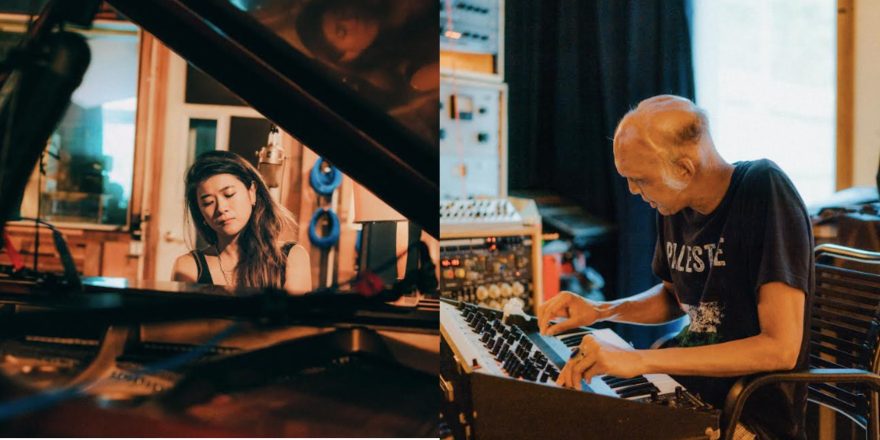

Described as “virtuosic” (NY Times) and “barrier-defying artist” (Mix Magazine), Osaka-born and New York-based pianist Erika Dohi is a multi-faceted artist with an eclectic musical background. From highly polished traditional classical to bold improvisation, she is a dynamic performer whose timeless style and unidiomatic technique set her apart in contemporary NYC avant-garde circle. Her latest record, Myth of Tomorrow, is out October 24, 2025 via Switchhit/Figureight.
Shahzad Ismaily is a Grammy-nominated multi-instrumentalist and producer; Erika Dohi is an Osaka-born, New York-based songwriter, composer, and pianist. Erika recorded her latest album, Myth of Tomorrow, while an artist in residence at Shahzad’s Figure 8 studio in Brooklyn. To celebrate its release — it’ll be out Friday via Switchhit and Figureight Records — the two caught up about its creation, and more.
— Annie Fell, Editor-in-chief, Talkhouse Music
Shahzad Ismaily: Where I can start is the first time I remember meeting you. I’m wondering if you have something earlier than this, but what I remember is Bon Iver and Mary Hickson had decided to make a festival in Eau Claire, Wisconsin—
Erika Dohi: Yeah, Eaux Claires.
Shahzad: Right. And William [Brittelle] was curating some Prince extravaganza, and I remember you were playing keyboards for it. It was so beautiful, your playing. I still remember from that time how much I enjoyed listening to you during rehearsals for that. One of the spaces in the venue was the main, large space, and I remember hanging out around there for meals and things.
Erika: Yeah. I remember pretty clearly it was right before the pandemic, Fall 2019. I just had finished my first record, which was also with William Brittelle, who produced the album. So it was kind of an exciting time for me to meet all these really cool people, including you. It was so many things happening, and I just remember the endless possibilities of collaborations in that festival. It was such a cool event. And then it just went downhill from there. [Laughs.] The pandemic happened right after that. And then, it’s a little personal, but I was also going through a separation. I mean, I wasn’t yet, but I think maybe the artistic freedom and just being with people like all of you triggered a little bit that I wanted to express more freely. Because at that time, I was living in Texas — and nothing wrong with Texas, but I was married and not really doing what I wanted to do.
Shahzad: So if you were living in Texas, how did you end up in Eaux Claires? Did you already know William, and he invited you?
Erika: Exactly. I kept my apartment here [in New York] when I got married, and so I would go back and forth between New York and Texas. I didn’t really tell anyone that I moved out. I just kept my mouth shut and took gigs when I could in New York. But, yeah, because I met Bill through Metropolis Ensemble, for his record, Spiritual America. That was, I think, a year before.
Shahzad: Yeah. And I remember Sam Amidon was a part of Spiritual America, or there was a big performance of it the year before in Sounds From a Safe Harbor in Cork, Ireland.
Erika: Oh, right! Wait, were you there, too? Was that where we met, actually?
Shahzad: I wonder if we just very barely crossed paths. But the time I really remember talking to you was in Eau Claire.
Erika: Those two are a little bit mixed up in my mind.
Shahzad: Yeah, because it’s a lot of the same people. And Mary Hickson curated both of them. I was also going to say, it’s such a thing — people sometimes leave New York, but they intentionally keep 718, 212, 917 phone numbers and never change them and never really tell anybody they’re living somewhere else. Then people will text and say, “Hey, so are you free this Thursday for this thing?” And you’re like, “Yeah, that’s totally fine!” And then you buy a plane ticket and fly back over. I think I might do something like that. I sometimes I feel like Bill Murray’s way of doing things is my favorite, and I hope to get there someday: He has a 212 voicemail — not even a phone call phone — and if you want to work with Bill Murray, you just call this 212 number and leave a message about the project. He goes all over the world, does whatever he wants, and then just picks up the answering machine and checks it once in a while, sees if there’s anything interesting. But he’ll just check the voicemail twice a year.
Erika: It’s almost like a lottery. You get lucky when you catch him. I love that.
Shahzad: One of the things I’m so extremely excited about with the record that you made is that you’re singing on it. Because over all these years of playing with people, I’ve seen people — myself included at times — stay behind the space that is most safe. Like maybe, “This instrument I play very well, I know what I’m doing, I stay in that zone.” And it’s such a profound gift and such a lesson to stretch yourself and go to things that are more new or more unusual or uncomfortable or challenging. Can you tell me a little bit about that decision and how that’s been?
Erika: Thank you so much for saying that. That really means so much. I’ve been thinking a lot about it too, that I’m singing, and I don’t know how it’s been received. I mean, it doesn’t matter what people think. Or, I guess it does, but I shouldn’t care. That struggle is always there. But I literally was thinking about it earlier today, What if I just kept doing what I’m better at, like avant garde piano stuff that I’m always doing? Would that lead to more success? But then — I want to talk about what I just came back from, which was yoga teacher training. I went to Sicily to get this training in September, and it’s in the middle of the album cycle. People were kind of telling me, “Wow, you’re leaving now? You should be doing your album stuff.” And I thought about that, but then, I don’t know… Something was really calling me to do this. Other than the fact that I love my teacher, I love yoga, I love meditation, something was really calling me. And what I really got out it of was studying yoga philosophy more than the physical practice, and what really struck with me was the part that said, “Only ignorant people would do work for fruit.” So the reason why I brought this up is because I said that word, “success.” And when you are attached to success or the fruit of what you do, then you’re missing the point basically. That was such a shocking thing to hear during the album cycle, because it’s like, that’s why you release something, right? Hoping for the success. So kind of dropping that expectation, it was such a big realization for me.
Going back to my singing: after my first album, I really wanted to dig deeper into what I really want to make. So that meant I listened to so many different genres of music, and what is going on now as well in terms of the musical landscape. And then I also got in touch with my childhood dream, which was to sing. When I was little, my friend and I would do karaoke. We loved this Japanese artist Hikaru Utada. She’s like an R&B singer. We would learn the songs and then we’d record it on our MiniDisc.
Shahzad: Wow.
Erika: Yeah. I had a device to record things because I would record piano lessons. So we would go into my piano room and record them, and that was my favorite time. It was kind of like a guilty pleasure away from practicing classical music. So I wanted to get into that side of me. I mean, I’m not saying that I’m going to be doing this forever. But I just wanted to try it out.
Shahzad: Also, [don’t] you find it ends up being about integrating, too? Because there was that Erika, and until that Erika is in the room with all the other Erikas, things are not right. Because that Erika shouldn’t be put away somewhere else. So it’s nice that that particular version of yourself comes closer to you again.
Erika: Yeah. And that’s something that William is so good at, I think. I didn’t even think about that side of me — he dug all that out of me for the first album. I was just going to make a simple piano record. But he was just trying to get things out of me, what I was like, and all of that stuff. So I kind of kept going on that journey of kind of finding truth to myself, I guess.
Shahzad: So for those pieces, what was the process for for lyric writing?
Erika: That, I think, was the hardest part for me, because I’ve never done lyrics. Everything was so new. And then the reason why I’m singing in Japanese is because I couldn’t write lyrics in English. I think because my native language is Japanese, that’s why. But then the topics are actually a lot coming from journaling, from my meditation practice, yoga practice.
Shahzad: Which philosophical aspects of yoga have you been into? Like Rāja yoga or other architectures? What’s it come from?
Erika: Patanjali.
Shahzad: OK, yeah. The Patanjali Sutras, right?
Erika: Exactly, yeah.
Shahzad: I randomly ended up taking a Zoom course on the Patanjali sutras, and it was so moving. What’s so incredible is it’s such a short amount of material, and it’s so profound.
Erika: Yeah, so much is in there.
Shahzad: It’s, like, seven pages or something. It’s very minimal, but it’s very strong.
Erika: Yeah. But one sutra has so many meanings, so it’s, like, one line of what Patanjali said, and then there’s…
Shahzad: So many paragraphs and pages [explaining it]. But even that is really moving, because it’s a nice reminder that even the smallest musical phrase or the simplest piece of music can unfold in a really heavy way. I think sometimes as musicians and composers and improvisers, you feel this pressure to be really dense or to be really active, and it’s not always necessary.
Erika: Yeah. I just want to share one more thing from the training: My teacher, at the beginning of the training, told us to talk 75% less. And then when you talk, you’re gonna talk 50% slower.
Shahzad: Woah.
Erika: And, I mean, I still catch myself talking really fast, and then I’m like, Oh, wait a minute, slow down. But when you do that, it’s so profound. You are so much more aware of what you’re trying to say. In music, it’s the same, I think.
Shahzad: Yeah, I think I have a disposition of talking fast and saying a lot all the time. But I really like the suggestions of slowing down. It’s very strong, whether it’s meditating. Or even, there are suggestions about walking into a social setting, taking time to connect with people, to look at a person, speaking a lot less and listening more. All those things I think are very strong.
Erika: Yeah. And then it’s so quick to affect other people, too. People, realizing it or not, really mirror the other person.
Shahzad: Yeah. Probably even if one person came into a dinner and slowed everything down, it would affect everybody. Even if there was 10 other people there, they would have a really strong effect on the room. When you’re in the studio working with people — because I’m sure when you’re sitting there, all kinds of people walk in the door — I wonder if your way of being set the mood in the room?
Erika: I mean, your studio [Figure 8, where Erika was an artist in residence] is so perfect for that. It just has such a great energy and vibration that you can kind of be quiet and really tune in.
Shahzad: I thought about that, especially during the pandemic, because it was empty. Not many people are using it, and I was home. So for a bunch of mornings, I would wake up early and just go downstairs and vacuum the studio or clean it, even though people weren’t coming. And that put me in such a quiet, focused feeling to be down there in that particular space. I think I got very, very lucky, because you can spend money making a space, but you can’t automatically pay for how it’s going to turn out. It just turns out whatever natural direction it’s going to unfold. So I feel very lucky that the space feels good and that people feel creative there.
Erika: Well, I mean, that is true. But also, I think it’s reflecting your personality. The way you are is just reflected in the studio.
Shahzad: It’s true. I mean, whenever we do things, we really set a tone for people, especially if we’re in some kind of a leadership position or where we’re the one setting something in motion.
Erika: Yeah. And I really couldn’t have made this kind of record without being given so much time in the space. I wouldn’t have been able to experiment. That’s the biggest thing: if you don’t have that abundance of space and time, I wouldn’t have had the chance to even experiment with singing. It actually all started because we were just like, “I don’t know what we’re doing!” I didn’t show up with a score or parts or anything, I was just like, “OK, well, I guess we’re just gonna create something, improvise with all these amazing synths and everything.” And then Michael [Hammond] and Bill brought the autotune with a microphone, and then I was just so in with that. [Laughs.]
Shahzad: Oh, nice. You got inspired.
Erika: Yeah. And it sounds good because it’s autotune. [Laughs.] So that was the beginning.
Shahzad: I’m really proud of hearing that, because in my idealized mind, I imagine that in the ‘60s, people had big record budgets and they had long times in the studio to make a record. One month, two months. And so the studio itself was a place for experimenting. And then in our current times, people have very small budgets, and so usually they can only afford to go in the studio one day, two days, three days. And they have a 14 song record, 10 song record. And so they have to be super organized and they plan everything ahead of time and they say, “OK, clarinets are coming in at 2:00. Here are the parts they’re doing. They’re finished at 3:00.” And so there isn’t the room to discover while you’re in the space, because you feel so much pressure of using the resource that you put all this money together for. So I’m very happy that it had more of the flavor of studio as a play area for experimenting.
Erika: Yeah, 100%. I mean, now we don’t have time nor budget. Especially in New York City, it’s just so hard to make the time. So I can’t thank you enough for the opportunity. It really wasn’t going to be possible without it.
Shahzad: I’m so happy you did it, Erika!
(Photo Credit: Samantha Valle)