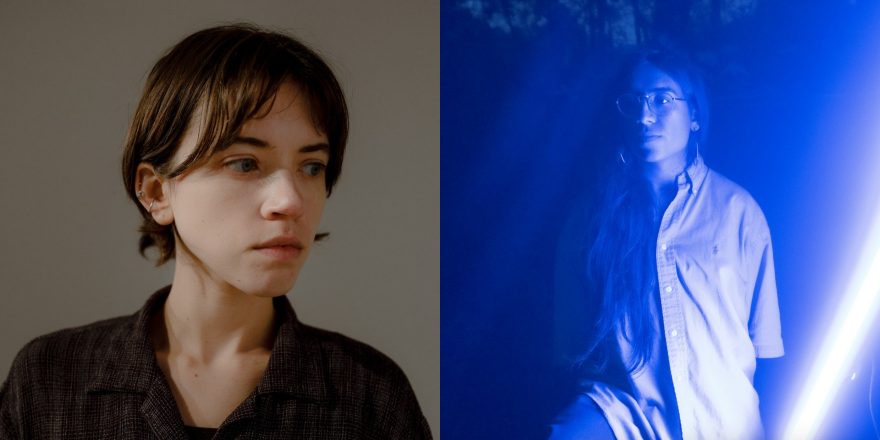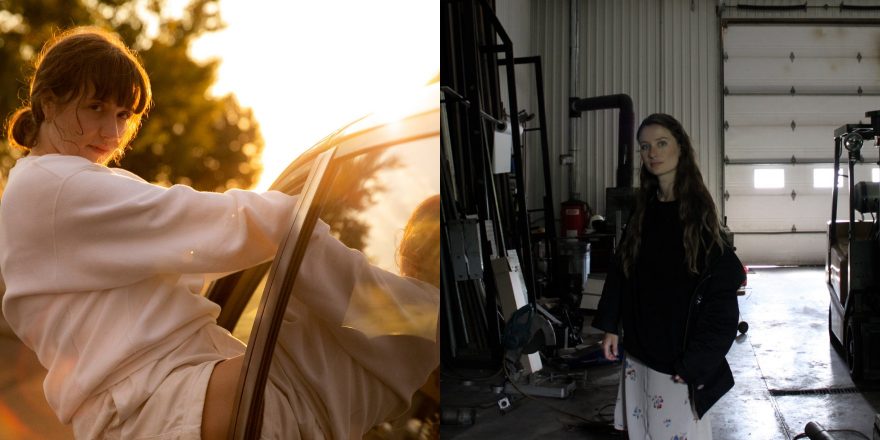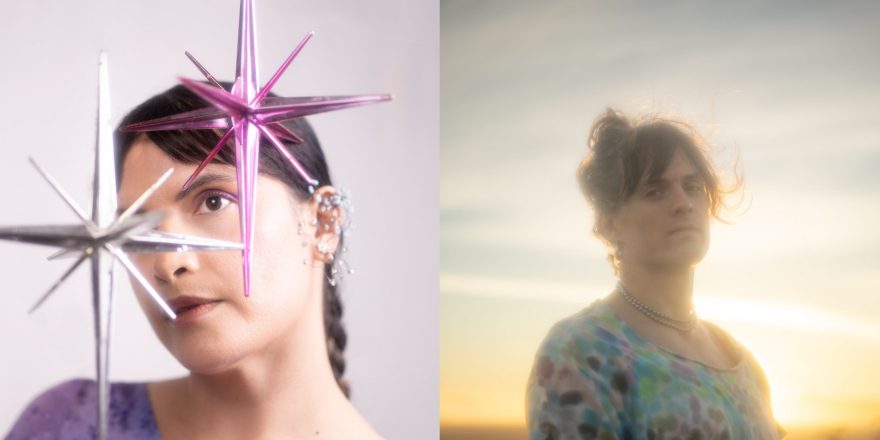


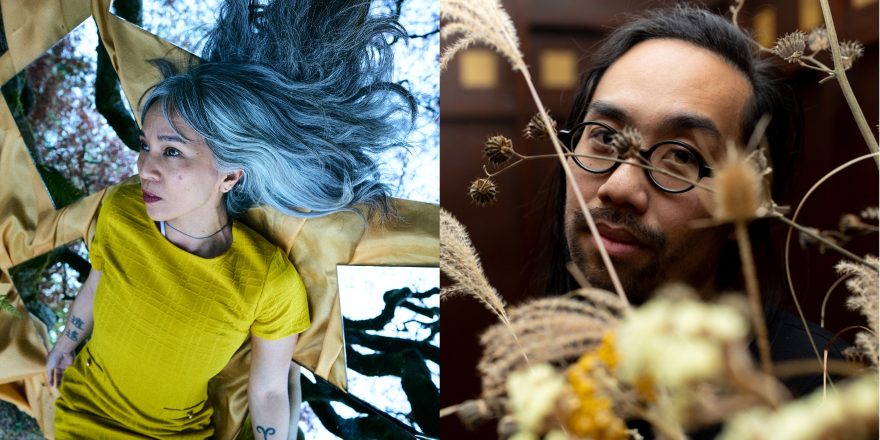
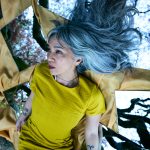
Dao Strom is a poet, musician, writer, and interdisciplinary artist based in Portland, Oregon. Her latest record, Tender Revolutions, is out now.
(Photo Credit: Kyle Macdonald)
Patrick Shiroishi is multi-instrumentalist & composer based in Los Angeles; Dao Strom is a poet, musician, writer, and interdisciplinary artist based in Portland, Oregon. Dao’s latest record, Tender Revolutions — which is part of a larger project called Tender Revolutions/Yellow Songs, comprising a four EP song-cycle and four chapbooks — was released earlier this fall. So to celebrate, she and Patrick got on a call to chat about the creation of it, and much more.
— Annie Fell, Editor-in-chief, Talkhouse Music
Dao Strom: We’re probably coming from very different worlds, but there’s the intersection of diaspora and Asian-American experience. And I know that you’ve done collaborations with Brandon Shimoda, a poet who I love and admire a lot. Where do you want to start?
Patrick Shiroishi: I’m curious to know about your most recent project. I feel like it’s a full package kind of thing — you have the music, which is in itself very deep and has incredible sound worlds and moments, and then this accompaniment with an even deeper dive into your own personal history. I appreciate it, because I love media.
Dao: [Laughs.] Yeah.
Patrick: Like the different papers you have in there to separate the different sections, and then there’s different color verses — I’m sure when I do the reread, it’ll pop out to me more, but just on a physical [level], it was very impressive and you could tell it was a huge labor of love. Do you see [the music and the chapbooks] as two of the same vehicle, or are they separate vehicles for you? And how did you arrive at that?
Dao: I guess I call my work “hybrid.” My simplest description is that I’m working with voice, and then that voice manifests through these different mediums and I can’t really contain it. But overall, I started out as a writer doing fiction. Then I was writing songs also, which were more folky and narrative. And with these hybrid projects, I think I’ve been trying to collapse the divides between the modes.
With this one, the color — and I feel like we could talk about “yellow,” too — I’m sure you are getting the reason why yellow is an important part of the project — it initially started off as, I had four EPs of music that felt connected but separate, and then I was conceiving four chapbooks. One of the key pieces was that “China Girl” cover, which I actually did years and years ago as a random experiment, as part of a poetry performance thing I did, and then I wrote this essay doing a deep dive into the song. I went to Antiquated Future, who had put out my album before, and I asked them if they would release the EP and the essay. So that was the initial idea. But then I had more pieces, and then it was a bigger project than they wanted to take on, so I brought in another label [Beacon Sound]. And then the publisher I’d been talking to [The 3rd Thing] — I actually did the layout and design of the books myself, and then she just elevated it with paper selection and things like that.
I know you’ve also dabbled in editing and compiling the anthology Tangled, which also looks really beautiful. What is that, and what has that trajectory been for you like?
Patrick: It’s been, I think, the most rewarding thing. Making music as a solo artist is cool and I’m glad it’s this vehicle to express what we’re going through, what we’re processing and everything. But I think growing up in the music scene here, community has always been really important to me. Tangled started in during the pandemic, when all the anti-Asian hate was going on. It was a place where I was like, OK, maybe some friends can express what they’re feeling, what they’re going through, like how I was scared about my parents going outside and all of these things. American Dreams, my label, was kind enough to release it as a chapbook along with the record, and I’ve been able to put out two editions after. It’s been awesome. It’s been nice to see everyone be together and have this sort of camaraderie. You mentioned Brandon Shimoda earlier — he’s an incredible facilitator of that. I was on a panel for the 80th anniversary of the Executive Order [9066, which authorized the forcible incarceration of over 120,000 Japanese Americans] that he assembled. I talk about it a lot in my music, but it was one of the first real times where I felt like, Oh, I’m not alone.
Dao: Sure, totally. That resonates.
Patrick: I think Tangled is kind of my way of taking inspiration from that. And I think if I had more time and energy and if I was younger, I’d want to create some sort of organization where we can all share resources and have a collective and take it to the next level.
Dao: Yeah, it takes a lot of organization… I’m thinking a lot about collective or multi-voice work, because I also am part of a collective She Who Has No Master(s), which is all Vietnamese women artists.
Patrick: Amazing.
Dao: We do collaborative poetry. And one of the books in Yellow Songs, too, is collaborative poems. So it really does contain multiple voices of Vietnamese women, and the photos also are a collaborative act.
Patrick: Is that all Portland-based?
Dao: We’re all over. There’s people in the Bay area and there’s a couple poets in Canada, and there’s some people on the East Coast. And we just did this project in Berlin, so we collaborated with Vietnamese-German artists. And we have a couple people in Vietnam.
Patrick: Wow.
Dao: The whole point was to reach across these diasporic boundaries. I guess my question is, because I have this same experience of starting out feeling alone — I grew up in a small town in California, so my experience is a little different, and my stepfather’s Danish, so I grew up in a multicultural family — I’m wondering, is it part of the experience of being an Asian-American artist? Is it part of what being a diasporic artist is about? Or does it contribute to some collective healing? I was having a lot of feelings at your show, so I want to ask about that trajectory from feeling like you were the only one doing this thing to being amid other Asian-American artists, or what it means to bring all that multiplicity together. Because we have so many different experiences.
Patrick: I think growing up, rock music, even the experimental stuff, a lot of it was white men — save for Blonde Redhead and Deerhoof, which were huge inspirations. Also, there was Linkin Park and James Iha from Smashing Pumpkins. But as far as the experimental, I was like, Oh cool, there’s other Asians. I think I would always gravitate more towards bands that I found like that, or would give them an extra listen. But I think growing up and being more ingrained in the scene, and being able to travel now and meet people, it feels more like a celebration. We are out there. And maybe it’s because of the way the internet is set up for press things that certain people aren’t getting the shine that I feel like they deserve. I think connecting with them and hearing their experiences and their stories, and letting them know, “Same” — I feel like that’s a rare feeling to get.
I have a dear friend, Randall, who goes by Amulets, who lives in Portland—
Dao: I actually just met him at your show.
Patrick: Oh, amazing! You guys should definitely hang out. But anyway, we were talking after after the show, and he’s also half but he looks very Japanese. And he was saying, “I felt really alone growing up,” and I was like, “Dude, I get it. It’s hard, especially doing the music that we make.” But I feel like having what we all have now, if we had it 15, 20 years ago or even knew each other in the scene…
Dao: I’m looking at the names of the musicians in Tangled, and it’s a lot of people I’ve never heard of, so I’m really curious. I played music in Austin, Texas initially, and I was doing country music, and there’s no Asian people there. So there’s a lot of that to work through. And I’ve since found a different, more experimental direction — which, I feel like there’s a lot more out there now than than there was 15 years ago.
Patrick: Totally. What made you do the switch from the country stuff to the experimental stuff?
Dao: I think it was just a progression. I started playing music in my early 20s, and initially what drew me in was folk and traditional gospel music. It’s all folk music, it’s forms of storytelling. And then I left Austin and at some point I started writing songs about my Vietnamese diasporic context, or about folk tales, and started to explore that hybrid. So it just sort of naturally happened that things changed. And I moved to Portland, so moving away and finding this ambient space, it was a lot of creative growth. Thinking about approaching music more as you would a poem or as an assemblage was a different way. The narrative trappings of the song were a little bit constricting, so finding a way out of that was good creatively.
I wanted to ask about noise and silence. [At your show,] the opening song you performed had a lot of noise and just a lot of notes and it was really intense. And I was thinking about Brandon’s essay — Brandon wrote that essay for your other album, and he talks a lot about ghosts and ancestors. And I felt like the noise was just sort of puncturing, doing something to the air in the space and creating these openings for something else to come through. And then that movement from that into extreme, long spaces of sustained notes and silence — that juxtaposition, are you doing that consciously? And is it an invocation? Is it a channeling? Do you think about it?
Patrick: I love that. I think initially I thought of it from a musician’s point of view. I think a lot of my solo music comes from that. I want to say all of my music is some sort of processing, whether I know it or not, and some sometimes I can connect the dots later, like, Oh, this is this that I was going through. I think it is definitely a channeling. Looking back at our past generations has become a very important thing in my practice, and just honoring not only my grandparents, but everyone’s ancestors. So starting it off like that, and into this chaos… Musically, I love the clash of the two opposites, the extreme noise into the silence that makes it more impactful. But also the chaos — there is a melody hidden in there, and it’ll be called back later on.
Dao: I mean, if you’re talking about dealing with intergenerational trauma, is it a form of transmuting that into something else? The album goes from that noise and that intensity, which is challenging, and it’s addressing something that is like a harsh truth or reality. And then there’s just these moments of beauty, and that juxtaposition is really striking.
Patrick: Thanks. Yeah, I think at the end of the day, all my music does come from a place of hope. And of course along with hope, there’s all the other feelings. But I think end to end, [it’s like,] “It might be bad now, but I don’t think it’s gonna be bad forever.” Meeting you in real life and, even though it was a short moment, sharing a moment like that to me is an act of hope. Broadening our collective networks and support — that, I think, is special. And I think that’s a great jewel of like the arts; we’re able to connect with strangers across the world.
Dao: I think about those encounters a lot. That is maybe our best chance of healing. And healing is not this thing that you have one experience and it happens overnight, and then we’re all good. It’s this incremental repair of all the things that we’re carrying, the ghosts and the wounds. And so maybe each encounter where we make a connection across those divides [is a step toward healing]. It’s also what you and Brandon are doing: you writing in response to his book, and then him writing in response to your music.
Patrick: Yeah. I mean, living in this time period is insane. But I’m also grateful with the internet — which is an awful place, but also kind of cool — connecting, being able to do this with you. And I’ve never met Brandon in real life before, but to have a connection where we’re able to work off of each other and talk…
Dao: That’s really beautiful. I’m also interested in how you do purely instrumental music, but then you also have vocals. Is that a different type of voice, when you bring words and language versus the voice of your saxophone?
Patrick: Yeah, it’s been a new investigation. I think singing is very scary. You probably don’t feel the same way, because you’ve been doing it for so long, but I only just sing in the shower, around the house. The original impetus of singing in Japanese was that so no one would know what I was saying, more or less. But it’s been also really powerful to get into poetry and reading and seeing the power of the words and the rewrite. Living with a book of poems on tour has been pretty inspiring. How about you, with your voice and your music?
Dao: I think singing is my more comfortable instrument. But, I mean, words create this trap of meaning or literalness, where I find myself craving not having words. I don’t really play the piano — I have piano music, but I’m not trained. I find my way around. So in a way, I’m learning a voice through that. Words are sometimes dangerous. They create beautiful meaning, but then sometimes they also create boundaries. An identity is defined by these certain words. So part of me also craves wordlessness, which is where a lot of the atmosphere and the music comes in, as something that frees us from the story of ourselves.
Patrick: When you did the book and the music, was it music first and then the book came?
Dao: I would say it’s music first. The “China Girl” cover had been around for a long time, and then the song poems were an inspiration from being with the collective. And then I started working in samples of our conversations. And then when I knew I had four parts — I had the essay already written, so I sort of knew I had four books. The last two books, I made in mind of that they went with the pieces of music. But a lot of the writing was just pulled from different places and then assembled. I’m not very orderly; I’m not a very linear writer. It’s an organic process, for sure. And then when I write songs with words, it’s usually happening simultaneously.
Patrick: That’s cool. I feel like sometimes in music, too, it’s little pieces here and there. Like, Oh, this is not great, but this part’s great from years ago. There’s so many different ways to do it.
Dao: I’m thinking of I was too young to hear silence, and it says that that was an improvisational recording. The names of the songs are very poetic, too, and I’m curious, how does the naming of the songs happen? And then how do you know where a song ends or begins when you’re doing a long improvisational piece like that?
Patrick: For that piece, I knew it was going to be one long thing. I could have just put it out as a 50 minute recording — which I’ve heard some in the past, and it’s been incredible — but I realized, for my own digestion, it’s easier when they’re split apart. When I played, it was just stream of consciousness improvising. And then after listening back to it, I was like, OK, this seems like I’m moving in a different direction. This will be a split here. And just trying to split it up so that there is movement, and just trying to match up where that is. And then the naming of it always comes after. I have a note pad on my phone of, if I’m in a coffee shop and I think of something, or if someone says something or I read something, just having a list, and I pull from that. Also just hearing it sonically, What would make sense? Or when I improvise, I knew the ending was going to be in this specific melodic realm. So for that, I wanted it to be in this uplifting vibe. But everything else was kind of like, What is this? What am I emulating? What does this sound remind me of? I think that’s also, with wordless music, another way I could get across a message.
Dao: It’s a different kind of language.
Patrick: Totally. And it’s been interesting going from that to trying to write poems… Are you bilingual?
Dao: I’m not, and that’s one of the things that haunts me. I grew up with a Danish father, and there’s a lot of reasons my mom wasn’t able to keep it. But my mother was a writer, and my birth father was a writer, so language and writing have been a big part of the legacy [of] my parents. So I have a lot of feelings about not being able to access it. But I feel like a lot of the work I’m doing is wrestling at that threshold. And then I have done things where I’ve worked with translators, and I did one book that was translated into Vietnamese. So I feel like it might just be a lifetime of work, continuing to wrestle with that bind.
But how about you? Are you are you fluent?
Patrick: I can kind of speak; I took Japanese school when I was younger. But when I was younger, I didn’t really care, and I regret not taking it more seriously. I think also not being able to practice these days, it slips away. The only person I really talk it to is my mom, but a lot of times, I’ll respond in English. We’ll text in Japanese, and then I’m like, It’s taking too long, I just need to text her in English. And that’s not helpful. But my mother came from Japan, whereas my father is third generation here. So growing up, I connected with [his] side more. And I think a lot of what I was doing in my music was on my father’s side, with the camps during World War II. Now being older, I want to investigate more on my mother’s side and try and see my family over there. I think it’s going to be interesting to see the next generation, what they’re going to be talking about and what they’re going to go through. I think about that sometimes, because I was like, Is my grandparents’ story my story to tell?
Dao: That’s a good question.
Patrick: That was a huge thing that I was working through. And my friend was like, “Sometimes it takes two generations to be processed.”
Dao: I was born in Vietnam. I came over when I was two, so I’m still, like, 1.5 generation. And then the stories of my parents’ generation, they’re dying out, so there’s still a lot of sorrow in that generation, and whether those stories are being sufficiently told… But then there’s also the silence that comes with trauma. So that’s what the subsequent generations are trying to bridge. It does take generations, I feel like, to wrestle with that collective trauma.
Patrick: Even just remembering those things, I think, is important.