


Daniel Avery is a producer, composer, and DJ based in London. His latest record, Tremor, is out now on Domino.
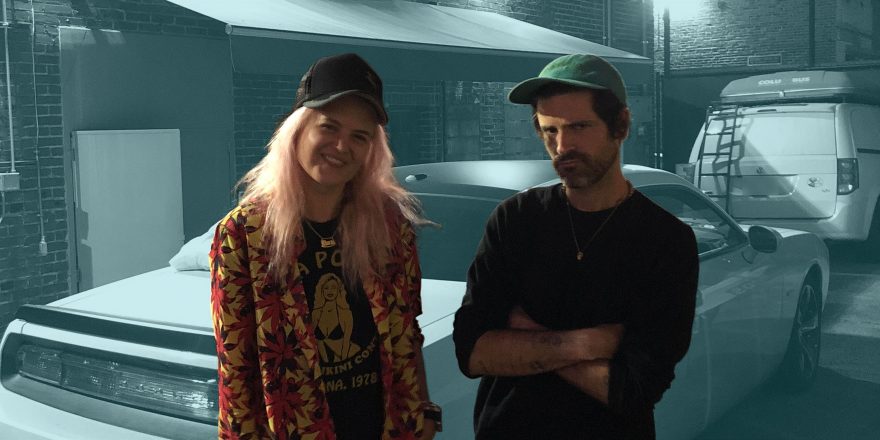
Alison Mosshart is a singer-songwriter who fronts the rock band The Kills; Daniel Avery is a producer, composer, and DJ. Daniel’s new record Tremor came out earlier this fall on Domino, and Alison collaborated on one of the tracks, “Greasy off the Racing Line.” So to celebrate, the two got on a Zoom call to catch up about it, and much more.
— Annie Fell, Editor-in-chief, Talkhouse Music
Alison Mosshart: I was at Rough Trade the other day and I saw the record. It looks awesome. You gotta send me one.
Daniel Avery: Do you not have one yet?
Alison: [Laughs.] No!
Daniel: I’ll make sure that gets sent out today. That’s Domino’s fault… Thank you so much, as ever. It’s such a pleasure having you part of the record, and I’m so happy with it.
Alison: I just keep hearing so many nice compliments about it. Everybody loves it. I love that I wrote a crazy poem about Formula 1 and race cars and it turned into something.
Daniel: I know, it’s madness. Let’s begin there: Would you say racing is as much a part of your life as music?
Alison: No. I only got into Formula 1 in 2018. I was invited to the race in Austin, Texas. Me and Jamie went and we were just blown away. Our brains melted. It was the coolest thing that we’d ever gone to. And so we’ve become as a band fully obsessed and watch every single practice, qualifier, sprint, race.
Daniel: Amazing. Is it the adrenaline of it, do you think?
Alison: The astonishment of it is that there’s only 20 drivers in the world. It’s the most impossible sport to get into, and these drivers are almost not human. I mean, their hand-eye [coordination] — it’s just a wild thing to think of how hard it is to get into that seat. There’s that element of it that is so incredible. But then the other element is just the mechanics of it and how every single race, they’re always trying to improve the cars. You’ve got the Constructors’ Championship, which is going on, which is the teams themselves building these cars — none of them are the same — trying to be faster than each other. So you have basically a team of scientists creating super jet engines, and then these insane dudes driving these cars. I just don’t know of anything like it. Of all the racing car things that are out there, this one is just so… extra. [Laughs.]
Daniel: Some people equate F1 drivers, or racing drivers, with rock stars in terms of how they’re perceived by people. Does that in any way chime with you? Or does it even sort of annoy you? Do you think they’re entirely different beasts?
Alison: I’ve never heard that comparison, to be fair, to be annoyed about it or to agree with it or not.
Daniel: I guess it’s just the lifestyle of it. And when you said they’re almost not human — when I was growing up and I was looking at someone like Iggy Pop, or Bowie, they didn’t feel like humans to me.
Alison: No, I mean, they’re magical creatures.
Daniel: And I’m certain people feel that way about you. Does that ever cross your mind? I don’t have it in the same way, but even I have it where sometimes people are like, “Oh, you’re you’re a nice dude to talk to,” and they weren’t expecting it. They were expecting me to, like, speak a different language.
Alison: Yeah, I’ve had that. A person on the street goes, “I can’t believe you’re nice” — which is always a weird thing to hear. I think when you’re a kid and you’re looking at something and you’re inspired by someone, you want them to be extra special. You think they’re extra special. And they are, because they work so fucking hard. I think just like these drivers, they’re the ones that worked the hardest and they’re the greatest at what they do. And I think when it comes to musicians, it’s the same. But there also is an element of luck, and there also is an element of being in the right place at the right time.
I guess it’s whatever dazzles you, right? [F1 drivers] dazzle me because it’s such a strange and small kind of thing. And it’s so interesting because you can’t just walk in the front door of it. It’s an amazing thing to witness. It’s mesmerizing. But I don’t think of them as rock stars the way that people think of rock stars as just going crazy and partying all the time and not doing anything. I don’t know when people think that musicians work, considering the idea they have of what they do with their time. [Laughs.] But it’s the same with the drivers. All they do is train. It’s so incredibly serious.
Daniel: That’s a really nice way of putting it. Because I think the more I got involved, the more I moved from being just a music fan into working in music, the more I realized that the thing that I was dazzled by wasn’t the alien nature, it was the fact that these people have poured their entire souls into their craft. And that’s what’s magical about it. That’s what I love. You can say that about any artist who’s unique and has their own voice, that it’s because they’ve lived and breathed this.
Alison: Maybe what’s exceptional about it is that they’re the people in the world that know what they want — that since they were generally children, knew what they wanted and went for it. It’s the expanse of time and the ambition and the focus that is so exceptional. It’s not normal to know what you want to do when you’re 11. You’re doing everything: You’re in gymnastics, you’re playing tennis, you’re playing soccer, you’re running around. You’ve just got a guitar — “Fuck the guitar, I’m going to play the drums.” You’re all over the place. And then in Formula 1, these guys are racing karts from the age of four. It’s bananas. And then you have those musicians who were writing songs in their room when they were six and there has never even been a shadow of a doubt for them, for their imaginations, for their dreams, that they were going to do anything but that. And then you have a lot of people that come at things because it’s cool, or something to do with pals, or whatever it is. There’s a different dynamic, and it doesn’t make it less than, but it’s a bit more on the normal side. And it’s important, too. But those kind of special beings that there is no other place in the universe for them, it’s all encompassing who they are — I think all of us as humans, when we see that, we are drawn to it. That level of being sure is so attractive.
Daniel: Absolutely. Do you have an idea of when you knew that music was was the path for you?
Alison: I always loved music and I always wrote poems to sing. I don’t think I necessarily thought, I’m going to be in a rock & roll band, just like I didn’t necessarily think I was going to be an artist, but I did nothing but those things — nothing — every single day. There was no transitional point. But I don’t remember ever thinking, I’m shooting to get a record deal. If I was ever shooting for something, it was to surround myself with people that thought like me, that wanted to do the same thing. That’s what my eyeballs were always doing as a kid, trying to find the people, and the space where I could exist. And it’s really hard to explain that when you’re a kid, but it’s what you’re just drawn to. I’ve been asked that question a million times, “When did you decide?” I never decided, ever.
Daniel: I have the same thing. I knew from around the age of 15, 16 that I, as you said, just wanted to be surrounded by music in some way. And I didn’t know what that was exactly. I was able to do that from even just working in record stores or putting on bands or whatever. I knew that was what was pulling me. I was making music at that time, but I never had a dream of being an artist in that way. I just wanted to be one of those guys — just to be part of it. That’s how I always felt.
Alison: I came to be in my first band [through] an interesting route, because I was obsessed with art and graphics and skateboarders — and I was obsessed with skateboarders because of the music that they listened to, and the music on the skating videos. I was never a great skater, but I skated to get closer to whatever that was. And so those are the kids that became my friends when I was, like, 10, 11, 12, 13. I would stalk the high school kids that had the boombox in the street, and just shove my face in it and live there. Where I grew up, there was nothing going on. There weren’t bands, there weren’t venues. There wasn’t even a record store. So this was the way in, hovering around the halfpipe with my head in a boombox — which suddenly made me find my friends, which suddenly formed my first band.
Daniel: Isn’t that the most beautiful formative experience, though? I’m almost wary to ask this question, because I’ve been asked this a few times recently and I don’t know if it’s useful. But a few people have said to me, “Do you think it’s a shame that younger generations now might not have those experiences because they can, in theory, find these things through a screen?” I don’t know how I feel about it. I guess it’s irrelevant, because it doesn’t apply to us, and every generation is going to find their own way through it.
Alison: Yeah, I don’t know if we are allowed to say the answer because we’re not them. Their obsessions, I don’t know what they are. It’s probably none of my business. They’re living in a completely different kind of emotional web. Their stresses and their feelings about fitting in… I don’t recall ever wanting to fit in with the majority, ever. I would have found that embarrassing. I was never trying to be popular in that respect. But I think there’s kind of a difference. Everybody’s so judgmental, so quickly, so you want to not be slammed, to not be canceled. So there’s this kind of walking a very safe path in a way, which I think is stifling and stressful and probably emotionally damaging. That’s their web to unfurl, that we didn’t have to. We had a lot personal space and emotional space and time to think without being inundated. How do you walk through that mire and figure out who you are and what you want when every day it’s 25 new things to fucking think about and have an opinion about? It’s overwhelming.
Daniel: I’d like to think that, ultimately — obviously, humans have not evolved in 20, 30 years since the internet was a thing — and at the heart of it, all of us still yearn for some kind of togetherness or connectivity and human interaction.
Alison: It’s at the core of survival. But I don’t know if it’s at the core of everything. I’d like to think that, too. It’s a very hopeful way to think.
Daniel: I’m doing a short run of record store in-stores at the moment, and I was in Brighton the other day and I commented that they had a lot of CDs. And they said, “Yeah, we brought them back because teenagers are buying these, because they want to own something physical.” Vinyl’s kind of expensive these days, but a CD you could buy for, say, £12, £10, and you could still have the artwork and show your dedication to something you love physically. It’s only a small scale thing, but it’s a hopeful sign.
Alison: Well, people like you and me — I talk about that in interviews a lot — I spend just as much time making the record artwork as I do making the record. It’s that important to me. And it’s lost on most people at this point. But it was so important to me as a kid to sit and pore over the lyrics and the artwork and try to get to know my band.
Daniel: Definitely.
Alison: It’s so random and odd how people consume music now. In the very short space of time that I’ve been making records, like 30 years, it’s gone completely the other direction where I’m always trying to make a full body of work, something with an arc, a thing that should be thought of as a piece, not parts. And you can’t make people think that way if they don’t think that way, you know?
Daniel: True.
Alison: But that’s cool about CDs. I remember when CDs started, I was pissed off because the artwork was so small. Before that, it was cassettes — you’d pull the accordion, lay it across the floor with a magnifying glass. [Laughs.] I think with just anything, it’s more niche now. It’s definitely cool, no doubt about it. Having the artwork, having the actual physical thing, is fucking cool.
Daniel: It is fucking cool.
Alison: But most people aren’t cool. There’s a lot of people in the world that are just not that into music. That’s OK. [Laughs.] There’s no way please everybody.
Daniel: You were talking about poring over lyrics. Can you remember some formative lyricists for you? People who you just thought were doing something that moved your brain in different directions?
Alison: My favorite band from the age of about 11 was Fugazi. I’ve never been more obsessed with another band in my whole life. It was just full-blown madness for me. Couldn’t believe they existed, couldn’t believe how great they were, couldn’t believe any of it. They were my David Bowie or my Iggy Pop at that time in my life. Back to the sticking my head in the boombox thing — those songs would come on, I wouldn’t know what the band was called, I wouldn’t know what the songs were called, because they were all on these cassettes that people had recorded. It was just mixtapes, basically, nothing with any writing on them. And there was a lot of things: There was X-Ray Spex and some English punk stuff, and there was some New York punk stuff and West Coast punk stuff. Even to this day, I’ll hear a song, like a really deep cut of something, and be like, Oh, shit, what was it? I’ll remember it from when I was a kid, stealing those tapes and copying them and never knowing anything, just loving them and listening to them over and over and over again. But Fugazi — that, I worked out pretty quickly, because there was a lot of that. So I was able to accumulate every single last recording that they ever made.
Daniel: When you fell in love with Fugazi, were you going around saying that you were into punk rock? Were you a punk rocker? Or was it more just about the music itself and not really anything beyond that?
Alison: No, it was more about the music itself. I wasn’t very genre specific. I loved all music. I knew what I liked and what I didn’t like, but I listened to the radio constantly, and I went through my parents’ record collection. I just consumed. But I think they spoke to me on a sort of personal and political level at that time. I wasn’t really that into ‘80s music. I loved guitars, so I was really drawn to that. I think it was just immediately my thing, and that whole DC scene was my thing, and Dischord Records and all of that. I loved it all.
Daniel: The reason I bring this up is because I’ve had a few interesting chats around this album campaign, where the overall question I’ve had is something along the lines of, “Well, some people know you as a techno guy or an electronic guy, and now you’ve made this album that’s more rock…” And what I have to say is, when I was growing up, I definitely was not sat at home making these delineations between these genres. I loved Björk as much as I loved Nirvana, or Smashing Pumpkins as much as I loved Portishead. I guess you could say it all had a kind of shadowy, dark aesthetic to it. But other than that, it was just things that I loved. When you’re on the inside of making music, you’re never thinking about what genre it fits into. It’s such a journalistic trait to want to pigeonhole you somewhere. And whenever you sort of wrongfoot someone — I just think that’s a great thing. I love it when an act comes back with something that is a little different to where they were before. It’s only ever exciting.
Alison: Yeah. People get uptight when you change lanes and they don’t really know what to say or write. And fans can be like that too. It’s like, “Well, I loved that, but I don’t like this because it’s not like that.” Well, I already did that.
Daniel: Exactly.
Alison: It’s the difference between the artist and everyone else. The whole reason to be an artist is to explore. It’s just constant exploration of yourself, of what you can do, what turns you on, what’s exciting to you. That’s the only honest place to start with any project. And that’s not everyone else’s personality, but screw it. I don’t give a fuck. There’s no apologies coming from me.
Daniel: Exactly. I heard a really good quote the other day from the English comedian Stewart Lee. He said, “If you know exactly what you want to do before you start making some art, then what’s the fucking point in doing it?”
Alison: Yeah. The whole thing is a curiosity project, all the time. I think the best stuff comes that way. I do not like knowing what I’m trying to achieve when I’m making it. I don’t know if there’s a better feeling than when I happen upon something, or I do something that I feel like I’ve never done, never heard, didn’t know I could do. That is just a wild moment, and that’s hard to come by. You really have to put yourself through the wringer to get there. And sometimes it just happens magically; sometimes lyrics just fall out of the sky like, “Where the fuck did that come from? Thank you so much. That rules. That was too easy.” Then there’s other times where you’re just, like, slaving, trying to understand what you are feeling and why. All of that — it’s wonderful, it’s painful, it’s fabulous, it’s fun. It’s all those things.