

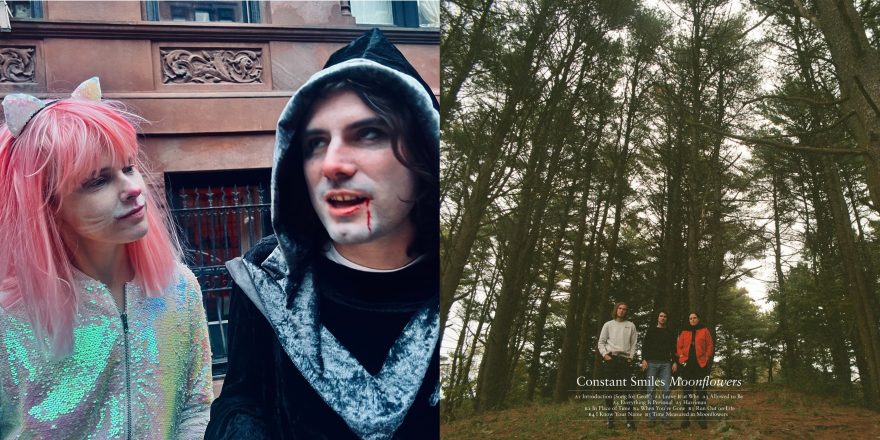
Cassandra Jenkins is a singer-songwriter born and raised in New York City; Ben Jones is fronts the New York-based band Constant Smiles. Cassandra features on the new Constant Smiles record, Moonflowers, so to celebrate, the two got together and listened back to the whole thing.
— Annie Fell, Editor–in-chief, Talkhouse Music
Cassandra Jenkins: So, we’re doing a thing I’ve never done before with Talkhouse, which is, we’re gonna listen to the album while we’re talking. And I actually get to hold this vinyl in my hand — this beautiful clear vinyl, and all of the credits and everything in physical form. There’s a lot to talk about… Tell me about this album cover.
Ben Jones: We shot that a rest stop on tour.
Cassandra: Which tour?
Ben: Northeast? I’m not sure, we were on tour for a while. But I like the cover because we wrote the record on tour, so it feels very fitting. Nora [Knight], Spike [Currier], and I [wrote it] over the course of a few tours. But I also like the cover because Nora’s wearing this red shirt I bought at a thrift store, and this is the last time we ever saw that shirt. I don’t know what happened to it.
Cassandra: Nora’s also got her eyes closed, which normally you don’t want to go for in a professional photo setting, but there’s something that I really love about it. There’s something candid about it. It’s got a quality that I think is in the music too, finding you guys where you are. That kind of sounds like bullshit, but I mean it.
Ben: [Laughs.] I like it too because I feel like — not to get woo-woo on it — I’m a capricorn, so you’ve got the earth sign, with a a fire moon, Nora’s red shirt. And then on the inside, you got the water, because I’m a pisces moon. And then you also have air, so you’ve got all the elements going.
Cassandra: Ooh, I didn’t even notice that the inside, where all the liner notes are, it’s basically a big gray sky. Everything about this whole package is very overcast. Was that intentional?
Ben: Well, actually, the cover on the vinyl was printed a little darker by the plant
Cassandra: No, you’ve got that very blown out, overcast sky. It’s not blue, it’s gray.
Ben: That’s true. I guess that was intentional, yeah. I’m going to say so.
Cassandra: Would you say that if you were to describe this album in the form of a day, would it be an overcast chilly day in the Northeast?
Ben: Definitely a foggy day in the Northeast. Light mist rain.
Cassandra: I feel like we’re talking about kind of superficial things, because there’s a lot of deeper stuff I want to ask you about the album. Can we start with talking about Katharine Cornell and who is she, and why are you so obsessed with her?
Ben: Katharine Cornell was a famous stage actor, and she donated a theater to Martha’s Vineyard. It’s a very special place, it’s got a lot of history, and she’s buried behind it, which is cool.
Cassandra: And for those of us who aren’t familiar with your lore, how did you come to know so much about this place and this person?
Ben: I grew up on Martha’s Vineyard, Spike and I. And the Katharine Cornell is a theater everyone’s played at, I’ve seen a million shows there. It’s also the town hall. The first song, the song I wrote for Spike’s dad who passed away, was recorded live at the Katharine Cornell. But then I’ve planted some lilies — I take care of Katharine Cornell’s grave. She’s a special lady.
Cassandra: Is there any symbolism behind the choice of lilies?
Ben: I think it’s a flower of sympathy that you give at funeral.
Cassandra: Have you ever done that for anyone else?
Ben: I weirdly got obsessed with her. She was just such a part of all of our lives on the island through the theater, and it was always kind of like, “Who is this person?” Because she didn’t do any movies or TV or anything. She was just a stage actor. So I didn’t really know anything about her.
Cassandra: One of the reasons I love observing your process as a songwriter is because it’s so different from mine.
Ben: Yeah, which is something I always appreciated about your process also. You take your time, you’re very methodical. You’re laser-focused. And I kind of make a mess of things.
Cassandra: [Laughs.] When you started saying “laser-focused,” I thought you were going to say “lazy”… I think you just have a veracity to your songwriting. How many albums have you published at this point? What number is this album in your catalog?
Ben: I think it’s 20.
Cassandra: You’ve lost count.
Ben: I’ve lost count.
Cassandra: I mean, 20 is like a nice round number. Maybe this should be front and center, “This is our 20th album.”
Ben: Well, it’s hard to say because there’s a few that are unreleased, too. But I think it’s close to 20.
Cassandra: At some point it would be really fun to hear one song off each album and sequence that.
Ben: You mean like a greatest hits?
Cassandra: You might call it a greatest hits album. [Laughs.]
Ben: I’ve thought about that before. There’s so many, I feel like it’d be a double album or something.
Cassandra: Speaking of greatest hits and sequencing, how did you go about sequencing this record? And is that important to you?
Ben: We spent a bunch of time sequencing it, yeah. Chris Liberato and Mike Mackey, who are in the band but don’t play anything — Mike Mackey will occasionally play live with us, but they’re both just semi-producers who tell me what’s good and what’s bad — they are really good at sequencing.
Cassandra: Do you consider them members of the band?
Ben: Definitely.
Cassandra: How many members of this band are there? We’ve got three people on the cover. This is the core band.
Ben: The core band, yeah, for this record was Nora, Spike, and I. And Adam Lipsky toured with us a bunch, and he plays on the record.
Cassandra: I mean, I’ve always understood Constant Smiles to be a collective.
Ben: Yeah. Mike Mackey’s been in the group for so long. Emma Conley is on this, who was one of the very first members, probably the longest running member of Constant Smiles, since the beginning. We got Cassandra Jenkins on here. We got Eri [King], who wrote some of “Leave It at Why.” Stephen R. Smith… It just keeps building. The world keeps building.
Cassandra: Do you have a number in mind for when you’re like, “OK, we’re at 50 members in this band…”?
Ben: [Laughs.] I think we just keep it going. Because, you know, different records call for different people. I feel like you work similarly, too, where depending on what you’re working on, you’ll have an idea of who can jump in.
Cassandra: It’s true. Co-writing is, like, my absolute favorite thing.
Ben: You did a lot of that on your last record.
Cassandra: Why didn’t you decide to say, “Constant Smiles is my moniker”? Why to you is it important to have it be a collective? What’s the difference between being a solo artist and being a band at its core? There are obvious answers to this question, but for you personally, what draws you to this format and this way of creating?
Ben: Well, I think it goes back to the beginning of, we used to change the band name every show.
Cassandra: Great for marketing.
Ben: It would always be Constant something — Constant Ingrid Bergman, Constant Sickness, Constant Vomit.
Cassandra: I love the tongue-in-cheek nature of that Constant whatever, one night only.
Ben: [Laughs.] But I think the Constant being change, and it being a collective allows it to be whatever it wants to be.
Cassandra: That’s beautiful… Nora has a song on this album — I love that song so much. I’ve listened to it so many times that it’s funny to know that it’s about to come out, because you guys have been playing it live for so long. When Nora joined the band, it kind of seemed like it was a centerpiece for her membership in this band. And from an outsider’s perspective, it felt like a solidifying force behind you collaborating with one another. Is that true?
Ben: Definitely.
Cassandra: We should name the song, also.
Ben: The song is “Harriman.” The first time we met, we wrote a song together. So I think instantly we were bonded in that, and her membership was solidified. She really jumped up head first in.
Cassandra: She also plays drums and sings, which is always such a killer move.
Ben: Such a badass. And such an incredible voice.
Cassandra: And isn’t she a licensed therapist?
Ben: That’s true! She’s doing social work now.
Cassandra: Amazing. That must be handy to have in a band. Good communication skills — essential.
Ben: Exactly. Always so helpful.
Cassandra: Do you want to tell us about the title of the record and why it’s called what it’s called?
Ben: Sure, yeah. We wrote the record on tour and we called it Moonflowers because it’s a night blooming flower and we’re all gardeners. Spike and I did rooftop gardening in the city.
Cassandra: I did, too. We’ve talked about this a little bit. It’s a very grounding job to have when you get back from tour.
Ben: [Laughs.]
Cassandra: That’s not my joke. Michael Azerrad, an incredible music writer, said that without dropping a beat to me when I told him that was my part-time gig…
Ben: But, yeah the title — we wrote this record over the course of two years or so on tour, and It felt like one of those things where you do the subconscious work and you just kind of pick away at something and then all of the sudden you have a record. I think also, I’ve been working on music since I was in high school, I’ve been gardening since high school, I meditate twice a day, and you do all these things and after a long time you realize that you have a bunch of knowledge. It’s always surprising that you’ve been doing something for this long. I feel like with this record, it was something I always wanted to make when I first started playing music. I loved Nick Drake and I always wanted to make a record like that, but I didn’t have the skill or the confidence. But now it feels like it’s like, Oh, wow, I can… I’m not saying it’s on par with the great Nick Drake but —
Cassandra: This song, though, feels very inspired by him. The song that we’re listening to is the one that I get to sing on the record.
Ben: That’s true. And you added so much.
Cassandra: We got to record it in a really beautiful place that we get to go to from time to time, which is the painting studio of Jeanne Staples.
Ben: My mom, yeah.
Cassandra: Aka, the Back Shack.
Ben: She’s a genius painter.
Cassandra: Truly though. In the most formal sense, a master of oil painting, and specifically portrait and landscape. And the study of light, in the Rembrandt sense. It’s unmistakably masterful painting. So when we recorded the lyrics, it was the dead of winter and we were surrounded by paintings and supplies and frames that have been taken apart or were about to be built, and canvas that needs to be stretched.
Ben: Lots of daddy long legs.
Cassandra: One of my favorite spiders. Greatest hits of spiders.
Ben: [Laughs.]
Cassandra: Do you have another favorite spider?
Ben: I like a wolf spider, even though they’re scary. But Joanna Newsom always sings about wolf spiders, so I think that’s cool. Makes me like them.
Cassandra: Their status increased.
Ben: When Joanna Newsom sings about you, your status is through the roof.
Cassandra: Are you ever gonna write about a spider? Has the spider community ever reached out to you about writing a song, because they felt like their popularity has waned?
Ben: That’s a good question. I should check my inbox… We should each write a song about a spider, as an exercise.
Cassandra: So, we just listened to the whole record. How long is it?
Ben: I think it’s my favorite length, around 35 minutes. I think a record has got to be really good to be longer than 35 minutes. For a pop record, I think.
Cassandra: Is this a pop record?
Ben: Yeah, I think. Fred Thomas dubbed it a ambient pop record, which I think is really beautiful. In the kind of Talk Talk sense.
Cassandra: Hell yeah. Love Talk Talk. Talk Talkhouse… I want to just quickly ask about lyrics.
Ben: I’ll say with lyrics, on this record particularly — going back to how we started with how we each worked differently — I work really fast and you are, like I said, much more methodical — you really encouraged me on this to take my time with it. And that’s why I was excited to bring in my old friend Emma Young, from my childhood, who worked at the local record store with me. She was a little older than me, so she was kind of before me.
Cassandra: Were you intimidated by her?
Ben: Oh, she was the coolest. She was a senior when I was a freshman. Everyone thought she was the coolest. And she was, and she still is the coolest. So me and her met every week for a while, and we would just go through the lyrics, because she’s an incredible poet and writer and she really helped me fine-tune things and think about things differently. And I think that came out of your inspiration to take my time and make it as good as I can.
Cassandra: That’s great. I just want to end on “Time Measured in Moonflowers” again, because I think the lyrics are sort of signature. They feel exemplary of what you were just talking about. I also remember being inspired by Miyazaki.
Ben: Yeah, it was inspired by The Wind Rises.
Cassandra: “Couldn’t catch the wind I know, but I never want to let it go,” is the opening line of the song. And the chorus that we sing together is, “Our time has passed now, the wheel can’t wait for it to turn itself, and all of the people that we see in ourselves.” And I like that that leaves a lot for the imagination, but it’s touching on some really beautiful universal themes. One thing I remember talking to you about around the time that you were working on this song was you went off on your own and did some solo traveling.
Ben: Yeah, before our European tour.
Cassandra: I think solo travel is one of my favorite ways to tap into the coincidences that can occur in life that maybe we don’t see or pay attention to when we are in the race of New York City. And something happened while you were out there traveling.
Ben: It was just such a wild coincidence because I was working on this song and I was obsessed with The Wind Rises. I would watch it all the time and play guitar to it. I just couldn’t quite grasp it; I was just really fascinated with it for some reason. My tour started in Italy, and friends of mine were renting kind of an estate above Milan, and when I got there they told me it was owned by this engineer who The Wind Rises was based on. Miyazaki went to the family and interviewed them. It was just such a weird coincidence that they were living in the house of this guy who the movie was about.
Cassandra: And that you were writing about, and you just ended up in the heart of what the film was about really.
Ben: Exactly. And then the other weird coincidence was when we went out for a drive one day, all the shops in the town outside of the estate were in Italian, but there was only one store that wasn’t, and it was called Moonflowers.
Cassandra: Really?
Ben: Yeah. It was like, What? It was so weird.
Cassandra: Wow, yeah. You can’t necessarily explain those things… simulation energy.
Ben: Definitely. It was very Neo sees the cat cross twice. [Laughs.]
Cassandra: What did that experience provide for you in terms of your creative process?
Ben: I remember being like, “What does this mean? The universe is trying to tell me something…” And I remember my friend was like, “I think it’s just telling you you’re on the right path.”
Cassandra: “It’s not that deep” vibes.
Ben: Yeah, or just that, “you’re on the right path,” instead of, “you need to rework the song,” or something like that.
Cassandra: Oh, yeah. I think it’d be easy to assume the opposite — like, “Well, I think I wrote the song.” [Laughs.] I think that’s something, as someone who’s just a sense of being floating around in the world, I like to write about a lot. Sometimes things are imbued with so much meaning that it’s like, well, why even write about this? It’s all there. How do I write about this? I think that’s our dilemma and our challenge, and the thing that makes me keep going.
Ben: That’s beautiful. Well, here’s to that, because I can’t wait for the next record.
Cassandra: I need to go off on some solo travel and end up in some estate somewhere I guess…