

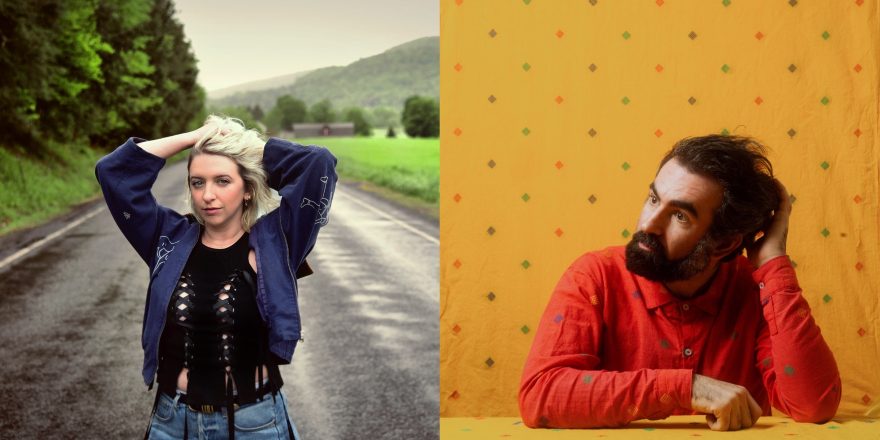

Casey Dienel is a producer, singer, and songwriter known for their genre-defying solo work and earlier releases as White Hinterland. Raised on the New England coast, they’ve released four acclaimed albums marked by bold emotional depth and sonic invention. From their studio in Scituate, MA, Dienel continues to evolve a sound Nylon once called “wild, vicious, poetic, feminine, brash, and singular.” Their latest, My Heart Is an Outlaw, is out now on Jealous Butcher Records.
(Photo Credit: Shervin Lainez)
Adam Schatz is a musician, writer, and record producer who leads the band Landlady and plays live with Japanese Breakfast and Neko Case; Casey Dienel is a singer-songwriter and producer, who formerly released music under the name White Hinterland. Adam produced Casey’s new record, My Heart Is an Outlaw — out now on Jealous Butcher Records — and to celebrate, the two got on a call to catch up about the making of it, and much more.
— Annie Fell, Editor-in-chief, Talkhouse Music
Casey Dienel: Nice CBS Morning.
Adam Schatz: Could you tell I had a back spasm?
Casey: I was thinking of it because I just had one.
Adam: I had one on camera. It started mid first song. And then before the last song, the Nord broke. I got one of the keys stuck — like, it snapped — and they were like, “We need to do it again.” I was like, “Alright, fine.” But it’s fine. No one cares.
Casey: I’m icing, because apparently when you turn 40 your back immediately gives out. You do your Mary Oliver shit where you are like, “A nor’easter is coming, I’m going to spread clover,” and then somehow you pull a muscle.
Adam: Right. You should stop—
Casey: I should stop holding five pound bags of seed, is the thing.
Adam: Well, that was me taking a backpack and a saxophone on the subway to Midtown, when I should have done the adult thing and gotten in an Uber and looked at my phone and had to throw up the whole time. Now I’ve learned a valuable lesson.
Casey: That’s what makes you a professional musician.
Adam: Yeah, being a professional musician is forgetting you’re a professional musician every time you are supposed to do the thing a professional musician would do. And instead, you have a back spasm on TV.
Casey: Well, you sounded really great.
Adam: Thank you. I’m trying a new thing, where when I get a compliment, I don’t respond with a negative.
Casey: I was trying to come up with questions for you, and I was like, How many of these questions I would like the answer to will you answer seriously?
Adam: We’ll find out. I mean, the problem is, I’m so over process talk. I feel like now that we’re in, like, year 15 of podcasts, it’s just like, Cool, now we know everyone has a process. Who cares? That’s what I think.
Casey: Besides just the impact on your own mental health of rehashing it and being like, God, I sound like such a goober. I had a podcast the other day where it was me and a very, very old friend who knows me so well, and we both had on our, like, serious artist caps.
Adam: Right, you’re faking it.
Casey: I felt like such a loser.
Adam: Yeah, and you were. In that moment, you were.
Casey: [Laughs.] And then he called immediately after and was just like, “Sorry about the Red Sox.” And I was like, “That’s really what we should have been talking about!”
Adam: It is what you should have been talking about. I mean, it’s lose-lose. I don’t think I’m right about any of it. Because I’m sick of hearing people talk about what they do, and then I’m also sick of hearing people talk about anything but what they do, because I’m like, Well, now you’re just not doing the thing you’re good at, and it’s going to become most of your life. People are going to forget that, like, Jason Bateman was an actor. That’s his gift. It’s not fucking being with his friends in the public eye in and just printing money. No one’s getting to just do the thing they’re good at anymore.
Casey: No, because you have to create so much content just to do it.
Adam: But for them, I think it’s more just that it’s easier. It’s easier to just be like, “Oh yeah, it’s less work. We’ll just do this thing…” And so everyone’s falling back on secondary skill, which is sort of the skill everyone has.
Casey: This is why we should all just be corgis, because corgis have one skill.
Adam: What is it?
Casey: It’s just being really cute. Give ‘em a bully stick and forget about it.
Adam: I would give anything to be a corgi today.
Casey: I mean, my legs are very short in proportion with the rest of my body.
Adam: You’re saving up for that corgi surgery.
Casey: [Laughs.] My true gender dysmorphia is actually, I’m a dog.
Adam: You’re going to donate your thighs to Habitat for Humanity, and then your shins are just going to go up…
Casey: I’m nothing if not generous.
Adam: OK, well, someone’s going to have to transcribe this, so we should probably start doing real things. But, this is real things.
Casey: I have real things for you.
Adam: Prove it!
Casey: I just moved into the studio two days ago.
Adam: How does it feel? Probably feels amazing.
Casey: It feels amazing. Man, do I need to fill it with shit — it’s still very roomy bouncy.
Adam: You were there the whole step of the way with mine when it came together, and there’s nothing that feels dumber than being like, “Cool, we worked really hard to make this thing exist, and now it just sounds like a parking garage.”
Casey: Yeah. I also feel like you had a similar thing where you went from being like, “Wow, we have so much stuff. How is it possible for one man to have this much stuff?” And then you put it in this big space and you’re like, “Actually, not that much stuff.”
Adam: You need some more stuff, yeah. I don’t actually have that problem — I just didn’t let you see all of the stuff. You didn’t go in the basement that much, and there’s a lot of basement stuff.
Casey: Well, definitely because of Apogee’s planned obsolescence, I need a new DAW. So what should I get?
Adam: This is what you want to talk about?
Casey: [Laughs.]
Adam: You want a new interface? They’re all bad. I honestly couldn’t tell you. I think the one I committed to isn’t necessarily the best one, which is Orion Antelope. I think UAD is sort of an expensive scam.
Casey: They’re all so expensive. I remember when I bought Quartet, like, 10 years ago, I was like, “How am I spending this much money on a box that’s the size of an Ellio pizza slice?”
Adam: Here’s what we should get into: What’s your Sweetwater guy’s name?
Casey: I think it was Jared.
Adam: What do you mean was?
Casey: Well, they switch around. In 15, 20 years I’ve had at least — and they’re all men.
Adam: Yeah, that’s why I said “guy.” OK, so for the one person still reading this, there’s a music equipment website called Sweetwater — based in Indiana, home of the Ku Klux Klan — and that’s where you order all your gear from. Sweetwater, not the KKK. it comes with a little bag of candy every time. It’s not candy you want. You also have a guy who calls you to follow up to see how it’s going, and I’ve had the same guy since high school.
Casey: They give you gobs of candy when you get your order, and it’s always, like, Tootsie Rolls.
Adam: It’s a waste, and it’s silly.
Casey: You’re like, “I’m not going to eat this because I’m not 12.”
Adam: But here’s the thing, too: if you order a $2,000 microphone, you get a little bag of candy. If you order a $5 pack of guitar picks, you get a little bag of candy. It’s the same no matter what. But I’ve had the same guy since high school, Kevin Scott, and he calls me and he sees how I’m doing, and sometimes we catch up. So I think you should take your corporate liaison and ask them to just talk you down, “What’s new on the marketplace?” There’s nothing better than evaluating the marketplace.
Casey: Oh, there’s nothing more soothing.
Adam: Next question. We can’t talk about this. This is too commercial.
Casey: OK, on My Heart Is an Outlaw, what was your favorite song to work on?
Adam: I have a soft spot for the funky one.
Casey: “I’m So Glad You Came.”
Adam: Yeah. I have a soft spot for that one because I think that’s also going to be the most surprising, when people hear you do that speed. But it’s also just one of those songs that it only works if it really works. You can’t fake it after the fact. So it just has gobs and gobs of human majesty all kind of bumping into each other. I think that one’s really fun. Because then production-wise, it’s easy. It just does itself. There’s other ones we kind of built brick-by-brick, and that’s fun in its own way. But the record, I think, is special because it has an even supply of both of those things, where one thing sounds like there was a whole lot of work put into this, and another thing sort of sounds like we played it in our bathrobes and that is what also makes it really good.
Casey: Yeah, somehow we achieved nothing sounding overcooked. And we worked very fast.
Adam: Nothing’s overcooked, and we didn’t leave any songs behind, which I think is also rare. There were some demos that weren’t done and so we didn’t take them with us. But I don’t think there’s anything recorded where then I was like, “Yeah, we didn’t get it this time.”
Casey: No, but we had the one that came in, the straggler.
Adam: Exactly, the opposite happened, where we thought we were done and then you snuck one more in there and we were like, “Fine, it’s as good as anything. Fine, we’ll record it. Fine, we love it. Great.”
Casey: “Oh, damn it! In the last 24 hours, a good one came in under the radar!”
Adam: That one’s “Junkyard Dog.” Some of these songs were years in the making for you. What’s the oldest one? Which one did you write the longest ago?
Casey: That I completed, “People Can Change.” That was the first done-done one.
Adam: When was that?
Casey: That was probably 2020, in lockdown. I was so bored. “Seventeen” started maybe before then, but it wasn’t done until, like, 2023.
Adam: Yeah, that’s the deal. Sometimes this stuff takes forever. So it’s really amazing that within the scope of songs like that, there’s also one that can sneak in at the last second and be the racehorse that you didn’t see coming.
Casey: Yeah. We had a couple that were just completely different than what we [planned]. “Tough Thing” was the one that we had planned to be kind of short and sweet, and then I don’t even know how it became this 11 minute long joint.
Adam: That song is an amazing example, because I think we actually didn’t even have a plan for it. We just knew there was a map for the song, so we were like, “Well, we know this is a song.” That’s usually my rule going in: let’s make sure these songs at least sound like songs so that when we get everyone in the studio, there’s no time wasted being like, “And how do we make this a song?” If you do have to press pause and put your heads together, it’s usually arrangement stuff. So that’s what we did as a band in the space. But with “Tough Thing,” we had it charted out and then we just started jamming, and you sang as we were jamming, and that was it. A lot of times, you try to manufacture that type of thing and it doesn’t work. So there was something really novel about it just coming out that way. And then we can pile on to it later on, and it sounds like it’s 19 people in a room, which is my favorite sort of trick.
Casey: I think the chemistry of having a good mix of, everyone kind of socially knows each other but it wasn’t a band where you’ve all played together for years so it’s a little bit nervy, works for some of those surprises. Because you’re like, What’s he going to do? What’s Max [Jaffe] going to do?
Adam: Some of those folks I’ve known forever—
Casey: You’ve played with them longer, but I hadn’t played with anyone.
Adam: Right, which is fun. But then also, if you take a few years apart, everyone is different. You have the faith that everyone has the right intuition, which is what’s required to be doing things on the fly in the studio rather than making sure everything’s sort of micro-directed. But there’s still always going to be surprises, because everyone is growing and changing at their own pace in life. That’s one of the only good things about being dragged in different directions and not getting to see the people you love all the time, is that when you reconnect with each other, you’re full of little surprises and wisdoms.
Casey: With your record, because you produced it, is it harder when you’re doing it for yourself?
Adam: I usually put enough on my own plate that I’m not thinking about it. It is important for me that the band can feel as band-y as possible, but for the last record, it was three people who had never played together in that configuration before, and everything else you hear was added after the fact. It still sounds like a bunch of people together, but it was actually started off as a trio. So it’s more just creating the healthiest environment for the most success. And the success can’t be blueprinted out as much as just, what are all the qualities I want in a space and in personalities, and how prepared everyone can be in knowing the music so that then when we press go, the likelihood of fun and interesting things happening will be higher. And that is how that record started. There’s been previous ones where we rehearse for a week, and then everyone feels really dialed in and knows exactly what their parts were going to be. This go around, we didn’t have that luxury, so it was two days of rehearsal, and then you get three takes maximum. Because we did 13 songs in one day.
But it’s just different every time, which is the best part. But I think it definitely goes top down, so I know I need to be the one to say, “OK, that one felt really good,” or give dynamic direction. Speed of song is always the trickiest thing because so often you get home after a day of recording and you realize the thing was too fast or too slow. So I think if you are producing and playing, it really is about being able to flip the switches of, “OK, now I’m the guy who’s present and in the group and making music with people,” and then flip the switch again and now I’m 20 feet in the air looking down and trying to see big picture stuff and not get caught up in micro things. Younger versions of me could definitely get thrown off by, “Oh, that one note was flat, or that one thing wasn’t quite what I wanted wanted it to be.” There’s a song that I reference all the time, which is an Eddie Kendricks song called “Girl You Need a Change of Mind,” and it’s the best song. The song is almost eight minutes. And the very first snare hit in that song is late. He was zoning out, or who knows? It’s not done to be cool. It. You would never notice it unless it got pointed out, because the song just cruises ahead. But once I heard that, it was such a good lesson of, if you yelled, “Cut!” Because that one dude played a snare hit, you miss out on an eight minute masterpiece. So sometimes you just have to be like, It’s not all about you. And that could be you the producer, you the artist, you the drummer who did the snare hit and wants another shot because of ego, or because of you thinking you know what it’s all about from your point of view. But you’re sort of always servicing another point of view that you’ll never fully understand, because it’s the listener, and they’re going to hear things differently. All you can hope is you’re making something you want to hear. But the you is not you who knows you are singing it; it’s this other version of you. The trick is having all these different hats and knowing how to take them on and off without anyone knowing that’s what you’re doing — including yourself. Kind of.
Casey: It sounds so weird to say on, like, the sixth or seventh album, to have a beginner’s mindset where you kind of treat it like it’s your first thing — but I think this was the first time where I actually got to show up as the band leader the way that I ideally would all the time.
Adam: Totally, because it requires both a confidence and a willingness to not care too much.
Casey: Yeah. And also just an understanding of where your ego is put to good use. I think I’m really good at being decisive in the moment when I need to be. But then to understand, nobody really needs me to know all the answers to everything. The questions that come up are the questions that I need to answer. I think I always felt pressure to know everything about every mic or everything about mixing, and you just can’t. And that’s not really what being the name on the masthead is actually about.
Adam: Yeah. And the same went for my record. I worked with Jonathan Rado on the tracking of it, and we just didn’t have time to try out a bunch of mics. And it’s also just, who cares? I think early on when you get into the process of it, you think that’s the point, because you begin to learn more about the Beatles or anyone who was in charge of their own recording designs at a certain point—
Casey: I mean, I didn’t know if we had a record probably until the second session. But it was like, “This is just fun. It’s fun to record.” But I had no, “This is gonna be this thing…” I think I went in like, “Yeah, it’d be great if we get six songs and we feel good.”
Adam: I think we went into the first one being ready to get three. And then when we came out with five or six, it was like, “Oh, OK. Well, good.” That is the healthy way to approach it. I think it’s fun to know how everything works and it’s fun to be in control of that stuff. It can be just as liberating to trust someone else else with it and know that later down the line, there’s plenty of things you can do to affect change. It’s not like you’re letting someone else steer the ship. It’s just letting people do their job and be good at their job. Which is the same with, I’m wearing the producer hat but Rob [Shelton] is engineering. He made most of those decisions. I would give feedback on something if I didn’t think it was quite right. But for the most part, me being able to say, “Hey, let’s work at Altamira with Rob,” is because I knew I could trust the sounds he would get, and that’s one less thing I had to worry about. And then in post-production and pre-mix stuff that we were doing, I can always make things sound crazier or different or shape how we want. But you just want it to have intention from note one.
Casey: I think having the the luxury — I don’t think I’ve always had the financial ability to do it this way, but — to work backwards… I think the thing we did that was really smart was just thinking through, “OK, we need this kind of room sound for these songs based on what we’ve got. We need this kind of player for these things,” and then rounding it as we went, rather than taking on too much right off the top. Because I’ve done it the other way, where you’re like, “I want a song with horns on it,” and like, you don’t know yet.
Adam: Totally. The song is the song. And if you believe the song is a song, by the time you’re in there, then the hard part is kind of done. Which is why I think it felt easy the whole time — which is amazing.
When does the record come out?
Casey: The record comes out on October 17.
Adam: OK. When did your last album come out?
Casey: May 16, I think, of 2017.
Adam: So, how are you feeling seasonally? Do you think this is a better time to release everything into the world?
Casey: Well, this is definitely a sweater weather record. And there’s a lot of references to seasonal appropriate situations.
Adam: Seasonal appropriation. Maybe that should be the genre.
Casey: [Laughs.] It’s definitely better than the one that we’ve been going with, “alt-pop.” What is that?
Adam: I don’t know. I think I got one of those out of the ice cream truck once… I think “seasonal appropriation” is a really good name for what you do. I think we should lean into it.
We have one minute and 48 seconds left.
Casey: Yeah, before my free Zoom kicks us off.
Adam: Any last words? I had fun.
Casey: I had fun! Well, what are we going to make next?
Adam: If there’s any advice for anyone making a thing, it’s once you finish the thing, put it out as fast as possible and make the next thing. Because otherwise, you’re going to look back and be like, “Those are years I’ll never get back spent just fucking wanting to make a thing happen that couldn’t happen quite in the right way I thought.” As opposed to being in charge of your own magic wand and just making the thing happen.
(Photo Credit: left, Shervin Lainez)