

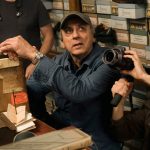
Darius Khondji is a Paris-based cinematographer renowned for his distinct visual style and his collaborations with some of the world’s most acclaimed filmmakers. His work has earned two Academy Award nominations, three César Award nominations, and a BAFTA nomination, and his credits include Delicatessen and The City of Lost Children for Marc Caro and Jean-Pierre Jeunet, Se7en for David Fincher, The Ninth Gate for Roman Polanski, The Immigrant and The Lost City of Z for James Gray, Midnight in Paris and Magic in the Moonlight for Woody Allen, Amour for Michael Haneke (which won the Academy Award for Best Foreign Language Film), Zidane: A First 21st Century Portrait, a documentary film for Douglas Gordon and Philippe Parreno, and Evita for Alan Parker, which earned him his first Oscar nomination. Khondji has worked on some of the most celebrated films of the past decade, shooting Uncut Gems and Marty Supreme for Josh Safdie, Okja and Mickey 17 for Bong Joon Ho, and Eddington for Ari Aster. His work on Alejandro González Iñárritu’s Bardo: False Chronicle of a Handful of Truths earned him an Oscar nomination, an ASC nomination, and a Silver Frog award at Camerimage. (Photo courtesy A24.)
I like to see a lot of movies and I watched very varied things in 2025. I watch a lot of really old classical movies, like the work of Carl Theodor Dreyer, and this year I discovered a documentary by Werner Herzog called Fata Morgana that I liked very much. It’s a very interesting conceptual art piece that I don’t think many people have seen. I also went to see the Wolfgang Tillmanns exhibit at the Pompidou Centre. It was in the last days of the museum building at Beaubourg, because it is going to be closed now for five years.
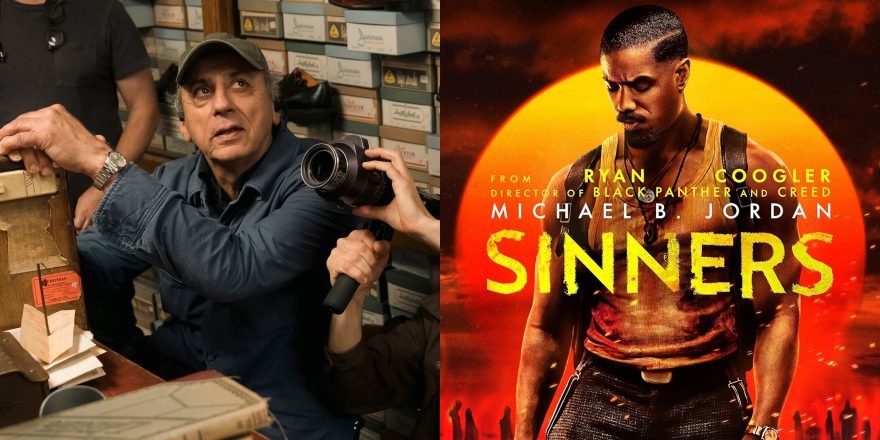
I don’t necessarily see all the latest movies or know all the current directors, but this year I saw Sinners. I’d never seen a film previously by the director, Ryan Coogler, but I found it very exciting to watch and really fun. I also loved Paul Thomas Anderson’s One Battle After Another, which I think is great filmmaking. All these movies, like our film Marty Supreme – which I can now see with a bit of distance, because I have watched it with an audience – belong to a new era of cinema. I think filmmaking in general is really great at the moment. There’s a new wave of filmmakers that are just very exciting, like Josh Safdie and Ari Aster (whose 2025 movies Marty Supreme and Eddington I shot), and also the Brazilian director Kleber Mendonça Filho and Albert Serra, whose new film Afternoons of Solitude, I really loved.
I’m a real cinephile and my passion is for cinema, so I basically spend a lot of time seeing films. The rest of the time I spend going to art exhibitions. I’m often in New York, because my daughter and her husband live here, and I spend all my free time here going to the Museum of Modern Art, the Whitney and the Guggenheim.
I’m always absorbing images, whether it’s consciously or unconsciously. Sometimes, in a period of time before I’m shooting a movie, it’s very conscious, like when I’m in an art gallery, looking at a classical painting. I’ll just get caught by one particular painting – something by Caravaggio or Rembrandt or another painter that I really like – and I will stare at it for a long time. But in the moment, it’s more like energizing myself and having a different visual experience. Most of the time, taking in images is an unconscious thing, like if I’m looking at the work of an amazing Japanese photographer or buying art books at the Strand bookstore. The casting director on Marty Supreme, my friend Jennifer Venditti, gave me the absolutely stunning book she made called Can I Ask You a Question? Looking at her incredible book was like being at an art exhibition, having an emotional discovery, and I am constantly looking for that kind of experience in between films. Sometimes I could find it in a random place that I happen to be going, like in a bar or an alley, when suddenly I’ll have an epiphany where I realize, “Wow, this is amazing!”
In those moments, I’m unconsciously capturing what I’m experiencing, and I remember those better than things that I have to remember. Sometimes I don’t remember people or things, but I remember visual moments and ambiance, and something like music can sometimes make a moment become visual. At a recent Q&A for Marty Supreme, my friend Daniel Lopatin, who composed the score for the film, was talking about how music becomes the continuation of certain images, and how those images fuse together with the music. The music creates new images and creates depth in the existing images. It’s so exciting for me to see this happen. And as I was listening to Dan, I realized how much the music creates an unconscious emotional reaction in the audience members watching the movie, and makes the scene and the actors even better.