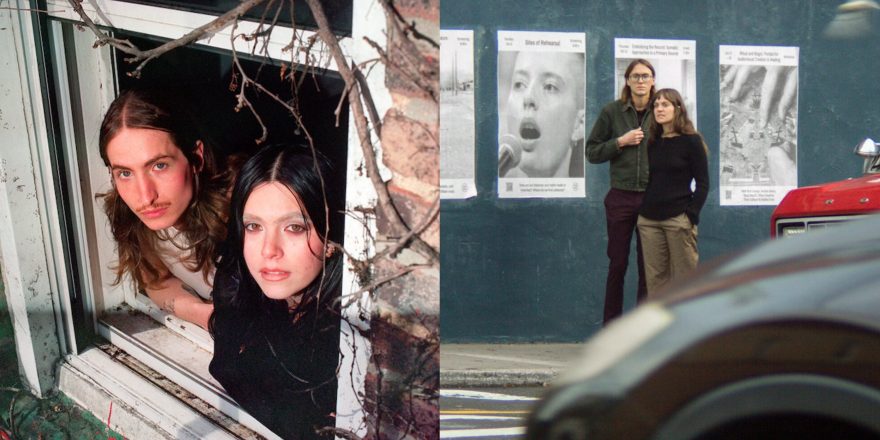




Asher White is a multi-instrumentalist and producer based in Brooklyn. Her latest record, 8 Tips for Full Catastrophe Living, is out now on Joyful Noise.
Stone Filipczak is one-half of the Baltimore-based folk pop duo @, and performs solo as E.R. Visit; Asher White is a multi-instrumentalist and producer based in Brooklyn. Both had new records out this year — E.R. Visit’s my children will ignore you, my children will type amen and Asher’s 8 Tips for Full Catastrophe Living — and to celebrate, the two got on the line to catch up about it all.
— Annie Fell, Editor-in-chief, Talkhouse Music
Stone Filipczak: I first got introduced to your music through your interview with Andy Cush.
Asher White: Oh, yeah.
Stone: The first thing that really popped out to me was how you clearly have this noise background — I also think maybe I saw you on the bill opening for Lightning Bolt — but then at the end of that interview, you talk about wanting to make more legible music. You specifically mentioned wanting to be able to play a track for your grandparents and have them be able to get something out of it. That really jumped out to me, because I actually said something extremely similar in an early @ interview. I had kind of a similar arc of doing a lot of noise stuff, and then making this pivot into more tuneful songwriting structure. And I specifically was psyched on the idea that I could play some of this music for my grandma and that she would get something out of it or be able to understand it. So the fact that you were saying almost that exact same thing in this interview, I was just like, Woah, who is this person? And I guess that leads me to the question: have you played your music for your grandparents?
Asher: I have recently begun playing my music for my grandparents, because I recently feel that it’s reached a level that would be inoffensive to them. Also, I only actually have one grandparent left at this point, my grandmother on my dad’s side. But I think the reason why I feel the compulsion is because I’m very lucky to have grandparents who support unconditionally, energetically the work that I’m doing. They are just nice people who are proud to see their granddaughter putting herself out there. I felt sort of awkward that they were being so sweet about my debauched and tuneless noise improvisations. I was like, They’re really putting all their love into this little rascal who’s returning 12-minute feedback songs into their hands. They must feel swindled in some way. [Laughs.] I would like for them to hear music that reminds them of their golden years, perhaps their own 20s. I think in maybe 2017 or 2018 is when I started making music that my parents felt was safe to regularly be forwarding to their parents, and the reception was really positive, which was really great.
I wonder how many artists in some way or another ultimately come around to trying to make work that is aimed at the hearts of their grandparents? I wonder if that is a subconscious drive that we all have, that you have to kind of resist at the start and play at your difficult angsty music, and then eventually you succumb to wanting to jam out with G-Ma.
Stone: I think if you zoom way, way, way out, there’s the theory that any type of art is an attempt at immortality and at outliving yourself. That kind of gets to the concept of timelessness, and if you’re able to make really lasting art, it should be able to speak to anyone in any time, I guess.
Asher: Yeah. For a while, I was making work with a lot of asterisks attached to it, or a lot of prefacing. If I was playing it for my grandparents, I’d have to be like, “OK, so you have to understand, there’s this movement in the ‘70s, and in the early 2000s, there was a whole indie rock boom…” And that felt really bad. I suppose a good metric for your art being meaningful is that it’s instantly resonant and there’s no context needed. I detect some religious upbringing, or at least some sort of fascination or compulsion, in a lot of your lyrics; I think at its most optimistic, that’s also a major appeal of religion, that in reciting prayers, you’re accessing something that ostensibly your great-great-great-grandparents accessed, and that your great-great-great-grandchildren will access. You’re going straight into the main vein.
Stone: Yeah, I’ve thought about that specifically with the Lord’s Prayer, like the “Our Father…” I grew up Catholic and the Lord’s Prayer is something that ostensibly has been in use for over a thousand years. It’s like it’s connecting me to this whole lineage of generations as far back as my blood really goes, of people who have been thinking about the exact same concepts around trespass and stuff like that.
Asher: Yeah. The only other analogue to that is, like, national anthems. People creating the nation optimistically are hoping that it lasts for a long time, but you’re trying to write a tune that will stir everyone who ever lives there, or has lived there, or has felt it belonging to them, which is a sort of psychotic undertaking… But, yeah, so I started writing national anthems for my grandparents.
Stone: [Laughs.] That’d be sick if you made a country album. I feel like that would sound awesome.
Asher: I mean, likewise. You totally have the voice, and also I feel like you have the true American spirit for it.
Stone: I don’t know about that, but I appreciate it. I just googled how old the Lord’s Prayer was, because I actually didn’t know, and apparently the lore is that Jesus taught it to his disciples. So they’re really saying that one came right from the [source].
Asher: But the translation, I wonder when…
Stone: Well, right. When you get the translations involved, it’s a little bit different. But even that is kind of interesting. Like in my grandma’s generation — her background is Croatian, she lives in an all Croatian community in Pittsburgh, full of people who speak Croatian, and the hub of their immigrant community was their Catholic church. And so when they were all getting together and saying prayers together in their native tongue of Serbo-Croatian, it was quite literally tying them to their ancestors and their homeland in a way that was outside of their experience of living as an immigrant in America.
Asher: Have you heard the Serbo-Croatian [version]? Does it bear resemblance to the English translation? I feel like the Lord’s Prayer in English has such a specific cadence.
Stone: Yeah, totally.
Asher: They really did a good job, I think, translating it.
Stone: I agree. I love the language of it. I do actually think about it pretty often. I’m not actively Christian or religious, but I was steeped in this stuff growing up, so it does occupy my brain quite a bit. And there are times when I think of the language in there, specifically thinking about the lines around trespass — “forgive us our trespasses as we forgive those who trespass against us.”
Asher: Yeah, that goes crazy.
Stone: It’s just about boundaries, you know what I mean? We have so much modern discourse around boundaries, but not a lot of practical advice around it. And here we kind of reframe it as “trespass,” which is such an evocative, beautiful word, very loaded. And then we say, just in the same way that we will always trespass against others, we must also forgive others who trespass against us.
Asher: It’s sort of a transgressive thing in today’s Catholicism, perhaps, as an idea. It’s a sort of nondualist thing. We’re all energetic forces trespassing across each other.
Stone: For sure. That’s a great way to put it.
Asher: This is going to be easy to take out of context and ruin my career — [laughs] — but I’m always very impressed at the collaboration between the English language and Christianity. I’m Jewish, and it’s very exotic to me. A lot of Christian vocabulary and Christian symbology and Anglo-Christian imagery is very exotic and sort of tantalizing to me — though I recognize it’s also a source of trauma for, I don’t know, most of the world, including the people who were raised in the church. But I’ve always been fascinated by it, because the development of the conquerors’ Imperial English, it’s completely inextricable from Christianity. It’s really very exquisite. And it’s also a language of sort of unspeakable violence. But religious potency doesn’t really exist in English in any other religion. Like, whenever you talk to people studying the Torah or the Quran — like Sufi poetry, kind of across the board they’re like, “It really doesn’t work in English. You don’t get it. It loses a lot of its luster.” A lot of the God of it is lost in translating to English, because it just has nothing to do with English. It was developed and written about and edited and revised in so many other languages. And so by the time it gets to English, it’s so watered down.
So it’s sort of sad that — and this is the plight of the monolingual American that I’m bemoaning — in terms of my language capacities, the only real God that I can talk about is the Christian God. I think about this a lot. The only real religious experience I can describe is the one that is sort of Christian. I would have to learn Yiddish or Hebrew to talk about the actual Jewish one that I would have been raised in.
Stone: That’s completely fascinating. Have you heard the theory that the line in Genesis, “In the beginning there was the word, and the word was God,” literally refers to language as an invention? In the beginning, the concept of God was formed by people literally uttering the first word back and forth to each other and experiencing, I guess what in Christianity is, “God is love.” Like, the whole concept of God is wrapped up in the concept of love. And so there’s a theory that God was born along with the first word, and that it’s all tied to the technology of language. You know what I’m trying to say?
Asher: Yes. Well, beyond language, I know what you’re trying to say. I feel it in the corners of my of myself. I mean, those opening lines, there are annotations and interpretations in the Zohar, which is a foundational book of esoteric Jewish thinking of Kabbalah. They really home in and spend a really, really long time on that initial moment. Because what is communing with what, or what is recognizing what? What’s going on here, is what they’re saying.
There’s this idea of the Ein Sof, which is the totality of the universe in all directions, in all timelines, before language and before anything is defined. And then from the Ein Sof, God retracts. And in that retraction — because the retraction is created by God, it is also God — that is the catalyzing incident that then defines all stuff. So it’s almost that that would be the Jewish birth of language, but it’s the absence, it’s the retraction. God shuts for a moment, and that is what defines language.
Stone: Wow.
Asher: Which is why you have people like Larry David. That’s a total key to Jewish mythology. [Laughs.] So what is your relationship to religion? When you’re naming these things, are you pulling from lessons of yore deep encoded into you, or did you have your own autonomous relationship with it?
Stone: I mean, I kind of just had Catholicism Lite. By the time we got to my generation, my parents weren’t very religious. It was more of a tradition than it was a genuine spiritual practice. I actually even went to Catholic school for a small amount of time, but I was never forced to get confirmed, which happens in Catholicism around age 12. I kind of just stopped getting made to go by the time I was a teenager. It had just sort of phased out, its cultural usefulness was no longer evident in the context I was living in the same way that it was evident in my grandma’s neighborhood in Pittsburgh.
I’m interested in this stuff because, for better or for worse, it’s the religion that’s held to you by the majority of the world, and certainly the majority of our country. I think it’s good stuff to think about and try to get your mind around and see what part of it can be useful both to yourself as an individual in your own life, but also on a larger social scale. I think there could be a lot of interesting stuff done politically if people started getting comfortable with employing all sorts of religious terminology, but specifically Christian terminology, in this country and using it for “good,” for lack of a better word. Challenging people to live up to it.
Asher: My drummer Martin is the child of two Catholic Workers, so I’ve learned a really cursory understanding about the Catholic Worker vibe, which is that it’s awesome.
Stone: It’s awesome, but it’s niche. Unfortunately, mainstream Catholicism right now is, like, JD Vance and all these weird motherfuckers who convert to Catholicism in order to cosplay this very conservative, traditional type of lifestyle. And that’s all bullshit. I think it’s actually important for people who have Catholic backgrounds and don’t like that stuff to make fun of those people and call them out as being posers.
Asher: That’s the most crucial thing, I think. I was raised in a moderately anti-Zionist synagogue, which was awesome, and then over the past few years, have become much more stringently and passionately [so]. It does feel like the dominant Judaism right now is causing horrifying genocide and suffering, so it feels actually really imperative for the other strains of Jewish thought and Jewish activism to be vocally and unabashedly and violently opposed to this horrifying perversion of the whole thing.
Stone: Absolutely.
Asher: It’s forever both on the margins of being cool, religious fascination, because it’s also always sort of a death trap and can go awry. I suppose when you’re holding a very powerful thing in your hand, it’s dangerous.
Stone: Yeah, you can burn yourself with it. I mean, I think it’s understandable because a lot of people are traumatized by these religions. I certainly have friends who grew up Catholic and do not want to talk about it in this way, because it’s too painful for them. And I respect that.
Asher: Tell me about the literary — I’m setting you up to do a really masturbatory, I’m-a-smart-guy answer.
Stone: Oh, god.
Asher: So don’t fuck it up. Tell me about the literary underpinnings of this album that you’ve just put out, that include obviously some Old Testament stuff, some New Testament stuff, some Wendell Berry, some Catholic criticism. It seems like some some contemporary religious thought and then also some real ancient convictions.
Stone: Wow. Wait, so what’s the question?
Asher: I don’t know. [Laughs.] OK, in terms of naming and pulling from the canon of Christianity and Catholicism, you’ve made an album that is obviously immediately very emotional and resonant on a heart level and a body level. And then you look at the lyrics and there’s some Wendell Berry references in there.
Stone: Yes.
Asher: It’s a very literate group of songs, I think. There’s a lot of ideas going on. What were you intaking at that time that you found yourself working into your songs, whether intentionally or unintentionally?
Stone: Well, thank you so much. I mean, that really indicates that you’ve spent time with the record and I appreciate it… I do really quickly want to say one more thing about Christianity, which is that there’s actually a really fascinating and well-documented history of Christian socialism in this country that I think we need to embrace and use for good. You brought up the Catholic Workers, and one person I want to bring up is Eugene Debs, who was the Socialist Party of America candidate for president I think five times — including one time he ran from a jail cell because he was imprisoned for being a socialist. He was basically Bernie Sanders’s idol. I think Bernie made a documentary about him. And he has this fantastic quote that I think about all the time, which I think could be really useful in the modern day for explaining socialism and socialist goals. And the quote is, “What is socialism? Merely Christianity in action.” And I love that. I think about it all the time.
Asher: Yeah, that’s a real a real mic drop.
Stone: That’s the type of shit I want to go up to fucking JD Vance and any other pretend Catholic and just be like, “Hey, what are you doing to be like Christ?”
Asher: Yeah, “Write down the virtues that you’re interested in. List for me the things that you subscribe to, and then tell me if that aligns with what you’re doing.” There’s a book, The Romance of American Communism by Vivian Gornick, that’s also in defense of American and Christian socialism or left-wing movements in this broken land. It’s basically an oral history of her traveling around America and talking to different unions and laborers and who are involved in their various local communist chapters, and you get a sense of how actually inevitable and effortlessly American Christians can pledge themselves to the project of socialism or of communism in this case. You understand on a really molecular level, and also just a very unpretentious, unadorned way, Oh, this is actually the easiest practice for most of the working people in America. It’s mostly what they believe in, and it is actually right in front of us and has been this whole time.
Stone: Totally. That’s what I love about the historical socialist movements in America. This stuff really has been around for a while. We just got propagandized to believe it wasn’t there. I do want to pivot to music—
Asher: We should make another national anthem.
Stone: Yeah, that’s a great idea.
Asher: There’s that line in Angels in America where they’re like, “The guy who wrote the national anthem made the word ‘free’ so high that no one could reach it.” Because it is the highest note in the song… That’s also a really good stoned mic drop moment for Tony Kushner. It is one of those things where you’re like, That’s a really good medium-message collab.
Stone: Yeah, totally. And pretty much that song is a soloist song, right? Like, we never really sing that all together, do we?
Asher: Yeah, it doesn’t really work when people do that. It’s also sort of a dirge. I mean, I love the American national anthem. I’ll come out and say it, I don’t care. It’s a great song and I sing it to myself morning and night. [Laughs.] But we didn’t do the thing that a lot of Eastern European, Balkan countries did, where they made it like a war cry. Some national anthems are like, “Get up on your feet and and go fucking buck wild,” and we did ours to be magisterial, like you can kind of only sit in an arena with your head in your hands listening to Beyonce destroy it. It’s interesting that we didn’t go the celebratory route.
Stone: Yeah, I wonder what influenced that… I bet America was influenced by France, because I’m pretty sure France would have been the first country with a national anthem right after the revolution. I think that whole situation was very instrumental in the development of the concept of countries and nations, and needing an anthem for your nation. But it’s hard to say.
Asher: You can really only hope that your nation forms late enough in human history that you can use Auto-Tune. Like, GarageBand was invented not that long ago, so now if you get to make a nation, you can put a MIDI synth in there. That would be cool. It’s like making flags, too: All the really old countries that made flags hundreds of years ago, they’re not that great. And then the ones within the past 100 years or so are so awesome.
Stone: I do have to step in for my home state of Maryland, though, and say we have the best flag.
Asher: It looks like F1 racing. I’ve actually always resented this, because I see it and I’m like, Oh, that’s a race car. These guys are going to be speeding around. And the Maryland cars that I see are always a busted white sedan, like a weird VW Jetta.
Stone: Totally, with the balls on the back.
Asher: Yeah. It’s cool though.
Stone: I think we should rewrite the national anthem.
Asher: I think we could double the length. I think it’s a little too brief. First of all, there needs to be a hoedown, and a breakdown. Did you ever go through a metalcore phase?
Stone: Absolutely. I know exactly what you mean by breakdown.
Asher: That also I think is in the national spirit, and it would be super cathartic. The fact that there’s not a breakdown in the national anthem is why you have arenas resorting to “We Will Rock You,” which is not even an American song. We’re outsourcing because we don’t have a breakdown, we’re stomping and clapping to Queen. It’s not good.
Stone: That makes me want to make a stomp-clap reference. But I feel you, and I completely agree with you.
Asher: Have you ever erred towards stomp-clap?
Stone: Oh, yes. I think @ is blatantly stomp-clap adjacent. There’s no way that we’re not at least in the same neighborhood as stomp-clap.
Asher: Yeah, I guess you’re down the block.
Stone: That’s something I’ve had to kind of embrace over the years. Some people don’t like @’s genre. Some people don’t like indie folk or anything twee, and that’s fine. It’s not for them.
Asher: Yeah. It’s funny, I think twee, we’ve kind of diluted that word. It’s lost its meaning. And I think it’s an important descriptor for some things that are actually twee. @ is, I think, not twee at all.
Stone: Really? Interesting. I guess I’m just betraying my own self-judgements, or even my fears… I don’t think it’s full blown twee, but I do think it’s twee adjacent in the same way it’s stomp-clap adjacent.
Asher: What’s the twee-est thing that you could weep to?
Stone: Honestly, in a lasting way… probably Bright Eyes. Do you think Bright Eyes is twee?
Asher: Totally. I do think Bright Eyes is twee.
Stone: I don’t listen to Bright Eyes actively, but I think if I listen to it passively, I would still really like what I hear. I think those are good, well-written songs, although the aesthetics of it might play into some of the cringe stereotypes of twee.
Asher: Well, he’s just an open wound, right? I missed the window of Bright Eyes in my youth. I forgot to listen to it when I was between 13 and 17. So then when I came back to it — just from an anthropological standpoint, I was like, I have to know about Bright Eyes — I couldn’t get past the opening monologue on I’m Wide Awake, It’s Morning, where he’s, like, drinking the coffee like, “There’s this girl and she’s on a plane…” It’s actually too twee for me.
Stone: Yeah, for sure… I do want to ask some basic questions. Something you said made me think about something you said in your interview with Andy Cush. You were talking about your most recent album, which I love, I’ve listened to it so much. But you were saying that you almost kind of regret not going in for a more conventional structure in some of the music. Do you still stand by that?
Asher: Well, now I’ve made an album that does do that, so I feel like I can sleep about it. This is my first press cycle, which is a kind of embarrassing thing to even have.
Stone: [Laughs.] I know exactly what you mean.
Asher: I mean, it’s also a huge privilege and honor and everything, but it’s also a sort of ugly thing to have to recognize that you consented to — and actually not even just consented to, but specifically sought out. But it was more that I felt guilty promoting this album on a press cycle, because I was like, “This is an album that I stand by the artistic vision of, but I think is sort of insular or navel gazing and specific to the formal ideas that I had at the time.” I’m not really playing ball with anyone. I don’t really feel like I’m in conversation with a lot of other music. I mean that in a derogatory way; I wish that it had been a more open-armed and open-hearted record. Or rather, I don’t wish that it had been that more that record, but rather that I would be promoting and asking people to listen to a record that was more open-hearted. So I was feeling remorse at this sort of closed off and insular record being the one that I’m forcing down people’s throats.
Stone: OK, that makes a lot of sense… Well, I really enjoyed this. I like talking to you, I like having conversations about music.
Asher: This is best case scenario.
Stone: Right, this is so chill because we’re both artists and we’re just talking about art.
Asher: And also we’re talking about nationalism.
Stone: Yeah, we got some good concepts in. I wish we had started the recording earlier, because we had some zingers up there too.
Asher: I’ll go and edit in a bunch of zingers.
Stone: Let’s officially end the recording and stay on the call. Is that cool?
Asher: Yeah.
Stone: Alright. Goodbye, Talkhouse!