


Talkhouse Contributing Writer Marissa Paternoster is the singer and guitar player in Screaming Females. You can follow them on Twitter here.
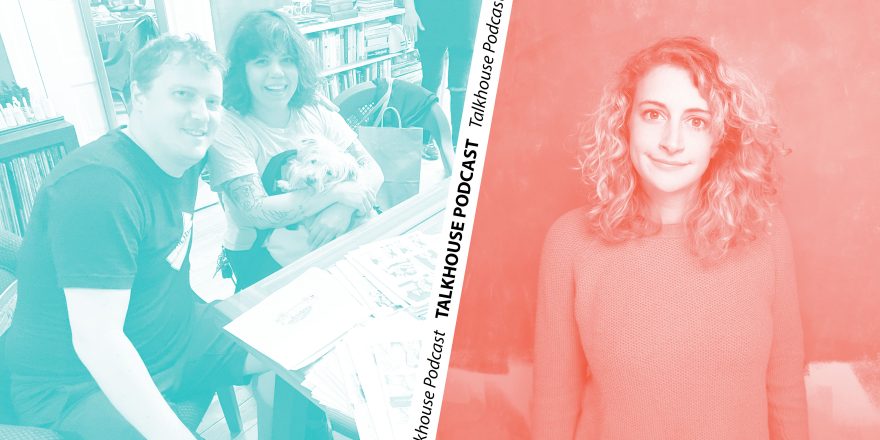
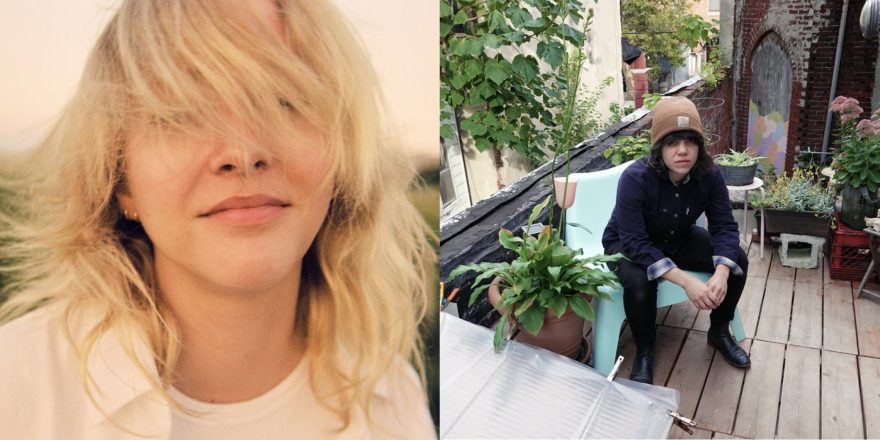
Ailbhe Reddy is a Dublin-born, London-based singer-songwriter; Marissa Paternoster is a musician and visual artist who’s fronted Screaming Females and currently plays as NOUN with Phillip Price. Ailbhe’s new record, Kiss Big, was released at the end of January, and this spring she’ll be touring the East Coast with NOUN. To celebrate, she and Marissa got on the phone to catch up about it all.
— Annie Fell, Editor-in-chief, Talkhouse Music
Ailbhe Reddy: I was looking at loads of your visual art work.
Marissa Paternoster: Oh, no. You must be bummed out now.
Ailbhe: [Laughs.] No, I love it… Looking at your art, I was struck by how you’re doing illustrations on top of everything else. How did you end up doing that?
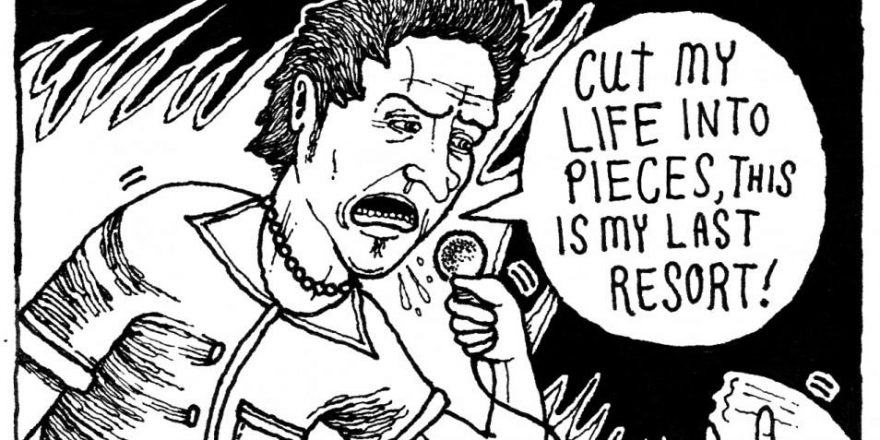
Marissa: I’ve kind of stopped indulging in trying to be a multidisciplinary artist in my older age, or whatever. I really don’t paint very much anymore. I don’t do much beyond illustrating. It’s always been my favorite way to make art. I grew up watching cartoons and reading comic books — I had a very vigilant and wonderful father, but I was also very much raised by the television set. [Laughs.] So I watched a fuck ton of cartoons, and cartoons happened to be really cool in the late ‘90s, like Ren and Stimpy. I was really obsessed with that show in particular, and the way the drawings looked and the grotesque stuff, the body horror stuff. I don’t know why it spoke to me, but it really did.
Then when I was in my early 20s, I started getting into graphic novels. A touchstone artist for me, even though I don’t really draw much like her at all, is Alison Bechdel — who is probably one of the most famous graphic novelists of our time. Dykes to Watch Out For was really a formative comic strip for me, just the representation of lesbians and queer people, trans people, people of color. I think Alison Bechdel was way ahead of her time in making really believable, tangible, palpable stories about these people. And growing up in suburban New Jersey, I didn’t really have access to groups of people like that. I didn’t get to be around them much until, I guess, my later years in college. So it seemed like a fantasy world. And I really wanted to make my own little fantasy world, so I just drew a lot. I was also an only child, so I had no friends.
Ailbhe: [Laughs.] I’m the youngest of four, so I just had a lot older friends.
Marissa: I gotta tell you, it’s pretty cool because everyone pays attention to you because you’re the only one. But it’s a very lonely way to grow up. The good news is that I always wanted to be alone, so it kind of worked out for me. [Laughs.]
Ailbhe: Yeah, I’m the youngest, but significantly. My older sisters are a decade older, and then my brother’s four years older.
Marissa: I literally can’t even imagine having a sibling in my room or in my house. Another young person around me at that age was, like, confounding to me. I had a hard time hanging out with other kids. I was just so used to being around adults — which did not serve me well in the long run.
Ailbhe: But do you think the fact that adults were always probably interested in what you were doing — because I have nieces and nephews, and every time they do anything, I’m like, “Oh, that’s so sick that you drew that.” But if you’re the youngest of a bunch of kids, people are like, “Yeah, cool…”
Marissa: Yeah, I do think I there was an unusual amount of attention given to me. I was very much encouraged to continue to draw. And my mom was an art teacher so one of her colleagues gave me private drawing lessons, and I was given some material and art books that I was way too young to be looking at. One of my earliest memories of looking at fine art is, I had a Robert Mapplethorpe book that was beautiful, but I was also, like, seven, and there’s pictures of genital mutilation in it and stuff like that. I didn’t really have the wherewithal to understand even what I was looking at. But as you probably can discern, it informed a lot of my work as an adult, and I don’t regret having access to those art books or movies or whatever media I was ingesting. I had an old soul, I guess…
But, yeah, I feel like I got to the age of 14, and then I was just like, “I’m into punk rock and that’s it.” And I just stopped reading superhero comic books and watching TV. I guess I have a tendency to hyper fixate on things that I’m interested in.
Ailbhe: I used to make comic books and stuff, and I completely just dropped that once I discovered music.
Marissa: Yeah. Again, being an only child, I’m super awkward around kids. I don’t really know what to do with them. A lot of my friends have kids and whenever I meet them, I’m just like, “Hello. How are you? Nice to meet you.” [Laughs.] But when I do make my kind of shameful attempts to interact with kids, the thing I usually try to do is be like, “Do you want to draw?” I feel like that’s a universal activity that all humans can indulge in no matter what age you are. It’s a really intimate and fun thing to do, to share some quiet time drawing with somebody and sharing your ideas. Like, “What kind of world have you constructed in your head?” So drawing is my favorite thing to do, for sure. I think if I had to choose music or drawing, it would probably be drawing.
Ailbhe: Yeah, I feel the same way about writing. I write as well, and it feels more closed off to the world than music does. Because music you are always thinking about eventually performing it. Or maybe just being an artist for so long puts you in that thing of always considering the listener.
Marissa: You need so many more tools to do something like make music, and in a perfect scenario, you have an audience, too. And I guess with writing and art, you want to have an audience as well. But it’s never felt that way for me. I just really like the kind of iterative, meditative feel of drawing. And I’m sure the same can be said for writing as well.
Ailbhe: I did the artwork for my first album, and it was in part because I just wanted total control and in part because I’d gone to see this David Wojnarowicz work in a gallery just before I put out my first record and was like, Why don’t I just do the artwork myself? And I’m absolutely not a visual artist at all, in any shape or form. But I thought, Why not give it a go? And I read an interview with you, where you talked about how when you heard punk music like Bikini Kill and stuff, you were like, “Oh, I can do this too.” And I wonder, was there a turning point for you with visual work that you felt that you could also take part in that world?
Marissa: I have just been drawing since the moment I came out of my mom. I really can’t even remember the first time that I started making comics — I have sketch pads from third grade that have comics in them, and I don’t remember even being alive in third grade. I didn’t really start developing any semblance of consciousness until I was, like, 14. [Laughs.] But, drawing for me, I think it’s a compulsion in a lot of ways. Sometimes I necessarily don’t even have anything that I need to be drawing, or work that has to be done or a project or whatever. Sometimes it almost feels burdensome in that way that it is a compulsion. But it’s something that is uniquely mine and I can do it anywhere at any time. So especially when I was in a band, it was very healing for me to be able to section off the rest of the world and just enter into my own world, which was the world of whatever was in my sketchpad at the time. I’m sure you’ve been on a bunch of tours — it’s really hard to deal with the day-to-day of being around the same people or massive groups of people, and you’re constantly socializing. You don’t have a second for yourself ever, for maybe months. So being able to create the fantasy of having time for myself was really important to me. But, yeah, I don’t really remember ever having a moment where I was like, “I can do that.” I just did it with the kind of confidence that a seven year old executes things, I guess.
Ailbhe: And do you feel like it comes from a different place than your music does? Or kind of a similar thing?
Marissa: I think it all comes from a similar place, but music’s so much more intimidating to me. Songwriting is so much more intimidating to me. I don’t know why, because I have so much more experience writing songs and making records and playing my instrument than I actually do making comics or drawing. Maybe it’s because I have more of an audience. There are more people paying attention to my music than to my comics or my art, so I feel a lot more liberated or less like people are staring at my illustrative work. Which feels good, to be honest. You know, both of us are working musicians, we’re always dancing on stage and trying to get people to pay attention to whatever we’re doing. But now that I’m not in a band full time, I have to admit that it’s kind of nice to not have as many people paying attention to you and still be able to practice your discipline. It’s nice to just do it and not worry about how it’s received or how the album rollout goes or how many units are distributed to stores or what Spotify playlists you’re put on. I can really focus on the stories that I want to tell and the songs that I want to write. I never thought I would say that because not being in a band was the most devastating thing I could have thought of two years ago.
Ailbhe: Yeah, I hear you. I started writing — like literary writing — about two years ago, and started working on a book. I feel like most musicians should have another artistic output, just so that you’re not constantly concentrating on the fucking admin of being in a band. For me, it felt like in the time between putting out my last album and putting out this album, I had this other special thing that was just mine and didn’t have any metrics of success attached to it. It was just a project that felt locked into this little room that felt actually freeing and not like pressure.
Marissa: Yeah. It’s amazing how what it all boils down to, obviously, is money. It is truly an an agent of evil. It doesn’t do anybody any good. It doesn’t make art better. It doesn’t make music better. It doesn’t make artists feel better. It doesn’t make us perform any better. It just kind of defiles and manipulates our output until it’s unrecognizable. In Screaming Females, we obviously made a really big point of trying to never defer to whatever the bottom line was and always be guided by our hearts and the kind of art we wanted to make. But at the same time, we wanted to be in a band full-time, and so unfortunately, money was important, and that did have to get considered when it was like, “Are we going to do this tour? How many records are we going to print?” Being an artist is a job, but it sucks to have to think about that kind of shit.
Ailbhe: I think artists are so scared to complain about it, because obviously being an artist is meant to be this massive privilege. But it’s also it’s not like we’re not working. It’s more than a full-time job — it’s like three different jobs. You’re wearing so many hats. And it feels like touring has become so much more expensive. When you talk about the bottom line: when I’m looking at it, I’m like, This makes less and less sense. Because there’s middle men who are just taking… The structure itself seems so top heavy. You do have to think about that eventually, because it’s kind of infuriating. I’ve been playing in indie venues in the last while, and when you do that, that makes sense. When you play and it’s you and the people who own the venue and the people who’ve come to see you, that feels so special and generous. It feels like you’re being generous, the venue’s being generous, and the people who’ve come to see are being generous. And when you do bigger shows that are more within the music business world, it feels like the fans are being ripped off, you’re being ripped off, the venue feels like they’re being ripped off…
Marissa: Everyone’s scrounging around for the same $250. It’s pretty dehumanizing. Especially when you’ve driven 12-plus hours to get to the show to play your 45 minute set. I’ve been out of the full-time touring game for a long while at this point, so I don’t really know what the scene is like out there. But all I can say is that Screaming Females worked really hard to maintain some semblance of sustainability. So we never really reached for the proverbial stars or whatever, and we definitely didn’t outsource labor that we could do ourselves. I’m really grateful for that, because that’s how I learned how to do everything myself, which is how I’m able to operate the Patreon platform that I’m able to operate now, which keeps me literally alive and keeps a roof over my head. If it wasn’t for DIY and that ethos, I would be pretty screwed. I’m sure a lot of young artists do think that they need to have a manager or a merch manager or a booking agent immediately, and I’m also sure that people have said this a billion times, but you just don’t need that stuff immediately. It’s tiresome and boring to learn a lot of these things, but it’s not that difficult. And then if you ever do need somebody to help you, you won’t get ripped off when you go out to hire somebody.
It seems like there’s no real middle class for musicians anymore. There’s just really, really famous people, and then there’s a bunch of people like us who have go on tour once in a while and have jobs — and being a working musician is a full time job, and having a job on top of that is taxing and burnout is super real. It’s happened to me.
Ailbhe: Yeah. I keep thinking about what you said, that it doesn’t make anyone perform better. I think that’s very true. And people almost expect, “Well, you’ll run the business sharper if you have a bit more pressure.” And it’s like, “No, it’s just stressful and actually stops you from taking risk.” And risk is probably one of the more important things to be able to take when you’re making art, right? We started talking about this with visuals — I’ve put so much time and effort and money and loads of collaboration into the visuals, and then when it gets to live shows, I’m like, “I can’t bring someone with me to just do that.” So I have to have it sorted in a way that I can do it as much myself as possible. I’m the same as you, I always think I’m going to do it all myself as much as possible. That you have to always be thinking about the possibilities of it, and if you can afford to bring a drummer on the road, if you can afford to have… it just dilutes everything.
Marissa: Yeah. After Screaming Females broke up, there were a couple people who were like, “You should hire a band and just go play solo.” But, to go back to talking about musicians morphing into business experts, it was just like, “I don’t want to run admin. I don’t want to be someone’s employer.” I didn’t want to do any of that stuff. But I did desperately want to not give up on being a full time musician. And I’m really excited for our tour together, which obviously is just you and I. But then I just was like, You know what? I’m going to let the chips fall where they may. I’m going to reach out to my friends here in Philadelphia and see what happens. Like, maybe I’ll start playing with people again, maybe I won’t. I don’t have to force it. My entire identity is wrapped in being a musician, but if being in a band has reached its natural conclusion, I am open to accepting that. And that was really hard for me to digest. But again, I just don’t want to run a business. It’s not the way I want to continue to make art into my middle age.
I did find a bunch of friends to play music with, and we’re going to go on a little tour in the spring. But are we going to go on tour for months at a time? I don’t know, maybe. Probably not, but maybe. I’m not forcing it. I am very willfully and intentionally taking the pressure off of myself that I put on myself, and that was probably inadvertently put on me for 20-some-odd years of my life. I think it made my work suffer, and I just want to be free to make whatever I want to make. And that might mean that I don’t get to travel the world. But I’m willing to leave some things in order to get better output.
Ailbhe: I hear that a lot. A friend of mine said to me recently that when I talk about my work, she noticed that there’s a massive compartmentalization between me as a person and my work, and she found that really confusing. She was like, “Why do you talk about it that way?” And I was like, “That’s the only way you can do this.” I can’t be defined by it anymore because it’s then that’s so painful.
Marissa: Yeah. I wish I would have had the foresight to have done that because my entire identity was wrapped up in Screaming Females, and I didn’t know what the hell was going to happen to me after. I didn’t even know who I was, really, because we started the band when I was 19, and it was over when I was 37. So my entire adult life had just kind of disintegrated. I had to go through what I can only describe as another puberty. [Laughs.] But just emotionally. I had no grasp on what kind of adult woman I was, what I wanted. I had never had a routine before. My life was just in complete shambles because I was traveling so much. And the one thing that reflected back who I thought I was, was gone. So I think maybe your friend saying that you do compartmentalize the artist version of you and the real version of you might not be the worst.
Ailbhe: No, it’s intentional. It took me 10 years to do that. It used to just be, anytime I got a bad review or no review or someone didn’t like me, I’d take that as, Oh, well, I suck. And it’s like: that doesn’t define you a partner, daughter, sister, friend. I’m all of these things, and then musician is this other thing, and if that falls, then the rest of them can’t just all fall as well. It took a long time to get there, but I think it’s something that everybody eventually has to get to. It sounds like you got to it as well. I mean, it must be even harder in a band as well when you’re wrapped up with other people too.
Marissa: Oh, yeah. You lose your identity and kind of a family, and then in some cases a community, a network that expands across the globe. But I’m grateful in a lot of ways that it did reach a conclusion because it was important for me and kind of inevitable that I should figure out who I actually am sans this project. When it ended, I was just like, Am I ever going to make music again? If I don’t have a band to write songs for, what am I going to do? So I’m really grateful that I do still have that compulsion and drive to make music, because I was really worried for a couple months that it just would just dissipate or I would be too anguished to continue to create. And that wasn’t the case. But I have thrown my hands up in a lot of cases like, I’m letting things just happen the way they happen. And I don’t think that’s the popular narrative when it comes to being a working musician. You’re always supposed to drive through the pain.
Ailbhe: Hustle.
Marissa: Put your nose to the grindstone and pick yourself up by your bootstraps. Do this fucking bullshit hustle culture stuff. I’m not with it anymore. I do not care. If I get to play shows once in a while, I’m grateful. I’m happy that anyone is listening to anything that I have to say literally at any time. I don’t care if there are any eyes on me anymore, and it’s very liberating.
Ailbhe: That’s awesome… I feel like every time people talk about this stuff, the whole gratitude part should go without saying. I keep making the work because I want to, but also it goes without saying that I put it out there because I’m grateful. I mean, I always feel the need to be like, “But also, I’ve had so many great experiences and it’s been awesome!” But also, if it doesn’t pan out the way I think it will, or if I slow down, that’s OK too. Two things can be true at once.
Marissa: Yeah. And again, talking about hustle culture with independent musicians, you’re never really given a chance to have a break and let the pitfalls of life happen. I’ve been on tour when family members were dying or I’ve been very ill. And I can’t think of any other job where you’re expected to just plow through that shit in such an intense way. I can’t think of any other job where you’re expected to be at work for 24 hours a day for months on end and just be available for the entire time… I guess there are jobs where you sleep at work. But I guess you don’t usually sleep in the same room as all of your coworkers. [Laughs.]
Ailbhe: That’s one of the things that’s funny, touring with a bunch of dudes and just being like, “Yeah, I see them every morning when I wake up and every night before I go to sleep.”
Marissa: And every night and every meal. First thing I see when I open my eyes, last thing I see when I close them. It’s a weird way to live. And I do miss a lot of it… I’m looking forward to our little trip.
Ailbhe: Me, too. Thanks so much for doing it.
Marissa: I hope you enjoy my Honda Odyssey. And I hope you don’t mind a lot of Diet Coke cans rolling around the floor.
Ailbhe: [Laughs.]