

Marilyn Fu is the screenwriter of Rosemead, a feature film starring Lucy Liu and based on the award-winning Los Angeles Times article by Frank Shyong. The film earned her a 2025 nomination for Best Adapted Screenplay at the Golden Horse Awards, one of Asia’s highest honors in cinema, and is currently playing in theaters in New York and opens in Los Angeles on December 12. She is a writer on Peacock’s espionage thriller series, The Copenhagen Test, executive produced by James Wan and starring Simu Liu and she wrote the pilot for the Will Packer/Roma Downey-produced The Baxters on Amazon Prime. In features, she wrote The Honor List, released by Lionsgate, and The Sisterhood of Night based on a Steven Millhauser story, for which she won an award at Tribeca. Earlier in her career, she was a writer/reporter for over 40 publications under Time Inc. She earned her degrees from the University of Pennsylvania and Columbia University’s School of the Arts, where she became the first recipient of the William Goldman Screenwriting Fellowship and later returned to teach television writing. She lives in New York with her husband, actor Graham Sibley and their sons, Lyon and K.P. (Photo by Joe Turner Lin.)
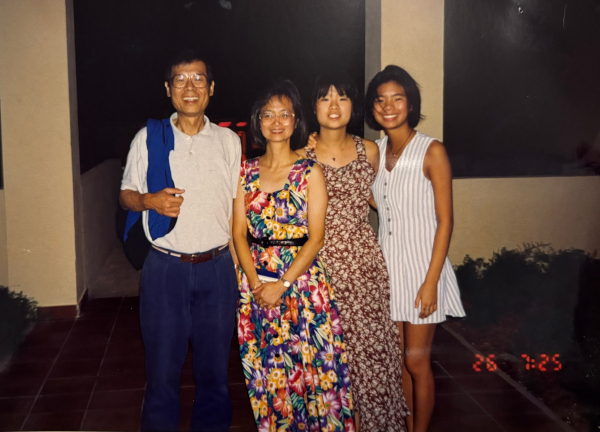
This is a story about love, death and movies, and it begins in 1994 with Eat, Drink, Man, Woman. I’m 17 years old, a self-obsessed suburban nobody. Boy crazy, too. I wear my jeans as tight as possible by putting them in the dryer before wriggling them on. And I run around with a clique of pretty, insecure white girls who I don’t think of as white because when your whole high school is, the descriptor is unnecessary. Still, that is what they are, while I am Taiwanese American and hoping no one will notice. So, I have no idea how my dad convinces me to drive into Philadelphia with him, my mom, and my sister to see this Taiwanese film about a chef who lives with his daughters. All I remember is the food. Steaming whole chicken, hands kneading mantou flour. It’s the summer before my senior year of high school and in a little over a year, my dad will be dead.
By the time The Ice Storm comes out, I’m a sophomore at the University of Pennsylvania. It’s 1997 and I’m nostalgic for the ’70s. I’m drinking and smoking and spinning beyond my control, just like the disaffected people in the movie. I show up late to class and eat cheesesteaks in front of my professors. The impudence. But I’m anchored to something. Writing. And friends who will become friends for life. My screenwriting professor knocks on my door one day, takes a whiff of the bong smoke from the other room and says, “You could be a really good writer. Take my independent study.” I know I need to read as many scripts as I can, if I want to be good. So I read The Ice Storm and this script by James Schamus is the first one that I admire as much as the movie itself.
I love to write but I hate taking tests, so I end up at Columbia University’s School of the Arts, where no GRE scores are necessary for admission. I’m working at the Movie Palace video store on 105th with a bunch of film dudes, swinging from ladders to retrieve videos of Breaking the Waves and Kieslowski’s Blue, White and Red. This is when I watch Pushing Hands and The Wedding Banquet. I get to haul home as many videos as I can carry. My coworker who’s 30 and ancient calls me “Lucy Liu,” because he says I look like her, which isn’t true. I see an early screening of Crouching Tiger, Hidden Dragon at school because James Schamus is a professor there. Every seat is filled in the theater. I can barely breathe. We’ve never seen people fly and fight like this before – and never will again. In future productions, all that wire work will be done digitally. Eight months later, two planes crash into the Twin Towers. It’s September 11, 2001. For the first time in my life, I’m not thinking about myself and the world is suddenly bigger. I leave school with one credit to go and elope with a skinny boy I just met. He likes the Strokes and recites poetry. We pack up my car and drive to Astoria, Oregon, where we’ll be writers and live happily ever after …
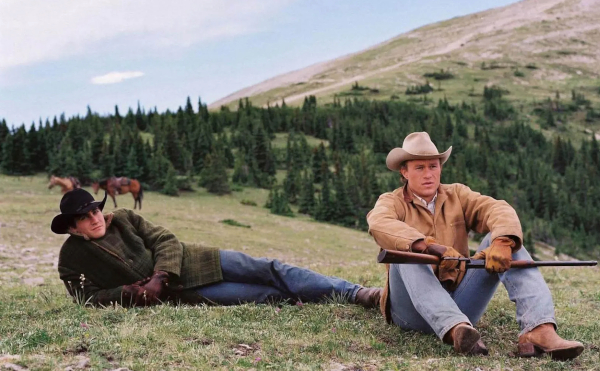
So how is it that I find myself back in the suburbs of Philadelphia, almost 30 years old and single, living at home with my mom when Brokeback Mountain enters the world? We blink. The needle on the record skips to 2006. I’m writing about a group of girls seeking silence in the woods at night and I will do anything to get it made. Chase actors down the street. Ask strangers and family alike for money. This will be my first produced screenplay. But I’m also writing screenplays that will never get made about King Tut, Norman Mailer and carnival strippers. I want to be like Ang Lee, who can tell stories about a tai chi master and a Taiwanese marriage of convenience just as authentically as he can tell stories about British manners and cowboys in love. It’s another 19 years until I meet him in person and can tell him how provocative the silences in Brokeback Mountain are. He’ll tell me that the only reason he could make that movie was because his dad had died and everything seemed impossible.
Stay with me. We’re almost up to the movie that brings us face-to-face.
Lust, Caution comes out in 2007, but I don’t see it until 2008. I know this from an email I wrote to Caryn Waechter, who will direct that first produced screenplay, The Sisterhood of Night, back when emails were like love letters, when a movie theater felt like the Sistine Chapel, and I still left two spaces after a period.
Caryn,
Have you seen this yet? Just watched it tonight …with my mom. Forgot that it got a NC-17 rating for a reason! Overall, I really liked it. I’m always so impressed by the range of subjects Ang Lee tackles. It was a very different kind of love story. The girl in it was brilliant. It’s an adaptation of a well-known Chinese novel about two people who fall in love/lust during 40s in China. The girl is a spy who’s trying to bring down a traitor – the man she falls for.
I got to the end which I know is supposed to be explosive, but I couldn’t help feeling that something was missing. The characters emotions had not been brought to the screen palpably enough for me to feel anything. And I got the distinct feeling that the book must have tracked their emotions closely but that in the adaptation to the screen not enough was brought to the surface. Maybe the symbolism and themes were there intellectually but not in a way that made me FEEL the story.
For the rest of my life, this will be my barometer for a good movie – whether it makes me feel something, even for a moment, during those 90 minutes that I can never get back. The next 10 years or so, Ang Lee and I go our separate ways, which is a strange thing to say about someone you haven’t met. He is focused on using technology in storytelling; I never get on Facebook. I make my first movie, then my second. In both, I create a Taiwanese-American character and insert her into the ensemble, but it doesn’t feel like enough. It’s 2018.
“The world isn’t just the way it is. It is how we understand it, no? And in understanding something, we bring something to it, no? Doesn’t that make life a story?”
― Pi Patel, Life of Pi
Around this time, something breaks in me and then regenerates. I’m turning inward and outward simultaneously, seeing myself for the first time and how I fit into the world. Targeted by our own president during the pandemic. Angry about the Asian women shot and killed in Atlanta. I’m tired of taking on other people’s perspectives, being acquiescent, fitting in. I want to write a starring role for an Asian woman. Something nuanced and complicated and dangerous. The way I feel. For some people, this is where they start with their first film. I do it with my third.
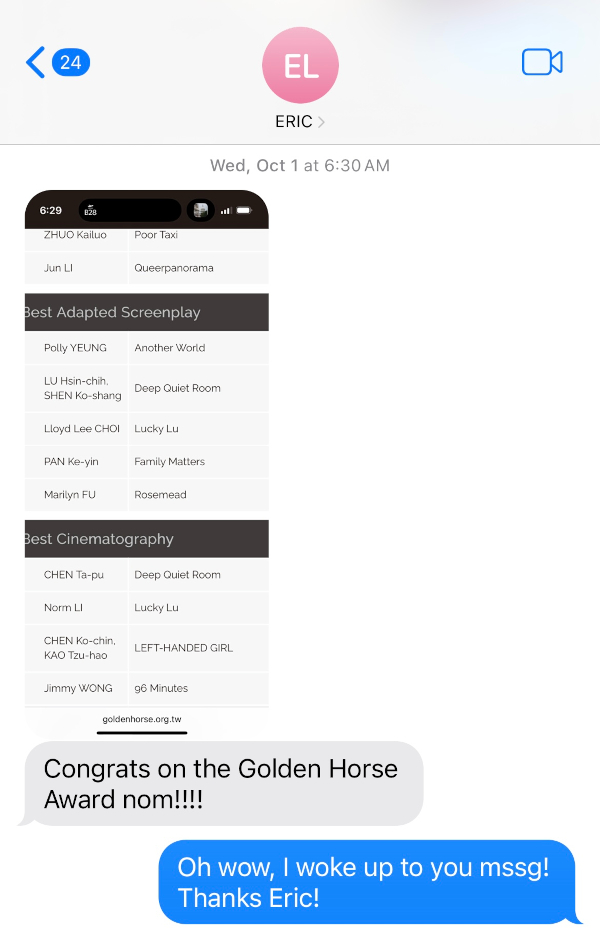
On October 1, 2025 I wake up to a text from Eric Lin, a director I’m working with: “Congrats on the Golden Horse Award nom!”
Then an email from Lucy Liu: “So happy for you!!”
I’m living in New York City, in the same bachelorette apartment I lived in when I went to Columbia. Except now it’s me, my husband and our twin sons. The number of humans has quadrupled, but the square footage is the same: five hundred. We are shell-shocked refugees from Los Angeles, used to having two cars and a backyard big enough to have a zipline. We left in a panic during the fires at the beginning of the year. Our renters in NYC were moving out, so we moved in. Ever since, we have been living in what Ang Lee calls a “floating island” state of mind. His “floating island” refers to Taiwan’s political situation of being unrecognized. Everything’s in limbo. My husband and I talk endlessly about whether we should stay or go back to L.A.
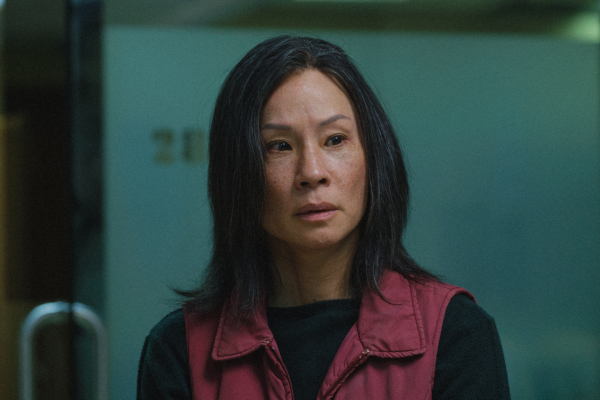
The nomination is for Best Adapted Screenplay for Rosemead, a film I wrote about a Chinese immigrant mother, played by Lucy Liu, who goes to hell and back to protect her troubled son. It’s based on a true story. I wrote it six years ago when I was pregnant with my sons, and as with all films, but especially independent films, there was no promise that it would actually get made, or turn out well. Rosemead did both. It’s a beautiful work. An elixir for my hardened heart. I stopped believing in movies when writing them became transactional.
My mom and I decide to go to Taipei for the awards together. She’s ecstatic; she grew up watching the Golden Horse Awards, aka the “Chinese Oscars.” Then I get an email with the subject: “Golden Horse Awards Dinner hosted by Taiwan Mobile (Nov 21)”
The first line says, “Dinner with Ang Lee!”
I write back: “Oh. My. God.”
I can trace my life through his movies. But it is a movie I write that creates the opportunity for me to meet him.
Our dinner is in a private room in Taipei 101, fashioned after a bamboo stalk and once the world’s tallest building. We have just come from the festival’s screening of Rosemead, where 30 of my family members who live in Taipei have come and taken a million photos together in the lobby in between stilted but emotional conversations. My Chinese is at a third-grade level, so there’s only so much I can say, but I get to hug my uncle who invested in my first movie.
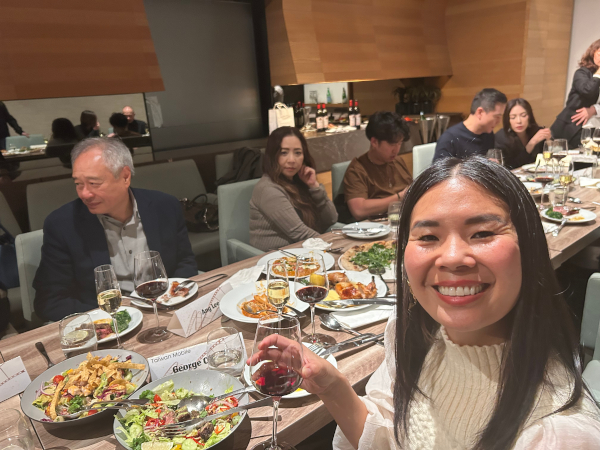
There are about 25 of us at this awards dinner, which feels like a small wedding. We’re celebrating Rosemead along with Lloyd Lee Choi’s NYC-set debut Lucky Lu (which will go on to win three Golden Horse awards; I do not win but learn a hard lesson about the necessity of sneaking snacks into these ceremonies). Ang Lee introduces himself first, exuding both schoolboy shyness and the impression that he’s carrying the weight of the world. In an odd but unsurprising compliance to the hierarchy of the movie business, someone invites the other two male directors to speak next. In the seconds of silence that follow their speeches, I jump up to say something. I can’t tell you what I say, only that I put myself forward because no one else does.
If this were a movie, the next scene would show how much I impress Ang Lee with my boldness and insight. I sit beside him while the other voices fade away. He tells me how much he admires Rosemead. We speak intimately about the deaths of our fathers and how they have affected us as artists. Others join in. We exchange provocative ideas about film as an art form, not an industry. I tell him about my next project and he wants to read it. There is so much food and drink – vodka bolognese, steak, shrimp salad – but I’m hardly eating. The champagne is endless. The decades of following this man’s work have led me to this moment and I am ready for it.
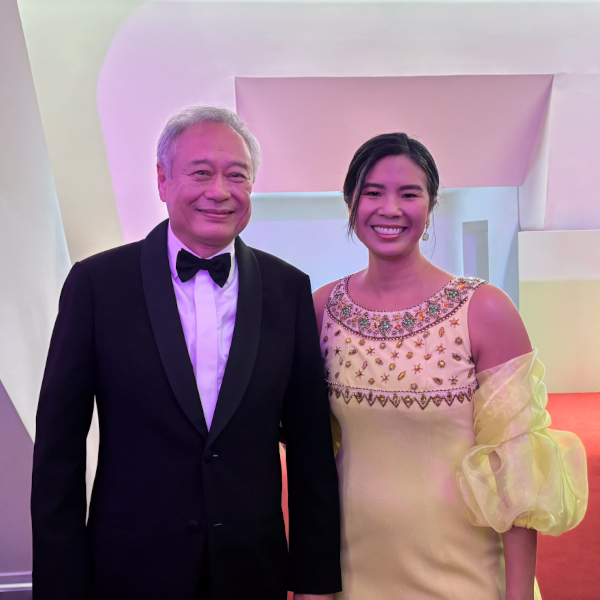
But this is not a movie. The scene doesn’t have a beginning, middle and end, because no one wrote it. There are no close-ups or long looks to emphasize a point being made, or to color in the face-value meaning of something that has been said. Ang Lee may very well love Rosemead or even like it, but he does not say. What he does say is that it has been about 20 years since he saw a film that really blew him away. That he thrives on reinventing himself with every film, but that the industry doesn’t support this. That he envies first-time filmmakers, because they are virgins and he can never be one again. I leave the dinner understanding that he needs us as much as we need him.
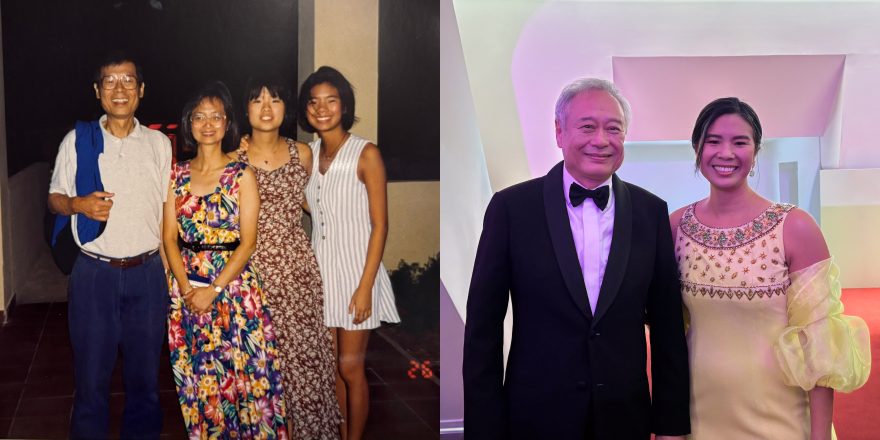
I see Ang many more times after that. At the awards ceremony, he admires the gown I’m wearing, handmade by my grandma when she ran her own dress shop in Hong Kong. He makes his red-carpet entrance in a flashy car, like it’s The Price is Right. He presents the Best New Director Award to Lloyd Lee Choi for Lucky Lu, and at the after-after party at a restaurant, as is the tradition, we wait for his visit into the wee hours of the morning. When he arrives, each production lines up one by one to take a photo with him like he’s the Godfather, which he is. A kind, spiritual Taiwanese Godfather who beats on, boats against the current. And I will beat on, too. Rosemead has given that to me.
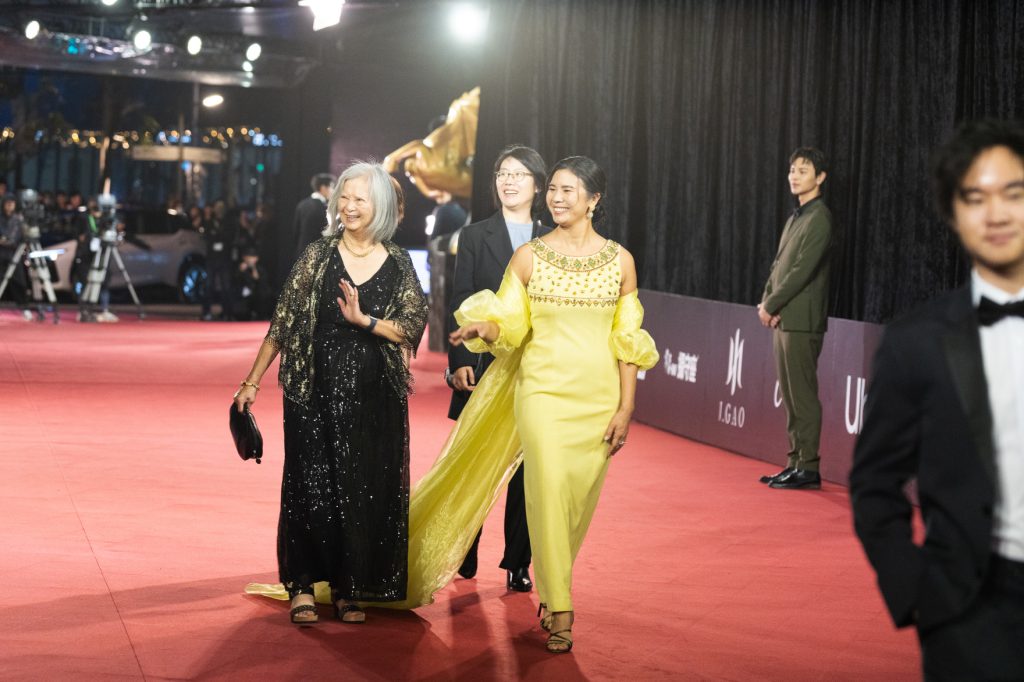
What will the next movie in this story be? Is there someone out there, someone I haven’t met yet –– we’re already in dialogue and I just don’t know it?
This is what a movie should do. It’s a message in a bottle thrown out to sea; a lifeline; the start of a conversation; a cry, a plea; sometimes an answer.
It’s anyone’s game, to write it down, pick up a camera, gather the people. We’ll make movies until we die and all that’s left is words and pixels.