


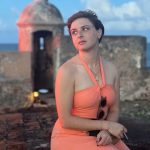
Writer-director Caroline Golum’s new feature, Revelations of Divine Love, about the religious visionary Julian of Norwich, premiered in the International Competition at FID Marseille and is now in theaters. A filmmaker and writer in Brooklyn, New York, her debut feature A Feast of Man screened at festivals include Sidewalk, Indie Memphis and Sarasota, and is available on Amazon Prime, Vimeo on Demand, and Tubi. In front of the camera, Golum appeared in Rachel Wolther’s award-winning documentary Cinema Rules Everything Around Me, Aaron Schimberg’s Golden Globe-winning A24 film A Different Man, and Ricky d’Ambrose’s Independent Spirit Award-winning film The Cathedral. Her bylines include Film Comment, Reverse Shot, Filmmaker Magazine and Screen Slate, where she is a contributing editor. (Photo by Jessica Rionero.)
It was late 2023, or maybe late 2024, when the idea popped into my head: filming Jesus Christ’s crucifixion during a total solar eclipse. How the thought occurred to me, I don’t exactly recall, but once the idea took hold, nothing could uproot my latest hare-brained filmmaking scheme. The timing was too perfect: on April 8, 2024, just a week after Easter, a total solar eclipse would cast its cosmic shadow across large swaths of the Northeast. And hadn’t the skies darkened while the Nazarene suffered upon the cross at Golgotha? For sheer spectacle, and historical accuracy, a total solar eclipse would be just the thing.
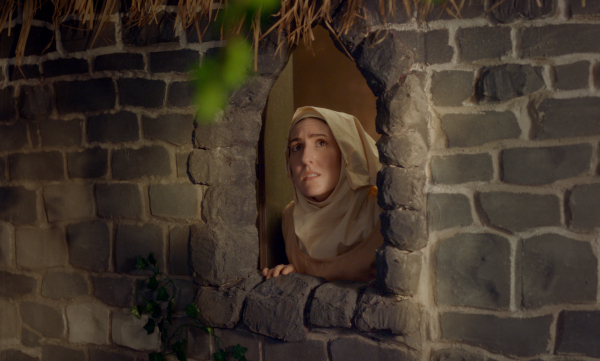
The whole production, up to this point, felt just as improbable. With a small crew and modest means, over the first three months of 2023, we’d managed to complete principal photography on my second feature, Revelations of Divine Love, an ultra-low-budget 14th-century period film based on the life and work of the English mystic Julian of Norwich. That our film concerned a religious visionary who had seen the face of Christ, and lived to tell the tale, put us on an ideological back foot: if had Julian had lived in our modern era, her fantastic experience would’ve been written off, if not heavily medicated out of existence. (Here I must issue a caveat: if you are hearing voices, seek help.) How, then, to put across what we believed in our collective movie-making hearts? For our film to succeed, we needed the audience to understand that Julian’s experience – her deathbed visions, her subsequent visitations from the Godhead, her decision to spend the rest of her life recounting this gift – was the genuine article.
It was an ambitious project from the start: the script, written over several years, with revisions and rewrites during season one of the COVID pandemic, underwent numerous changes on its primrose journey from page to screen. Adjustments were made on the fly, with dialogue adapted to better suit the needs of a scene, or new scenes conjured entirely from whole cloth to plug an errant plot hole. Over four weeks of prep – and later, on days off and overnights, during our five-week shoot – we fabricated a stone church wall, a fake oak, a town square, a convent kitchen, and sundry other quotidian medieval locales, largely from sheets of pink insulation foam, in a Queens warehouse previously used as wardrobe storage for the CBS cop show Blue Bloods.
The fruitful results of our warehouse shoot were decidedly stage-bound, willfully artificial and anachronistic, a manifestation of the ethos my screenwriting partner, Laurence Bond, and I had decided on from jump. Drawing from St. Augustine’s duality of the City of Man and the City of God, we established a simple rule: the look and feel of Julian’s everyday medieval life would embrace this fabricated nature, while her visions would occur outside our storybook set, in expansive locales or under the blazing sun. With the “hard stuff” on set in the rearview (N.B., it’s all hard stuff, actually), my editor Zach Clark and I spent the summer of 2023 putting together an assembly of the film.
We had three more pick-up scenes to shoot: Julian’s first meeting with Christ in a splendid, church-like space, Julian’s final meeting with Christ in a cloister courtyard, and Julian’s presence at the crucifixion, surrounded by what the script referred to as “weeping Jews.” (As a weeping Jew myself, I always appreciated that Jesus was a landsman.) In late summer 2023, on a well-deserved and long-awaited vacation, our brilliant producer Kate Stahl caught wind of an ideal spot for our splendid church interiors: the Glencairn Museum in Bryn Athyn, Pennsylvania, built by millionaire glass magnate Raymond Pitcairn over several years, from 1928 to 1939. With a skeleton crew, and our lead actor Tessa Strain on a short visit from Los Angeles, we knocked out her final scenes the following President’s Day weekend on the sprawling grounds of Glencairn. That left the crucifixion scenes which, per our guiding aesthetic philosophy, could only be filmed outside.
While the exact moment of inspiration eludes me (I’ve searched my emails, to no avail!), I suspect the eclipse notion occurred while I was reading my horoscope. True to the “as above, so below” ethos held by European and Arab astronomers, astrologers and scientists throughout the Middle Ages, eclipses are said to exert great influence on our earthbound lives. Esoteric significance aside, the total eclipse on April 8, 2024 was a rare treat, with several upstate New York and Rust Belt towns falling within the elusive “path of totality.” The prospect of harnessing a rare cosmic phenomenon to get my film over the finish line was too good to pass up.
We were in good company, too! As best I could tell, only one other film had managed to depict the crucifixion eclipse: Richard Fleischer’s 1962 biblical epic, Barabbas, starring Anthony Quinn as the thief who evades execution and finds salvation through Christ’s sacrifice. Legend has it that producer and consummate showman Dino de Laurentiis delayed production so he could capture the total solar eclipse on February 15, 1961. The resulting scene is mesmerizing, a masterclass in special effects techniques and a thematic standout in a crowded genre of Italian pepla and American sword-and-sandal stories of early Christendom. In the foreground, two life-sized crosses split the cloudless sky, backlit by the midday sun. Then, the encroaching darkness: a time-lapse shot, matted in behind the towering crosses, swallows the blazing sun, leaving a void in its wake.
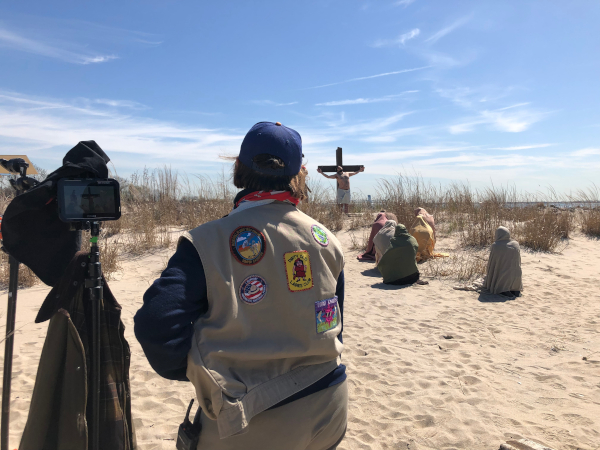
With Fleischer’s film as our guide, Kate and I set about finding a suitable outdoor location for our ambitious shoot. Shlepping our cast and crew to Rochester, New York, or Cleveland, Ohio, was out of the question, but in a city as big as ours, surely some off-the-beaten-path corner would suffice? After a day tooling around Brooklyn (including a pilgrimage drive-by at Barbra Streisand’s childhood home), we landed on Plumb Beach. It’s a remote strip of sand just off the Belt Parkway, notably depicted in Eliza Hittman’s queer drama Beach Rats. The hilly shoreline and ample tufts of tall grass, shot at the right angles, could easily pass for ancient Golgotha, which lay just outside occupied Jerusalem.
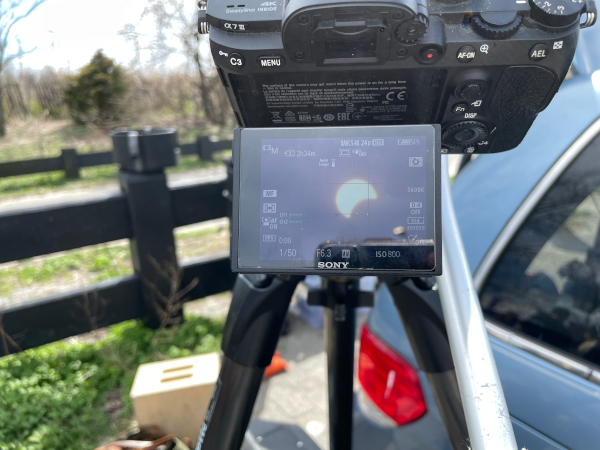
Knowing we would only have a few hours, we forewent the customary permitting process and went back to our run-and-gun roots. A flurry of emails ensued as I put out the casting dragnet for friends with flexible schedules and their own means of transport. In order to capture the movement of the moon blocking the sun, we’d have to train our camera directly at the sky. Cinematographer Gabe Elder, a born magician, identified the necessary lens filter to shoot the eclipse in real time – an especially dark tint so potent, it blocked out every light source but the sun. Much like Barabbas, what we really needed were two shots: one of the crucifixion, with our actors in costume, and one of the eclipse itself, which we’d composite into the background later.
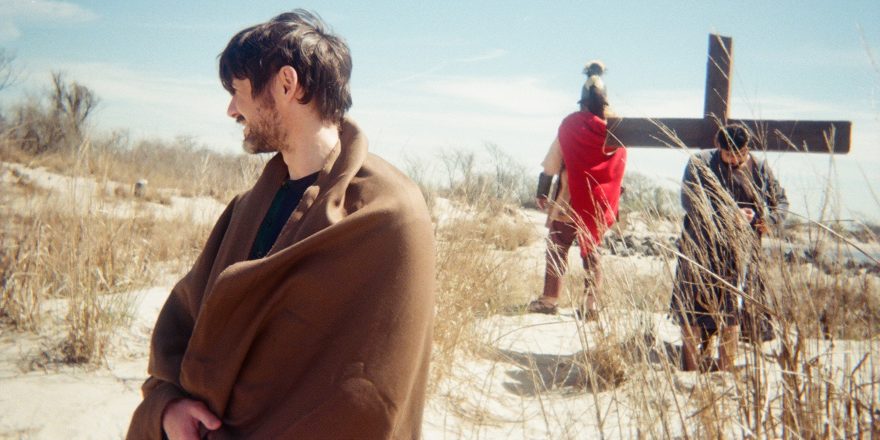
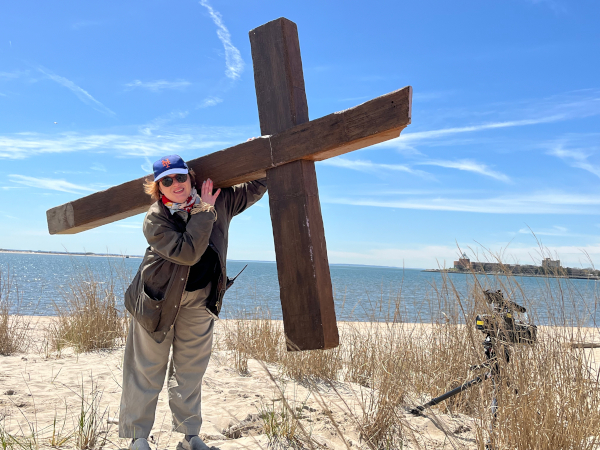
The eclipse was “scheduled” for 3 p.m. that afternoon, giving us all morning into midday for coverage. Our expert costume designer, Nell Simon, used her customary skill and cleverness to dress a small ensemble of nine: seven “weeping Jews” in various colorful fabrics, Jesus Christ in a humble loincloth, and a Roman centurion in armor rented from a California costume house. The foam crucifix, built by art director Grant Stoops the year prior, was still at my apartment, waiting for its encore in the film’s climactic scene. Though the beach itself is somewhat small, we managed to “cheat” a wider shot of the cross with a foot-long model – purchased from a Catholic website that still sends me emails – by jamming it in a sandy hill and shooting from behind.
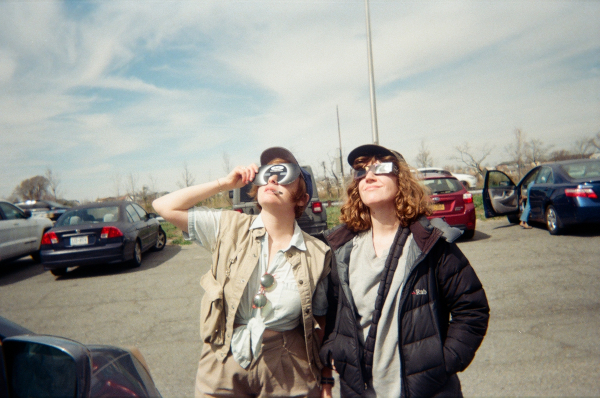
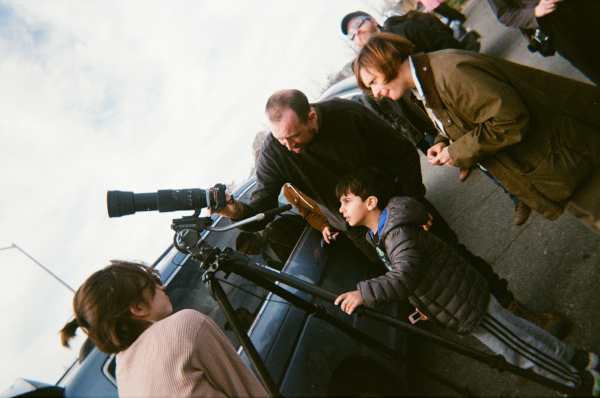
The cast was wrapped, more or less, by lunchtime, but everyone stuck around, eager to see if we could pull off the eclipse shot. Finished with the coverage, we packed up Gabe’s ARRI Alexa and set up my humble Sony FS-100, a decade-old camera I could afford to sacrifice if something went horribly awry with the sensor. We installed the filter, pointed it at the sun, and waited. I’d brought a small collection of eclipse glasses from the “Great American Eclipse of 2017,” while some of our merry band had their own, ensuring enough eye protection to go around when the show began in earnest. Bit by bit, the adjacent parking lot began to fill up, creating an ad hoc tailgate with Brooklynites from diverse walks of life: a family of orthodox Jews idled outside their Honda Odyssey beside a Muslim family in a luxury sedan. A pair of Russian men, already in a celebratory mood, cracked beers in their folding beach chairs (and helped themselves, at our insistence, to food from the craft services table). Teenagers cavorted on the fringes of the lot, play-fighting and shouting. At one point, a flight attendant, nattily dressed in her uniform, pulled over to catch a glimpse of the eclipse on her way to work at nearby JFK Airport.
Eclipses have long held sway over the human imagination, whether as portends of doom or augurs of divine favor. It’s a remarkable effect, recalling a time centuries ago when the cosmos was mysterious and frightening. We never want for knowledge and stimulation in our kinetic and modern world – we know, now, what an eclipse entails, and can find awe and amusement on any number of screens large and small. Yet long before the moving image reared its alluring head, we looked to the natural world for understanding. The origins of modern moviemaking can be found in the stories told around campfires, the “movement” of cave paintings lit by flickering flame, the heavenly firmament above us, and the cosmic dances that awed our curious ancestors.
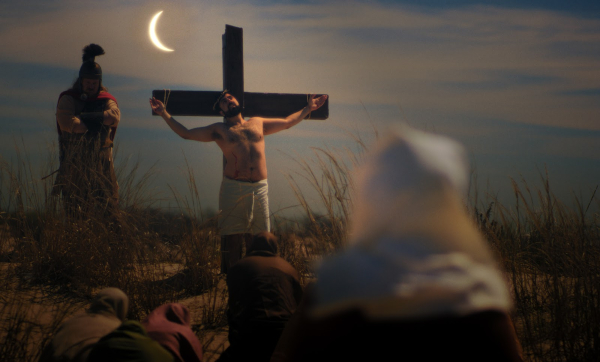
Standing in the parking lot at Plumb Beach, we transcended space and time, willingly giving ourselves over to an ancient ritual practiced since time immemorial. The young and old, secular and pious, were united in eager anticipation, eyes gazing heavenward, waiting for something bigger than ourselves. Darkness fell upon the gathered, followed by an eerie silence: cars on the road pulled over, birds ceased their singing, only waves upon the shore could be heard. We looked up at the hidden sun, shivering in its absence. And then, just as quickly as it had disappeared, the sun reemerged, the temperature rose, the traffic and birds resumed. I watched the playback with a lump in my throat, knowing there’d be no chance for retakes. But there it was, clear as (darkened) day: the total solar eclipse of 2024, in real time, as seen from Plumb Beach-turned-Golgotha. “We got it!” I cried, “that’s a wrap on the sun!”
Featured image, showing the making of Revelations of Divine Love at Plumb Beach in Brooklyn, is by Sierra Pettengill; all images courtesy Caroline Golum.
